Showing posts sorted by relevance for query south. Sort by date Show all posts

Sunday, 27 February 2022

It’s a miracle… South (1919) & the Heroic Age of Antarctic Exploration on Film, with Neil Brand, BFI Dual Format


I wonder if three spools of film ever went through more exacting experiences before they were developed.’ (F Hurley, Shackleton’s Argonauts, Sydney 1948).


SHACKLETON


A century after the death of Sir Ernest Henry Shackleton CVO OBE FRGS FRSGS on South Georgia at the start of his last great adventure, the Shackleton–Rowett Expedition, the BFI have paid tribute by rereleasing South along with a host of extra films dedicated to all those who pursued the unknown. This was the golden age of polar exploration and there were compelling motivations of national prestige and personal glory that drove Ernest Shackleton and his team to the South Pole and, when all went wrong, they proved to have remarkable qualities above and beyond mere pride. Ultimately Shackleton could have opted for an easier life after South, the war, the Russian Civil war… but something compelled the 47-year old to return.


Shackleton had previously been on two missions to the South Pole, once as third officer on Captain Scott’s expedition from 1901-04 when his health failed and he had to return home early and the next time as commander of his own Nimrod Mission in 1909 when his team got to within 97 geographical miles of the Pole, a record which earned him a knighthood. After Scott had narrowly lost the race to Amundsen in late 1911, the biggest challenge remained the crossing of the Pole from shore to shore, from one sea to the other.


It was this that Shackleton set off to achieve in 1914 as part of the Imperial Trans-Antarctic Expedition referring to the transcontinental route as the "one great object of Antarctic journeyings". One ship, the Endurance, would take the team from South Georgia through the Weddell Sea to Antarctica and then, after a crossing of 1,800 miles they would join up with supplies left by a second ship, the Aurora, which would then take them to New Zealand, completing an epic journey from the South Atlantic to the South Pacific… in one mind-boggling, map-defying stretch.


Endurance sets off from Buenos Aires

On 8th August, just five days after the outbreak of the First World War the ship set sail and a few weeks later, Shackleton joined them and the show really got on the road. In the circumstances the team had naturally asked British officials whether they should go on but the answer came: “proceed”. The hope was that it would all be over by Christmas after all...


As with Scott’s expedition of 1911, Shackleton’s was a miracle of fundraising with a commercial eye on the future so, just as Herbert Ponting was to record Scott so Frank Hurley was nominated to do the same for this latest adventure. Interesting in this case that a film about so much British pluck was led by an Irishman and filmed by an Australian… let’s just say that this was a film about pluck full stop not to mention discipline and courage.


FRANK HURLEY

Frank Hurley

The film starts with shots of various members of the crew, including Shackleton himself and you search each line and every nuance of expression for a clue to his character: this is what a brave man looks like… even if the close-ups were taken after the event with him in uniform ready to do his bit in the War.


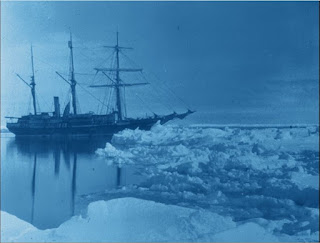
We then see the Endurance as it sets off from Buenos Aires, waved off by a large crowd as Shackleton’s pre-publicity had encouraged world-wide wonder, and then makes its way south to the Antarctic landmass, smashing its way through ice and passing by enormous ice bergs. It looks unstoppable, reinforced steel providing an extra cutting edge for the spring ice floe: this is the best modern science can offer and surely nature will not be able to stand in its way. There are stunning shots from high overhead up the foremast as one member of the crew sits on the bowsprit steering the ship through the weakest parts of the ice; Hurley was some sailor as well as cinematographer.


Hurley’s camerawork is not only brave but technically so impressive, far more mobile than you might expect as he pans across and upwards to show the depth and range of this forbidding landscape and, through use of close-ups and point of view, places the crew and consequently the watcher in the heart of this deadly landscape. Unlike Ponting, brave though he was, Hurley was in the middle of the main drama itself – he too was stranded and in peril - yet he kept on working.


Steering through the ice

The film proudly shows us the packs of dogs who were to be the expedition’s backbone once they landed and there’s a typically British fascination with animals both domesticated and wild throughout with a long section on penguins and seals near the end (eat your heart out Herbert P!).


Before the Endurance was able to make land it became trapped in the ice in mid-January 1915. At first this seemed just a temporary setback but then the predicament became much clearer and much more serious. The crew tried many times to hack a channel through the ice to enable the ship to make progress and to break through to clear water but this wasn’t to be.  After some days they were resigned to a long wait for the ice to thaw and they kept themselves busy with research, hunting and football matches. Obviously, we only see what’s on film and what Hurley edited and was perhaps allowed to show but clearly the command from Shackleton was strong and effective: moral appears to be high. They knew they had a long wait ahead… until the arrival of the arctic spring later that year.


Yet, when the thaw did start in September 1915, a far more serious challenge arose as the force of the shifting ice started to compromise the Endurance’s hull and the ship began to be lifted from the water. Hurley’s shots of the stricken ice-breaker are amongst the most iconic of the whole journey especially those he shot at night using dozens of magnesium lights… it’s haunting, not just because of the eerie phosphorescent glow but also because you realize that the men could be watching their best hope of survival being crushed and sunk.


The men try to cut a way through the ice

Shackleton had the men strip everything of use from the Endurance before she finally sank in November and he established a camp using tents, shacks built from the ship’s timbers and upturned lifeboats. One of these, the twenty-foot James Caird, with some major adjustments from the team's carpenters, was used to make Shackleton’s heroic journey from Elephant Island to South Georgia. Before that the crew had had to use the boats to make their way from the melting ice floes to land an epic adventure in itself.


That Hurley’s film survives is one thing but that it survives in such good quality is another. He buried film canisters in the snow during parts of the escape in order to preserve them in the event that things didn’t quite work out…  When Shackleton departed on that final stage, Hurley remained behind with the rest of the crew and the gaps in the story are made up of illustrations and then later footage of both the forbidding ice wall Shackleton and his men had to climb in order to reach help.


In the end Shackleton returned with help and ensured that every one of his crew returned safe: the greatest survival epic of the golden age of polar exploration at a time when far less was known about these still treacherous waters…  Whatever the merits or otherwise of Shackleton’s motives you cannot doubt his leadership and courage nor that of the men, like Hurley, who followed him come thick and thin ice.


Endurance high and dry

Hurley later remarked that the earlier Australian expedition he had been on was a means to a scientific end whilst the British focus was on the adventure first with science an added bonus. Be that as it may, there was certainly great domestic interest in viewing the strange creatures of the South as Ponting’s film had already proved and there’s some twenty minutes of crowd-pleasing wildlife footage once it’s clear that the men survived. This is all the more remarkable given that according to Bryony Dixon in her booklet essay, Hurley was persuaded by the Ernest Perris, editor of his sponsor, the Daily Chronicle, “…to return to South Georgia (in the middle of a war, we should remember) to capture images that would be popular with the public of Antarctic wildlife (penguins) and the whaling station.”


THE SCORE


This splendid transfer comes with a stirring new orchestral score from Neil Brand which perfectly captures the spirit of the times and of adventure as it used to be: indomitable, brave and with the passion to overcome all obstacles - they endured!


I hope that the overall effect of the score is to help us go through the screen and onto those icy wastes with those men...


This set includes a feature on Neil Brand’s approach to the scoring and, it is every bit as revelatory as the music as the composer explains his relationship with the film and the reasons behind his choices. Neil uses the film in teaching at the Royal Academy of Music and one of the reasons is the sheer relatability of the events; when the ice crushes the Endurance we all feel as the men must have felt, that this was probably their doom, their only means of return destroyed leaving them a thousand miles from the nearest human.


Endurance finally succumbs

Neil chose a small ensemble combining flute, piccolo, cello, violin, viola and horn – no piano, no safety net – to enable an uplifting and febrile composition that could change with the sudden shifts in mood of the film. This works so very well, music full of the hope and determination of these men as their near disaster plays out against the deceptive tranquillity of the sublime white silence and stark, sunlit cinematic contrast. It’s the most extraordinary meditation on human perseverance against all odds, as they determinedly fight for their ship and then their lives. As Neil says, this film has been a major part of his professional life for twenty years and this familiarity has enabled him to construct a deeply resonant musical response.


Long-time collaborator Ben Palmer helped with the score and the mucisians from the Covent Garden Sinfonia who he then conducted for the recording: Francesca Barritt (violin), David Campbell (clarinet/bass clarinet), Kira Doherty (horn), Simon Gilliver (flute/piccolo), Matthew Kettle (viola) and Alexander Rolton (cello)


Having been unable to attend the IMAX screening with live accompaniment, I hope the show is screened again with the musicians – this is a story we all need to see and hear right now. Neil previously scored the film in 2002 and you can listen to that to as an option on these discs too.


Trapped but the team played on

EXTRAS


The set also includes extra footage of the expedition – the football match with Endurance marooned in the ice, perhaps the purest example of the team spirit, and there’s also extra animals and terrifying icebergs.


There’s also an audio commentary from Luke McKernan, who worked on the restoration, and a bumper 38-page Illustrated booklet with new essays and credits for all content including contributions from the BFI’s Bryony Dixon, Naomi Boneham and Charlotte Connelly, Masaki Daibo, Eirik Frisvold Hanssen, and Quentin Turnour, which gives a truly international perspective on the Heroic Age of Antarctic Exploration – Japan, Norway and Australia, so many were pulled south.


There’s footage from these countries expeditions as well as other British adventures: 

Fram’s South Polar Expedition (1910-12, 22 mins) documents parts of the legendary ‘race to the Pole’ won by Roald Amundsen and his Norwegian team. This the English version of the film footage seen in cinemas and theatres in 1913.


Nihon nankyoku tanken (1910-12, 19 mins) is the extraordinary and rare footage taken in the second year of the Japanese expedition to Antarctica led by Nobu Shirase.


Australasian Antarctic Expedition Films aka The Home of the Blizzard (c1916, 68 mins) film taken by Frank Hurley of the 1911–1914 scientific expedition to the Magnetic South Pole led by Sir Douglas Mawson.


Other films in the set, range from 1898 – 1922 and include visual references to these and other notable Antarctic expeditions. Additional special features include film and audio extracts, including from Shackleton himself in short audios My South Polar Expedition (1910) recorded a week after returning to New Zealand and Shackleton Speaks (1910) naming his Nimrod crew.


800 miles to South Georgia Island... 

WHAT TO DO NEXT


It’s a wonderful and inspiring package and absolutely essential for all those fascinated with the spirit of adventure both in cinematic and Antarctic terms.


You can order now from the BFI online shop. Go on, be bold!


Endurance's Captain Worsley

Captain L Hussey with his moral-boosting banjo

Some of the Endurance's 70 dogs

Hurley's haunting night shots of the frozen ship

Shakleton's men needed to climb this huge glacier in South Georgia

It took them 36 hours to finally find refuge at Stromness Whaling Station.


Saturday, 25 January 2014

Call of duty… South (1919)


One question kept on being repeated as I watched this film with a room-full of friends and family: “why are they doing this?” The “what were they trying to achieve?” is perhaps more easily answerable, yet there always lingers a bigger question: “what kind of person would put themselves in such danger?”

This was the golden age of polar exploration and there were compelling motivations of national prestige and personal glory that drove Ernest Shackleton and his team to the South Pole and, when all went wrong, they proved to have remarkable qualities above and beyond mere pride.

Under conditions of incredible hardship, when their ship looked doomed and they were many hundreds of miles from help across impossible terrain, the crew kept on functioning: scientific tests were run, the dogs were exercised and order was maintained. Most significantly, for us at least, Frank Hurley’s camera kept running, documenting the hardships and also the hopes of the crew who, under what must have been almost intolerable pressure, kept their discipline and trusted in the energy and invention of their leader.

Sir Ernest Shackleton
Ernest Shackleton had previously been on two missions to the South Pole, once as third officer on Captain Scott’s expedition from 1901-04 when his health failed and he had to return home early and the next time as commander of his own Nimrod Mission in 1909 when his team got to within 97 geographical miles of the Pole: a record which earned him a knighthood.

After Scott had narrowly lost the race to Amundsen in late 1911, the biggest challenge remained the crossing of the Pole from shore to shore, from one sea to the other. It was this that Shackleton set off to achieve in 1914 as part of the Imperial Trans-Antarctic Expedition referring to the transcontinental route as the "one great object of Antarctic journeyings".

One ship, the Endurance, would take the team from South Georgia through the Weddell Sea to Antarctica and then, after a crossing of 1,800 miles they would join up with supplies left by a second ship, the Aurora, which would then take them to New Zealand, completing an epic journey from the South Atlantic to the South Pacific… in one mind-boggling, map-defying stretch.


On 8th August, just five days after the outbreak of the First World War the ship set sail and a few weeks later, Shackleton joined them and the show really got on the road. In the circumstances the team had naturally asked British officials whether they should go on but the answer came: “proceed”. The hope was that it would all be over by Christmas after all...

As with Scott’s expedition of 1911, Shackleton’s was a miracle of fundraising with a commercial eye on the future so, just as Herbert Ponting was to record Scott so Frank Hurley was nominated to do the same for this latest adventure. Interesting in this case that a film about so much British pluck was led by an Irishman and filmed by an Australian… let’s just say that this was a film about pluck full stop not to mention discipline and courage.

Breaking the ice...
Hurley’s camerawork is stunning, far more mobile than you might expect and none more so than when he keeps his film rolling on the bough of the ship as it cuts through the icy waters. But he also pans across and upwards to show the depth and range of this forbidding landscape and, through use of close-ups and point of view, places the crew and consequently the watcher in the heart of this deadly landscape.

Unlike Ponting, brave though he was, Hurley was in the middle of the main drama itself – he too was stranded and in peril - yet he kept on working.

The film follows the Endurance as it makes its way south to the Antarctic landmass, smashing its way through ice and passing by enormous ice bergs. It looks unstoppable, reinforced steel providing an extra cutting edge for the spring ice floe: this is the best modern science can offer and surely nature will not be able to stand in its way.

Frank Hurley at work
The film proudly shows us the packs of dogs who were to be the expedition’s backbone once they landed and there’s a typically British fascination with animals both domesticated and wild throughout with a long section on penguins and seals near the end (eat your heart out Herbert P!).

We are provided with various members of the crew including Shackleton himself and you search each line and every nuance of expression for a clue to his character: this is what a brave man looks like… even if the close-ups were taken after the event with him in uniform ready to do his bit in the War. Before the Endurance was able to make land it became trapped in the ice in mid-January 1915. At first this seemed just a temporary setback but then the predicament became much clearer and much more serious. The crew tried many times to hack a channel through the ice to enable the ship to make progress and to break through to clear water but this wasn’t to be.


After some days they were resigned to a long wait for the ice to thaw and they kept themselves busy with research, hunting and football matches. Obviously we only see what’s on film and what Hurley edited and was perhaps allowed to show but clearly the command from Shackleton was strong and effective: moral appears to be high. They knew they had a long wait ahead… until the arrival of the arctic spring later that year.

Yet, when the thaw did start in September 1915  a far more serious challenge arose as the force of the shifting ice started to compromise the Endurance’s hull and the ship began to be lifted from the water. Hurley’s shots of the stricken ice-breaker are amongst the most iconic of the whole journey especially those he shot at night using dozens of magnesium lights… it’s haunting, not just because of the eerie phosphorescent glow but also because you realize that the men could be watching their best hope of survival being crushed and sunk.

The stricken Endurance shot in the dark
Shackleton had the men strip everything of use from the Endurance before she finally sank in November and he established a camp using tents, shacks built from the ship’s timbers and upturned lifeboats. One of these, the twenty foot James Caird, with some major adjustments from the team's carpenters, was used to make Shackleton’s heroic journey from Elephant Island to South Georgia. Before that the crew had had to use the boats to make their way from the melting ice floes to land an epic adventure in itself.

That Hurley’s film survives is one thing but that it survives in such good quality is another. Apparently he buried film canisters in the snow during parts of the escape in order to preserve them in the event that things didn’t quite work out…

The James Caird is prepared for launch
When Shackleton departed on that final stage, Hurley remained behind with the rest of the crew. The gaps in the story are made up of illustrations and then later footage of both the forbidding ice wall Shackleton and his men had to climb in order to reach help.

Hurley later remarked that the earlier Australian expedition he had been on was a means to a scientific end whilst the British focus was on the adventure first with science as an added bonus. Be that as it may, there was certainly great domestic interest in viewing the strange creatures of the South as Ponting’s film had already proved and there’s some twenty minutes of crowd-pleasing wildlife footage once it’s clear that the men survived.

The crew of the Endurance
In the end Shackleton returned with help and ensured that every one of his crew returned safe: the greatest survival epic of the golden age of polar exploration at a time when far less was known about these still treacherous waters… As I write there are two ice-breakers currently trapped in the ice, a Chinese ship sent in to rescue a Russian.

Whatever the merits or otherwise of Shackleton’s motives you cannot doubt his leadership and courage nor that of the men, like Hurley, who followed him come thick and thin ice.

I watched the BFI DVD which is available direct or from Movie Mail. It comes with a stirring score from Neil Brand which perfectly captures the spirit of the times and of adventure as it used to be: indomitable, brave and with the passion to overcome all obstacles - they endured!

Sunday, 24 May 2020

The Lady of the Shadows… The Call of the Cumberlands (1916), Julia Crawford Ivers


“Mrs. Ivers has proved time and again that she yields the palm to no mere man megaphone manipulator.” Betty Compson

I don’t know about you but, like a lot of the compulsively inquisitive/acquisitive, I have a considerable archive of the un-read, the un-listened to and the un-watched. Watching Mark Cousin’s excellent new series, Women Make Film – a film school that just happens to be run by women – I reach out to the Kino Lorber *six* disc box set, Pioneers: First Women Filmmakers and select a film by a woman I’ve never heard of… this is a time to broaden our minds.

IMDB has The Call of the Cumberlands being directed by Frank Lloyd but it has now been identified as having been directed by Julia Crawford Ivers who, according to April Miller’s excellent biography on the Women’s Film Pioneer website, is chiefly remembered for scripting some twenty films for William Desmond Taylor (she was even one of those implicated in his murder in 1922).

Julia Crawford Ivers
Ivers was apparently introverted and not one to seek the limelight it seems with the few photographs that survive being testament to her reputation as “The Lady of the Shadows”. Yet, she still made her way in a notoriously male industry and directed at least four films of which Cumberlands was the second, and one of three she made in 1916. By this time, she had been working in Hollywood for three years and she’d clearly learned her trade for, whilst it follows much of the standard western feud formula, there are some unexpected twists and some impressive scenes.

 
“If all scenario writers could direct at least one picture… and all directors could write just one scenario, motion pictures would benefit tremendously…”

Ivers clearly understood structure and Cumberlands fits a lot of scenes into a relatively modest running time, she wrote the scenario based on the novel by Charles Neville Buck, a Kentuckian who saw that changes was coming and that the traditional blood rivalries would be swept away. To Ivers credit, the source complexity doesn’t get in the way of the film’s range or flow and she covers the ground well. 

Dark deeds afoot...
It begins in the mountainous woodlands of Kentucky with the latest events of a family feud between the Souths and the Hollmans, no relation to the Hatfield–McCoys or the Hamilton–Burrs. The families have been in a truce for two years but dark deeds are afoot and Ivers shoots in near darkness as a sniper takes aim at Jesse Purvy one of the senior members of the Hollman clan. He’s badly wounded but asks his kin to kill Samson South to avenge him if he dies.

There’s further impressive use of shadow as Ivers’ cameraman, Dal Clawson, catches the dappled shadow and bright light on young Sally Spicer (Winifred Kingston), one of the South clan who is radiant innocence watching the birds in the woodland. She comes across an abandoned oil painting and finds its painter, George Lescott (Michael Hallvard) unconscious in the shadows having slipped whilst engrossed in his view.

Dappled shadows as Sally looks for the missing painter.
We cut to Samson South (Dustin Farnum), “a fighter and a dreamer…” who is perhaps surprisingly sketching his own less sophisticated picture of the glorious scenery. Here’s a tie back to Mark Cousin’s opening episode of Women Make Film on introductions, Ivers deflty establishing the main characters and the main thrust of the story all within three short and technically proficient scenes. Lescott will prove to be an agent for change just as the blood feud is a direct threat to Samson’s ability to progress with his art and with his love… Sally’s not just there for the doves and squirrels after all.

Sally takes Lescott back home to recuperate and whilst Samson’s father isn’t keen on allowing strangers to stay, he starts to bond with the painter over their love of art; trying to capture views that make the “eyes sing”. Meanwhile, the Hollmans are trailing the attempted assassin with bloodhounds and there’s some gorgeous night-shots of men with torches heading inexorably to the South’s land.

Richard L'Estrange, Dustin Farnum and Winifred Kingston
Samson’s useless/devious cousin, Tamarack Spicer (Richard L'Estrange) pops up trying to implicate him and to stake his own claim on Sally. The Hollman’s arrive and the hounds find no incriminating odours on Samson… as Sally, as you’d expect of a wild woodland spirit, hides in the trunk of an ancient tree praying for her love’s innocence. The identity of the gunman will remain a secret for later as the story shifts to focus more on Samson’s relationship with Sally and his artistic ambition when, Lescott invites him to New York to develop his art. There's an eye-popping scene involving gracefully draped semi-nude women, interesting that three of the prime examples of female silent nudity come from Ivers, Lois Weber (Hypocrites (1915) and Nell Shipman (Back to God's Country (1919)) who asked, "is the nude rude?" Not so much under the female gaze Nell.

Samson has a good look in the life class...
Here’s the nub of things, in New York, distant from the Cumberlands in time as much as space, Samson develops aesthetically and forms a bond with Lescott’s sister Adrienne (Myrtle Stedman) who decides to teach him the manners of polite society. But is Manhattan society polite? Not so much that they all tolerate Samson and there’s feuds here of a different more political and capitalist nature. Will Samson be drawn into these dirty deeds and will he forget about his Sally who, even as he is playing tennis with Adrienne, is teaching herself to read and write. None of the characters stop moving and that family feud isn’t going to stop either; will Samson go all soft when it comes to defending his family?

Sally confronts Tamarack
"Ye lies, Tam'rack," she said, in a very low and steady voice-a voice that could not be mistaken, a voice relentlessly resolute and purposeful. "Ye lies like ye always lies. Yore heart's black an' dirty. Ye're a murderer an' a coward. Samson's a-comin' back ter me.... I'm a-goin' ter be Samson's wife." From Charles Neville Buck’s original novel.

Ivers makes light work of Neville Buck’s overwrought prose - though many title cards reflect that local dialect - and adapts with a subtle dynamism. The story grabs the attention even now despite being plagued by some chemical deterioration in some of the middle sections – as you can see most of the film looks sharp! It’s a genre film made with confidence and confidence to take a few risks with images and storyline.

I love this shot through the window of Samson greeting Adrienne in a car...
I like Ivers treatment of Sally and she places her in a number of inventive shots that emphasise her connection to nature and commitment to her Samson; she's a key part of his loyalties and the highest of stakes when he's being lured by East Coast aesthetics, society and Adrienne. The painter's sister is herself a free spirit but one operating within the learned behaviours of classical music, etiquette and even the sport of kings. Ivers pre-figures Nell Shipman with Sally's imagined comparison of a similar life versus woodland frolics with friendly bears and she also lifts a shot or two from Lois Webber's Shoes as Sally looks into a mirror realising that she can't change who she is.

Influenced by Lois Webber and influencing Nell Shipman?
As April Miller notes, Ivers was generally well-reviewed and this film was no different with Margaret I MacDonald writing that whilst “the production is not an altogether perfect one… “there were “scenes that could scarcely be excelled”. Cumberlands is an exciting romp that takes in East cost cultural improvement and Western family values; a man can be true to both and still be true in love.

April Miller’s biography on Ivers can be found on the Women’s Film Pioneer website.

There is also a new Kino Lorber disc, The Intrigue: The Films of Julia Crawford Ivers which has four films including A Son of Erin (1916) which she directed after Cumberlands. It’s available from Kino Lorber direct and it's on my birthday list!


Bonus screen shots!!