Tuesday, 5 June 2018

A million miles, for one of your smiles… The Ancient Law (1923), with Meg Morley, Phoenix Cinema, London


This was the UK premier of a new restoration from the Deutsche Kinematek and, possibly, for the film itself: a real coup for the Phoenix and ace programmer Miranda Gower-Qian. Finding a German film sympathetic to the Jewish community in 1923 is not too surprising perhaps – the community was arguably more integrated than in other parts of Europe - but there had long been undercurrents of anti-Semitism even before the Great War and its aftermath. The Weimar arts community was liberal and forward thinking and hadn’t yet been shut down by the dangerous populism filtering through a society deeply in debt and poltically-fragmented.

Directed by EA Dupont – later to direct Variety, then Piccadilly and Moulin Rouge after his escape to Britain – Das alte Gesetz is a highly accomplished film that deals with the push and pull between those who want to integrate and those who want to stay separate.  Assimilation can split families but so can self-exclusion, it is still an every day tragedy and one that gives this pitch-perfect story significant power still. There’s additional resonance from the fact that so many of the cast and crew were Jewish… actors enjoying the freedom to ply their trade denied their more orthodox forebears with far worse to come.

Avrom Morewski and Robert Garrison
This restoration was completed from several non-German copies (as with Pandora’s Box and many others… the original negatives have long since been purged) and first presented at this year’s Berlin Film Festival and today the Phoenix was presenting the premier hours before it was unveiled at the San Francisco Silent Film Festival.

Set in 1860’s Vienna and – apparently the basis for The Jazz Singer – the story focuses on tensions between orthodox society and the ambitions of a Rabbi’s son to become an actor. Rabbi Mayer is superbly played by Avrom Morewski and his son Baruch by Ernst Deutsch - such a feature of later talkies.

Ernst Deutsch 
The family lives in the Ghetto and are happy to stay amongst their own people as they follow a life of religious and traditional diligence. Baruch seems happy to be a part of things but during the festivities of Purim where the young dress up to act the part of religious figures, Baruch can’t resist and plays one of the leading roles much against tradition and to his father’s displeasure.

Baruch wants to be an actor, he wants to leave the Ghetto and is inspired by Ruben Pick (the excellent Robert Garrison) who travels afar and amongst wider Gentile society. Ruben sees the wanderlust and ambition in Baruch as a good thing whereas Rabbi Mayer believes the only way is to stay. There’s a great shot of Pick leaving the Ghetto, a low-angle showing him walking off down a path stretching to the far distance, he walks for some time and then a gust of wind suddenly floats a cloud of dust across the path behind him: the cinematography from Theodor Sparkuhl is crisp and inventive - this is a very good-looking film and the restoration is quite lovely.

Margarete Schlegel - told you...
Baruch is in love with a local girl, Esther (the striking Margarete Schlegel) and promises to return for her once he has made his name and fortune: it will break his mother (Grete Berger), he is determined to leave even after his father locks him in the house. He finds a way and his father’s desperate cries reflect the film’s subtlety – unlike The Jazz Singer perhaps, we have sympathy for all the characters, throughout. Plus, there’s no minstrelling… this film is just more authentic and nuanced. 

Baruch has no money and finds work mucking out the horses and writing programme notes for a travelling band of performers with whom he eventually gets a chance to act. His Shakespeare is not to everyone’s taste – far from it – but it attracts the attention of the Arch Duchess Erzherzogin Elisabeth Theresia (the always watchable, Henny Porten) who takes a shine to more than just his acting talents… She engineers him his big break at the Royal Theatre managed by the fearsome Heinrich Laube (Hermann Valentin) upon whose memoires the story is originally based.


Henny Porten and Ernst Deutsch

Proper cultured, urban types really love his work and Baruch is soon playing Hamlet and Don Giovani and it’s during a performance of the latter that Ruben persuades the Rabbi to come and see his son. It’s overwhelming… and the impact so great that the old man enters a decline his broken heart unable to resolve his love with acceptance.

Can there be a meeting between minds old and young, before it’s too late, and will the struggle even end there?

Phoenix-debutante Meg Morley played up a storm on keyboards, presenting flowing accompaniment of impressive warmth and narrative flexibility. This was the first time I’d heard Meg play electronic keyboards and the added bass allowed a jazzier feel more akin to her day job, with music that – for me - channelled Keith Jarrett, Jacques Loussier-baroque and a flavour of Klezmer. Very assured and full of likeable content, her improvisations flew by just like this absorbing and gently stunning film.

The Ancient Law is just being released on Blu-Ray DVD by FlickerAlley and is already on my birthday list.


Monday, 4 June 2018

Once more out of the box… Pandora’s Box (1929), new nation-wide cinema release


Even if you’ve seen it countless times, you just have the cheapie DVD or are new to silent film and want to start with something really special – now’s the time to see Pandora’s Box on the big screen.

This is a stunning digital presentation of the Hugh Hefner-sponsored restoration that combined three-different duplicate copies to present something close to a definitive version of a much -censored film. Louise Brooks and GW Pabst’s masterwork should not be taken for granted and is simply one of the most vibrant of the silent era and beyond.

Every time I watch Pandora I see something new and whether it’s the accompaniment, the audience, the observations of Brooks’ commentators, I understand more about what the story is saying: what was meant and what just happens naturally, Brooksily…

“When I acted, I hadn’t the slightest idea what I was doing. I was simply playing myself, which is the hardest thing in the world to do – if you know that it’s hard. I didn’t, so it seemed easy.” 


Undoubtedly Pabst captures the 22-year old’s unique qualities and brings out an honesty as well as a beauty all too real. Whatever motivation he gave, Pabst also edits so well, creating that high-impact opening sequence when Lulu flows powerfully across the screen with avian grace and that shadow-less smile - the very embodiment of Frank Wedekind’s Earth Spirit. She is an experience beyond words and simply has to be seen to be believed.

This new digital version features an orchestral score by the late German composer Peer Raben who scored for Rainer Werner Fassbinder numerous times. I’ve only ever seen the film with live accompaniment, but this score brings its own flavour to the film with symphonic subtleties that take practiced care not to compete with the narrative. It’s a mammoth task to score 139 minutes of film and Raben does a complex job very well capturing the mysterious spirit of a film that is always more than the sum of its parts and, with some lush, regretful lines, still leaving the space for the drama to breathe.


Which is the way to go… you can’t put Brooksie in a corner and everything about this film is about the projection of her meaning. On every level.

Pandora’s Box is showing at BFI Southbank, Filmhouse Edinburgh, QFT Belfast and selected cinemas UK-wide through June and into the summer.

It’s a great chance for those outside the usual silent film hotspots to watch cinematic herstory and an alternative to this overblown summer of superheroes and sci-fi: if anyone can take down Thanos, Darth Maul and all those CGI supervillains it’s Lulu! Louise Brooks was a special effect all of her own…


There are also three screenings with live accompaniment at the BFI:  Monday 4 June 18:00 NFT1 (by Cyrus Gabrysch), Friday 8 June 17:50 NFT2 (Costas Fotopoulos) and Thursday 14 June 17:50 NFT1 (Stephen Horne)

Please don’t miss this rare opportunity to see one of the great silent films on national release.


Thursday, 31 May 2018

Nevertheless, they persisted… The Suffragette (1913), Make More Noise with Wendy Hiscocks, Barbican


These films were being shown as part of the Barbican’s Nevertheless, She Persisted: Suffrage, Cinema and Beyond - the Art of Change – a season to mark the centenary of some women first getting the vote. Very few films survive documenting either the suffragette movement in action or fictional depictions and those that do, tend to have a negative view of the disruption.  This was a point made by researcher, writer and performer Dr Naomi Paxton in her introduction and even when the films were sympathetic they had to overcome censorship. Naomi researches the performative propaganda of the suffrage movement and it was fascinating to hear her thoughts on this selection of shorts, newsreel and the main feature: more noise was being made and by a mass movement across society.

By 1914 there were over fifty suffrage societies with the Women’s Social and Political Union (whose colours were the iconic purple, white and green), the Women’s Freedom League (green and gold) and the National Union Woman’s Suffrage Society (red, white and green) who were the oldest and largest.

The men of Widnes, where my grandfather lived, supporting suffrage
These groups were adept at using media as it was to get their point across… whether it was those colour ways of their branding, the use of photographs taken in the heart of protest marches or post cards of suffragette leaders doing routine household tasks to show they weren’t distracted from the daily tasks of motherhood. They were fighting a propaganda war but, unlike the movement satirised in our main feature, never aimed at injury and assassination – the only lives lost being their own.

The first part of the programme included a series of short films that were drawn from the BFI’s Make More Noise compilation: the cinema of suffrage. They were a mix of newsreel, comedy and reportage from 1901 to 1918 including two reports on the Derby day death of Emily Davison. In the first the race was shown with no comment on the incident but in the second we could clearly see her step out and be smashed down to the ground as she attempted to pin a rosette on the King’s horse… Footage of her funeral followed; clearly a major event with tens of thousands lining the route.

A democratic revolution
There are crowds throughout this footage, Trafalgar Square rammed with tens of thousands with banners showing support from across the country in largely peaceful process. There’s anxiety in the air though as the police look on anxiously in Whitehall and scuffles break out forcing a quick exit for Sylvia Pankhurst in one sequence. It’s amazing to have history captured so eloquently on screen especially at a time when the capitol’s streets are once again full of protest, for the NHS, against Donald Trump and Brexit… the vote wasn’t the ultimate aim of democracy and “noise” continues to be made.

The fiction in this mix is mostly comedic – a reaction against the disruption and one picking up on contemporary bemusement as well as anxiety. But this is Britain and so the idea of strong, independent women is both a funny thing as well as an odd idea… things being always as they seem to be anyway.

Chrissie White shows that wife is not the weaker...
Thus we have Wife the Weaker Vessel (1915) in which a man gains revenge on his pal for accusing him of being hen-pecked by lining him up with a fitness instructor for his wife – played by Chrissie White (aka Tilly) who was in so much British film at this time. Here, as elsewhere, she demonstrates a keen feel for comedy as well as some impressive physicality, eventually having her husband cowering as she raises her fists. These moments do cut both ways though and in Milling the Militants, a man called Brown dreams of abolishing the suffragettes only to wake and have to face up to his fatherly responsibilities. 

Anarchy in the UK: Alma Taylor and Chrissie White as Tilly
Then in the Tilly series, Alma Taylor and Chrissie White play merry havoc with social norms by cheeking their way through anarchic adventures which must have made the women in the audience feel just that bit more amused than the men. The girls disrupt a gathering at their parent’s house, lead the angry guests on a merry chase sat on the handlebars as their boyfriends cycle away. 

The women’s movement was so ingrained in society and so many women went to the pictures… perhaps cinema was more subtly supportive than the government may have thought?

Asta Nielsen rising up!
Now onto the main feature, a tricky proposition in which the Danes and the Germans pass comment on the matter of the British suffrage movement.

Asta Nielsen plays socialite Nelly Panburne, a thinly veiled Pankhurst, who has her pick of suitors from the upper echelons and yet who opts for the unobtainable Lord William Ascue (Max Landa) ...not a million miles from Lord Asquith, Britain’s PM at the time. Nelly’s mother, Mrs Panburne (Mary Scheller), is an aristocratic wife who has decided to join the struggle… even though she could presumably find other entertainment. (By contrast her counterpart, Emmeline Pankhurst, founder of the Women’s Social and Political Union (WSPU), was middle class and from solid Lancastrian socialist stock.)

There's no denying that Asta's character is bored of expected behaviours
She and her “sisters” suck Nelly into their world by showing her people in poverty (hey, sign me up too!!) and, overcome by their zealous fervour, she decides to become a suffragette. Nelly’s first bit of civil disobedience is to smash a shop window for which she is imprisoned. In jail she goes on hunger strike and there is a fairly uncomfortable demonstration of the attempt to force feed her with a rubber tube.

Under Asquith’s odious “Cat and Mouse Act” from 1913, suffragettes were allowed to go on hunger strike and then released when they were too unwell to take part in any further protest… giving the women enough rope to starve themselves. Here Nelly manages to avoid the feeding and is released in good health to a hero’s welcome from the suffragettes. 

Meanwhile Lord Ascue is the driving force behind an attempt to outlaw the suffragette movement. But, being a Liberal, he was having a relationship with one Lola Rodrigues who – scorned – gives her love letters over to the suffragettes so they may use them to blackmail her former lover and stop the legislation.

Book nibbling: so seemingly casual...
Nelly is given the task of delivering the ultimatum to Ascue but, before she leaves, her mother gives her a time bomb which she is to place in his study. Still ignorant of who her enemy is, Nelly plants the bomb and then realises to her horror that her intended victim is also the love of her life…

Once home Nelly tries to draw Ascue away to an assignation, but he already has a meeting planned in his house at precisely the time when the bomb is due to go off. Nelly finally breaks free of the hold the suffragettes have on her and goes to try rescue the Lord. The film is genuinely thrilling for this last section as Nelly struggles to get past the men of officialdom as the clock ticks down on their leader 's meeting… 


At the end there’s a sly intertitle saying “she who rocks the cradle rules the World” which cuts to a picture of Asta and her husband surrounded by four babies… this is so over-the-top it has to be pointed. We’ll never know for sure but I wouldn’t be surprised if Asta felt that cradle rocking wasn’t necessarily the be all and end all…

She is such a relaxed and empowered performer, streets away from anyone else in the film in terms of technique in front of the camera. It’s little moments that make her appear so genuine and relaxed, picking up her mother’s pen on the desk as she talks with her or biting the corner of her book as she thinks. If a group of people were able to go back from the future to view her, they’d be hard pressed to know if she was acting. That’s us that is. Asta Nielsen, the future of cinema performance… you heard it here last.

Asta is also glammed up for this role and in addition to blonde highlights in her enormous hair, wears a range of quote outrageously opulent gowns that show just how extravagantly stylish the 1910s could be… how could she be so willing to give up these posh frocks for the poll box?
 
Asta Nielsen
Composer-pianist Wendy Hiscocks accompanied and brought her considerable experience to bear on the changing tones brought by the mix of news reportage, genuine tragedy and the complexity of Asta’s comedy.  She’s one of those pianists who has absolute surety on the keyboards and gracefully anticipated and responded to every change up on the screen.

Make More Noise is available on BFI DVD  (cheaper at BFI Shop than the other place...) with Lillian Henley’s lovely accompaniment whilst The Suffragette is on the EditionFilmuseum set, Four Films of Asta Nielsenwhich is essential for all those fascinated with the actor who at the very least, co-invented naturalistic film performance half a world away from Hollywood and with foresight and style all of her own.

She persisted and she took control.

* Even the granting of suffrage in 1918 was very limited - women over the age of 30 were given the vote in provided they also met certain property qualifications. It wasn’t until 1928 that suffrage was extended to all women over the age of 21, equal with men… That was the year Emmeline Pankurst passed away, having helped change British society for ever.

She who rocks the cradle?
Good question!

Thursday, 24 May 2018

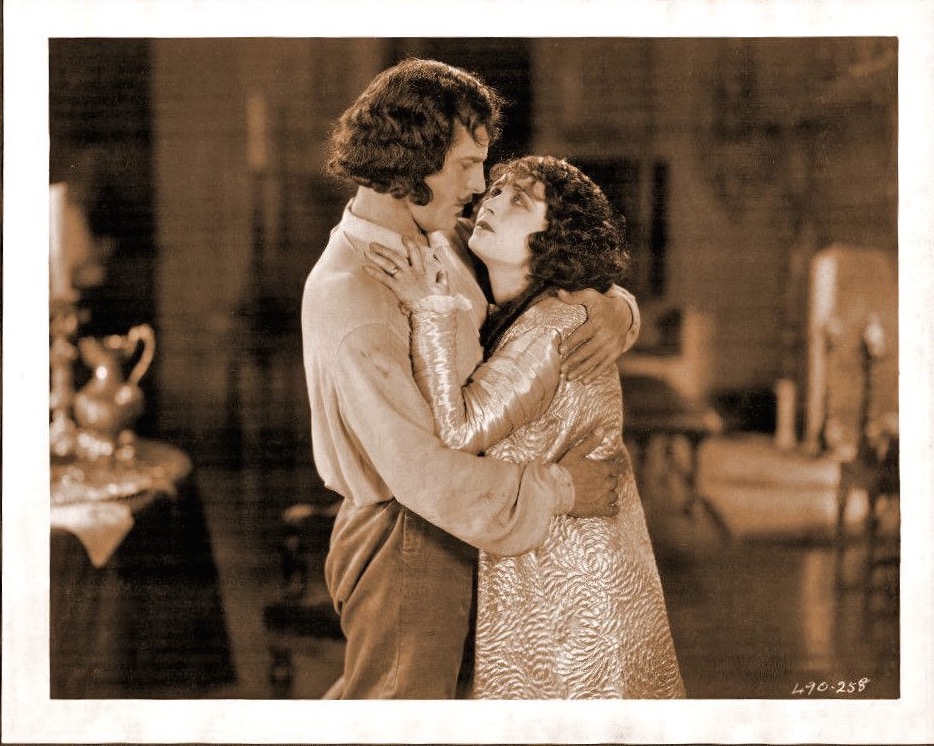
Her name was Pola … The Spanish Dancer (1923), with Meg Morley, Kennington Bioscope


Pola dancing, Meg Morley playing… it’s enough to make you forget the Lambeth Walk and  flamenco down the Kennington Road.

In his introduction, Amran Vance quoted Jeanine Basinger on Negri’s ability to present emotion throughout form and here her every extension was balletically convincing in a story which sometimes almost put the pain in Spain. You can’t take your eyes of Pola as she ignites the screen with a power and cultured restraint sadly lacking from Wallace Beery’s boorish performance as King Philip IV.

It’s an odd mix of humour and drama that never threatens to take itself too seriously, although if you think the way to a woman’s heart is to shoot her husband and then seductively surprise her on her wedding night; then be my guest. There was the odd snicker at rather than with, but this tone was not unusual in a time of Fairbanks thrills and Barrymore blockbusters: see, how they laugh in the face of death!

Stitch that Pickford!
Any gripes are dispelled by the ambitious direction of Herbert Brenon and the majesty of Negri in a role that lets her dance, fight and love as only she can. Even in the spaces of a vast royal garden party you can see her movement as she leads an energetic group of gypsies in dancing for the Queen. Pola’s gypsy Maritana is distraught as she reads handsome Don Cesar de Bazan (Antonio Moreno) his fortune and faces him with a passion Moreno struggles to match. The story was originally written for Rudolph Valentino and was re-tooled for the female lead, but you can’t imagine even he matching the swash in Pola’s buckle. She’s fierce – Lubitsch fierce – and there’s even a scene nicked from Die Bergkatze (1921) in which she douses herself in cologne.

Herbert Brenon had clearly done his homework and, after two so-so films in Hollywood, the former Barbara Apolonia Chałupiec scored her first major hit, one compared favourably with her old pal Ernst Lubitsch’s work with Mary Pickford in the similar tale of Rosita. Brenon gives Pola every opportunity to show her physicality, dancing and fighting as well as riding a horse and it suits the grand scale of his film in ways few leading actresses could match.

Antonio and Pola...
 Brenon has a cast of thousands and in addition to grand garden parties, shoots a mass carnival scene which is given extra atmosphere by tonnes of confetti and expert depth of field from cinematographer James Wong Howe. There’s excellent tracking work which gives a real feeling of atmosphere as the screen is filled with movement.

Against this are the acute emotions of court intimacy as Adolphe Menjou’s Don Salluste tries to manoeuvre King Phil into betraying his French wife, Queen Isabel of Bourbon (an excellent Kathlyn Williams) who really does deserve better. I liked the way the royal characters are introduced as poor old Velasquez tries to paint Phil and his favourite midgets only to be repeatedly interrupted by every significant new arrival.

Then the gypsies run out at the castle of Don Cesar de Bazan (Antonio Moreno) who is about to fall instantly in love, be declared bankrupt and have to go on the run: a rough night on balance. Luckily his fortune-teller reciprocates and even seeks him out the following day to return a purse one of the gypsies had stolen; the only money he has left it turns out.

I can't watch Adolphe without imagining his Irish brogue and I can't watch Wallace without thinking, "poor Gloria..."
The same young gypsy boy who had stolen the purse, Juan (Robert Agnew who was 23 at the time) turns up next as an ill-treated apprentice to a bullying nobleman. Ironically, Don Cesar defends him from his tormentor and ends up breaking the royal decree: no swordplay on carnival day. Things get really complicated as King Phil decides only the gypsy dancer will do for him and all manner of callous enabling is provided by Don Salluste as events spin seriously out of control…

Making sense of all this was Meg Morley whose exuberant and assured accompaniment was filled with so much content all providing subtle tone and colour to the spectacle. Her understated Latin lines and energy kept pace with every sweep, stomp and throw of the hair, not only from Pola but from Señor Moreno too.

Gimme a break 2017, it's a comedy-drama!!
Another superlative spectacle from Lambeth and London’s finest and, as if all of the above were not enough we were treated to three rare and, in one case, possibly unique, 16mmm films from director and collector, Chris Bird.

The first of these was a Georges Méliès film, Paris to Monte Carlo in Two Hours (1905) – imagine having something like that in your collection!? Prince Leopold can’t be bothered with a 17-hour train journey down south, so a mad motorist gives him a lift at what Phil calculated to be 214 mph. It’s magic Méliès with only one confirmed casualty, a man flattened by the car who is blown up so much he pops.

The great race begins
Next up was a Cecil Hepworth film, Miss Deceit (1915) of which this may have been the only copy remaining – anywhere! It features Johnny Butt as Podgmore, a financial manager who competes with his clerk Whatley (Arthur Staples) for the love of Miss Elysia de Seete (Chrissie White - British film’s first leading lady?). Podgmore keeps Whatley working overtime but the roles are reversed when the latter signs up and becomes a Sergeant. All the girls love a man in uniform, don’t they? Maybe…


Lastly, we faced the real horror of director-to-be James Cruze acting in Dr. Jekyll and Mr. Hyde (1912) alongside the delectable Florence La Badie. There’s a lot of potion drinking and gurning as the white-haired Dr J turns painfully into his black-haired and dentally-wayward alter-ego. I also liked the way that not only must the hair change but so must the hat, Hyde purposefully beating it into a jaunty signifier of his up-to-no-goodness. It’s fun and a prime example of the many films Cruze and La Badie were making at the time.

All three were meat and drink to John Sweeney, who took us on a rigorous journey river deep mountain high, via bizarre British love triangles and onto the good, the ugly and La Badie!

Florence and James
Ken Bioscope, you do spoil us rotten sometimes!!

Hyde's bad hat-titude in evidence!
Flo-La-Bad was a stunner
So was Pola
Look at Antonio's hair.
...she was a dancer (classically trained)