Wednesday, 7 October 2020

Musical actors… La Tempesta in un Cranio (1921), with Günter A. Buchwald and Frank Bockius, Pordenone Day Four


“Cinema must be a messenger for propaganda: for righteousness, for goodness, for honesty, for the noblest human and societal feelings. In short, it must educate while entertaining.” Carlo Campogalliani


This special Limited Edition of Le Giornate, does not feature the usual live accompaniment and it was fascinating to listen in to today’s Masterclass with five of the Festival’s musicians discussing the different challenges of recording what are normally one off improvisations. Chaired by John Sweeney, the panel featured Philip Carli, Mauro Colombis, José María Serralde Ruiz and Daan van den Hurk.


Philip Carli dislikes recording in this context ask it makes him all too aware of passages and musical decisions that he would do differently given a second take; nevertheless he recorded his accompaniment for Where Lights Are Low (1921) in one take as if live. Jose also adopted the performance style for his but Daan took longer over his recording as he was playing a previously arranged score for the Bioscope compilation which made for the different challenge of obtaining the most accurate takes and one that supports the discipline of short films of varying length and tone.


John highlighted the lack of audience as the crucial third part of the improvisational “live” experience” whilst he also recorded on midi so he could edit his work. This led him to worries about losing that constantly shifting awareness and response to the timing of the film he gets from playing live which has in the past, he feels, challenged his sense of continuity with the source material.


The Famous Five


This is fascinating for non-musicians and not surprising for a group of players who improvise for a living. It also goes to the very nub of the “live” silent cinema experience, the three-way interplay between sound, screen, and auditorium. Now we have all these elements in place but just not in the same space or even at the same time with some viewing on “catch-up”. The music, the film, the audience are all out of joint and yet… it still works powered by our digitised intimacy and propped up by social media, comments, and other direct connections.


Most importantly, it’s not only the musicians who treat their contribution as a performance, the audience does to; that’s the way it works best and we’re all viewing with hard-wired expectations and responses – memory and imagination plugs the gap and I wake up every day feeling the Festival spirit. If only I had proper Italian coffee and cornetto alla marmellata… I can almost smell them.


Coming up: phototelephonophotography!

Quoting Elmer Bernstein, John said you have to align with the heartbeat of a film and all agreed that, even with films they’ve played for unseen, the best accompaniments have come when they’ve become submerged in the events on screen.There was a discussion about authenticity in terms of the musical themes used and there was a feeling of being “imposters” – albeit highly-skilled ones - overlaying musical suppositions onto defined works of art with often unknowable agendas. Then Mr Carli suggested that, as much as anybody on screen, “we are actors… doing our best with parts…” and then a giant penny dropped. Most silent films weren’t tightly scripted for dialogue with performers having to constantly improvise and the musicians are still carrying this process forward every tiem they connect with the action on screen.


It is always good to hear more about a process that, for me, is almost indistinguishable from magic and which is essential to the silent film experience.  I’m also pretty sure there could be a reality TV series in this, Five Pianists Go Busking perhaps or maybe just Go into a Bar?


Carlo Campogalliani and Letizia Quaranta 

At least Günter Buchwald and Frank Bockius had each other for company when creating their accompaniment for today’s main feature, La tempesta in un cranio (1921) aka Kill or Cure, rather appropriately for this moment.


Directed, co-scripted and starring “the Italian Fairbanks”, Carlo Campogalliani, the film was an energetic and light-hearted affair, featuring an experiment in “phototelephonophotography” – something like a prototypical Zoom call - as well as much running, jumping and climbing. Presented in a new 2K digital restoration by MIC LAB of the tinted and toned period nitrate print held at the Fondazione Cineteca Italiana in Milan it looked like one of Doug’s more fevered dreams.


The film announces itself as being based on a (fictional) book by one by Alfredo Ariberti, Tempest in the Cranium, an hygienic-curative novel against neurasthenia… and proceeds to show the history of the De Otis family for whom every generation eventually becomes deranged. Campogalliani plays Renato De Ortis, “the last descendant of a line of lunatics, wealthy, noble, beloved…” by his lady Liana (Carlo’s wife, Letizia Quaranta) and yet worn down by his fear of this inherited insanity. His home is laden down with books on the mind, life curtailed by the fear of turning into the next deranged De Otis. Can the cycle be broken?


Mad with worry

But how can I think of the smiles of life when I'm under the most terrible ancestral threat?


Renato’s friends set about trying to get him to snap back to life and the above mentioned novelist, Alfredo Ariberti, brings him a specialist, Professor Valenti, who recommends he do more exercise and stop reading books; his muscles are inert because of idleness and I know the feeling! But Renato can barely lift a small dumbbell and slips back into his stupor… as his friends fret about how to help him.


Strange and unfortunate things start happening as Renato’s mines are flooded following a volcanic eruption and his remaining money is stolen in a burglary; life seems to be taking a turn for the worst and after a deep and disturbed sleep he finds himself waking up under a park bench… The Storm in the Cranium is about to begin!


No hanging around, not in this film.


Now the film picks up a pace and Renato goes on a breathless adventure during which he gets accused of being a master criminal, chased repeatedly by the police and encounters a scientist and his daughter. The scientist is working on a televisual telephone and there are enemy agents aplenty out to stop him and steak his idea, they kidnap the boffin and his backer and then try to finish Renato and the girl by tying them up in chains in a mill house, the grinding stone moving down ever closer to the maiden in distress as Renato does his Douglas-best to stop it.


There's also a greta bit of business involving a tower, a rope that is too short, some cheese, a candle and a mouse which is very well worked! Yet, where this adventure leads, I cannot say, but if you’re very quick you can find out for yourselves on catch up.


Go to the Giornate site as soon as you can!

Different premise but the film did remind me of the Fairbanks film When the Clouds Roll By (1919) and Campogalliani shows similar levels of aerobic invention as he free-runs through the film.  It’s not so much madcap as motivational and, whilst it’s exhaustingly daft, going back to Campogalliani’s quote at the top, perhaps the message to us all to get up and get out a lot more!


Günter and Frank kept up with all the manic movement, making musical sense of the madness by injecting some wondrous wacky lines of their own over percussive pandemonium. This is probably not a good film to accompany unseen but I’m certain these two would cope; there’s never one way to improvise and circumstance as well as cine-film, lead to the maximum level of “known unknowns” especially given the amount of cine-telepathy they have.


Bonus screen grabs made using Windows Snipping Tool if you want to know.


Tuesday, 6 October 2020

Sessue superstar… Where Lights Are Low (1921), with Philip Carli, Pordenone Day Three


Unlike his ancestors, Tsu Ya Woug Shih follows the principles of Western culture. He loves according to his heart…


The New York Times thought this film a standard movie melodrama and that “Mr. Hayakawa is worthy of something more genuine…” and yet, in Japan, future Toho producer, Iwao Mori, praised it for its authentic depiction of “Eastern ways of thinking.” Mori even went so far as to call Hayakawa “an unofficial diplomat…” to be supported by a Japanese public who were initially less impressed with his roles as the bad guy in films like DeMille’s The Cheat (1915).


By this point Sessue Hayakawa was in a more powerful position in Hollywood and this was the twentieth film made by his own production company, Haworth Pictures through which he was able to play more of the hero. This progression was much welcomed in Japan according to his biographer Daisuke Miyao from San Diego University who was on hand for the post-screening discussion. He estimates that only some 40% of Hayakawa’s silent films survive which makes this restoration from a 35mm nitrate print at the Jugoslovenska kinoteka, Beograd, all the more important.


Learning Western ways

Where Lights Are Low is evidence of the actor/producer’s appeal and he has star power to burn with ridiculous good looks, focused expressiveness as well as action hero athleticism – his big brawl with the film’s equally impressive baddie, played by Togo Yamamoto, is clothes-ripping, choke-holding, nose-bloodying authentic in the manner of Hobert Bosworth; exhausting to watch.


Whilst I can see the Times’ point of view – this is a melodrama and it does have moments of cultural cringe - it shows how off the pace they were in terms of recognising both the uniqueness of the star and the effectiveness of the film’s production. Colin Campbell’s direction is smoothly assured and there’s a wonderful set-piece in a ballroom that cuts between the elegance of the dancing and the reactions of Tsu Ya Woug’s uncle on his first trip to the West. He looks down in amazement at the dancers’ graceful cohesion and imagines the jazz band as Chinese; cultures crossed in one cross-shot.


Sessue and Gloria Payton


That said, as Professor Mori states in his notes, Hayakawa’s company was being run by the Anglo-American Robertson-Cole company who were setting the agenda in terms of productions that conformed to fans’ “Orientalist imagination of Asia”. But their star was still intent on authenticity – even though he is playing a Chinese character – and this shows in the commitment to portraying both the eastern and western environments.


The set design is superb and the overall aesthetic from China to San Francisco’s China Town is high quality even if the latter was based on photographs less than experience; this is a well-resourced undertaking!


The story is from Lloyd Osbourne, a stepson of Robert Louis Stevenson, and tells of a Chinese nobleman who is intent on following Western ways not least in matters of the heart. He is in love with his gardener’s daughter, Quan Yin, played by Gloria Payton who, in unconvincing make up and with limited range is the film’s biggest weakness. It’s strange casting to modern eyes when you consider that the rest of the oriental cast is either of Japanese or Chinese origin but despite acting with his wife Tsuru Aoki in The Dragon Painter and others, Hayakawa seems mostly to have been restricted to either Caucasian actresses or love interests.


Introducing Uncle to new pals


His Uncle is having none of it and has plans for Tsu Ya Woug to marry the socially acceptable Jae; “nobles are not allowed to choose according to their own will… “


Tsu Ya Woug heads off to America to train as a lawyer although I’m not sure what relevance this will have to his noble responsibilities back home, and vows to return for Quan Yin. Four years on he’s qualified so well he’s dressed in a smart evening suit playing craps with his buddies in a backroom when his uncle comes to find him.


Meanwhile, in Chinatown, the police are looking to crack down on human trafficking and fail to look deep enough into a consignment of tea chests that includes a drugged Quan Yin hidden beneath the Oolong. She’s taken for auction where local mobster, Chang Bong Lo (Togo Yamamoto) is determined he’ll buy her for himself. Yamamoto is just fantastic here, he looks the part and acts with real menace and unpredictability, especially in one later scene when he confronts our hero by throwing a rotten banana at him. He went on to make many Japanese films including Yasujirō Ozu’s Sono yo no tsuma and Ojosan.


Togo Yamamoto

Anyway… back at the auction Tsu Ya Woug, slumming it, walks in to find his love for sale and bids $10,000 to buy her back. Unfortunately, his Uncle refuses to fund his investment of the heart and he ends up having to work for three years to raise the money himself. Confusingly he doesn’t do this by using his legal training but by washing dishes and then opening a grocery store where he encounters his rival for the aforementioned fruity face off.


Even when he eventually raises the money though he will still face opposition from Chang Bong Lo when it turns out that, surprisingly, money can’t buy you love and you have to fight for it!


Accompanist extraordinaire, Philip Carli, is very familiar with Campbell’s work and described him as a “penny plain, tuppence coloured director… very straightforward” yet, this film he found to be much more colourful than the director’s usual fare, presumably because of Hayakawa’s drive for realism. Philip said that the fight sequence is reminiscent of the fight Campbell filmed in The Spoilers (1914), but silent film scraps could be brutal.


Grocery grievance


In musical terms Carli had to approach the film carefully because he didn’t want to fall into the obvious “traps” of an American film on an oriental subject. He aimed to keep the musical inflections as light as possible, and, as with everything in silent accompaniment, he knows exactly how to step back in the overall mix allowing the flavours of the images to speak for themselves. His playing delivered showing, what he described as “sensitivities towards the culture of the film making as well as the characters on screen…”


He lifted the film and complimented the heroic Hayakawa so well that I almost felt I was in the Teatro Verdi… looking forward to the after-show Aperol Spritz.


Next year!!


Monday, 5 October 2020

"Down with luxury and romance!" Guofeng (National Customs) (1935) with Gabriel Thibaudeau, Pordenone Day 2


“We are country people, they come from the city. They are too extravagant and modern, we mustn’t imitate them.”  “If all peasants in China behaved like modern citizens, we would lose the virtues of simplicity and frugality and the country would succumb!”


Day Two of Le Giornate del Cinema Muto #39 and I’m already planning to become a schoolteacher in rural China. Frivolity and beauty products are undermining the country’s resilience, culture and productivity and frankly, I think it’s about time I did my bit.


Guofeng (National Customs) (1935) was made during a fighting pause in the China’s lengthy civil wars with Chiang Kai-shek’s Kuomintang (KMT or Nationalist Party) advocating a return to core values with its New Life Movement. The movement, sharing values with the opposing Communist Party, was reaction against Western imperialist influence and urged the people to observe social and political responsibilities, practice frugality and to know one’s sense of shame.


This period of Chinese history is a complex one yet the interpretation of these issues by director’s Luo Mingyou and Zhu Shilin speaks largely for itself with a clear message that modernity and western ideals are to be at least kept at arm’s length as people work hard to secure social cohesion and prosperity during harsh times. At one point the Principal of the rural school at the heart of the story, appeals to her pupil’s conscience, asking them to recognise their privileged position at a time when many were starving and in poverty. Similarly, the obsession of her daughter Zhang Jie (Li Lili) with make-up, western style and consumerism, is nearly everyone’s downfall.


Lim Cho Cho's Principal


Things have gone and will, in the film, go too far, but there is redemption in working together towards common goals. There’s an almost slapstick ten minutes in which the town councillors see an opportunity in modernisation and Western-style shops pop up all along the main street with the councillors getting western suits, cigars and even "Western socks" to make themselves look younger. This is then juxtaposed by a stirring segment in which Principal Zhang (Canadian born Lim Cho Cho) and her loyal teacher, bring the people back together with forceful speeches that push back the torrents of decadent confusion.


I have another love, says Zhang’s other – sensible – daughter Lan, to her former lover, it is for education!


Lan is played by the radiant Ruan Lingyu, the star of Goddess (1934) among many other Chinese silents, before she committed suicide aged just 25 in early March 1935, some two months before the film’s release. She is extraordinary here as every time I’ve seen her, gently emoting and disarmingly direct, sometimes straight to camera if not to the audience, she never leaves her character. She has a direction in life and is hardworking, believing in truth, justice and the Chinese way. She is betrayed by her flighty sister Jie played by Li Lili who is superbly sassy, with the “pre-code” “presence” of a Joan Blondell or Glenda Farrell and the cruel sneer of a Barbara Stanwyck.


Li Lili dresses for the part

The film itself is a study in the New Life aesthetic and in the ways that Western culture was absorbed and utilized in new ways. The direction is very “European” with fluid camerawork and plenty of tracking and dolly shots, montage and inventive cross-fades; it’s a very well-made film with state-of-the-art design, costumes and staging. Allowing for the odd drop of pace and it is also clearly addressing a cinema-literate audience with a narrative economy that knows somethings can be un-said or un-shown.


“If you love him you have to stop dressing up and behave more seriously…”


The story? The two sisters couldn’t be further apart in their view of life, Lan the best in class and gaining a scholarship to Shanghai University and Jie, obsessed with make-up and social excitement. Lan warns her to forget about the foundation and knuckle down but she won’t listen. Yet Lan not only loves her sister she also loves social order and for this reason selflessly backs away so that Jie can marry the man that she loves and who had just proposed to Lan, Chen Zuo (Zheng Junli).


Westerngoods undermine cohesion


Lan cannot lie and tells him she loves another, she says this twice and always means it, and departs leaving him to marry Jie. Lan goes to work in an elementary school in Huai’an and three months later… Lan reads of her sister’s marriage just as she is selected to go to Shanghai at the expense of the state for further education… Lan was the best in class. Her sister is already bored with married life and jealous of Lan asks Zuo to pay for her to join her in Shanghai.


Meanwhile, handsome Boyang is also sent to Shangai – “what a lively city!” – and we spy trouble ahead. Jie asks for more and more money from Zuo who is tearing his hair out at home whilst she wears make up and goes out more with her flighty friends… meanwhile goody-Lan sends money to her old school to buy books. It is heavy handed to us western sophisticates from the future but was clearly designed as patient propaganda for a rapidly changing society.


Boyang also asks for money from his long-suffering parents and whilst he tells them he’s working hard the reality is that he’s skipping lessons and gets reprimanded. We just know the lad is perfect for Jie and Lan tries to put him off by urging them to be good citizens, highlighting the problems of this new generation who come from the country to be city educated and then, when they cannot adjust, bankrupting their parents in their demand for material goods and leisure experiences.


They don’t listen and remind me so much of Gen-X…


Ruan Lingyu battles Li Lili's smarmy bf

“Are you scolding us, we don’t have time to argue with you…”

Lan plans to ask Boyang to marry her but her sister and he use it to humiliate her and to encourage the other students to take revenge on her and her “saintly” ways. She ends up ill and will have to graduate late... giving the film time for its final flourish as the two return to their town laden down with luggage and take up posts as teachers in their old school.

They proceed to make a mess and set the worst of examples for students and the local populace leading to the final fight back from Principal Zhang and the film’s central address and dramatic conscience call. It’s as dramatic as anything you’ll see with Walter Pigeon and, frankly, I was stirred.

Gabriel Thibaudeau accompanied and provided his own discourse between ancient and modern with subtle lines that reflected the film’s central concerns as well as delighted in its dynamism and emotional force. A reminder of the skills of Le Giornate’s musicians and the due diligence they pay to their source material: a fine duet of audio-visual balance.


Zheng Junli and Ruan Lingyu


Before this we delighted in The Brilliant Biograph: Earliest Moving Images of Europe (1897-1902) captured in 68mm with expert accompaniment from Daan van den Hurk.


This was a tour of Europe drawing from Eye Filmmuseum’s The Mutoscope and Biograph Collection – which includes over 200 films on the original 68mm stock – as well as the British Film Institute and The Museum of Modern Art in New York. Some I had seen before but all were a feast for the eyes and you could only wish to see these on the big screen as we had with the BFI’s Victorian film show at the BFI’s Imax a few years back.


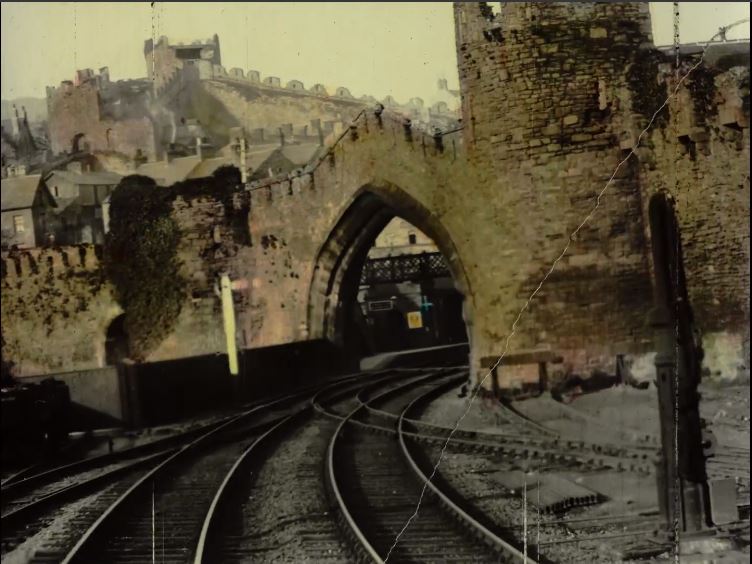
It was a stunning compilation though and I especially enjoyed hand-coloured Conwy (1898), Funeral procession in Rome (1898), Venice, Grand Canal and Ponte dei Sospiri (1898) and Captain Deasy promoting Martini cars, Switzerland (1903)!


And, never forget...


Sunday, 4 October 2020

Back home… Penrod and Sam (1923) with Stephen Horne, Le Giornate del Cinema Muto 39


Every October we travel in time and space to Pordenone in north-western Italy for a week of silent film, socialising and the odd few hours of sleep. In these Covid-curtailed times we’re still transported digitally and emotionally if not physically by the streaming of an event many call home, as Le Giornate Cinema Muto goes online-only. It’s the best we could hope for as we hope for the best… for cinema and for culture.


Festival director Jay Weissberg captured the moment as he introduced a collection of travelogues, taking us from monochrome New York to silent London, via tinted Ostend and eternal Egypt, a magical carpet ride of spaces and people that are recognisably the same as those we know. He quoted from a Michel Robida article: “A journey in one’s armchair – a journey of the mind – is the nicest kind of journey, because it’s what we want it to be, because there are no obstacles, and all our dreams are granted.”*


There’s certainly something dreamlike about the Svenska Biografteatern footage of New York from 1911 – used in August Blom’s Danish film, Atlantis (1913) amongst others – which captures the attitude of the locals proudly being photographed in front of impossibly tall buildings, crossing the Brooklyn Bridge, Times Square, the Flatiron Building on 5th Avenue and Broadway… It’s a glimpse of the future world as viewed by our great grandparents – railways over head and below, constant motion as motor cars vie with horse-drawn carriages and electric trams, with one family standing out as they’re chauffeured behind the ghost camera, that of Antoinette Lochowicz, identifiable via its number plate.


Accompaniment for our tour was provided by Mexico’s José María Serralde Ruiz, whose well-travelled improvisations perfectly matched our feelings of awe and longing, trapped, as surely now as the moment when the light first struck the nitrate elements of the time.


Tonight’s main feature was the recently restored Penrod and Sam (1923), the second of the film adaptations of Booth Tarkington’s novels about young Penrod Schofield as he grows up in a small town that is an idealised mid-western America before the Great War. Tarkington wrote three books on Penrod, and later The Magnificent Ambersons, and there are public domain audiobooks of his trilogy if you’d like to hear more. The story as seen through the film, is something of an updated Tom Sawyer, with plenty of underlying adult themes if you look hard enough.


Sam (Joe Butterworth) and Penrod (Ben Alexander)

The opening title cards dedicate the film to “The spirit of Boyhood which always has been and always will be the same… “ and what follows is a superb capturing of childhood concerns from director William Beaudine who brings out some extraordinary performances from his cast of kids and, indeed, their pets – take a bow Cameo aka the noble Duke, Penrod’s dog. Beaudine was adept at working with youth and went on to direct Mary Pickford’s child-like fable Sparrows (1926) as well as a talkie remake of this film in 1931 and many more including Billy the Kid Versus Dracula (1966) which may or may not be as childish as it sounds.


Right here in 1923, he captured the life of a pre-teen as accurately as the Swedes shot those New York streets with be-freckled Ben Alexander (11 and a ½) coached and edited to a very impressive performance as the pugnacious Penfold. Penfold, together with his best mate Sam Williams (Joe Butterworth), lead a gang of boys dedicated to re-enacting battles based on very-specific childish logic and they also have a boys-only members club called the In-Or-In Lodge, which has a strict no-girls allowed policy – not even for Majorie Jones, Penfold’s “most beautiful girl in the world” – and a rigorous ’nishiashun ceremony.


Penfold is immediately shown to be, almost literally, at war with big Roddy Bitts (Buddy Messinger) the son of the richest man in town, and the story starts with light-hearted run ins between Roddy’s rebels and Penfold’s “Federal” forces. The rules of engagement are largely non-contact and wooden swordfights can only be won by first contact with the opponent’s clothing.


Boy's club

Interestingly Roddy’s most valiant soldiers are his “colors”, two black brothers Verman (Joe McCray) and the younger Herman (Gene Jackson) who are both treated as equals in the gangs even though they look noticeably poorer. Again, both lads give excellent performances and their position in the film feels so much more natural than other black performers in many other productions of the time.


Herman gets captured by Penrod and Sam and hidden in Penrod’s elder sister’s wardrobe until further notice. War is Hell.


We soon get to meet that sister, Margaret, (Mary Philbin, who’s next film was a staring one, in Erich von Stroheim’s Merry-Go-Round) as well as the parents, Dad (the super Rockcliffe Fellowes) and Mom (Gladys Brockwell, possibly Brooklyn’s eye-roll champion of 1915…) and the family dynamic unfolds. Dad’s about business, his evening cigar and the newspaper whilst Mom looks after the housework not covered by their black housemaid and Margaret is in love with Robert Williams (Gareth Hughes), Sam’s elder brother.


Ideal American Family

Herman’s escape from his wardrobe cell, hidden under one of Margaret’s dresses is typical of the tone of the film’s mostly slapstick first half but things do take a darker turn as the boys themselves take things too far in victimising their underserving enemies, bookish Georgie Bassett (Newton Hall), whilst their deserving ones, Robby, backed up by Dad (William V. Mong), up the ante by levelling false accusations and getting Penrod a “good lashing” from his father’s belt.


There’s a growing dislike between Penrod and Robby that gets more intense and, as they’re destined to become grown-up rivals like their fathers, there’s no particular happy ending other than the wealthiest having the fewest real friends. Even Mr Burns has Smithers…


Mary Philbin and Gladys Brockwell

Stephen Horne’s accompaniment played deeply on the narrative and emotional vectors as he presented slapstick lines at helter-skelter pace, aiming, as he said in the after screening discussion, “… to create the feeling that it was fun but… slightly out of control and that at some point (the fun) would come to an abrupt halt!” It was the kind of sure-fingered and thematically premeditated improvisation we’ve come to expect from Mr Horne and he rounded off the viewing experience with rich dashes of humour and a melodic flourish.


Also in the discussion, Katherine Fusco, associate professor of English at the University of Nevada, Reno, observed that the boys are imitating the adults and also instructing them as it is only through remembering how it felt to be a boy that Penrod’s father is able to help his son whereas Robbie’s Dad is millions of dollars away from being able to empathise. This has echoes today but it's fascinating to see how US writers and film makers have always been suspicious of capital wealth – not so much as socialists - far from it - but in the way that money brings conflicted priorities that, if not addressed after salutary lessons are learned, will bring nothing but bad fortune to you and those you are supposed to love.


Celebrating the spirit of '76!

So, Penrod and Sam was far from child’s play (sorry) and is a typical Pordenone gem, one that was very well polished by this Library of Congress restoration!


More to come for the next week and full details are on the festival website. The films are available to view for 24 hours so you can still catch the show if you’re quick.


* Images de Paris. Girouettes. Les rêves tournent au gré des vents, La Presse, 22nd October 1934


Duke waits to hear his master's voice...

Pordenone 

Saturday, 3 October 2020

After hours… Dementia (1955), BFI Dual Format


I enjoyed DEMENTIA. It stirred my blood, purged my libido… The work was a work of art. Whether YOU like it or not will depend entirely upon the permeability of your emotional shell, your idioplasm and your previous conditions of servitude.”


Filmed in Venice, Los Angeles, mostly on a single night in 1953, Dementia makes up in atmosphere what it lacks in budget and is that rarest of things, a silent film made after 1929. It’s audacious and combines disjointed narrative with music and performance to project defined mental states onto screen. David Lynch would love it, Jim Jarmusch too as another fan of night-time dislocation in Mystery Train or Martin Scorsese for After Hours. Maybe even Orson Welles, whose Touch of Evil famous single-take opening was also shot on Venice’s Windward Avenue, which is where Dementia’s lead character, The Gamin, is seen running from and towards trouble.


Preston Sturges definitely was a fan and gave his friend, writer-director John Parker, carte blanch to use the quote above. Praise indeed and we must celebrate the cleansing of Preston’s libido even now even though I’m not quite sure what he meant! The film does have a feminist edge though and the usual treatment of femininity in Hollywood is subverted as violence against women is not glorified or used to titillate, it’s there as an every-present unease with The Gamin, played by Adrienne Barrett (Parker’s secretary and a decent actress in her only leading role), also capable of violence and, whilst distressed, certainly not a helpless damsel. But, as Ian Schultz says in his essay in the set’s booklet, there are “… multiple incidents (that) let the viewer know that The Gamin is living in a world where women are pursued and abused.”


The opening shot into the hotel


Dementia
is a silent film with only sound effects and screams emanating from its players all set to the uncanny vocalese of Marni Nixon over avant-garde composer George Antheil’s music. Antheil had composed the score for Ballet Mécanique (1924) by experimental filmmakers Fernand Léger and Dudley Murphy (with cinematography by one Man Ray) – another silent link. Antheil was also the musician who worked with Hedy Lamarr in developing theories of spread-signal radio guidance… We also have some cool jazz from the actual Shorty Rogers and his actual band, the Giants, which roots the pivotal night club sequence in the deceptive comforts of sophisticated modern improvisations as the action takes its turn to be more surreal.


Originally a ten-minute film, Parker expanded his film to an hour with help from two of his leading actors, Bruno Ve Sota who, according to Shultz was most probably the film’s director and Ben Roseman, who plays The Gamin’s abusive father and the rather strange police officer who tracks her throughout – it is a film that wears Freudian psychology on its sleeve.


The titles roll as the camera focuses on the stars over LA and then pulls down to reveal a skid row street before moving across to pull through a hotel window where sleeps a young woman known only as the Gamine. She’s restless, pulling at the bed clothes disturbed by feverish conscience perhaps and by the thought of being overwhelmed by a wave at the beach as she runs for safety.


Male menace throughout night-time Venice


She wakes and heads out into the night encountering characters from her past or present and which, taken at face value, build into a defined story of who she is and what she’s done but the air of unreality leaves enough uncertainty to keep you uncertain as almost everything that does happen is like a waking dream. She keeps on seeing newspaper headlines about a “mysterious stabbing” and doesn’t react as we expect… she’s not repulsed by violence; she may well enjoy it?


She meets Richard Barron as the Evil One – the Charley Chase of Earth 2, turned to crime rather than comedy – who appears to pimp her out to a passing Rich Man (Bruno Ve Sota), who takes her to various night clubs. The Rich Man is greasily seedy, eyeing up the dancers like so much property and as they travel in his limousine, the Gamine thinks back to her parents or rather her parents’ graves. She’s shown a graveyard by a tall ghoulish figure wearing a black mask, rather like a sinister Ghost of Christmas Past, and sees visions of her mother (Lucille Howland) and father (Ben Roseman) as the latter shoots the former and, in revenge, we see her stab him in the back. Did she or did she just want to? The fact that the Detective wears the same face may suggest either or neither.


Mum and Dad in the graveyard

So it goes as she heads to the Rich Man’s apartment where events do not quite pan out as we expect on any level and from there further into the darkness encountering strange flower sellers, drunks and Short jazzmen. Is it reality? You have to be kidding… but she definitely had too much to dream last night.


Dementia was too much for the censors and it was banned with Parker only managing to get it screened once in 1955. Jack H Harris bought the movie and it was re-worked in 1957 as Daughter of Horror – also on this BFI disc - with added narration from Johnny Carson sidekick Ed McMahon who claimed to be the ghoul in a re-shot cemetery scene, although this seems unlikely given shots of Barrett with said figure from ‘53. That sequence is best known as that featured as the movie-within-a-movie in Harris’ The Blob (1958) as the film teenagers are watching when The Blob arrives to kill them.


The vibe turns strange for Shorty and the Giants


So, you’ll want to check over your shoulder when you’re watching Dementia but you’ll probably be too engrossed in what is a remarkably stylish and engaging film. Ed Wood’s cinematographer, William C Thompson was used for the film yet his capture of Venice after hours is far beyond anything Wood brought out from him. Somehow, the stars aligned to create a work of lasting interest, cinematically oddball but sincerely strange!


Dementia is available for pre-order from the BFIonline shop right now and will be available on 19th October, well before Halloween.