Saturday, 21 July 2018

A simple soul… Kipps (1921) with Neil Brand, Kennington Bioscope

"…the ruling power of this land, Stupidity… a monster, a lumpish monster, like some great clumsy griffin thing…  like some fat, proud flunkey, like pride, like indolence, like all that is darkening and heavy and obstructive in life…" HG Wells, Kipps (1905)

There is more joy in Heaven (the one that looks like The Cotswolds) over the screening of a decent British silent film than over any number of talkies… It’s probably in the Bible; check out the gospel according to the Saints Pearl and Dean.

It's useful, of course, to have the wonderful source material of an HG Wells' novel and the acting of George K Arthur, who simply “was Kipps” according to the author. Wells was less favourable over the actor’s subsequent film, The Wheels of Chance but, personally, I think that film has almost as much charm as this.

It also helps greatly to have an accompanist like Neil Brand who really understands the period, the source material and the very British story being told. In his introduction he said he hadn’t played with the film for twenty-odd years, but it didn’t show as he patiently built up a thoroughly Edwardian sentiment with flashes of more modern – classic – scoring. All this whilst resisting the temptation to reference a note or two from Half a Sixpence which was based on this story.

George K Arthur headed off to Hollywood not to long after this and I’d last seen him in Lights of Old New York with Marion Davies and Mr Brand again on piano. He has charm and a natural reticence which makes him perfect for romantic comedy but he’s a canny actor with more to his game than he’s often credited. One of his most unusual castings was in Von Sternberg’s The Salvation Hunters in which his vulnerability plays off against the dockside thuggery and, indeed, Paulette Goddard’s own toughness.

"Kipps is Kipps"
Here he is in his element as the man to whom Life just keeps on happening…  The full title of Wells’ book is Kipps: The Story of a Simple Soul and George is the perfect straight man for the jokes perpetuated by the ruling powers of the land. He is Arthur Kipps (don’t delude yourselves that I’m not looking for a way to fit Arthur Sixpence into all this…) an easy-going orphan who lives with his stern and often disapproving uncle, Old Kipps (John Marlborough East) and his wife (Annie Esmond).

He grows up with his best friend Sid, the neighbour’s son and there are lovely scenes of imaginary pirate fights on what looks like the wreck of a Great War battle ship. Arthur takes a shine to Sid’s sister, Ann Pornick (Edna Flugrath) but takes a long time to express his intentions. When he does he finds he is loved back and they split a sixpence in half to remind them of their incompleteness when apart.

Now, having finally got started, Arthur is exiled to an apprenticeship at the Folkestone Drapery Bazaar, run by Mr. Shelford (Arthur Helmore). Wells’ class concerns are still very much in evidence and Kipps’ dialect comes out in the title cards as easily as his discomfort in “polite society”. People like him have little control over their lives and must follow their duty, and, in his case, this means separation from the other half of his sixpence.

Edna Flugrath in 1919
Gradually he forgets Ann and starts to woo his arts teacher – self-improvement was all the rage - Helen Walshingham (Christine Rayner). He also makes a new pal, aspiring playwright and actor, Harry Chitterlow (Teddy Arundell) and whilst their initial meeting ends up with his losing his job after they get drunk, Harry spots an advert in a paper that means Kipps is due a life-changing inheritance.

Newly enriched with his long-lost grandfather’s posthumous generosity, Kipps now has to adjust to his new social status and also to look after his fortune… Will money guarantee his happiness and acceptance, and, as Ann re-appears as a humble housekeeper can true love overcome the phoney concerns of social status?

Director Harold M. Shaw makes light of the story’s literate origins and constructs a deft, enjoyable narrative that allows his actors to shine. Kipps is very enjoyable, professionally-made cinema that even manages to smuggle in some of Wells’ social concerns. You wouldn’t get so much of that in Hollywood... or would you?

The Sun winks
The first half of tonight’s programme featured the Georges Méliès’ masterwork, Voyage à travers l'impossible (1904) which takes the template of 1902’s Le Voyage dans la Lune and swings off even further into the solar system.

Méliès plays an engineer called Mabouloff who has devised an expedition to take his fellow explorers across the Alps, up into space and back down again using steam, airships, rail, automobiles and submarines… it’s madcap and inventive and feels slightly more structured and technically advanced than Moon even as one thing keeps on leading to another. There are fades from one scene to the next and the shot of the Sun's face is what you might a close-up!

Fernande Albany - who would have been 15 - plays the inventor's cheeky servant and one of the few woman among the travellers. She stands out from the grey, bearded boffins adding kinetic interest to the chaotic tableaux throughout. She went on to enjoy a long career in France and it’s good to put a name to one of the faces.

The plans are unveiled - Fernande Albany on the right in light blue?
The version screened was in magnificent colour – originally hand-tinted – and this worked especially well when the travellers hit the stars and get eaten by the Sun. Luckily the rules of physics were suspended for the adventure and they managed to drop back to earth in a submarine, past several disinterested perch or sticklebacks stuck in front of the camera.

It was an absolute joy and John Sweeney played along with his old friend with adventure and much gusto of his own: it’s not just the musical narrative but the ability to create just the right period tone that is so extraordinary about Messrs Brand and Sweeney; the Bioscope piano must look forward to their accompaniment.

Crossfading from one scene to the next...
As if that wasn’t enough we saw an episode of the British Sexton Blake serial The Mystery of the Silent Death (1928) starring Langhorne Burton as Blake and Mickey Brantford as his assistant Tinker. There was some excellent detecting, thrills with spills – possibly down to this being two reels cut down to one. Ultimately the message was, gentlemen clearly in a “funk” almost certainly have something to hide.

We also had the World’s most popular cartoon cat (until Walt ripped him off) in Felix Strikes it Rich (1925) and an adventurous western from the Nestor Film Company, The Awakening of Apeta (?) which was a turbulent tale of mixed-race love and loyalty; in America as in Wells’ Britain, social mores held people down so miserably; you can only hope we can cling onto the changes brought by the ensuing century.

Tonight, we were, once again, spoilt rotten by the Bioscope: enjoy your summer break and see you all again for a lot more in September.

Wednesday, 18 July 2018

Forbidden colours… The Red Lantern (1919), Costas Fotopoulos, Kennington Bioscope


“East is East, and West is West… and never the twain shall meet.”

Anna May Wong makes a brief and almost impossible to spot, film debut in a film in which a Russian and an American play the two Asian leads. The Red Lantern is “of its time” and yet it is not unsympathetic to these characters whose lives are limited by Caucasian prejudice. The eye make-up is jarring and makes for awkward viewing but whilst attitudes have shifted there were those even at the time who found this unacceptable… in a time when Sessue Hayakawa was a bona fide star. But this is about love and prejudice and whether the lines quoted from Kipling should still be true some twenty years after the Boxer Rebellion led to the deaths of over 30,000 in Peking.

The film features Alla Nazimova in dual roles as Mahlee the illegitimate, mixed-race daughter of Sir Philip Sackville (Frank Currier) and half-sister to his pure English rose Blanche. Nazimova proves again her ability as the most stylised protean performer of the time and you’d scarcely recognise her as her own sister – blonde wig and a lighter touch – vs the taught angularity of Mahlee.

Alla Nazimova, also known as Naz (natch).
The Boxer Rebellion was not old news at this point as the Great War ground out its last days, and issues of self-determination drove the post-war agenda. China had been the subject of many international hands and the “allies” opposing the uprising had been a mix of British, American, German and Japanese who by the time of this film had assumed the lead role.

June Mathis’ screen play was based on Edith Wherry’s novel, written in 1911 and described in The Spectator review on release as an extra-ordinarily “vivid” account of missionary life and as “… a statement of existing conditions it is of the very highest interest.”

In this context it’s fascinating that Noah Beery’s Doctor Sam Wang is not an out and out baddie; firstly, he’s a Doctor, committed to heling and secondly, he too is “Eurasian” – mixed race – and has been humiliated by his attempts to integrate in the West. He gets involved in the uprising as he wants to earn his place in the East… he’s also a bit too fresh with Mahlee, just to push him into “bad guy” territory, behaviourally. As the book reviewer noted, the two best realised characters are Mahlee and Wang.

Another Beery baddie? Also the father of Noah Beery Junior of the Rockford Files!
Mahlee herself is got at for not having had her feet bound – the express wishes of Sackville as he abandoned her as a baby, little realising it would mark her as an outcast. So much so that when her grandmother is dying she asks her to cut her feet so that she may be accepted into heaven by the gods (tough gods!). But, nor can she truly find a place with the Christian Europeans, even as she works as a nurse in the Mission.

 
“Hush, child! You are like a cat treading on my heart. You have the foreign devils’ fear of death… my time is near and I am not afraid.”

She falls for Andrew Templeton (Darrell Foss), the son of the mission leader Reverend Alex Templeton (Winter Hall), but the son's admiration is tempered by her mixed race as indeed is that of his father and mother; as much as they like and admire Mahlee, she is not for their son.

Naz and Darrell Foss
Things become even more pronounced when the Stackville’s arrive and Andrew is automatically drawn to the Caucasian version of the woman he has felt such an uncomfortably strong attraction for. This is not good news and naturally Wang plays the rejection as another reason for Mahlee to help the Boxer rebellion by pretending to be the Queen of the Red Lantern.

Again, it’s of interest that the story doesn’t leave it there and there is still a chance for the Westerners to redeem themselves by accepting Mahlee for who she is and not how she was made but no… they can’t even manage that and so it is that Mahlee joins the revolt. What else has she got left and, despite her efforts to save them and repeated offers of friendship they just can’t get over her skin colour… even her love and even her father.

The imperliasts aren't budging!
So, by now we’re rooting for the Boxers… and so – probably - were many of the audience in 1919 which is an extraordinary thing.

 
Veteran Albert Capellani directs… and there are some excellent crowd scenes and luscious mise-en-scene: it’s an epic and I’m not surprised it was one of the biggest films of the year and established Nazimova as: ”The star of a thousand moods… in a drama of a thousand delights.” I wasn’t counting and that may well have been hyperbole but there were many delights…

Costas Fotopoulos accompanied and, sight unseen, did a marvellous job matching the dramatic and emotional pace of a film that does lead its audience along a twisted path to the denouement.

Now THAT. Is a hat.
Illegal drug frenzy at South London Silent Film Speakeasy!!

Before all this we were treated to Coke Enneyday (Douglas Fairbanks) and his opioid adventures trying to break up a gang of evil-doers using inflatable fish to smuggle. Lovely Billie Love is caught up in all of this and I especially liked the moment when one of the – Chinese – henchmen trapped her and said he could now do what he wanted with her… she beats him up and ties him up in his arms.


Anita Loos probably added the Girl Power and Todd Browning (you know, him!) summoned all the rest coming down from one bad trip on Venice Beach. Maaaann!

John Sweeney played along, as sober as a Judge m’lud! He had to be: Doug takes no prisoners and in amidst the fun drugs, he clearly forgot to take his worming tablets.

The men in a boat. 1910.
There was also some beautiful colour footage of the Italian Lake Garda taken in 1910 using the innovative British Kinemacolor process which, as the Bioscope’s expert projectionist, Dave Locke, explained, used a spinning disc, with red, green and clear plastic to synchronise with film shot using tinted stock. The result was simply stunning and “colour fringing” aside, when someone moved a little too fast for the camera to follow, it was something to behold.

If you travel down to Brighton and Hove, you can still see the Kinemacolor sign on the side of the building where it was developed.

One of the most remarkable shorts ever shown at the Bioscope or, indeed, anywhere else.


The Red Lantern was the recent Belgian restoration and was screened on 35mm. It is avialable from the Belgian Cinematek as an extraordinary extras-laden DVD with a 200 page book which tells you all you could possible imagine about Naz, the Boxer background and the making of this film. Highly recommended!


Sunday, 8 July 2018

Blogogna… The Eight Days of Il Cinema Ritrovato, Bologna 2018


No amount of pre-planning can prepare you for your first experience of Il Cinema Ritrovato – there’s simply too much film, culture and place to process. But the ever-present nagging doubt that there is something you’re missing just has to be cast aside… So, turning my mind off, relaxing and floating downstream… here’s a non-exhaustive list of my highlights excluding Rosita and 7th Heaven about which I’ve already burbled.

1.    Partying like it’s 1898…

This was my favourite strand of shorts because historians love nothing more than Steam Punk Cinema: Victorians revealing the verve and imagination you always knew they had in abundance. The Age of Engineering and the start of very modern enlightenment.

I started with some silent animation from the BFI archives, or was it animation? There was some devilment with scissors which mixed live action with stop motion to great effect and then a doll rises up to follow its owner as she goes on a date with a young man: think Toy Story mixed with Chucky… a film that re-ignited my childhood dreams of animated plastic…

Playing along was Stephen Horne who added vocalise to his array of instrumentation, a moment as shocking as it was entirely fitting as with all his accompaniment.

There were genuinely stunning 35mm reductions of 68mm originals which showed the World of our grandparent’s almost as clear as yesterday. I’m reminded of sci-fi novelist, Bob Shaw’s idea of slow glass through which light moves so slowly that you can look on events as the happened years later… mind-boggling but the light of events reacting with nitrates in 1898 is revived again through 2018 projection.

Definitely one of the shocks from this period was the five minutes long Opération chirurgicale du Docteur Doyen: Hystérectomie abdominale, ablation de la tumeur (1898) which showed the good doctor hacking his way inside a living patient – heavily sedated – for what seemed much longer. Not to forget it was intended as an instructional scientific film but…

120 years on the pigeons grand children still get fed in Piazza San Marco

2.       Underground cinema: Wolves of Kultur (1918)

All 15 episodes of this propagandist serial were screened through the festival in the Cinema Modernissimo which, originating in the 1900s, is an impressively atmospheric subterranean hall very much under re-construction. In the rip-roaring opener as all-action Alice Grayson (Leah Baird) tries to avenge her Uncle’s murder by the evil quisling duo of Henry Hartman (Austin Webb) and Mario Zaremba (Edmund D'Alby) and recover the plans for a wireless controlled torpedo.

The pace is relentless as are the stream of characters… as a mysterious detective, Roger Barclay (Sheldon Lewis) follows events and a young engineer, Bob Moore (Charles Hutchison) becomes involved after Zaremba tries to marry his sister Helen (Betty Howe) … Oh, and Karl Dane’s in it as a henchman called Carter!

Directed and written by Joseph A. Golden, it’s fun comic-strip nonsense which plays like a more paranoid Les Vampires… I saw about half the episodes including the finale and it was fun!

Accompaniment was from many hands and the one I seemed to find the most was Daniele Furlati who had a lilting main theme that took full advantage of the magical acoustics.

Leah Baird. A real trooper.
3.       Les Deus Timides (1928), with Gabriel Thibaudea

I’ve managed to miss this 2016 restoration several times and it was the perfect start to day two with sprightly, controlled direction from Rene Clair and a performance from handsome Pierre Bascheff that walked that delicate tightrope between Frank Spencer and Harold Lloyd.

It’s “French whimsy” mon amis and the pure, delightful distillation that makes you laugh out loud and forgive the inevitable minor frustrations of two, too-timid souls in service to a plot reliant on the inability to perform even the simplest acts of self-interest.

It’s such a “neat” film with Clair’s direction, editing and camerawork so precise throughout. There are so many cute inventions and I especially loved his use of split screen especially as Batcheff’s character launches into an imaginary fight with his bête noire, the bully Garadoux who, frustrated just the same, fights back screen right. At one point the camera dips, allowing room for both men to raise their arms at the same time: funny in a cinematic way. There’s also their climactic court case in which Clair uses hilarious stills showing the two exaggerated sides of their arguments in a who started it and who finished it war of weasel words. It’s packed with visual punchlines that offer a spectacular parallel narrative to the interpersonal action.

Pierre Batcheff is Fremissin a timid lawyer who sends his own client bad-beardy Garadoux (Jim Gérald) down for three months’ chokey after he’s found guilty of marital assault. Two years later and both men are out in the country and pursuing the same woman, Cecile Thibaudier (Véra Flory).  Cecile wants the one who can ask – Fremissin is too afraid of failure - whilst the other drives her wild by bullying her father (Maurice de Féraudy) who is clearly just a dad who can’t say no.

Garadoux spots his old nemesis trying to make a move on his gal – and potentially his loot – and tries to frighten him off using his pipe as a gun and covering his face with a hanky… Fremissin doesn’t take much scaring but slowly he edges forward. But will the tortoise beat the heavyweight hare as the latter moves in with family and lawyer to try and force the wedding contract…

Gabriel Thibaudeau accompanied with fleet fingered assurance; he’d danced this one before I think.
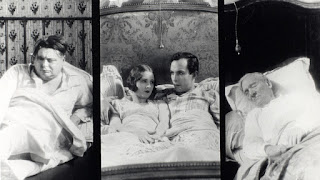
A split screen interacting with audience sensibilities...

4.       Women… under pressure and disguised as seals
  
Woman Under Oath (1919) with Donal Sosin

There was a substantial strand of John M. Stahl flickers with this one silent film and lots more to come at Pordenone. This film managed to be both insulting and inspiring… raising important questions about whether women could “handle” the pressure of being on a jury – locked in late at night with all those manly-men… It’s a well-made vehicle for stage star Florence Reed whose character Grace Norton is becomes New York’s first woman juror.

Of course, it couldn’t just be about her actually doing the job of a juror could it; she had to be something far more significant. Though stylish, the twist does tend to undermine the whole point of the story, at least in my opinion.

Eleven angry men and one level-headed woman... almost.
Woman (1918) with Mie Yanashita

“Woman…” as John and Yoko sang dangerously in 1972, “… is the n*gg*r of the World” and if you thought Woman Under Oath was tricksie from a feminist point of view then Maurice Tourneur threw us a few curved balls… tongue in cheek, peut etre, but still… how we’ve changed eh?

A middle-class, middle-aged couple row about something, she storms out and her shakes his complacent male head as if to say, bless her emotional little heart. He starts reading a history book and it tells the tales of women through history… and their faults: Eve’s obsession with that bloomin’ apple (who needs knowledge, right?), Emperor Claudius’ betrayal by his exceptionally unfaithful Messilna (played by dancer Flore Revalles, who is very good) and then the bizarre story of the seal-turned-women who deserts her children and husband Cyrene the fisherman in order to swim once more as a seal. I genuinely had no idea that woman were originally seals: why didn’t any of you mention this?!

Then there’s a girl in the Civil Way who, hiding a Yankee soldier from a Confederate troupe, loosens her resolve when their Captain offers her his watch… she gives the soldier away and he’s executed in front of her.
  
But wait!
  
The gentleman turns from the book and thinks his great thought: women aren’t all bad, now they have purpose because of the War and stuff! She who rocks the cradle, probably doesn’t get enough sleep (or credit) and… cue montage of helpful nurses, munitions workers in skirts and women who, now, distractions set aside, could probably be in a film without having a major character flaw.

I really doubt that my Grandad – union member and supporter of suffrage after a First World War in which he saw too much masculine unfairness – would have liked this film. He would have thought it daft and wrong. My Nan would have lamped the projectionist. Still, nice framing and cinematography Maurice.

Oi, Eve, leave that apple alone!
5.Naples au Basier de Feu (1925) with Guido Sodo and Francoise Laurent

Projected under the stars at the Piazzetta Pasolini using what the locals term lanterna a carbone this was arguably the best film in the Naples strand even though it was directed by a Russian and featured French actors.
  
The otherworldly Gina Manes plays a local beauty Costanzella who escapes the clutches of her violent lover to move in with the unlikely pairing of Pinatucchio a beggar/holy man (Gaston Modot) and a violinist/street singer, Antonio Arcella, played by proto Delon Georges Charlia – last seen being very jealous of Louise Brooks in Prix de Beauté).

Antonio is a hustler on his uppers – he’s had to sell his violin – and is looking to fall in love with someone beautiful and rich. He targets Silvia (Lilian Constantini) a rich socialite, who travels with her aunt, and she gives him money in exchange for charm and melodies. But love takes a turn as he gradually falls for Costanzella, despite promising Pinatucchio that he wouldn’t as the old fellow is besotted himself. It’s a terrific performance from Modot and the bizarre love quadrilateral is resolved in unpredictable ways…

Guido Sodo accompanied on mandolin, mandoloncello and vocal with François Laurent on chitarra helping to create a perfect moonlight movie night. Al fresco may have been on drums…

Naples au Basier de Feu (1925)

6.       Vendemiaire (1918) with Stephen Horne and Frank Bochius (Parts 1&2)

This was a four-part serial (well three plus prologue) from the master of the multi-part adventure, Louis Feuillade and showed a more technically-accomplished and down-to-earth, director three years on from Les Vampires. There were some lush landscapes of the canals and countryside near Lyon and a feature feel to the lengthy episodes as a plot unfolded about two escaped German POWs infiltrating a group of farm workers in the Great War.

René Cresté plays Pierre Bertin a soldier on leave to recover from his mental and physical wounds and he meets a family heading away from the front line to seek work and to find out what happened to their siblings. They all end up working on a vineyard in Lunel (Feullade’s home town) run by Capitaine de Castelviel (Feuillade regular Édouard Mathé) and where the two Germans also infiltrate.

Wilfred (Louis Leubas) and Fritz (Manuel Caméré) cause much disruption as they try to further the fading German cause and frame a gypsy, Sarah (Mary Harald) as they rob the Captain… there are more characters than in the director’s more adventure-based serials and, as the propaganda it undoubtedly was, Vendemiaire stirs your heart as you hope for the best for these refugees.

Stephen Horne and Frank Bochius were on fine form and worked so well together here as elsewhere with an instinctive understanding of their musical combination as well as the momentum of the movie.

Driven away by the war

7.       Vintage colour: Cabaret (1972) and Leave Her to Heaven (1945)

It’s not all about silent film of course and there were so many fascinating and ultra-rare opportunities to see rare celluloid that, all geeking aside, offers a significantly different experience of film watching. The early 60’s copy from the original nitrate of John M. Stahl’s colourful noir was a blaze of greens and turquoise and Gene Tierney was even more striking than usual as the woman who, putting it mildly, loves Cornel Wilde just a little too much.

Cabaret was the real hum-dinger though with a print that was so warm and slightly worn that I half expected some ads for Kiora and a local carpet shop. I’d never seen the film all the way through – although I’d seen Alan Cummings and Jane Horrocks at their famous run at the Donmar Warehouse. Those two simply were the MC and Sally Bowles for me but now I can truly appreciate how good Liza Minelli and Joel Grey were on screen.

Silent film style and references abound and then there's Bob Fosse's extraordinary choreography; still jaw droppingly angular and expressive.
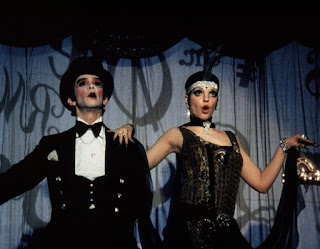
Joel and Liza-with-a-Z...

8.       Lights of Old Broadway (1925) with Neil Brand

We’d been missing some solid, silent Hollywood and Marion Davies delivered in style with this entertaining romp. It was based around the shift from gas to electric lighting in New York and featured sequences in colour using tinting, Technicolor, and the Handschiegl colour process.

Marion is one of twins separated at birth as their mother dies on an Atlantic crossing: one Marion, Anne, grows up with the wealthy de Rhonde family whilst the other, Fely, with the riotous O’Tandy clan who squat on the edges of town, never paying rent and looking to fight, or rather “foight” their way out of trouble. There’s a lot of Oirish intertitles if yer get moi drift… but then it’s well known that *all* the people of Ireland love 1. Not paying their dues, 2. Drinking 3. Larking and 4. Foiting

Of course, Fely meets the de Ronde’s son Dirk (Conrad Nagel) and they fall in love but the two fathers like none of it and only a fist fight will bring them together – the Dads – so that peace can reign and Dirk’s daring fortune in electrical illumination can establish a new dynasty.

All good fun and Marion is wonderful as usual.   Sometimes that’s what we want and Neil O’Brand played along with a twinkle in his eye, he knows when entertainment is due!

Technicolor fragment of the nitrate print of Lights... by Barbara Flueckiger.

Epilogue... Lyda, Pina and Francesca

I was not going to Italy to miss out on diva films so there’s more to be said later about I tre grandi as well as the remarkable smiles of Leda Gys, the amazing hair of Rosè Angione and the films of Elvira Notari.

There were some films I'd already seen and liked including Parts One and Two of Christian Wahnschaffe with Stephen Horne, which I saw in Berlin and the mighty Shiraz which was the LFF Restoration Gala last year, and screened here with a recording of Anouska Shankar's amazing score.

Then, there was so much that I missed... It’s always best to leave wanting more… and the pile will probably grow even more next year. Lost in film, as surely as Sister Sledge were lost in music.

Sunday, 1 July 2018

Brock and Bologna: Paradiso… 7th Heaven (1927), with Timothy Brock, Teatro Comunale di Bologna Orchestra, Teatro Comunale di Bologna, Il Cinema Ritrovato Festival 2018


If Mary and Ernst lifted had us on our feet in the Piazza then Janet, Charles and Frank took us off the ground in the stunning setting of the eighteenth-century Teatro Comunale. Rain had stopped playing on the Wednesday and the whole shebang shifted to the orchestra’s home to sensational effect.

You couldn’t find a grander venue for a film, the acoustics were perfect for Timothy Brock’s outstanding score – soaring, heartfelt, powerful and emotionally-aligned; this was a mighty song for the two humans on screen, locked in their story of perfect love… The picture itself was a new digital restoration funded by 20th Cebtury Fox, based on a nitrate print from the 1927 negative made in 1930... this was its European premier.

Lights down and the focus is immediately on Janet Gaynor’s amazing febrility, her delicate face anguished and alive with the interminable terror of Diane’s life crushed by the ferocious disdain of her alcoholic sister Nana (Gladys Brockwell). The New York Herald Tribune noted at the time that Gaynor could “…combine ingénue sweetness with a certain suggestion of wideawake vivacity; to mix facial lyricism with a credible trace of earthiness.” There is no doubt in her presentation nor in Brockwell’s for that matter; Nana is in Hell and even her sister - especially her sister – must join her. She beats her senseless with a whip and forces her to forage for every drop of absinth.

There are further depths but only literally, as we find the ludicrously dashing Charles Farrell as Chico the cleaner: he is by his own mantra, a “remarkable man” and one, who whilst he works in the sewer is always looking up and dreaming of the gutter… and beyond.

Things getting out of hand...
A visit from their well-off Aunt Valentine (Jessie Haslett) and Uncle George (Brandon Hurst) offers the women some hope but Diane has just enough strength to resist her sister’s attempts to make her lie about their virtuosity. She is violently cast down for this and is in the process of being throttled in the gutter when Chico’s hand reaches out of the drains to lift Nana high above a manhole – there’s a superb overhead shot of her struggling against his might.

Chico has to lift Diane up – there is almost no fight left in her. When her sister is arrested and tries to drag Diane with her, he intervenes again telling the police that Diane is his wife. This lie needs to be substantiated and so Chico takes Diane up the stairway to the seventh floor – the arrangement is meant to be temporary, only until the Police are satisfied that their relationship is real. There’s a lovely light touch in this film and Diane’s panic at seeing the single bed in Chico’s room is played out with comedic concern until she sees her gallant room-mate set out to sleep on the floor.

But things don’t end there, and Diane grows on Chico in spite of her wayward hairdressing skills. Farrell towers over Gaynor but there’s a real gentility and respect in their physical relationship. What was a marriage for convenience soon becomes something more – Chico and Diane are Heaven together. There’s faith in the film but it isn’t necessarily derived from organised religion. Diane and Chico’s love is based on their faith in each other and they remain true to themselves. Even their marriage is a home-made affair: no need for a priest when they are sure of love.


War is declared… and the real tests are to come as Chico heads off to the front. He gives Diane one of two religious medals handed to him by a priest but, again, these symbols will prove to be more about their own devotion. They promise to hold the necklaces every day at 11 and to “be” with the other – to connect no matter what the distance and to find their personal heaven.

This is something of a repeated theme for Borzage and you find it even with his early films such as Pride of Palomar. I don’t know if he believed in the “Beau Dieu” but he was sure of love alright. As are we all, at the end of the day, it is all you need. Even after death… the war will be long and with so many tragedies around them can Diane and Chico’s state of grace possibly be maintained? Please see this film and find out.

Mr Brock’s score simply shone, radiating with emotional force out from the orchestra pit filling the Teatro Comunale’s baroque walls and stalls with a magical mix of cinematic fantasias: a timeless mix of cinematic symphonies perfectly moulded around this most emotionally-engaging film.


Rich brass lifted our hearts as strings combined with the wind section in depicting the everyday drudgery and threat of Diane’s struggles. This was classical film composition of the highest order with far more subtle give and take than most modern thunderation… Brock knows what he’s dealing with and is as carefully delicate with his Gaynor as he is playful with Farrell: he underscores their love story and pricks our tear ducts as they are united and re-united. An enigma variation of unresolved, beautiful lines, that converge more than once in joyous crescendo. The violence from Nana and then the War is conveyed equally well – with stark atonal clashes, hope-less clarinet and weary strings… we share in musically-living every moment. And, after Ares finally comes Diana and a simply lovely recurring theme for our couple that all but breaks my cynical old heart…

A few days earlier we’d walked past the Teatro Comunale and dearly wished we could see a concert there; well, we did and it was indeed something to write home about!

Bravo Timothy Brock, Teatro Comunale di Bologna Orchestra and Borzage and his players. 7th Heaven is one of the greatest love stories in silent film and tonight we were all indeed high in the air, past Cloud 9 and in Heaven no. 7 with Chico, Diane and a full house of silent dreamers. Grazzie Mille!