Showing posts with label Warwick Ward. Show all posts

Thursday, 6 December 2018

Priscilla, Queen of the Desert… The Virgin of Stamboul (1920), Kennington Bioscope with Cyrus Gabrysch


“The moving finger writes and having writ, caresses a camel…”

This was one of Universal’s most expensive productions and starred the irrepressible Priscilla Dean as Sari, part-time street thief, occasional dancer and full-time force of nature. Kevin Brownlow introduced and held us spellbound recounting his meeting with Ms Dean who, even in her old age was larger than life being a volunteer driver of her local fire truck and as down-to-earth as any former Hollywood idol had any right to be.

Kevin saw this film half a century ago and doubted that it had been projected since and this is the pure essence of Kennington Bioscope; yes, we’re quite spoiled in London with screenings at the BFI, Barbican and elsewhere but at the Cinema Museum we get to see the rare and unusual. It matters not whether every one is a classic; there’s always something to appreciate and this audience is packed full of connoisseurs.

Now, there may have been a little cork in this vintage adventure but with Mr Gabrysch conjuring up a musical meltemi and Pruce – as co-star Wally Beery called her – whipping up a storm, this one flew by without presenting too many surprises: we even get the inevitable Omar Khayyam quote.

Zoonoses are diseases that can be transmitted from animals to humans.
In the streets of Stanboul, the striking Sari steals bread to feed puppies, kisses pigeons as she shares her food and even snogs the odd camel… that’s how committed ‘Cilla was and some evidence of director Tod Browning's gift for strange charm. Naturally she attracts the attention of Capt. Carlisle Pemberton (Wheeler Oakman aka Mr Dean) who is in town to cement an alliance with the Black Horse cavalry of Capt. Kassari (Nigel De Brulier, later John the Baptist, out of the desert in Nazimova’s Salome).

There’s also less welcome attention in the form of Sheik Ahmed Hamid (Bad-boy Beery) who collects wives like some men collect 16mm film and has trust and anger-management issues that spell trouble. Finding out that his favourite wife, Resha (Ethel Ritchie), has been carrying on with a westerner, Hector Baron (Edmund Burns), he kills the man in the mosque. Now, as luck would have it, Sari has snuck into the mosque, even though women, “not having souls” (a false understanding of Islam still persistent in Western views at the time), are not allowed to be there.

Wheeler Oakman was married to Cilla Dean from 1920 to 1926
Sari went there to try and teach herself to pray after overhearing Capt. Carlisle discussing her, and, clearly impressed, wondering out loud if he should teach her… You have the feeling that the Captain’s God may be required to help at some point, especially after Sari attracts the attention of the sour Sheik.

As Carlisle heads off to the desert – which seems remarkably close to Stanboul – Ahmed makes moves to marry Sari by making her mother an offer she can’t refuse… Can Christian fortitude triumph over misguided local custom and will Leery Beery emerge triumphant with his hareem enhanced?

It’s fast paced with a thoroughly predictable yet thrilling ending and Priscilla Dean is impressive throughout although perhaps not the most convincing casting given the film’s title. The film was based on a story by one Herbert Harwell Van Loan… who turned to writing after his vehicle hire business folded (that’s a lie).


Before this we same a vary rare print of a British film, Maria Marten (1928), which was based on a sensational murder in 1827. The film was introduced by Michael Pointon who explained the extraordinary circumstances of the murder where one William Corder shot dead his lover as they met at the Red Barn in Polstead, Suffolk. Corder buried Maria at the barn but pretended she was alive and living with him in Ipswich. He was eventually found out and hanged in public and the murder was so infamous that bits of the rope and indeed his body have been preserved to satisfy public curiosity.

The film moves things back half a century and turns Corder into a nobleman with additional characters to produce something that turns into something like a silent Gypsy Columbo.


There’s some interesting camerawork that showed director Walter West had been watching German films with a great pull-back at a dining table as the nobles celebrate and a sumptuous shot of figures silhouetted through trees on a hill as a man mourns in the foreground. The murder itself, though missing the deed itself, does have real atmosphere and, as the killer emerges from the Red Barn, the shadow of a noose falling grimly on his neck: we know he’s going to get his.

Australian actress Trilby Clark plays the unfortunate Maria and you have to take your hat off (ahem) as she does a good job as does wicked Warwick Ward as her murderer. He’s thoroughly nasty (a bit like a more charming, better looking and much tougher version of Jacob Rees Mogg) and makes the mistake of murdering a gypsy whose daughter he has put in the family way. The man’s son witnesses the event and, after his sister also kills herself, he resolves to join the constabulary and right these wrongs through legal means.
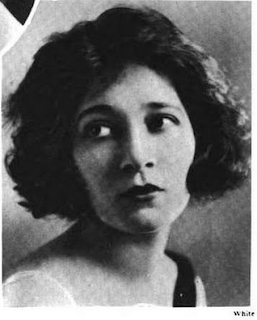
Trilby Clark
It’s sensational stuff but, combined with John Sweeney’s sparkling accompaniment, entertaining as well as historically interesting; it’s always good to see British films of this period and whilst it’s no masterpiece it’s better to exist than not.

And so ends another special year at the Cinema Museum and only 42 days until the next screening on 9th January!

Warwick Ward and Pola Negri in The Way of Lost Souls (1929)
Beery looms...
Beware of false advertising...

Tuesday, 18 April 2017

The Irish questions… The Informer (1929) on Blu-ray/DVD


Last year’s London Film Festival archive gala restoration is now available on sparkling BFI Blu-ray, all the better to show the dark heart of this republican mood piece filmed almost entirely on-set in Elstree. The Informer is set in the context of the fight for Irish independence but it’s mostly about loyalty, love and betrayal: country, friends and lovers, all can be let down in the heat of the moment.

It’s remarkable that an English film of this time – based on Liam O'Flaherty’s 1925 novel - would tell a sympathetic story of republicans so soon after the fact of the uprising and the establishment of the Irish Free State in 1922, the politics may be side-lined but there’s no doubt who these people are and why loyalty matters so much. In her introduction, the BFI’s Bryony Dixon quotes O'Flaherty later writing that he based his story on the style of the cinema and that he wanted to treat his readers “…as a mob orator treats his audience and toy with their emotions…” – there’s a proto-noir feel to a film that is infused with uncertainty and a sense of dread.

Lars Hanson
It’s easy enough to identify with selfless comradeship and the loyalty of lovers but it’s harder to recognise the spiteful urges that drive us all towards betrayal. After that, all that is left is understanding and forgiveness and that is so rare.

As with a number of the best British silent films, The Informer featured European talent, including its German director (Arthur Robison, of Warning Shadows fame) and his cinematographers Werner Brandes and Theodor Sparkuhl, who combine to create such a superbly oppressive world of on-set shadows – as if the darkness was pushing down on the fragile hearts of the cast. There’s plenty of image mobility, especially impressive when the camera moves from where Francis hides as Gypo turns from his mate’s house and walks down an alley across a perfectly-synchronized crowded street to the police station to do the dreaded dirty on his pal…

Lya De Putti and Carl Harbord
Hungarian Lya De Putti (last seen swinging with Emil Jannings in Varieté) is Katie, the woman stirring such strong emotions between best pals Gypo Nolan, played by Sweden’s finest, Lars Hanson and Francis McPhilip played by Carl Harbord of Salcombe, Devon.

The cast is a very strong one bulked out by some great character actors like Warwick Ward as Dan Gallagher commander of the group, Dennis Wyndham as his right-hand man and the mobile mug of Craighall Sherry as his left, Mulholland. Ward was interesting casting, looking so much like the British heroic ideal – hawk-like features and resolute moustache: a man of decision.

Dan Gallagher, Warwick Ward, Craighall Sherry, Lya De Putti, Carl Harbord and Lars Hanson
Daisy Campbell is also very fine as Mrs McPhillip, the woman who loses a son and yet has the faith and heart to bring redemption whilst Johnny Butt is nasty enough as the pimping Publican aiming to make Janice Adair lost-lass Bessie earn her keep no matter what. There’s even a sharpshooter played by young Ray Milland who looks like he might be one to watch in the future.

But it’s all about the magnificent leads… Katie loving Francis then Gypo, Gypo loving Francis but mainly Katie and Gallagher loving his cause above all also.

The film begins with a fire fight as two groups of unknown allegiance battle each other in the streets of Dublin before the Police move in… One of the group, Francis, accidentally shoots the chief of police and must go on the run. He can’t stick it though and returns in secret to the house of Katie Fox his ex-sweetheart only to find that she has moved onto the slightly more dashing Gypo and yet still tries to hide Francis’ presence. It doesn’t work though as Gypo sees more than he ought to and jumps to all the wrong conclusions…

Lars and Lya
It doesn’t take much to tip Gypo over the edge – remember what Lya did to Herr Jannings in Varieté?! – but here she makes double sure forcing him to make the rash decision to gain his revenge by telling the police where his former friend is hiding.  The scene is well constructed as the camera follows Hanson as he marches through Dublin streets towards a cinema just disgorging its audience, to the police station where he is rewarded with twenty pound notes (not pieces of silver…).

No good can come of this but it will not be the last telling betrayal in the film…

Garth Knox - compositional coffee
I’d enjoyed Garth Knox’s new score live and there’s an extra on the disc in which he details the creation of his score aimed at “shaping the silence”. It’s interesting that he tries to put back some of the rougher edges of the characters taken out for the film but very much present in O’Flaherty’s book. He used uilleann pipes and accordion to re-patriate the story in Irish tones and purposely used a small ensemble to recreate the close-quarters dramatics on screen. He goes on to say in the notes that “the idea was to rub the organic grain of the folk sound into the more polished perfection of the… more classical instruments (flute, viola) …” this also contrasts Gypo’s hot blood with Gallagher’s coldness.

Knox takes a strong lead from the actors and I liked his attention to detail when, for instance, Gypo loses sense of his surroundings under stress and the score follows him into detached reverie. It is an emotionally-intelligent and stirring score which largely works in tune albeit occasionally foreshadowing the tumult of the performances and the narrative flow.

Warwick Ward and Lya De Putti before and after restoration
The BFI team having done a superb job on a mix of source materials for this restoration and amongst the extras there’s a comparison showing before and after… well, there is no comparison really. The sound version is also included and was restored ten years ago but just seems lumpen when compared to the fleeting, shadowy nuance of the silent. Again the extras show a comparison; silents were just so much more dramatic at this stage.

There are also a number of Topical Budget newsreels from the period which show the events outside the picture houses... they are terse reminders of tensions that persist to this day.

The Informer is released on DVD/Blu-ray on 24th April and you can order it direct from the BFI shop online

De Valera - I Want Peace (1921)
De Valera's message - I Want Peace (1921)
Protesters outside the Unionist Conference in Liverpool 1921

Saturday, 15 October 2016

Trust and honour... The Informer (1929), BFI, London Film Festival Archive Gala with Garth Knox Ensemble


This was a World premiere of a stunning new restoration that once again proved the power of late British silent film… The Informer was directed by a German and starred a Swede, was made in Elstree and was all about Ireland. We have always been so European and long may that continue!

Like Blackmail, A Cottage on Dartmoor and others, The Informer was made as both a silent and a talkie and was shot separately for both formats. Bryony Dixon, introducing, showed a clip from both that illustrated perfectly the backwards step talking pictures were – like some sort of cinematic Brexit. A change in one aspect led to a long list of negative consequences as those who brought the noise, focused on the one thing at the expense of all the others: camera fluidity, performance, shot-making and overall cinematic elegance.

In the talking sequence a group of Irish republicans interrogate a young woman, there’s shouting, flat lighting and clod-hoping pace whilst in the other the atmospherics come first and the narrative actually moves ahead more effectively through quickness of expression and thought - clearly it was early days and the silent way was the skills-preference of a crew including noted German cinematographers Werner Brandes and Theodor Sparkuhl but… how many decades did it take to truly get all of the magic back?

Lya De Putti and Carl Harbord
This is a powerful film that pulls no punches, taking the hard road with a cast able to carry its opening lightness of tone forward into the dramatic depths of betrayal: of love and of country. It proves, if proof were needed, that Lars Hanson was one of the supreme actors of his age as he provides as perfect an example of naturalistic pantomime as you’ll see in the film’s emotionally exhausting closing sequence.

The archive gala is usually the silent film highlight of the Festival and this was no exception with the BFI team having done a superb job on a mix of source materials. The sound version was restored ten years ago but, after seeing this I can’t think of a single reason to watch it.

As is usual, the restoration was accompanied by a new score this time from Garth Knox with a crack six-piece ensemble featuring Garth on viola/viola d'amore, Eliza Marshall flute/alto flute/whistles, Frode Haltli on accordion, Joby Burgess percussion, Robert White uilleann pipes and Mary Scully on double bass. Top players from across the spectrum of classical, folk and the West End.

The result was emotionally-intellgent and stirring, working in perfect tune with the tumult of the performances and the narrative flow. Amongst many highlights there is one especially clever scene where Katie Fox (Lya De Putti) puts on a 78 to cover the sound of smuggling the fugitive Francis McPhilip (Carl Harbord) out of her flat and the group created a perfect simulation of a poorly-wound record player – violin bow scratches and skips and a slowing down of tempo as the tension mounts and the record slows down to reveal the sounds of getaway.

Lars Hanson and Lya De Putti
This attention to detail was matched by some thrilling Celtic lines, the insertion of Danny Boy (natch!) and a punchy performance that flavoured but didn’t overwhelm the moving images above.
Based on Liam O’Flaherty’s 1925 novel, the story focuses on a group of revolutionary working class Irish republicans. The Informer is overwhelmingly more about the group's human frailties than their politics which, given the film’s Elstree routes, you might expect but still, these are principled people and not monsters: imagine a contemporary film about terrorists…

One of the group, Francis, accidentally shoots the chief of police and has to go on the run. He can’t stick it though and returns in secret to the house of Katie Fox his ex-sweetheart. Katie has moved onto the slightly more dashing Gypo (Lars, returned to Europe and fresh from Lillian Gish in The Wind and Greta Garbo in The Divine Woman) and yet still tries to hide Francis’ presence. It doesn’t work though as Gypo sees more than he ought to and jumps to all of the wrong conclusions… He confronts Katie who out of spite tells him everything he doesn’t really want to hear.

Lars Hanson outside the studio Cinema (production still from the Townley Cook Collection)
It doesn’t take much to tip Gypo over the edge – remember what Lya did to Emil Jannings in Varieté?! – but here she makes double sure forcing him to make the rash decision to gain his revenge by telling the police where his former friend is hiding.  The scene is well constructed as the camera follows Hanson as he marches through Dublin streets towards a cinema just disgorging its audience, to the police station where he is rewarded with twenty pound notes (not pieces of silver…).

No good can come of this but it will not be the last telling betrayal in the film…

On the run. Photo from BFI
The police surround Francis’ mother’s house and he falls to his from the roof after a desperate struggle. Too late, Katie tells Gypo that she made it all up to hurt him… but the die is cast. The finger of suspicion is pointing firmly at Gypo now and it’s his own side he needs to worry about as the moral course of events becomes the focus of the film’s intense conclusion.

The Informer’s intimacies serve its broader narrative well and you are left trying to grasp the complexities of wider conflict when these fragile, passionate lives are lived so much based on truth and trust. Irish nationalism was more than just the context for this story and for understandable - 1929 English - reasons the film strips out the more overt references to the Free State and republicanism from Liam O'Flaherty’s novel.

In Britain then as now you need to smuggle out the meanings any way you can.

Arthur Robison was an American brought up in Germany and who directed the expressive (if not strictly expressionistic according to Lotte Eisner’s definition) Warning Shadows. Here he brings dark Germanic moods to the set-streets of Dublin aided by his camera men.

Lya De Putti and Carl Harbord (BFI)
The multi-national cast excel and there are noteworthy turns from the Brits too - chiefly Warwick Ward as Dan Gallagher as the rebels’ leader, Janice Adair as Bessie – a small but crucial part – as well as Johnny Butt as a disreputable publican. Daisy Campbell is also heart-breaking as Mrs McPhillip mourning a son killed by misunderstanding and jealous betrayal.

We all need to listen to each other and now as then to truly comprehend ourselves. Don’t just believe what you feel…

The Informer will be released on DVD/Blu-ray in February 2017. Details are on the BFIwebsite along with notes on the restoration of what Bryony Dixon has described as “one of the finest films produced in a British studio in the 1920s”. It is.

The band pre-performance

Monday, 19 October 2015

The spice of life… Variety (1925), Stephen Horne, BFI, London Film Festival


“The strongest and most inspiring drama that has ever been told by the evanescent shadows…”

After the red-carpeted glamour of the LFF Archive Gala back to the concrete picture palace that we still call the National Film Theatre and a matinee performance of one of the defining moments of Weimar cinema. I’ve held off watching Variety in the hope of seeing it on screen and with live accompaniment from someone as uniquely adept as Mr Horne: there were apparently some new “talkies” on show in the Festival but this was one of the must-see events of the week.


My patience was doubly rewarded by the fact that this is a film re-born following extensive restoration by the Friedrich Wilhelm Murnau Foundation, in co-operation with the Filmarchiv Austria, using nitrate prints and duplicate negatives to create something as crisp and fresh as one of Herr Jannings’ leotards on the first day of filming!

In her introduction Bryony Dixon suggested that you could view Variety as the German leg of a loose trilogy of Ewald Andre Dupont films dealing with the seedier end of show business, the other two being the delicious Piccadilly (1929) and Moulin Rouge (1928). He had a fine eye for the sub-cultural and was helped by the technical imagination of his cinematographer Karl W. Freund who, of course worked on so many great films of the period including The Last Laugh and Metropolis.

Fireworks above and below
Here Freund along with Carl Hoffmann, produced some impossible shots amongst the acrobats on the flying trapeze. It’s hard to imagine the technicolour circus dramas-to-come bettering these moments as you really feel the pressure, the sheer physical improbability of these daredevils connecting with each other, their apparatus or achieving a triple somersault whilst blind-folded and in a sack…  There’s no safety net… and, squirming in my seat, I had a vivid flash back to childhood anxiety watching similar acts at the Blackpool Tower Circus (and there was me thinking I was over that!?).

The family caravan
As Mordaunt Hall fizzed in his New York Times review:  “…there is a marvellous wealth of detail: the lighting effects and camera work cause one to reflect that occasionally the screen may be connected with art.”

Well I would venture that it is more than occasionally as the core of Variety’s appeal is in the performances of the three leads.  Emil Jannings’ presence is first felt at the beginning as you watch the back of a long-imprisoned man walking with a defeated gait, strong shoulders at a stoop, head bowed, to yet another parole meeting in prison. We don’t see Jannings' character’s face but we know how hard his life is… his wife and son are willing to have him back but he has to open up about his crime.

Emile's expressive back...
Finally he does and the film cuts back to the full-faced, confident circus huckster that Jannings’ character, Boss Huller, was before… He seems content living with his baby and wife (Maly Delschaft), running a side-show beauty pageant that attracts the drunks and the old men, but once he soared until a fall left him hospitalised and he longs to return to the heights.

Lya De Putti
To his door is brought a young woman who has been rescued from a ship wreck and destitution. She catches the eye of both husband and wife and the former over-rules the latter when he spots a talent he can use: a genuine attraction in all ways…

The woman (Lya De Putti) is named Bertha after the ship of bad luck from which she was rescued: as new names go it’s not the most re-assuring. She drives their barely-controllable audience wild and Boss decides enough is enough.


Meanwhile Bertha attracts Boss closer to her and as his wife foretold from first sight, he cannot resist this appeal. Too poor to buy a motorcycle and not in possession of a PA to run off with, Boss decides to go back to the trapeze and leaves wife and child to run away with Bertha.

They build up their act in fairgrounds and soon get noticed in Berlin by a British acrobat Artinelli (Warwick Ward) short of a partner following his brother’s fall from on high. Soon they are three and are wowing the audiences in Berlin’s massive Wintergarten theatre.


But success brings its own costs and soon Bertha is spending more time with the younger man leaving Boss at home to darn her tights and to wait for her return. 

No profession is based as much on trust as theirs and yet whilst they depend so much on each other to stay alive they fail to protect each other’s interests on the ground… This is a triangle of trust that can only lead to tragedy if it breaks down.


Clearly it might but possibly not in the way you might expect as even their manager cannot bear to watch the triple twist anymore…

It is a superbly well-balanced film that is a well-practiced as the performers it portrays: Dupont manages to balance the dramatics with deeply personal performances which are especially rich from De Putti as well as Jannings: she matches him for intensity and tells her story in reverse revealing more of her strength as the story progresses while his ebbs away to leave only murderous desperation…


None of the three protagonists are anything other than true to themselves: Artinelli is artful, Bertha wild and Boss a force of his will… the greatest pity is that they met each other.

Stephen Horne took all of this in his surefooted stride and maintained a balance of his own between the low swings of fury and the lovers’ leaps. There is an amazing level of “content” in his improvisations especially when compared to a pre-prepared score: but then he does play up to four instruments almost all at the same time…


I’ll leave the last word to Mr Hall - “Scene after scene unlocks a flood of thoughts, and although the nature of the principal characters is far from pleasing; the glimpses one obtains are so true to life that they are not repellent.” I don’t think I’ve ever read “Mordy” so enthused but he had every right to be.

The restored Variety is available on Blu-ray and DVD from Amazon.de with English subs and a modern soundtrack that is by all accounts of un-paralleled clunker – maybe Stephen could make his improvised score available for download?
