Louis Feuillade not only popularised the dramatic serial as
we still know it, he did so during a period when his country was at war with
the majority of these four epic series made during the Great War either in and
around Paris or in the relative safety of Nice. In truth the form had many
parents across the cine-world with America providing The Perils of Pauline
starting in 1914 and Edison's – or someone’s - What Happened to Mary in
1912 then Germany, Viggo Larsen's Arsène Lupin contra Sherlock Holmes in
1910 and even earlier, in 1908, the French with Victorin-Hippolyte Jasset
launching his series of six Nick Carter films: le roi des detectives! Carter
le roi? Je ne pense pas, messieurs... cet homme vit à Baker Street!
Anyway, using the same techniques as these great and not so
great detectives, Feuillade evolved the cinematic style across four series, Fantômas,
Les Vampires, Judex and Tih Minh all of which left their
mark and established motifs that have been used ever since. Some have been
available on Blu-ray overseas but for the first time in the UK Eureka’s Masters
of Cinema series has now pulled all together in one luxurious and absolutely
essential box set celebrating the birth of the box set in many ways!
The films have all been transferred from 4K restorations from original 35mm nitrate originals where possible and the results create such an immediacy and connection with the material, it almost feels like you’re clambering on a roof top with Irma Vep, with the distant sounds of German guns only 70 kilometres away at one point, with the First Battle of the Marne, in September 1914.

René Navarre in disguise as Fantômas, the master criminal!
Fantômas (1913)
Adapted from a series of popular novels by Marcel Allain and
Pierre Souvestre, Fantômas stars René Navarre as the eponymous criminal
mastermind. Across the serial’s five episodes, Fantômas is pursued by Inspector
Juve (Edmund Breon) and newspaper reporter Jérôme Fandor (Georges Melchior) as
he carries out his nefarious schemes. As Kim Newman says in his video essay on
the set, Fantômas is a supervillain, a “fusion of Professor Moriarty and
Sherlock Holmes…” He’s certainly a master of disguise with each episode opening
with Navarre in the disguise he will use in each story and, as Newman observes,
we never really find out exactly who he us. He’s a universal and uncatchable
master villain.
Each episode features Detective against Villain… and
cliff-hangers are the order of the day. Fantômas is relentless and Juve is
always one step behind. The serial was hugely successful and spawned many
impersonators in print and on screen with both the public and, Newman again,
the intellectuals, the surrealists attracted by the anarchy and the
anti-establishment agenda.
 |
| Feuillade filmed so often on location, here at Avenue Junot... |
Les Vampires (1915-1916)
Most people’s first introduction to Feuillade and probably
the best and most entertaining of this set, the ten-episode Les Vampires
tells of a group of vicious criminals who terrorise Paris, stopping at nothing
to gain money and to disrupt the powers that be. They are led by the Grand
Vampire (Jean Aymé) who adopts different guises and disguises in most episodes
and his key operative (possibly even superior?) is the anagrammatical Irma Vep,
played with such vibrant menace by Musidora (the rightfully legendary Jeanne
Roques*), who helps to infiltrate elegant society, financial institutions and
even the hero’s household for the Vampire cause. She is, as Newman says, the
first female super villain, years ahead of Cat Woman and in every way
transgressive – a challenge to audience and mankind from her first appearance
on stage rousing the gathered gang members.
The hero in pursut is not a policeman but an intrepid
reporter – one of the first of his kind - Philippe Guérande (Édouard Mathé) who
is mostly helped (occasionally hindered) by the comic Mazamette, knowingly
played by the fourth wall busting Marcel Lévesque who moves from working with
the criminals – his family being under threat. It’s not the first example of
characters’ mutability in the free-running serial that sees an ever-changing
battle between the forces of order and disorder.
 |
| Les Vampires also had to contend with costumes of silk and wool with elasticated fabric still scarce... |
As film scholar Elizabeth Ezra says in her video essay, the
serial included a number of references to the ongoing conflict beyond with code
breaking, gas attacks and other weapons of war such as the canon in episode
seven and the exploding ship in episode eight all to redolent of events so
close and yet, cinematically, so far. So many men were mobilised too and the
original Vampire leader had to be called off, after the actor playing him,
Louis Leubas, was called up.
Another fascinating observation from Ezra relates to the
multiple personalities each character potentially presents, with this being an
extension of paranoid delusion, Capgras Syndrome patients traumatised by the
loss of loved ones belived that those around them had been killed and replaced
by imposters in their bodies. Les Vampires is therefore full of people who are
not quite as they seem, and there is frequent reference to loss, the serial may
not specifically mention the conflict but it’s “haunted by the war” in Ezra’s
words.

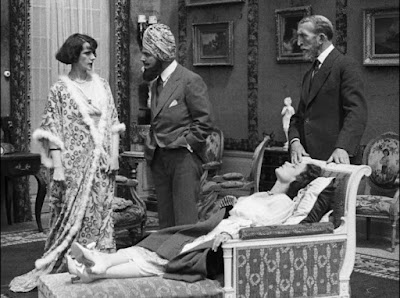
René Cresté, Édouard Mathé and Louis Leubas in Judex; secret lair
Judex (1916-17)
Judex is probably the first Masked Avenger – essentially a
good version of Fantomas/Musidora possibly after an official reaction to the
criminality of the first two serials. At this year’s Il Cinema Ritrovato
Festival in Bologna, I was able to watch the screening of the entire series –
12 episodes plus prologue - with live accompaniment which really brought out
the full flavour of Feuillade’s sense of drama, his eye for dynamic framing, and
his team building and his ability to keep the narrative ball rolling even when
you think he’s backed himself into a dramatic dead end.
It's not quite up there with Les Vampires but it does
have the essentiality of Musidora playing Diana Monti aka Marie Verdier, a
scheming opportunist who becomes more and more dominant the longer the story
unwinds. Judex himself as played by René Cresté, is a goodie version of
Fantômas, part Sherlock Holmes, maybe part Eugène-François Vidocq – an actual
French criminal turned criminalist - certainly an outlier for The Shadow, Doc
Savage and even The Batman. Feuillade had been criticised for glorifying his
evil masterminds and so here was one of good intent even if he does kidnap and
fake the death of the businessman responsible for his father’s death and many
others, Favraux (Louis Leubas) before imprisoning him for life in a remote
castle.
Judex has worked a very long game, disguised as
Favraux’s secretary, to infiltrate his business dealings. His plan is soon
complicated when he falls in love with the banker’s daughter, Jacqueline
(Yvette Andréyor) who is soon targeted by the evil Monti! There’s great support
from Vampires’ alumni Édouard Mathé as brother Roger and Marcel Lévesque as the
comedic Cocantin whose swimming-costume clad fiancée Miss Daisy Torp (Lily
Deligny) helps save the day. The kids are alright too and Le petit Jean (Olinda
Mano) and The Liquorice Kid (Rene Poyen) deserved their own series!
.JPG) |
| René Cresté and Mary Harald |
Tih Minh (1918)
Tih Minh is a change of pace - and technically the most polished - with a new cast of
characters and a number of Feuillade’s regular cast playing them again. Set in
the South of France the focus is on the goodies again with explorer Jacques
d'Athys (René Cresté) who has returned from the Orient with a new fiancé from
Laos, Tih Minh (Mary Harald) – a half Vietnamese heroine, interesting in itself
- to be greeted by his mother (Madame Lacroix), sister Jane (Lugane) and maid
Rosette (Jeanne Rollette) who is romancing his faithful, cheeky, manservant
Placido (Georges Biscot).
The baddies are the mysteriously bearded “Asian” Kistna
(Louis Leubas), Doctor Gilson (Gaston Michel) and the La marquise Dolorès
(Georgette Faraboni) who has the real dash of stylish super-vixen, biting a
rose with menace in the introductory segment. What they’re about is disrupting
the old order… undermining the British Empire and controlling minds with
chemical concoctions. They also hold a cellarful of chemically controlled young
women… for what purpose we can only guess but there is some nudity revealed at
this point… and, whilst you’d never see that in a British or American film at
this point, it is a reminder that down the same avenue as entertainment is the
darkened rue latérale of exploitation.
This serial looks stunning and it’s rare to see such detail
and to feel the century melt away as you watch the performers inhabit their
roles and the familiar spaces of Nice, with such clarity. The Palais de la
Jetée and the beautiful Crystal Casino may be long gone but this is very much a
travelogue for the jewel of the Riviera, magnificent views, glorious mansions
and the warm breeze of a Mediterranean mistral running through the relentless, narrative
parkour, pace of the storyline.
Without doubt as film historian and author David Kalat says
in his commentary, Feuillade’s crime serials had a huge impact on Fritz Lang
who responded with Dr Mabuse, Spies and much more not to mention Alfred
Hitchcock and everyone that came after. The influence spread also to pulp
magazines – The Shadow – as well as comic books, radio, television and one of
the most successful Caped Crusaders also known as Bruce Wayne.
 |
| Musidora in command, hands on hips, sleeves rolled up... |
Join me in investigating these suspiciously special
features…
·
Limited Edition Hardcase Box Set [2000 copies]
· Set includes all four serials across 9 Blu-ray Discs, all presented in 1080p HD from stunning 4K restorations courtesy of Gaumont Film Company, with uncompressed LPCM 2.0 audio on all serials
·
Fantômas – audio commentaries on In the Shadow
of the Guillotine and Juve vs Fantômas by film historian and author David Kalat
·
Les Vampires – new audio commentaries on
The Red Cipher and The Spectre by film historian and author David Kalat
·
Judex – new audio commentaries on the
prologue, The Mysterious Shadow, Atonement, The Water Sprite and The
Forgiveness of Love by genre film expert and Video Watchdog founder Tim Lucas
·
Tih-Minh – Brand new audio commentaries on The
Potion of Forgetfulness, The Mysteries of Circé Villa and Justice by genre film
expert and Video Watchdog founder Tim Lucas
·
Casting a Long Shadow – new interview with
critic and author Kim Newman
·
Pamela Hutchinson on Musidora – new
interview with critic, film historian and silent cinema expert Pamela
Hutchinson on the star of Les Vampires and Judex
·
The Spectre of War in Les Vampires – new
video essay by film scholar Elizabeth Ezra, editor of European Cinema and
France in Focus: Film and National Identity
·
Feuillade in Context – a new interview with
writer, composer and silent film accompanist Neil Brand
·
A Closer Look at Feuillade – Brand new
interview with critic, writer and film commentator Tony Rayns
·
Fold-out poster – yay!!
·
A limited edition 100-page collector’s book
featuring new writing by Louis Feuillade experts Jonathan Rosenbaum, Calum
Baker, Annette Förster, Wendy Haslem, Robin Walz and Leon Hunt on the filmmaker
and his crime serials alongside select archival imagery
The set is released on 11th November and can be ordered direct from Eureka, not home should be without it. As Neil Brand
says in his video essay on the director, not only are these lengthy series with
their lose plotting – “one damn thing after another” – enthralling and still
engaging, they’re also a social document of the Third French Republic, the war
years and the development of one of the most enduring genres in cinema. Where
would The Avengers be without HYDRA or James Bond without SPECTRE? And just where
would Netflix, Apple TV and everyone else be without crime and punishment? Where
would any of us be? This is one to binge and relish. But you know that already.
*For more information on Musidora visit the Womens Film Pioneers Project pages and follow on from there. Pamela Hutchinson’s video
essay on this Eureka set is also thoroughly recommended!