
More seasonal lolling about watching my presents, this time a box set of three Universal films, fully restored and issued on Blu-ray at a very reasonable price and with essays and commentary on what could be regarded as lesser works in the silent film "cannon". All three are, however, very well made and feature noteworthy participants, they represent popular films from Hollywood's golden age and act as fine examples of the type of film that made up most of Universals output and which were enjoyed by large portions of the film-going audience. In historical terms, there’s no such thing as “standard fare” and these films may well have had a wider audience than many an arthouse classic. So play on...
The Shakedown (1929), 4K Restoration
Directed by some fella name of William Wyler, this
fast-paced morality tale features The Crowd’s remarkable James Murray in only
the second film I’ve seen him in and he’s good, very good, making his
life-struggle with addiction all the more tragic, as if anything could. He was
so bright and not only soul full of light and shade but also physically brave,
seen here rising high onto an oil rig and in the ring going toe to toe with boxer
and professional wrestler George Kotsonaros. The latter appeared in Beggars of
Life (1928) and others, but his life ended tragically too in a 1933 car
accident.
 |
| James Murray |
By contrast, Barbara Kent made it to 2011 and 103 years
of age although her career petered out in the mid thirties while she was only
in her twenties. So it goes and the other star of this film Jack Hanlon, would
have further grounds for complaint, with a film career that ended he was just
16… a smashing child actor who became simply too old for the job.
Everyone acts well in this film with Wyler moving things at
a pace and incorporating comedy, love, criminality and some excellent late silent
period dolly shots following the cast along streets and in the boxing ring. In
the excellent booklet with this set, Richards Comb talks of Wyler’s later acknowledged
“deep-focus look” and “the ability to hold many actors, in different planes of
action, across the screen…”. Combs startling evidence of this in The
Shakedown starting with the early set up of the scam at the heart of the story.
 |
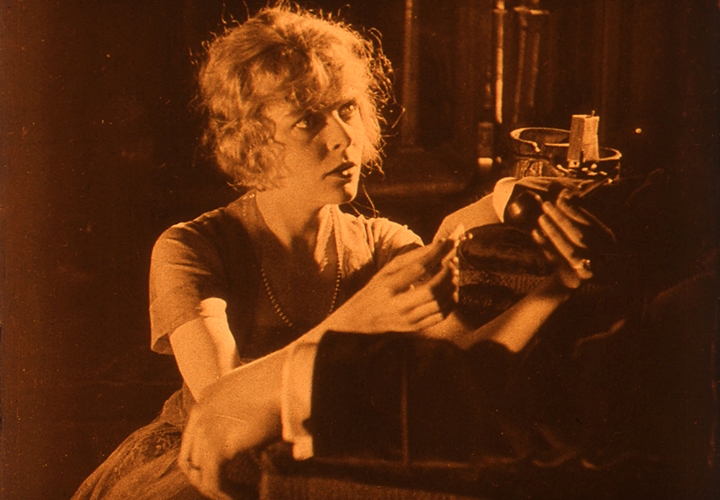
| James Murray and Barbara Kent at the fun fair |
It’s the way the director and his cinematographers
Charles Stumar and Jerome Ash, show the action in the bar where Murray’s
character Dave is showing his boxing skills. He’s challenged by a rough-looking
type, boxer Battling Roff (Kotsonaros) and as the bruiser tries to hit Dave,
the action is seen from behind him at the bar and the street outside is fully
visible. Then the camera view shifts to the reverse as Dave talks to a young
woman at the doorway, back inside as Roff spots her, then outside tracking her
walking away and being followed by Roff, back to Dave who moves to intervene
and rush to the damsel’s distress.
Dave knocks down Roff and the latter’s manager (Wheeler Oakman) steps in saying the two should settle things in the ring where Dave could win $1,000 if he lasts three rounds. The contest agreed, the manager starts taking bets from the gathered crowd… we’re sucked in, and the next shot shows a hotel room with Dave, Roff, the girl and even the two guys arguing about who would win, all in on the scam. It’s quality filmmaking and I’m not surprised that Wyler spent months planning the project.
 |
| The excitement is in tents. |
The rest of the film shows Dave setting up another scam
in a new town only this time he gets too involved helping a young boy called
Clem – tough and lonely as he once was – and falling for the girl he works with
at the oil company, Marjorie (Barbara Kent). Will the outcome be different this
time? Wyler packs a lot into a relatively short film and the climax is intense;
you really care about Murray’s characters! A very proficient Hollywood film and
a delight for rainy seasonal afternoons and any time really.
The film comes with a new score by Michael Gatt and commentary
by film writer Nick Pinkerton.
The Shield of Honor (1927), 2K Restoration
Directed by Emory Johnson a one-time actor whose career faltered after the silent era and who directed the superb news-based action thriller The Last Edition (1925), this is another exciting feature even though it starts off like a promotional film for the LAPD.
 |
| Ralph Lewis and Neil Hamilton |
The LAPD has a new weapon in the fight against crime, an
airplane that is going to be piloted by one Jack MacDowell (Neil Hamilton,
later Adam West’s Commissioner Gordon, a fact I love). Jack is the son of
long-termer Dan played by Ralph Lewis who was so good in The Last Edition who
although only 55 is tasked with playing a man ten years older and on the point
of forced retirement. Dan is a natural cop and is still fit and raring to carry
on. Naturally events conspire to give both father and son the chance to prove
themselves and in the most heart-warming fashion.
A jewellers run by police supporter, Matthew O'Day (Fred
Esmelton) has been infiltrated by a bad sort, Robert Chandler (Nigel Barrie)
who is working with gangster A.E. Blair (Harry Northrup) on an elaborate plan
to defraud the company by making it pay to get by diamonds already stolen from its
vaults. Chandler is assisted by a woman working as a secretary for O’Day, Flora
(a young and feisty Thelma Todd), and even an odd-job man; this caper is well
organised.
 |
| The gang with Thelma Todd on typewriter |
But even the best laid plans can go awry and when they do
O’Day’s daughter Gwen (Dorothy Gulliver) – Jack’s sweetheart – gets caught up
as does Dan who is retired but working as a guard at O’Day’s. Chandler plans to
fly his ill-gotten gains away but his is not the only plane in town… the finale
is dynamic and multi-channelled – planes crash and burn, a woman gets locked in
a safe in a burning building, the tough very much get going, men fight and a dog
barks! It’s breathless and the likeable cast make it work very well.
The film comes with a new score by Alex Kovacs and audio
commentary by professor and film scholar Jason A. Ney.

Skinner’s Dress Suit (1926) 4K Restoration
I once saw Kevin Brownlow introduced this film at the
Kennington Bioscope and he described how he’d met its star, Reginald Denny, in
1964, many years after the British actor’s silent heyday and after decades of
playing stock English characters in the talkies. Brownlow projected the film
for Denny and his family and, despite the actor’s fears that the film might
“creak” he was rewarded with an emphatically amused response.
Skinner's Dress Suit is that rare thing, a
genuinely charming comedy featuring two vibrant leads – Denny and the lovely
Laura La Plante who cut a rug almost as sharp as her platinum bob. In thrilling
style, the two dance the Savannah Shuffle, a variation on the Charleston,
before leading a host of society types in trying to learn the steps.
 |
| Laura and Reg fret |
Directed by William A. Seiter a keen golfer and close
buddy of Denny’s, the film never strains and the relaxed humour is testament to
the compatible temperaments of both men: “we never had an argument, never a
cross word, “he told Brownlow, “…and we always brought the picture in within
budget...” Seiter was clearly a very able manager of time and people.
Skinner (Denny) is an over-reaching and under-achieving
office worker whose wife, Honey (Laura La P), keeps egging him on to get a
raise. But Skinner not only doesn’t have the nerve he doesn’t really have the
edge being walked all over by both his juniors and his superiors. Unable to
tell Honey he’s been passed over yet again, he pretends that he’s had a $10 a
week raise and the two start extending their credit starting with a party dress
for her and a dress suit for him.
 |
| Reginald Denny in said suit |
Both prove very useful after Skinner is taught the new
dance craze, the Savannah, by fellow wage slave Miss Smith (a peppy Betty
Morrissey) and simply everyone at the party they attend wants to learn it.
Social mobility awaits but in keeping up appearances their credit gets
stretched to the limit. But gradually they are accepted by their snooty
neighbours, The McLaughlin’s and are invited into higher society.
All comes crashing down when a major contract is lost,
and Skinner is the man to be let go… he hasn’t the heart to tell Honey as she
entertains but has to fight off the repo men gathering for their furniture and
the tailor who wants his fine dinner suit back. There’s just one last chance…
an invitation to the party of the season held by the Colby’s (Hedda Hopper and
Henry Barrows) if they can make an impression Skinner could still save his
social standing. Cue Mr Jackson (Lionel Braham) the man who withdrew his
contract with Skinners firm and his wife (Lucille Ward) both eager themselves
to get introduced to society… You can work out the rest, but the story is so
well pitched the resolution works as smoothly and reassuringly as you’d hope.
 |
| Denny and La Plante |
It's a thoroughly enjoyable slice of mainstream silent Hollywood and just edges The Shakedown as the most entertaining of these three.
The film comes with a new score by Leo Birenberg and audio commentary by film historian and writer David Kalat. There’s also an excellent collector’s booklet featuring insightful new writing by critic Richard Combs and film writer Andrew Graves.
This is great set, and I can’t wait for more as the Universal
restoration project proceeds. We’re lucky to be at a point where such a broad
range of material is being considered for release and we need to support this
as much as we can. The second volume is already available, and you can find further details and order both, from the Eureka website.




%20credits%205.png)


+colour.png)





