Showing posts with label Paul Wright. Show all posts

Saturday, 18 March 2023

The Time Has Come… Arcadia (2018), Barbican with Adrian Utley and Will Gregory Ensemble

Photo from Mark Allan 

“She realised that answer lay within her all along… everything is connected… the past is gone, the future’s unwritten…”


Paul Wright’s amazing Arcadia continues to reveal new meanings and having not seen it since the Before Times it has matured in an organic way to present an evolving commentary on the soil we plough post-plague and the mulch of political discourse. We stopped abruptly before we started though as few minutes into this performance musical director Ross Hughes – also synth, clarinet, flute, baby bass and drums, of which more later… motioned to cut as the click track wasn’t working. This was Arcadia Live and the nine musicians on stage had to gather themselves to start all over again and act as the musical conduit between the screen and audience.


Those first few minutes were played again and I swear sounded different to what we had seen and what’s more the film felt different too… all more urgent and more passionate than before. Co-composer Will Gregory wasn’t kidding in the post-match Q&A when he talked of the relationship between sight and sound and the audience and this was now an audience willing them on just as they dug deep and played with perfect pitch and eloquence. All of the right notes, in the right order and on the right instruments, extraordinary dexterity and deftly moving.


Gregory and Adrian Utley’s original score had featured snippets from Daniel Avery and, especially folk musical legend Anne Briggs, who gave her blessing to the use of her songs and the re-editing of her uncanny voice on The Time Has Come, My Bonny Boy and Lowlands. So, apart from having to present a complete score of their own making, the duo needed someone to sing like Anne and the, actually astonishing, Lisa Knapp filled the bill, strong and true, pitch perfect and yet with the haunting vulnerability that makes Briggs so meaningful, it was breath taking and one of the best live vocals I’ve ever heard: there’s no margin for error with notes these pure and she was totally present.


Victoria Oruwari, Lisa Knapp and Will Gregory (Photo from Mark Allan)

The score is so varied and complex that Gregory said each player had to be multi-instrumental, otherwise an orchestra would be required, so Emma Smith played violin, whistle, guitar, Francesca Simmons violin, synth and keys, Zami Jalil viola, synth and keys with Ivan Hussey on bass and cello. Oh, and everyone had to be able to sing too with only Lisa and the powerful Victoria Oruwari purely on lead vocals. For their previous work on Dreyer’s Joan of Arc, Uttley and Gregory had used a choir and larger group of players but here the multi-tasking was so precise you couldn’t tell where and from whom the sounds were coming from.


This, of course, reflects the fact that, as with all live film scores, the sound and vision blends together and you experience both at the same time; with your focus on the totality which, as Uttley said, is different ever time, every venue and each audience. So it proved for the audience too and Arcadia live was unlike any other Arcadia I’ve experienced before. With the music, as with the film, there’s a timelessness in everything and the answer is in our ears and beneath our feet, grounded in sound, our hearts the perfect click track for the marvellous expression. They played and we listened, all connected in appreciation and those time-stilled moments.


Arcadia remains a stunning mix of its source material and perhaps his background in fiction helped develop the directorial vision needed to make such a coherent narrative from this many disparate parts – separated in time and style – all sourced by Paul Wright from the BFI archive and elsewhere before being subjected to the alchemy of his editing and his ability to juggle meanings so adeptly. There's a strangeness that feels like period folk horror, that rich seem of unsettling pastoral tales from The Wicker Man to Children of the Stones that took the ghosts of our rural past and used them to chill our urbanised present. We’re, literally, rootless and need to find our feet again, standing on the soil. In Wright’s narrative – and in the source materials - the suggestion is that we have lost something in the transition sparked by industrialisation “…from a time when we were connected to the land and to each other…” to a world of isolation. This is probably even more the case now than in 1948, 1965 or 1975 and if you don’t believe me, look again at that device you’re reading these words on.


Adrian Utley and Emma Smith (Photo from Mark Allan)


Starting with the microscopic worlds of Frank Percy Smith we see the almost unseen life beneath, moss and lichen growing, tadpoles gestating… then switch to the macro world of ploughing fields and sowing seeds. It’s a passionate programme of delicious slices of English whimsy but not without a dark side – a child (Jenny Agutter, from I Start Counting (1970) ) crying out “mummy, mummy!” in terror, miners being attacked by policemen, urban isolation and dark deeds abound: there’s something unsettling in the country but its natural balances are undermined by explosive urbanisation…


There’s country dancing, May poles and May Queens, Morris dancing and nudists too – more than I recall - all connected to the grass and the mud. And did those feet…? Jerusalem emerges with added themes and Blake’s meaning, yet, curiouser and curiouser, none of the images can be taken at face value any more. This alchemy is signalled by section headings like Into the Wild, Folk, Utopia, Amnesia, The Turning and In a Dark Wood… It as if Syd Barrett had written the mood board. Blood in the Soil is perhaps the key and the connections are made elegantly again and again shifting the feeling forward by association, image and music. This is where Anne comes in and tonight Balham’s finest, Lisa Knapp, musical proof of the countryside continuum.


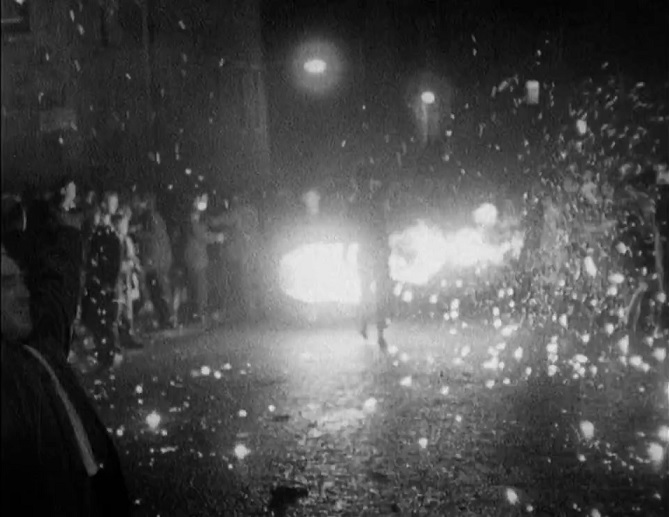
The dance is a key part of Arcadia and whether it’s acid house, punk, Morris or psychedelia we all love to move, hitting down on the ground in eternal rhythms, a little faster here and there but essentially the same animal celebration. Sometimes we dance for the May Queen, or we fling burning barrels at the Beltane fire festival, we dance in protest but mostly we dance to connect.


Dancing days

Wright says he always tries to use images from “all angles and even from different states…” he didn’t want to show just filmed theatre. His source material was a mix of documentary and drama with films like Herostratus (1967), Winstanley (1975) and Anchoress (1993) mixed in carefully so as not to drag the narrative off course. Literally thousands of films were considered and around 100 made the film with Cecil Hepworth’s Alice in Wonderland (1903) and A Day in The Hayfields (1904) being amongst the earliest. Hippies older and younger are featured from Pioneers of Nudism (1938) to Tribe of the Sun (1972) and there are dark tones indeed from An Untitled Film (1967) and The Watchers (1969).


Ultimately Arcadia is a tone poem for us to interpret as we will in despite the specifics of word, action and song. It’s an intimate multi-media dialogue with some very talented and careful individuals who have produced something far greater than the sum of its parts: Arcadia, the feeling won’t go away and it could be the grounds on which we take our last stand? 


As I wrote on its first release, Arcadia is *exactly* the kind of thing you’d hope the BFI would do: a film that highlights the wealth of content in its archive and which makes something bold, beautiful and new. It’s challenging and sometimes disturbing but if we’re not disturbed sometimes we’re only dreaming. I really hope there’s more like this but for now, Arcadia takes a breath on our video shelves and Mr Wright gets back to fiction! The initial score and DVD are both available from the BFI and beyond, wouldn't it be good to have a live album too?


What a send off this was! 


Saturday, 22 September 2018

We have an anchor… Arcadia (2018) out now on BFI DVD


"It’s a country which for centuries has enjoyed a special fame, there’s nowhere else like it on Earth…"

A few seem to have confused this film with a conservative view of old England but the more I view Arcadia the more it’s clearly a call to ground ourselves: the answer being “in the soil” and not the rituals and hierarchies that have developed around ownership and those who work on the land.

Paul Wright’s Arcadia is interpretable as a political film and definitely a post-Brexit one, but it’s deeper than even that as it references people being disconnected from the land by aggressive owners for whom sentimental connections are to profit and not place.

But Arcadia is subtler than propaganda and allows the viewer to make their own mind up – would you rather be dancing on the rocks by yourself or in the city amongst the crush; would you rather be dancing in a crowd or charged by police on a march? The film is full of stark juxtapositions but always with the reservation that “olden times” were often ‘orrific times, there’s always a chilling moment to pop the rose-coloured bubble.


Arcadia is not a gentle compilation of nice old images but there’s undoubtedly hope amongst the oft-quoted folk-horror. How can there not be with the uncanny power of Anne Brigg’s glorious vocals demonstrating the purity of honest human expression and a score from Will Gregory and Adrian Utley that is so well referenced tonally. I love the sequence where three young tykes roll down a slope on their favourite trespass spot and suddenly we have a glam rock beat - it’s 1972-cheeky!

“Does your mum know you play down here?”

“She will do wi’you lot showin’ this on telly!”

Gregory (from Goldfrapp) and Utley (Portishead) have experience of lengthy composition from their magnificent work on Carl Dreyer’s The Passion of Joan of Arc (1928) and with a song-track from Wright to guide them, set about interpreting his film with a mix of modern and traditional instrumentation along with found sounds and music. As I’ve said before, Anne Briggs’ songs are the soul of the score and Uttley was able to contact her through contemporary Norma Waterson (wife of Martin Carthy and Eliza Carthy’s mum!) in her rural Scottish retreat, she hasn’t performed since the early 70s but gave her permission for three songs to be used.


Apart from sending a chill down my spine every time I hear her sing, Briggs gives Arcadia a deep connection all of her own – few have channelled folk spirit like she has. But the composers wanted to respond to what Utley calls a “sensory journey” with a variety of styles and genres and so, whilst we also have Becky Unthank’s modern folk purity there’s also Daniel Avery’s stunning Drone Logic – techno/IDM or whatever you kids call this stuff nowadays – accompanying raves of all ages.

The dance is a key part of Arcadia and whether it’s acid house, punk, Morris or psychedelia we all love to move, hitting down on the ground in eternal rhythms, a little faster here and there but essentially the same animal celebration. Sometimes we dance for the May Queen, or we fling burning barrels at the Beltane fire festival, we dance in protest but mostly we dance to connect.


Wright says he always tries to use images from “all angles and even from different states…” he didn’t want to show just filmed theatre. His source material was a mix of documentary and drama with films like Herostratus (1967), Winstanley (1975) and Anchoress (1993) mixed in carefully so as not to drag the narrative off course. Literally thousands of films were considered and around 100 made the film with Cecil Hepworth’s Alice in Wonderland (1903) and A Day in The Hayfields (1904) being amongst the earliest. Hippies old and younger are featured from Pioneers of Nudism (1938) to Tribe of the Sun (1972) and there are dark tones indeed from An Untitled Film (1967) and The Watchers (1969).

Whilst Arcadia is, as the BFI’s Archive Projects Co-ordinator, Simon McCallum says, “…one of the most ambitious and painstaking exercises in archival repurposing to date…” it also makes you want to seek out more of these source films.

I’ve already ordered the BFI DVD of Chris Newby’s The Anchoress (1993) which is used to bookend Arcadia – it’s a tale of religious ecstasy in 14th century Surrey and stars Natalie Morse, Toyah Willcox, Pete Postlethwaite and Christopher Eccleston buy it!

Natalie Morse in The Anchoress
In short, Arcadia is *exactly* the kind of thing you’d hope the BFI would do: a film that highlights the wealth of content in its archive and which makes something bold, beautiful and new. It’s challenging and sometimes disturbing but if we’re not disturbed we’re sometimes only sleeping.

Arcadia is available now on BFI DVD and comes complete with a handsome illustrated booklet featuring writing by Simon McCallum, Stanley Donwood and Adrian Utley, director Paul Wright interviewed by Adam Scovell, and film credits – fascinating for those trying to play spot-the-clip although it doesn’t list them all.

There are some fascinating extras too including the trailer, a post-screening Q&A at BFI Southbank with Paul Wright, Adrian Utley and Will Gregory, some great silent shorts including ''Oppin' Makes You Earty!' (1925) about hop-picking in Kent and coverage of Shetland's Up Helly Aa in Old Norse Vikings Festival (1927).


Also featured is Once We Were Four... (1942) a potential Watership-downer for young rabbits plus Peter and Ruby (1973) traditional Dartmoor farmers facing up to modern life: what happened after them?


“She realised that answer lay within her all along… everything is connected… the past is gone, the future’s unwritten…”


Wednesday, 13 June 2018

Soil music… Arcadia (2018), Paul Wright with music from Adrian Utley and Will Gregory


“She was told, the truth is in the soil…”

This is a painstaking work of cinematic horticulture that plants seeds from many dozens of different source films, ploughs it good and deep and then carefully tends the starting mix of rustic wonders that grow forth. It takes uncanny directorial vision to make such a coherent narrative from this many disparate parts – separated in time and style – and Paul Wright is to be congratulated on the alchemy of his editing and his ability to juggle meanings so adeptly.

Underpinning it all is a score that binds and extrapolates; making the most of the source materials and being fully attuned with their director’s vision: a tremendous act of collaboration given the huge compilation with which all began. You could argue that Mr Utley has had practice with musical sampling in Portishead, Gregory too with Goldfrapp, but, as they have already shown with their magnificent score for Dreyer’s Joan of Arc, they understand the subtleties and responsibility of film music.


There’s also an element of taste and whilst I generally agree with their musical direction I was almost leaping out of my seat when Anne Briggs’ voice suddenly cut through as her song, The Time Has Come, was featured. Briggs is a genuine folk legend, she was there with Davey Graham and, especially Bert Jansch at the start of the folk revival in the early sixties and sings with a voice so clear and true it is very much English soul music. She features on two other songs, My Bonny Boy and Lowlands and it’s a thrill to hear her in this context: for me the star!

Uttey and Gregory work their music around her, paying as much respect as to the other primary sources. The fact that Annie follows on from techno artiste du jour Daniel Avery’s Drone Logic, says it all about the complimentary collage created by the two; as with the film, there’s a timelessness in everything and the answer is in our ears and beneath our feet.


Arcadia feels initially like period folk horror, that rich seem of unsettling pastoral tales from The Wicker Man to Children of the Stones that took the ghosts of our rural past and used them to frighten our urbanised present. We’re, literally, rootless and need to find our feet again, standing on the soil. This era holds an enduring fascination for many, not least the likes of the League of Gentlemen and the Ghost Box record label which specialises in a kind of “folk-tronica” – part Blood on Satan’s Claw and part Tomorrow’s World.

In Paul Wright’s narrative – and in the source materials - the suggestion is that we have lost something in the transition sparked by industrialisation “…from a time when we were connected to the land and to each other…” to a world of isolation. This is probably even more the case now than in 1948, 1965 or 1975 and if you don’t believe me, look again at that device you’re reading these words on.

It's not as simple as black and white

It’s a passionate programme of delicious slices of English whimsy but not without a dark side – a child (Jenny Agutter) crying out “mummy, mummy!” in terror,  miners being attacked by policemen, urban isolation and dark deeds abound: there’s something unsettling in the country but its natural balances are undermined by explosive urbanisation…

Starting with the microscopic worlds of Frank Percy Smith we see the almost unseen life beneath, moss and lichen growing, tadpoles gestating… then switch to the macro world of ploughing fields and sowing seeds.

There’s country dancing, May poles and May Queens, Morris dancing and nudists too – all connected to the grass and the mud. And did those feet…? Jerusalem emerges with added themes and Blake’s meaning, yet, curiouser and curiouser, none of the images can be taken at face value any more. This alchemy is signalled by section headings like INTO THE WILD, FOLK, UTOPIA, AMNESIA, THE TURNING and IN A DARK WOOD… as if Syd Barrett has written the mood board.

Fans of Daniel Avery syncopate
BLOOD IN THE SOIL is perhaps the key and the connections are made elegantly again and again shifting the feeling forward by association, image and music. I heard Becky Unthank, a young 'un with some of Briggs’ breathy purity; musical proof of the countryside continuum.

Ultimately Arcadia is a tone poem for us to interpret as we will in spite of the specifics of word, action and song. It’s an intimate multi-media dialogue with some very talented and careful individuals who have produced something far greater than the sum of its parts: Arcadia, the feeling won’t go away and it could be the grounds on which we take our last stand?


Arcadia opens on 21st June at the BFI on Mid-Summer’s day, the Summer Solstice ensuring the right combination of magic and marketing. It is one of the very best compilations I’ve seen from the BFI and if, for example, you enjoyed From the Land to the Sea Beyond with British Sea Power and Public Service Broadcasting’s work then you’ll love this.

Highly recommended and also fascinating for the sheer range of archive material it includes. Many of these are available – free to view – on the BFI’s iPlayer and those that are not are worth paying for like the brilliantly unsettling Herostratus starring Michael Goatherd and from which a snippet of young Shakespearean Helen Mirren is included.

There’s plenty more and I know what I’ll be doing this weekend… BFI Player link here.


To book tickets for Arcadia visit the BFI website which also lists previews on 19th across the country. Don't miss it!!

There will also be a digital release on 20th August as well as a soundtrack album, details on the Common Ground site.