 |
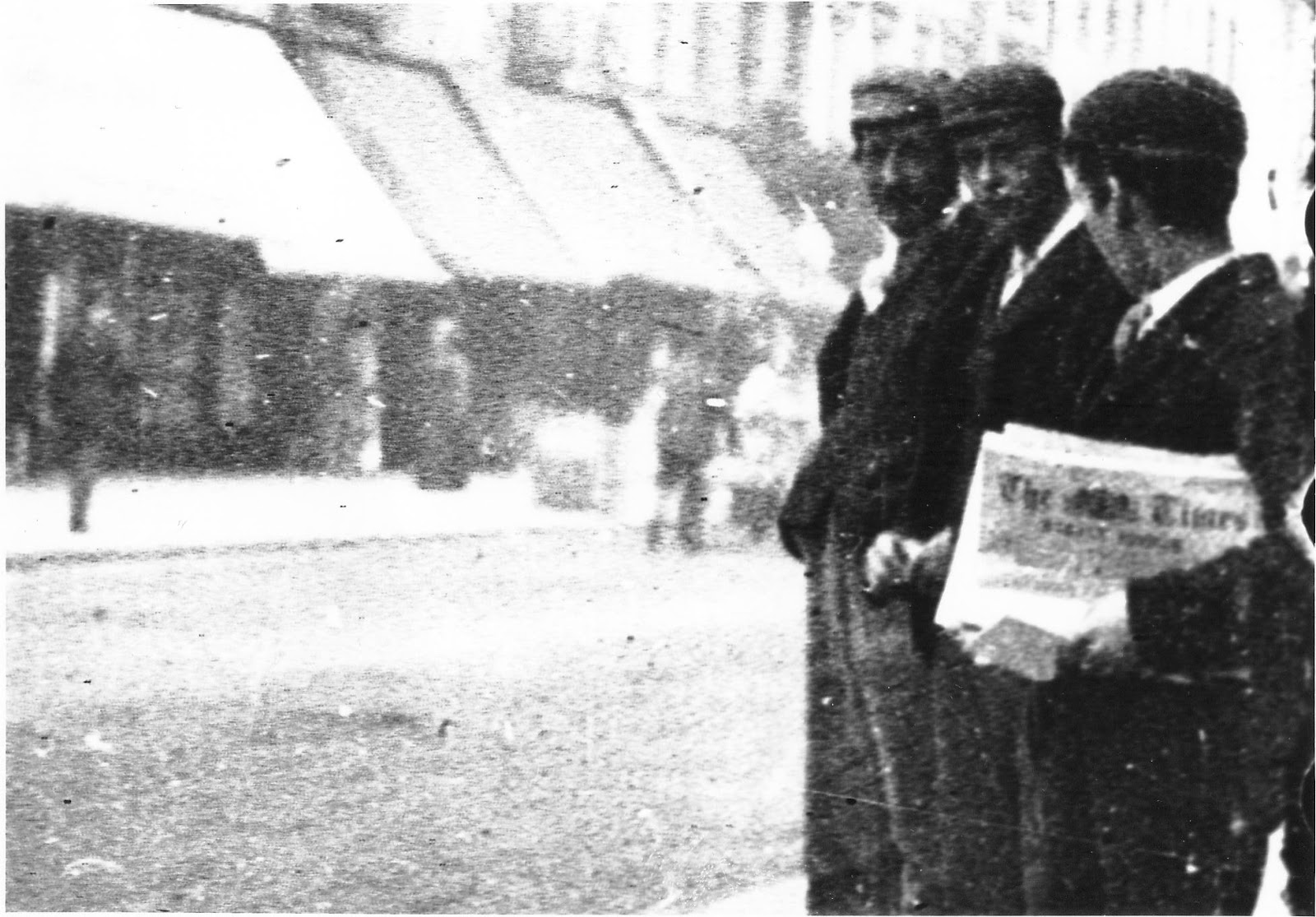
| Kings Road, 1891 |
The joy of history, as my tutors never said directly, is in reconnection with the
feelings of the past; looking through the dates to the actual emotion around
events and change. Today’s
presentations pulled us back to the moments when uncertainty fired invention and
genuinely brave hearts kickstarted the medium we are all so cool about now. But
nothing was inevitable and collaboration by men working on parallel courses determined
the future. The birth of cinema was more along the lines of Hedy Lamarr’s
spread frequencies than a single signal (and if there was one it certainly was not from Thomas Edison).
EARLY INVENTORS & SCIENTISTS
Ian Christie – The
Tarnished Myth of British Precedence
Ian Christie kicked us off and introduced the man of the
day, William Friese-Greene by way of the Boulting’s The Magic Box (1951) in which bemused PC Laurence Olivier witnesses
the first projection of moving images, supposedly in 1890. Whilst Friese-Greene
had not developed his magic to this extent, this scene is fiction based on fact
only not William’s but RW Paul’s in 1895 when he and Birt Acres made so much
noise celebrating running a film on a Paul Kinetoscope (Edison wouldn’t supply
them with “his”) that a policeman did indeed make inquiries.

Why didn’t Paul get the credit and why were some so keen on attributing
credit to Friese-Greene? The answer is in the ebb and flow of historical
agendas and a rush to lay the crown on single heads. Friese-Greene’s reputation
has paid many times over for the infamous film but both he and Paul deserve a
balanced appreciation.
Ian Christie showed panels from a graphic novel detailing
Paul’s work and has more to come with book, blog and exhibition. More details on
the blog:
Peter Domankiewicz –
William Friese-Greene and the Art of Collaboration
Peter also came up with genuinely jaw-dropping boost for
WF-G’s with his re-animation of the latter’s film of Kings Road, London in
1891! This was probably the first time
the pictures had been shown on anything other than a Kinetoscope and we’d like
to see more. In the meantime, it is on YouTube.
Friese-Greene, as with Paul, collaborated with a number of
others to develop his technology, including John Arthur Rudge, inventor of the Biophantic Lantern. Together they made a sequence entitled Rudge Loses His
Head, in which, examination of the slides revealed Friese-Greene played the
body from which Rudge’s head seemingly detaches.
Later F-G worked with Mortimer Evans to develop a camera
capable of taking a rapid series of pictures – 6-7 frames a second and
potentially up to 100 all in 1890 (but not projectable onto a sheet for gasping
policemen…).
 |
| William Friese-Green |
Then there was Frederick Varley who had devised a machine
for weighing mediums – to work out the impact of ectoplasmic discharge (ew!) –
and with whom F-G came up with a stereoscopic camera.
After Friese-Greene’s reputation has been trashed until the
point he was claimed to have contributed very little, it is ironic that a
review of his choice of collaborators shows just how significant he actually
was. Maybe he just wasn’t good at the PR aspect – and we know he struggled at
business. Edison – a master at both, didn’t acknowledge Dickson’s role (and
others’) in his’ company’s developments whilst even Le Prince wouldn’t have
captured Leeds on film without James Langley’s camera.
Peter Domankiewicz
also makes films and further details can be found on his site.
Elizabeth Watkins –
Scientific Photography and the Fantastic in Polar Expedition Films: Reading the
Notebooks of Fred Gent
There was collaboration on a grander scale in the pioneering
films of Herbert Ponting who filmed the Scott’s expeditions and Frank Hurley
who worked with Douglas Mawson and Ernest Shackleton.
Their work was not only driven by commercial imperatives but
also a supplement to established methods of scientific documentation and not
juts in extensive sequences of penguins. Watkins work has focused on the
influence of Fred Gent, General Manager for Gaumont (Sydney) on the resultant
expedition films from the selection of camera equipment even as far as lecture
rights and exhibition work.
There were some gorgeous tinted and colour shots (applied
colour) of polar landscapes – Arch Berg, Castle Berg and so on which used a
colour-coding following Gaumont’s lead: green for wildlife and so on. The use
of colour is part of the performance and I had never thought about how specific
that could be.
 |
| Castle Berg, William Ponting 1911 |
THE TRADE IN THE 1910s
Andrew Shail – The UK
Film Market, 1907-1912
In case you didn’t know, by day I’m a marketeer and I love
data – not in a Cambridge Analytica way – but as a means of understanding
behaviours and better supporting customer service delivery (yes, I’m one of the
Marketing Good Guys…).
I was therefore naturally in awe of firstly Andrew Shail’s –
and later Nyasha Sibanda’s – data-driven analysis. Historical analysis rarely
gets the chance to use a quantitative approach and Andrew’s database of some
19,000 films from 1907 to 1912 has enabled him to draw some startling
conclusions about the UK film market. The data was captured from the
Kinematograph Film Review and represents around 90% of the domestic film market
– an over-whelming sample ration in terms of likely accuracy.
 |
| Changes in source of origin. Hard work and copyright Andrew Shail |
It reveals a huge growth in the number of production
companies issuing films in the UK, from just 7 in the first quarter of 1907 to
78 in Oct-Dec 1912. What’s more the country of origin, whilst being
surprisingly varied with film from Italy, Denmark and even Japan part of the
regular imports.
UK and France dominate until the start of 1912 when US
output accelerates away, a few years before I expected with the Great War.
Italian production also come in a healthy third (not unexpected perhaps) which
Nordisk consistently contributes a steady flow of increasingly lengthy films. A
fascinating glimpse of the size and scale of the new media as it matured during
its second decade.
Lucie Dutton – From
Glib-Smooth-Tongued Travellers to Cabbages: Maurice Elvey and British
Distribution in the 1910s
Now for another of the traditional highlights of BSFFS,
Lucie Dutton’s revelations on our most prolific film-maker and a maker of grand
cinema almost the equal of Griffith (without the, you know…). In a day when so
many themes interlinked, Lucie had analysed cinema advertising in Derby that showed
up to 70% of films shown to be of US origin with just 21% being British.
It was therefore crucial for Mr Elvey to establish good
relationships with renters and much of the director’s early film-making was
shaped more by distributors than production companies: he saw himself as the
producer of “the cabbage” reliant on the wholesaler to deliver to the
greengrocers – i.e. the cinema. Even in the case of Elvey’s passion project –
some cabbage! – which he sold to Apex for £15,000, they enabled him to make a
“director’s cut” that had more action (re-shoots after some sequences were
lost), educational content (the moving plans of the battles), illustrated
intertitles and those stirring shots of modern warships.
 |
| It's that man again. Courtesy of Lucie Dutton |
Another lovely snippet was the schools essay competition of
which four entries survive detailing the pupils’ responses to the films.
General agreement was that we’d love to read their reviews!
Neil Parsons –
American movie-maker Harold Shaw as an agent of British Influence 1916-1920
Harold Shaw was born in Kentucky but came to work in Britain
where he perhaps surprisingly produced a string of films that supported our role
in the world. Shaw seemingly succeeded
in making a pro-Boer film that kept the British onside, Winning a Continent (1916) and went on to wrote a pro-Empire, Anglo-Zulu
epic, The Symbol of Sacrifice (1918).
He eventually made his own film, The Rose
of Rhodesia (1918) and from there an anti-Bolshevik romance about a
character called Lenoff (geddit?), The
Land of Mystery (1920) which was immensely popular, re-assuring in the
turbulent times…
He appears to have grasped the counter-intuitive notions of influential
propaganda: giving the benefit of some doubt to the opposition.
 |
| The Imperial Film Company Ltd presents... |
WARTIME AND AFTERWARDS
Chris Grosvenor –
‘Wake Up!’: British Cinema, the Outbreak of War, and the Voluntary Recruiting
Movement, 1914-1916
Before the huge hits of The
Somme (1916) and The Battle of the
Ancre (1917) which showed those at home exactly what life was life on the front
line, there were other films which were filmed on training grounds and were
aimed at encouraging volunteers before the introduction of conscription in 1916.
Long before the War Office set up its own committee for war-related film
production, the British film industry was already doing its bit with a host of “invasion”
films such as Wake Up! Or a Dream of
Tomorrow (1914).
Is it to our credit that our government didn’t “industrialise”
this propaganda process from the outset? Chris Grosvenor’s research highlights
how – mostly - united in thought Britain was at this time.
 |
| A story book produced to accompany the film, Wake Up! |
Ellen Cheshire – The Lads of the Village: From Stage to screen to court
Now for one of the day’s most shocking revelations… The Lads
of the Village was a hugely popular stage play that was made into a film in 1919
(you can watch it on the BFI Player here). It was written by Clifford Harris
and a man known simply as Valentine with music from James Tate. Ellen blew Valentine’s
cover; his real name was Archibald Peachy, who also used the writer’s nom-de-plume
of Mark Cross and who just happened to father Fany Craddock probably the UK’s
first TV chef and a legend beyond her own lunch and dinner time.
Ellen is involved with Portsmouth’s Kings Theatre and as
part of a research initiative, the Great War Theatre project, she discovered
that it’s position in the busy naval port had meant it premiered a number of
First World War propaganda plays including “Lads…” which the team re-staged in
2017.
The film turned out to be controversial, at least with the
three original creators who sued Joe Peterman, the producer of both play and
film, for using the story which he clearly felt, stripped of its 14 songs, was
not their copyright.
 |
| Those Lads and that pig. |
Christina Hink –
Wonderful London in the 1920s
Harry B. Parkinson and Frank Miller’s 1924 travelogue
series, Wonderful London provides a
precious insight into London in the midst of change and, thankfully a BFI DVD
is available of the twelve surviving films. Christina looked at the history and
form of two of the films, London’s Sunday and London Old and New to show
existing tensions in a city stuck between ancient and modern. It was ever thus
with change the only guarantee as indeed is contrast whether between East and
West, rich and poor or the future and the past.
 |
| East is East and West is Best... |
Llewella Chapman –
Government Policy on Filming at Hampton Court Palace, 1910-1930
As with precious architectural heritage, sometimes the
powers that be just don’t understand what they’ve got until, regrettably, it’s
gone…
Also, suspicious of the new-ish medium the Governments of
the day were always cautious about allowing their precious property to be used
as a backdrop for cheap shot entertainments. But gradually, as is our hallmark,
they allowed more access, specifically to Hampton Court as Llewella’s research
shows. In spite of films such as Hampton Court Palace (1926) – available on theBFI Player right now - the landowners were still not fully understanding the
purpose of the films and their power in promoting their architectural wares.
 |
| Oh, the goings on in Hampton Court... |
TOWARDS SOUND
John Izod – Arthur
Dulay and John Grierson: fitting Drifters (1929)
Sarah Neely read Mr Izod’s words as he was sadly unable to
make it and she did a grand job. The research has uncovered a fascinating
instruction sheet for musicians to help them play along appropriately to John
Grierson’s Drifters (1929).
The film was accompanied by an orchestra for its premier and
thereafter was “fitted” both tonally and prescriptively with the themes and
tunes on this instruction sheet. On the right were instructions for disc operators
– the disc jockeys of their day – and on the left was a list of music and
playing styles for live accompaniment. I especially liked some of the
instructions: “stormy agitated” and “flowering involvement” sound grand!
Not surprisingly The
Clarion reviewed the film in 1930 as “a poetry of sound”.
 |
| Arthur Dulay's sinister agitations... |
Geoff Brown – Did Britain Really Invent Film Sound?
Geoff Brown gave yet another of his witty talks and his
humour so perfectly suited the subject matter of hurt Great British pride as
those American’s took our baby and made it run. Returning to Mr Christie’s discussion
of “first-ness”, Geoff explained how domestic efforts were made to claim the
breakthrough of “sound” as well as vision. No doubt there were sound commercial
reasons for this and the need to remain competitive, but it does feel a little…
unreserved.
It was war, ladies and gents, a war against the impending
invasion of high-tech American sound especially as viewed by those who viewed
talkies as Hollywood’s revenge for the British quota system introduced in 1927.
Bringing the day full circle, it was around this time when the “legend” of
William Friese-Greene began to develop along with other British pioneers such
as Eadweard Muybridge. As Geoff intimates thought, it doesn’t matter who came
first just why exactly they were suddenly supposed to have been.
 |
| White heat of Brit-talkie invention |
Nyasha Sibanda –
Sound Arrives at the Tudor 1927-1931
Back to data and the rewards of a good spreadsheet well
defined, maintained and interpreted! Nyasha has applied tremendous method to the ledgers of Leicester’s
Tudor Cinema by data capturing tickets sold, revenue receipts, films screened over
the silent era and into sound.
His findings were most enlightening showing the most popular
films from 1927-29 with Ben-Hur just
pipping Chaplin’s The Circus to top
spot with 9,573 tickets sold. Maurice Elvey features twice with the most
excellent Hindle Wakes (1928) and Mademoiselle
from Armentieres (1927). The latter wasn’t the only feature I’d not heard
of with something called Johnny Get Your
Hair Cut staring Jackie Coogan in at number six!
British films do better in the silent era and, proving Geoff’s
points about British defensiveness, after sound, Hollywood becomes ever more
dominant. That said analysis of the audience feedback forms showed that they
did prefer British voices but then you didn’t get many US films without an
English accent…
 |
| Leicester's Top Ten: how many have you seen? |
Laraine Porter – Elstree melodies and ‘the charm of the English voice’: musical moments in early British talkies
Laraine picked up on that “English voice” – seriously good
programming! – and discussed the emergence of home-grown musicals which at one
point made up a third of the total output from British studios featuring stars
such as Jan Kiepura, one of Laraine’s favourites. Chasing what they saw as popular tastes and much to the distaste
of the snobbish Close Up magazine
(honestly, did they like anything?!) there was even a pop song in Blackmail
with Miss Up to Date as sung by the
grabby artist himself, Cyril Ritchard. The curse of the “theme song” struck the
shadowlands of so many shandy silent/talkies with Sonny Boy the dubious
template before full-scale musicals such as Elstree
Calling (1930) all trying to emulate American successes. Despite the
emergency of home grown talents such as Jessie Mathews and, later Gracie Fields
and George Formby the British musical failed to compete with Americana much
beyond the end of the decade. Maybe it was just not our style?
 |
| Cyd sings |
By now the sun had heated our Kings College lecture room to
levels that would parch a camel. It was time to re-locate and the Edgar Wallace
pub awaited eager drinkers…
This was another highly
successful event from the KC and BSFF team and today’s talks the most
impressive of the three I’ve attended. More next year please Dr Napper!





