Showing posts with label John Altman. Show all posts

Sunday, 21 July 2024

In the navy… Remembrance (1982), BFI Flipside #48 Blu-ray


Well, I’m in the navy see, and that’s work of national importance. That’s why we can’t go on strike, that’s why we sign on for fucking years… I’m proud of what I do!


I missed this first time round, busy in the college bar and having an easier time of it than many of my generation. My cousin became a marine a decade later but I did know people who were in the Navy at this time, some who served in the Falklands that preceded this release by a few months. I still remember the chill I felt as Ark Royal and the other ships headed off to a war I never expected to be fought. My college hosted HMS Glamorgan’s rugby team the year later and they were a different breed, out-drinking and out-playing is with ease, men of the world.


Remembrance never set out to be as political as it turned out but… the elements were always there given references to Northern Ireland and John Altman’s outburst to a drunken teacher at a middle-class party reproduced with minimal swearing above. In truth this is always the bottom line for the armed services and for the young men who make up the majority of the recruits and it was always writer Hugh Stoddart and director/producer Colin Gregg’s intention to make a story that focused on their first big sacrifices: their time, family and friends.


The result was one of the first films produced by Channel 4 and featured a now astonishing cast of soon to be highly successful, cast members from Timothy Spall to John Altman via, in his first substantial part, Gary Oldman but there are many more who have made their living on stage screen and TV since this film.


Mr Oldman feels a little worse for wear...

The film has a lot of characters, all of whom feel real, well-written and well-acted by this young collective, and its narrative keeps you guessing as the story slips forwards and backwards between elements that will eventually coalesce into a poignant whole. It begins with a group of lads laughing and joking as they watch an old cinefilm of themselves at the Royal Albert Hall for the annual Festival of Remembrance. As they watch they recognise faces and their younger selves until the Army gymnastics team perform and one of them spots and unfamiliar face…


Cut backward and we see an inebriated youngster walking on his hands in the dark, he’s ten-pint drunk staggering around in search of even more cheap lager. Gary Oldman is almost unrecognisably youthful but protean as ever, is the individual who we later learn is called Daniel and he displays one of the most convincingly painful depictions of what we used to refer to as “paralytic” back in those days of 35p pints. He finds his way into a disco bar on the notorious Union Street drag between Plymouth and naval base at Devonport, home to thousands of off-duty sailors and dozens of pubs, strip joints and cheap restaurants.


He quickly upsets some of the older regulars who berate him for being out beyond curfew and, following his brief and emphatic suggestion that they go away, wait for him to pass out. He staggers over to a baby-faced jack tar, Mark (David John) who invites him to join him and two young women, even though he’s nearly as incapable. The two talk, as drunken men do, and Oldman’s character talks about his dream of becoming an acrobat and there’s a haunting keyboard motif accompanying his reveries on this subject each time provided by Brian Eno’s track Aragon (from Music for Films (1978)*), which carries the sense of stillness both of the skilled athlete but also the moment in time when decisions are made.
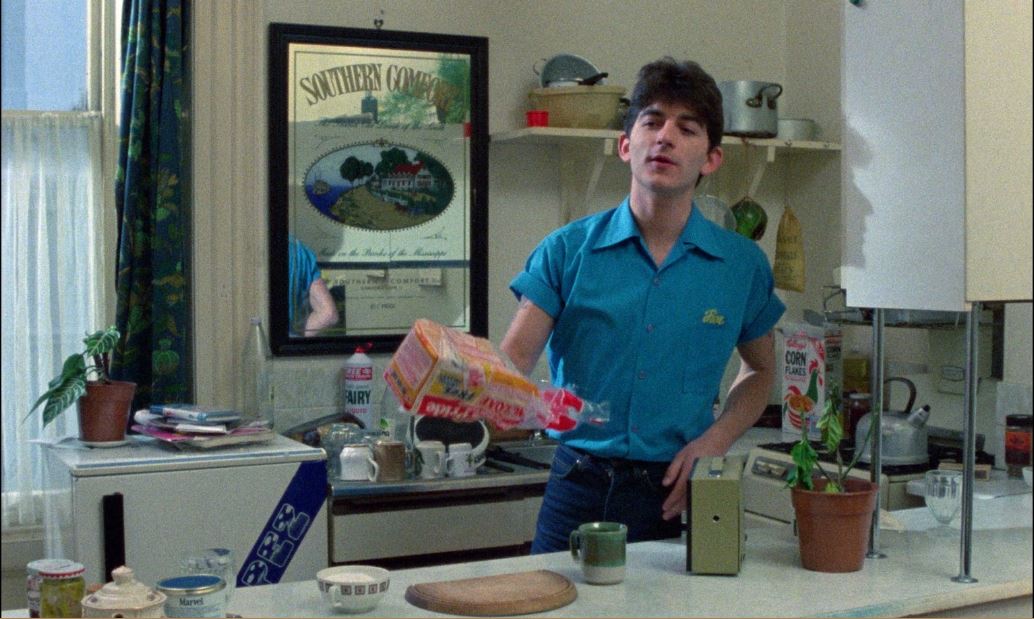
 

The not-so-nasty John Altman


The young man also says he can dance and after encouragement from Mark goes onto the dance floor and does indeed dance attracting the attention of the watchers at the bar who then thrown glasses onto the dance floor. The in-house bouncer steps in and drags the by now sick youngster outside where he administers an horrific beating – the lad is too drunk to defend himself - witnessed by local preacher/down and out Joe (Kenneth Griffith) who does all he can, he prays and watches.


The next day Mark’s hangover is made all the worse by the arrival of his sister and parents for his last day before his next tour and then by the knowledge that his temporary friend was now in a coma in hospital. Gradually he gets involved trying to remember what the two had talked about and even visits him as the newspapers have reported that there was no wallet on him and no name tag. Meanwhile others plan a revenge mission the next night on the bouncer even those that started the glass throwing.


But there’s more going on in Plymouth than this unfolding tragedy, and we meet Mark’s pal Vincent (the excellent Pete Lee-Wilson) who likes his friend’s sister but hates his parents, one of whom is now married to the man who runs the bar in which Daniel was injured. Vincent and his parents have yet to come to terms with their separation and his, resulting in some of the film’s most emotional moments.


A golden age of rail, sailors plus McEwans and Carlsberg

There’s also a young married couple, Douglas and Christine played by Timothy Spall and Kim Taylforth sister of Gillian Taylforth – the Eastenders connections are very strong here including the fact that Oldman’s older sister Laila Morse plays Little Mo. Christine is heavily pregnant and her husband will be at sea on the due date, another painful separation.


More pain could well be felt by John Altman’s character Steve who has started seeing the girlfriend of one the toughs from the older ratings who is intent of engaging in irrational debate about the situation. All is set for another lively night on Union Street and there will be blood…


This new 2024 restoration by the BFI marks the first time Remembrance has been available in this format and it’s so surprising that the film has not received more attention over the years given the quality of cast and crew. Still, now it’s here and I would recommend it very highly.


The 80s, they say if you can remember them you weren't really there...

Special features


  • Newly remastered from original camera materials by the BFI and presented in High Definition
  • Gary Oldman on Remembrance (2018, 3 mins): an introduction recorded for a screening on Film 4
  • Vivid Memories (2024, 21 mins): newly recorded interview with director Colin Gregg
  • Working Away (2024, 21 mins): newly recorded interview with screenwriter Hugh Stoddart
  • Acting The Part (2024, 13 mins): newly recorded interview with actor John Altman
  • David Rose in Conversation (2010, 11 mins): extracts from a career interview with the former senior commissioning editor for Channel 4 Television, conducted by Sir Jeremy Isaacs
  • Raleigh: The First Few Weeks (1986, 19 mins): following the daily lives of new naval ratings, from their arrival at training establishment HMS Raleigh, beginning the first phase of their training and onwards to the day of their passing out parade
  • Royal Navy Amazon (1980, 1 min): a made for TV advert used to bolster the recruitment of ordinary naval ratings
  • Galleries – a collection of materials including an early handwritten draft of the screenplay


Illustrated booklet with a new essay by screenwriter Hugh Stoddart, new writing on the film by Johnny Mains, an essay by the BFI’s Dr Josephine Botting and full film credits. This is limited to the first pressing only and so you better get in quick!


You can order Remembrance now from the BFI shop and other reputable retailers.


*Ironically perhaps, the middle-class party attended by John Altman’s character features first a Genesis track sung by Phil Collins and then a solo track. Collin’s the epitome of MOR rock/pop success was also the percussionist on the Brian Eno track that acts as the film’s and Daniel’s theme, more than anything, Collins was one of the finest drummers of his era and Eno tended to work with the best (and U2).


Sunday, 20 March 2016

Cricklewood Babylon… Shooting Stars (1927) on Blu-ray and DVD


“The success of the production will depend to a great extent upon the excellence of the photography… The most modern form of technique is involved.”

After featuring this superb restoration at last year’s London Film Festival Archive Gala, the BFI have now released Anthony Asquith’s bravura debut – nominally directed by A.V. Bramble - on a generously-priced Blu-ray/DVD dual format set and it’s a worthy package for this gem.

Persuading ourselves that we had little credibility as a film-making culture began almost as soon as the first British hands cranked a camera. Perhaps moving images were seen as too cheap a trick for a nation with such a proud theatrical history yet, all the same, quality films were made in the UK and there’s a growing number restored and projected that show that we could hold our own.

Annette and Brian sitting in a tree...
Here Asquith – already seeped in film culture – takes aim at the darker and dafter side of the business and creates one of the first domestic films about film: a narrative that manages to be both effective as satire and affecting as a story of love gone awry.

This film opens with a stunning overhead tracking sequence that you could have sworn belonged in a German studio rather than one in Cricklewood. The stars of the film are stars in a film – Prairie Love -  and after an amusing opening showing Annette Benson being filmed in a blossom tree cosying up to Brian Aherne on a wooden horse (and wearing the most outrageous cowboy chaps), the camera looks down on the stage then follows the characters as they move around the studio.


By the time the motion has finished Benson has removed her phoney blonde wig and Ahern’s four-wooden-legged friend has been revealed: they’re not “acting” now and are a man and wife about to see their relationship move into very stormy seas.

Benson’s character, Mae Feather has walked up the stairs to another stage on which they are filming a comedy featuring madcap Andy Wilkes (Donald Calthrop… last seen blackmailing Anny Ondra) a man of no fixed moustache.  Bizarrely, she sees him as an alternative to her handsome husband Julian Gordon (Aherne)… maybe she’s short on laughs or just finds handsome boring.

Brian Aherne on his steed
Mae skips seeing her own film to stay in with Andy whilst Julian ends up on his own, watching their film next to a couple of school boys – he’s barely older than them and even starts cheering himself on screen, easily lost in the process. Julian’s clearly very imaginative and easy to play but this miss-aligned love triangle cannot carry on for ever and in a moment of madness Mae loads a gun due to be fired at her husband on stage…

As previously mentioned in my rave after the live presentation, Asquith brings out the best in his performers, especially Annette Benson who manages to bridge the gap between spoilt bractress, bored stage-wife and guilt-ridden devastation whilst still retaining a lightness of touch that makes her likeable. It’s her emotional flexibility that makes the story special as the reality of her violent plan could simply have appeared as ruthless.

Insert "gets the bird" line here
But there’s regret and the realisation that sometimes we get so mired in routine we forget to find the obvious truth but will it be too late? You have to hope for the best – that’s usually the best you can hope for… and all plays out in the film’s superbly anxious closing sequence.

No spoilers – you have to see for yourself.

The film has a surprisingly-high consistency of tone for a first time effort but Asquith’s script notes – quoted at the top - showed how well he had already thought through the photo play before the shooting began: the sequence described above is pretty much as he planned it although credit must also go to his cinematographers Henry Harris and Stanley Rodwell – the “expert cameramen” he sought.

Donald Calthrop and Dorothy "Chili" Bouchier
Live, the score from John Altman and the Live Film Orchestra swung in an emotionally-emphatic way and the studio version on this disc reveals levels of more nuanced feeling  – with a predominant theme of bittersweet endeavour: love’s labour’s inevitable loss amongst misaligned affection and ambition. It’s a hard mix to get right and whilst some may feel the score a little too defined at times, for me it enhances the flavours already present. Hearts will be broken and it’s almost as if the protagonists know this from the start: not that this sentimental premonition will ever stop them trying.

The crew of Prairie Love
Shooting Stars comes with an extensive side order of extras including an illustrated booklet with revelatory essays from Bryony Dixon, John Altman, Henry K Miller and Chris O’Rourke.

There are seven shorts, the longest of which Starlings of the Screen (1925, 15 mins) is of the most interest to me as it features my friend Nikki’s Great Aunt Sybil Rhoda who, in addition to acting in Hitchcock’s Downhill (1927) and Boadicea (1927) also enjoyed a career as a chorus girl and model. She lived to 102 and only passed away in 2005 - by all accounts one of the family’s great characters!

Then there are further glimpses backstage including Secrets of a World Industry  - The Making of Cinematograph Film (1922, 8 mins),  Around the Town: British Film Stars and Studios (1921, 2 mins),  Opening of British Instructional Film Studio (1928, 4 mins) and a chance to Meet Jackie Coogan (1924, 11 mins)


It’s a very handsome package and available on Monday 21st March direct from the BFI online Shop and other less reputable digital emporia…  Either at home or in cinema I cannot recommend Shooting Stars highly enough not just for fans of silent cinema but for anyone who expects good storytelling from cinema and to simply be touched sat there, almost alone, in the silvery darkness.

Saturday, 17 October 2015

Shooting Stars (1927), John Altman, Live Film Orchestra, BFI London Film Festival Archive Gala

Annette Benson, naughty white dove and Brian Aherne
So, to the Leicester Square Odeon for one of the few occasions in the calendar when silent film gets to be the big shot… even in this palace built for the talkies. The red carpet was rolled out and in the absence of the film’s original stars this could be construed as a recognition of the special audience silent cinema attracts although it’s probably just Festival branding…

This was Anthony Asquith’s first feature and, whilst he may have co-directed with A.V. Bramble and co-written along with John Orton this feels very much like what was to come with Underground and A Cottage on Dartmoor. In short, Shooting Stars is another late period British silent that shows we were much, much better than we thought.

Annette Benson: new favourite actress alert!
Shooting Stars is one of the first British films about film-making – although Hollywood had got there much earlier with the under-rated Souls for Sale, the lost Merton of the Movies and others. The business of film provides perfect fodder as the impudent young director sets about the delusion industry with relish… But then what do you expect from Herbert’s son, ex-Winchester and a Balliol alumnus: he was a bright lad with a background in confidence.

Newly restored by the BFI National Archive, the film was presented with a live score by BAFTA and Emmy award-winning composer John Altman whose work includes some of the more elegant sections of Titanic and who, more importantly, has worked with the genius Nick Drake.

Beach cheeky: Donald Calthrop
Here he employed the 12-piece Live Film Orchestra to superb effect in playing his elegantly-energetic themes.  The music moved with the emotional flow of the film with sections of jazz-age swing flowing into romantic themes that hopped between the action on film and the action being filmed and which were infused with the promise of somehow-inevitable sadness even amid the hope. At times the playing seemed to be within the film; echoing the characters’ sentimental journeys with sweetly mournful lines from Chris Garrick on violin, Simon Chamberlain on piano, Jim Hastings, Bob Sydor and Robert Fowler on woodwind: is there anything sadder than the Clarinet?

That’s not to say that Shooting Stars is a sad film it is funny, saucy and very poignant: a study of human frailty and hope. Annette Benson is quite superb as aspiring superstar Mae Feather – enough of a prima donna to bring the show to a halt when nipped on the lips by a dove but somehow lost in her marriage to the blue eyed and frankly dashing leading man Julian Gordon (Brian Aherne who is so-o cool he manages to carry off the most outrageous pair of cowboy leathers).

A British Coop?
Benson isn’t quite pretty enough to be a Hollywood star but she is all the more interesting for that especially playing alongside this Anglo-Gary Cooper. She’s bored and he’s a bit detached not even bothered enough to stop her going to see their own flick with the cheeky comedian Andy Wilkes (Donald Calthrop – the blackmailer from Blackmail). Andy’s rather underfed in comparison with Julian but he’s funny and at least he pays attention.

The action shifts from studio to homes as Mae goes out to stay in with Andy whilst Julian ends up watching his own film next to a couple of school boys – a marvellous glimpse of cine-watching culture as the actor, almost forgetting his own story starts to cheer along with the audience as he (acting) comes to the rescue.

Andy struggles with the telephonics
Their triangulated affections play out across the backlot and studio with some eye-popping set pieces from Asquith and his cameramen Henry Harris and Stanley Rodwell. There’s an audacious opening when the camera pulls back from a cosy blossom tree cuddle to reveal the mechanisms of the studio and then the camera floats overhead as the characters move from stage to stage. As BFI head curator Robin Baker pointed out in his introduction, the script prepared by Asquith shows just how much of these shots were already in his head. The consistency of tone is remarkable throughout and he clearly works so well with the performers.

With apologies to the BFI... the camera floats over the action within the action...
Then there is a marvellous final sequence that I won’t discuss save to say that it is a suitably emotional coda to a wonderful film: pure cinema in a way that wouldn’t be equalled for decades once the microphones popped up to restrict movement, imagination and the visual drama. This film moves like the best of European silent cinema but is very British all the same.

The restoration was another triumph for the BFI and Robin’s pre-show demonstration of the “before and afters” illustrated just how much had to be done. The film looked spanking new even though only one reel of the original negative survived. Watching this wonder, in cinema and with such a score brought more audience engagement than a dozen iMax/3D films involving grim-faced crime fighters and Norse gods. It was almost too much of a shock to walk out to the outside world where Leicester Square was being loudly serenaded by a longhaired man with an electric guitar.

Mae's mellow in the process of being harshed...
As my friend Mary from Santa Barbara would say: “don’t let it harsh your mellow…” and it didn’t.

BFI, can we see this one again please?

There’s more detail on the film on the BFI site with an excellent essay from Bryony Dixon - How to make your first (silent) movie count.

The Live Film Orchestra site is here whilst John Altman’s Facebook page is here – he really has worked with everyone – and there’s an interview with him talking about Nick Drake on MIMO. He also received the Anthony Asquith Award for Achievement in Film Music for Hear My Song...

Red carpet for silent film...
