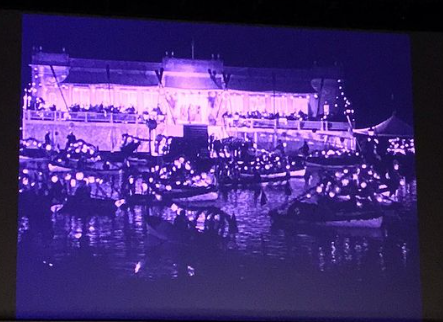
Well, here's another clue for you all, the Walrus was
Paul… John Winston Lennon, Glass Onion
Let me take you down to the Piazza Maggiore, nothing is
real and there’s nothing to get hung up about… There’s no limit to the Beatle
references I can fit into this stuff so, anyone of you in the cheap seats can clap
whilst those in the sponsored area just rattle your jewellery because this is
my personal selection of mini-reviews for screenings that struck me in the eight
days a week that was Il Cinema Ritrovato 36th Edition… Eight halves
as it were and most certainly not definitive. There's more...
As you would expect, my week was mostly silent but the
joy of this festival is firstly that there are half a dozen choices at any one
point and secondly you can go eclectic at any point you choose, when it’s just
too hot to walk all the way to Silent Town at the Sala Mastrioannie, or you just
really need to see what Peter Lorre is doing or what Sophia Loren is wearing.
It’s All Too Much, as I believe George Harrison once sang, but that’s the
beauty, after a mad few days of completism – gotta see them all! -
exhaustion, hangovers, sore feet and failing concentration demands variety!
1. Ménilmontant
(1926) with Stephen Horne
There were quite a few films I’d already seen but this
new restoration was something else with Lobster films restoration not only
adding clarity to the images – Nadia Sibirskaïa’s freckles have never been
clearer – but also tinting which adds so much to one of the most beautiful of
silent film. There was also the revelation that director Dimitri Kirsanoff was
not actually a Russian emigre but from Estonia whilst Nadia was from Brittany;
the two having adopted the more exotic background as part of the vogie for
creative emigrees from Russia?
Whatever their reasons, the films they produced were esoteric
and distinct even shot in the middle of Paris and this ethereality was enhanced
by the new colours and, of course, Stephen Horne’s way with sympathetic and emphatic
accompaniment. It was the most perfect blend of “special” audience, film and
music. Not for the last time this week, the restoration of a film I thought I
knew really brought new depth of meaning and fresh response.
The same could be said for Timothy Brock's splendid new orchestral score for Nosferatu (1922) which, watching him conduct the Orcestra del Teatro Cimunale di Bologna in the Piazza Maggiore, was as good a screening as I've seen, revealing much new about this very familiar film and helping the audience access a narrative of broader meaning. Good job sir!
.jpg)
2. Superheroes…
Protéa (1913) with Maud
Nelissen
There were some interesting early serials, pre-dating the
works of Louis Feuillade and with a focus on the works of Victorin-Hippolyte
Jasset with his evildoer Zigomar and endless adversary Nick Carter seemingly
engaged in a non-stop exchange of capture and escape. Far more engaging was woman
of mystery Protéa played by Josette Andriot, who was not only a mistress of disguise,
she also had a male sidekick called The Eel (Lucien Bataille) so called because
of his ability to squeeze in and out of tights spots.
Protéa was far more stylish in all ways, with disguises
and a plot that was thoroughly entertaining and not, even by 1913 standards,
hackneyed. She wears a black body stocking two years before Musidora as Irma
Vep and needs it too to practice her martial arts and physical daring. Not surprisingly
her protean quality and striking looks insured that four other episodes
followed. Well, I’m onboard for more screenings and for the box set if at all
possible.
Maud Nelissen accompanied with sisterly dynamism,
supporting our heroine as she leapt from conclusion to capture and freedom,
outwitting her captors time after time.
 |
| Jean Valjean (Henry Krauss) and his nemesis Javert (Henri Étiévant) |
3. Les
Misèrables (1912) with John Sweeney, Gabriel Thibaudeau and Silvia Mandolini
Talking of serials, this was an unexpected joy equalling
in its own way, the lengthier silent serial of 1926. Based in four parts totalling
168 minutes in length it was split into two screenings and, like a true serial
left you wanting more – see above).
The first parts, focusing on Jean Valjean and then
Fantine, dealt economically well with the complexities of the source material
and was genuinely gripping as our hero made his way from humble beginnings and
his arrest for stealing bread for his dying mother, to imprisonment then escape
where his huge strength of character and physique enable him to take control of
his own destiny always pursued by his nemesis, the unforgiving Walmer.
John Sweeney’s accompaniment gave the classic support this film required and the audience were on the edge of our seats before leaping off for the cheering applause. We were back the next day for Gabriel Thibaudeau’s piano and Silvia Mandolini’s violin to provide equally pleasing musical support as the focus shifted onto Fantine’s daughter Cosette, whom Valjean, having promised to support, rescues from a miserable family who use her as little more than a slave. Valjean once again makes a fortune and sets Cosette up for love with Marius a radical student who takes part in the battle of the barricades to try replace the post-revolutionary republic with an more egalitarian one. Recommended for fans of French history and film alike. An extraordinary clarity of purpose from Albert Capellani, way ahead of many at this time.
%202.jpg) |
| Glamour in Tu M’Appartiens |
4. The
Diva endures… Tu M’Appartiens (1929), with
I don’t recall seeing anything with Francesca Bertini, one
of the three great Italian Divas of the 1910s after that decade and yet here
she is in this French film towards the very end of the silent era and her
screen career, looking as proudly beautiful and emotionally nuanced as ever:
the eternal diva.
Directed by Maurice Gleize, Bertini plays Gisèle a woman
who is intent on gaining revenge for long ago being dumped by Rudolf
Klein-Rogge’s Burat Laussade a reformed criminal who long ago escaped justice
and the penal colony to build a new life for himself married to the
nice-but-not-Bertini, Suzy Vernon. Under French law, anyone who manages to stay
free for 20 years after the offence is able to avoid prosecution and, Laussade
is quietly approaching that safety line before Gisèle catches up with him with
her operatically grand revenge: she, naturally, wants it all.
The pace of the second half is especially intense and we
get the chance to see Bertini ease through the gears like an emotional explosive
device that sucks the air from your lungs as you hold your breath just watching
her shift from violent resolve to heard-breaking compassion with audacious
precision. They never made another one like Francesca and this is a precious
film.
We watched a new sparkling 4k restoration from Gaumont in
collaboration with CNC – Centre national du cinéma et de l’image animée presso
il, and when it comes to the UK and elsewhere, is not to be missed. Daniele Furlati accompanied, enhancing the drama and working at the same esoteric levels
as Bertini and, to be fair, Klein-Rogge who knew a thing or two about guilt,
all the better to portray some innocence here.

5. Roscoe
returns… Crazy to Marry (1922) with Donald Sosin
Having recently seen a presentation on the ill-fated and entirely
innocent Mr Arbuckle, how he was kept working by his mates like Buster and how
he almost made it back only to die young with a heart attack. Had it not been
for the false accusation of rape this is the kind of film he would have made
more of; just imagine, a body of work that may have been as inventive and as
funny as Buster’s, Harry’s and Charlie’s?
Directed by James Cruze, this was a laugh riot from start to
finish with Roscoe on top form with every facial trick, forlorn look to camera
and that extraordinary trademark prat fall when he shifts his bodyweight to
fall flat on back or front. Donald Sosin accompanied his old friend, thousands
of hours shared between them on sight and sounds.
 |
| Jean-Louis Trintignant |
6. The
Conformist (1970)
Screened on the opening day in the Piazza Maggiore; a
film about how fascism works in front of a largely Italian crowd, who applauded
it long and loud at the end. I can’t think of many similar films for the UK,
maybe parts of Gandhi, but can you imagine Oh, What a Lovely War being
screened in Trafalgar Square and the Daily Mail and various commentators saying
it was traitorous. Strange times for us Brits and this film is even more
essential viewing given the recent drift towards intolerance in public
discourse.
The late Jean-Louis Trintignant is of course, incredible as
Marcello Clerici, faithless civil servant happy to help out the secret service
in the matter of “dealing with” his former friend and teacher, the
wrong-thinking anti-fascist Professor Quadri (Enzo Tarascio). Marcello travels
with his fiancée Giula (the ageless Stefania Sandrelli who was on hand to
provide the introduction) who seems to reflect more his desire for normalcy than
romantic connection. He’s also accompanied by his handler, Special Agent
Manganiello (Gastone Moschin) and things get very complicated when Marcello is
attracted to Quadri’s lover, Anna (Dominique Sanda) who is also attracted to
Giula.
Marcello sees marriage as the way to fit in and, whilst
he certainly has some fear of his own true sexuality, this is not the only
thing forcing him to make compromises that cost him friends, lovers and anyone
but himself. He’s a survivor, he’ll do and say anything. Terrifying.
A 4k restoration from an original camera negative by the Cineteca
di Bologna, in collaboration with others, it was magnificent on the Maggiore’s
huge screen, a feast for the eyes and with ever more complex puzzles for the
conscience.
 |
| Down on the street was my friend Charlie, taking a break from Bunjies folk cafe... |
7. Get
Back (2021), with John, Paul, George and Ringo
Peter Jackson’s extraordinary three-part reworking of The
Beatles Let it Be sessions, recorded at Teddington and Apple Studios in January
1969, has already been streamed but watching it with the thousands in the open
air of the Piazza Maggiore, was something else indeed. You may not like this 60-year-old
pop group but for some generations it’s musical magic, beyond nostalgia. If you’re
from Liverpool and your Dad went to school with John and lived near George,
then there’s not only local pride but community involved.
Jackson’s film allows us the most intimate access to their working methods and also completely blows away the bad taste of the original Let it Be film which focused on the negative. Here there’s the natural dialogue between very close friends and the piss-taking of a strong group. At one point Paul and John discuss the recording’s direction and it’s a startling moment as the two look directly into each other’s eyes, with even Ringo and George on the periphery; this is core band discussion, no producers, directors or wives… We see the creation of some epic tracks, even Octopuses’ Garden, alongside Paul’s epics hymns, Let it Be, Long and Winding Road and the rocker Get Back.
Everything culminates in the Apple Building Roof Top
concert and this has never been fuller of more extensively covered. You feel The
Moment and the vox pop support from all ages in the streets below runs
alongside a triptych showing differing camera angles. Then the Police arrive
and Macca turns round to whoop with extra energy, Mal Evans unplugs an amp, but
George plugs it right back in and Lennon, already transformed by performing
live, rises up a notch, Time travel doesn’t get much more visceral.
Film, plus audience and memories… we got back alright.
 |
| Maria Jacobini, the hills are alive. |
8 Cainà: La Figlia
Dell'isola (1922), with Laura Agnusdei, Tullia Benedicta, Stefano Pilia and
Cecilia Stacchiotti
Under the sky at the splendid carbon arc projector fired
up at the Piazetta Pier Paolo Pasolini this film
was confused by my late arrival as well as an electronic
score that was sincere but just too emotionally inflexible to add much to the
rather lovely images and dynamic central performance. Having now rewatched the
whole film my impressions are reinforced with Gennaro Righelli’s film making
the most of the Sardinian locations on land and sea as well as the remarkable display
from Maria Jacobini as Cainà a part she co-wrote.
Cainà lives with her goats and conservative parents in a
small farming community on the island and is on course to marry local boy Giannatola
(Sig. Carmil) but she dreams of escape and the world beyond, even just the
mainland. A boat arrives and she listens intently to the stories from the
sailors. She stows aboard their ship and leaves, being discovered by the captain
Pietro (Carlo Benetti) as a fierce storm strikes almost sinking the ship but
killing her father on land. Unaware of the tragedy back home Cainà follows
Pietro, much to his two sister’s disgust, and struggles with his expectations
as well as life in a town.
It's a classic tale of restless youth and Cainà will find
that she has no home wherever she goes… as the critic P. Amerio, wrote in the December
1923 Rivista Cinematografica, Maria Jacobini … expressed with
admirable effect… the eternal fatal torment of the restless wanderer.
8 ½… C'era una volta (1922)
There’s more, of course there’s more… and there’s
a number of films I shall be writing about in more detail over the coming days
but it’s been fun!
Grazie mille Bologna, everyone who took part, who
screened and who played, who organised and who served! See you in 2023!!