Showing posts with label Harry O. Hoyt. Show all posts

Monday, 5 September 2022

The young ones… The Primrose Path (1925), with Stephen Horne, BFI


The eldest son is recklessly squandering his days along the path of folly - the Primrose Path - bordered by alluring  blossoms that ever beckon to youth...


This was Clara Bow’s 24th film and yet she was only just 20 when it was released in September 1925, positively ancient in comparison with Baby Peggy (aka Diana Serra Carey) who was on her 25th film aged just five with The Kid Reporter (1923): there was no hanging about in early Hollywood was there? Both films are testament to the professionalism and productivity of cinema at this stage and the opportunities for young talent to make an impact. Once you were noticed, the demand for your services was inexhaustible so long as you kept on delivering and saying yes… or at least had a parent, guardian or agent willing to do so.


The Peggy short was up first in this double bill of restored films… The Kid Reporter is a very competent effort that was designed to meet the expectations of its stars fan base and in its own terms it succeeds. You can see why Peggy was such a compelling character and why audiences of all ages were able to relate to her energy and humour.


A lot is down to the direction of Alfred Goulding who uses his remarkable asset wisely but you still have to perform even as a five-year-old and Peggy was clearly able to play act with the best of them, playing the unlikely stenographer at a newspaper run by barely-grown-ups. A string of posh pearls goes missing and the Chief offers the post of Managing Editor to the staffer who can find the story and the jewellery. No spoilers but watch the one who’s about three feet high.


Baby Peggy takes charge.


It’s always great to see Clara Bow on the big screen and whilst an unrestored and incomplete version of The Primrose Path had been screened earlier this year at the Bioscope, who also showed Kid Boots recently, a restoration of which was shown at this year’s Bologna Il Cinema Ritrovato, these are rare events compared with other actors of similar and, indeed, lesser status. Louise Brooks chided Kevin Brownlow for not focusing more on Clara Bow who she considered much more talented than herself and, whilst their styles differed, Bow was something of an emotional phenomenon, able to tap into a deep well of experienced sadness to present high-impact expression seemingly at will.


She was a natural, natural… as we can see it here even when, as the BFI’s silent film archivist Bryony Dixon said in her introduction, she’s not given much to do other than look pretty and cry which, on both counts, she does exceptionally well. But even when she’s not the centre of dramatic attention it’s always fascinating to watch Clara Bow and, as Bryony said when referencing her biographer David Stenn, his book, Running Wild, contains a lot of painful insight into Clara’s early years and the reasons why she was always able to tap into a well of sadness and would have struggled to match Peggy’s unblemished childhood charm.


Stenn was involved in both these restorations as was the BFI with materials used in conjunction with others led by the San Francisco Silent Film Festival. The colour tinting reproduces the dye-tinted colours present in the original nitrate film sources and restored 35mm print has been chemically dye-tinted, looking as good as almost any of Bow’s films in current circulation.


Clara in curls with Tom Santschi
 

The Primrose Path is no It! or Wings but it is a very entertaining programmer well-made by director Harry O. Hoyt (who went on to make The Lost World and many more) that pulls on the heart strings whilst presenting an effective plot line with many proto-gangster elements and genuine threat. You are ware of a limited budget and the tightest of briefs as sometimes cinematic code is used where linear storytelling might elaborate more fully: that is, you need to turn off your mind, relax and suspend disbelief as you fill in the odd gap.


The story is based on a fatherless family of Bruce Armstrong (Wallace Macdonald), a young man who has had his struggles with drink which resulted in an accident which left his younger brother Jimmy (Pat Moore, a bit elderly compared to Peggy but pretty good!) requiring a leg brace. They boys have no father, only a caring mother (Lydia Knott who is so quietly effective) who carries on amidst her despair at Bruce’s missteps.


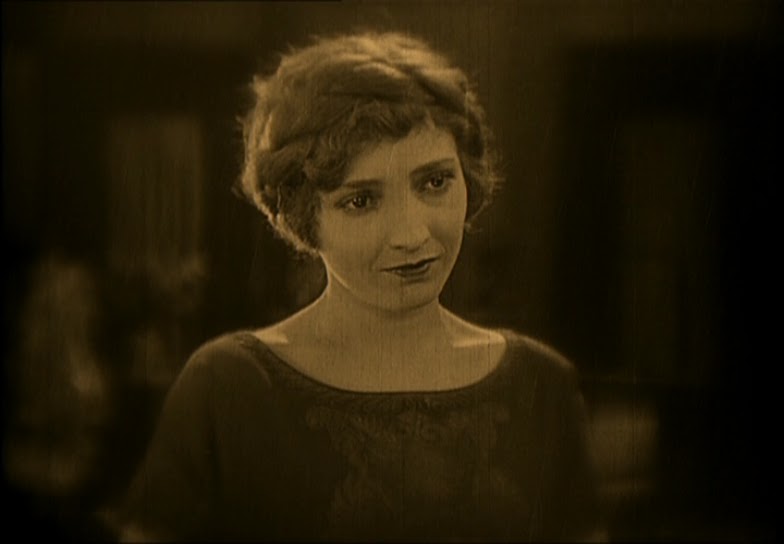
Bruce is just about to get himself in deeper as, unable to pay his gambling debts to Tom Canfield (Stuart Holmes) a thoroughly corrupt Broadway producer, he agrees to help smuggle diamonds in exchange for a clean slate. Sounds fine, doesn’t it? Just about the only thing Bruce is doing right is dating one of Canfield’s chorus girls, a proper stunner name of Marilyn (Clara) who is no dope, seeing all the good in Bruce, and all the bad in Tom, providing more help than the young man probably deserves.


The review in Variety noted that “Miss Bow looked cute…” which is code for Miss Bow looked incredible in a series of daring costumes designed to show off her “dangerous curves” but which she never lets overwhelm her striking expressiveness; she gives this script total respect and adds much to the level of drama. I’m reminded of what some of the Hammer actors have told me, they had almost no time and no budgets as well but their job was to turn up and deliver a quality performance which is what we see now and then from most of this cast.


Holmes is despicably nasty as is his muscle, Big Jim Snead (Tom Santschi) and an Englishman, Dude Talbot (the wonderfully named Templar Saxe) who is bringing the diamonds over from Blighty hidden in a cane. He exchanges the cane with one exactly the same carried by Bruce, who the authorities do not know, and is able to evade been caught sparkling-handed. It seems like everything has worked, until a row erupts between Big Jim and Canfield who, knocked backwards, breaks his neck on the fireplace.  Dude and Jim make like bananas and split leaving a stunned Bruce to be hauled away by Marilyn…


The evidence pretty much fits Bruce though and he faces a fight for his life after Big Jim, assuming he has taken the loot, comes looking for vengeance… and things get a lot more complicated.


LV Jefferson wrote the screenplay aka Leah Baird whom the Variety review praised for putting “much of the maternal instinct into the plot” and for “making Miss Bow a clean, good, lovable girl of a cabaret who (sticks) with her boy…”. The review reproduced in today’s screening notes, is pretty jaded – so many free screenings, so little time - but concludes that “this is a very interesting picture just that, which may be more for those who prefer a reliable.” Translation required…


Stephen Horne accompanied, fresh from his orchestrated score for the newly restored Stella Dallas (1925) at the Venice Film Festival. There was no orchestra on the Southbank today but there was a pleasing array of themes and tones played by the one man as Stephen brough his uncanny sensibilities to bear on supporting these two quite different films. As usual he caught the emotional resonance exactly right and was especially good with Clara as she took us from upbeat to potential tragedy.


Another lovely screening at the BFI, London’s most functional Tardis, taking us far and wide, forward and back on a regular basis. Here’s to next time, an appointment with one Pam Greer!


Saturday, 19 August 2017

Tall tails... The Lost World (1925), Lucky Dog Picturehouse, Wilton’s Music Hall


Dunkirk and superpowered Amazons aside, 2017 has not been a vintage year for blockbusters but in 1925 it was a little different with The Big Parade being a huge $20 million hit followed by the likes of Ben Hur, The Gold Rush and The Phantom of the Opera. Also comfortably in the top ten grossers was The Lost World a science fantasy from the pen of Arthur Conan Doyle who swapped Baker Street for brontosaurus in his wildly successful book of the same name

We’re not so different 1925 and 2017, are we? Literary adaptions fuelling Hollywood invention and excess only in this case they knocked the ball right out of the Jurassic Park using techniques rarely seen before and on a scale that was to set the template for the next century of alien worlds from Kong all the way to Skull Island.

Sir Arthur abides... a snip from a contemporary documatary replaces his original intro.
For Harry and Mabel, Frank, Lil, Jenny Wren, William, Jessie and Jim, this would have been their first exposure to prehistoric animation a visual shock on a par with any technological leap seen since although I can’t see our Jessie being that impressed with such frippery.

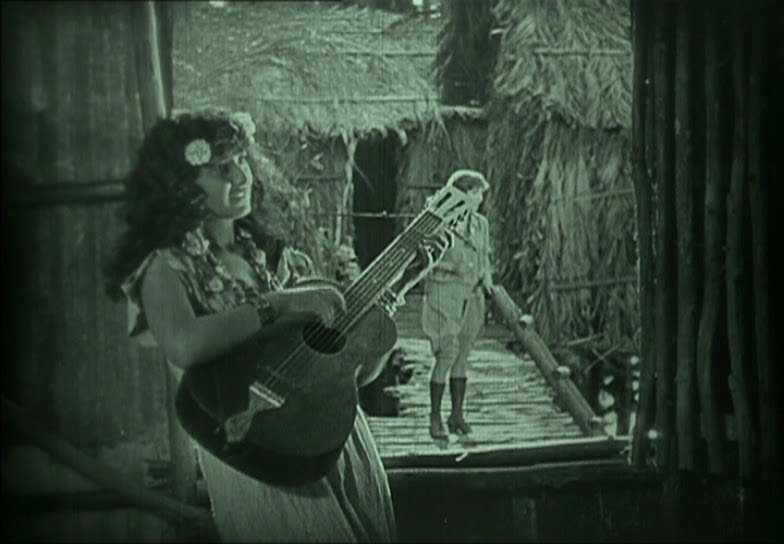
Directed by Harry O. Hoyt and completely unlike anything he or anyone else had produced before, this was adventure cinema as adventure based on a concept that was far more believable in an age before satellites took some of the fun out of exploration. As recently as twenty years ago an expedition to a huge meteor crater in Africa was touted as possibly revealing a “lost world” of new and previously-extinct species… we live in hope and we want to believe.

But here the brave band of explorers discovers the past alive; mind-blowing wish fulfilment we cinemutophiles can completely relate to. And here in the restored stucco walls of our oldest music hall, we feel the same frisson as, with Emily O’Hara’s intrepid troop of musical adventurers to guide us, we simply connect with a lost world of nitrate wonderment.

The indigenous sounds of the deep Amazonian rain forest.
The Lucky Dog players snuck on stage in character, pith helmets and jodhpurs along with an inflatable tyrannosaurus. Their music is witty and very tightly orchestrated with Emily on guitar, mandolin, cello and musical direction, Christopher Eldred on piano and clarinet, Daniel Tiberius Mays (parents, Star Trek fans?!) on woodwind – a deliciously poignant flute and Nicholas D. Ball on percussion and some very effective dino-sounds!

I loved their playful syncopations and when they were clicked off by Nick’s drums their ensemble playing is a real joy – is dancing allowed mid-film?! They also handled the thematic work well and I was especially entranced by Emily’s Spanish guitar lines and Mr Eldred’s way with the pianoforte: the bedrock of a score which not only included snatches of contemporary songs – the lovely What’ll I do? – but also a few notes from Jurassic Park (or was that just my projection?!).  It’s music that competes sometimes with the narrative but for this film and in this setting, that’s exactly what you need.

Hipsters go mad for silent film!
Wiltons is an interesting silent film gig and it was good to see so many young and unfamiliar faces and an audience who, inspired by the Lucky Dog verve, had a ball with the film: laughter is the gateway response to silents. Not that The Lost World is ever meant to be taken entirely seriously; as with its modern counterparts, there’s a rich mix of humour and action from the relationship between the squabbling professors to the convenient get-out for our main hero at the end: what happened in the jungle doesn’t always need to stay in the jungle!
                                
The Trachodon about to do battle with the Allosaurus!
We shouldn’t underestimate the impact stop motion techniques had on contemporary audiences, just as the CGI from the first Jurassic Park looks slightly awkward compared with Jurassic World over twenty years later, technology moves on and our perceptions follow. The film’s special effects maestro, Willis O’Brien had worked on stop-animation since 1918 and a short test film he made was shown by Conan Doyle a meeting of the Society of American Magicians, which included Harry Houdini in 1922. Doyle refused to discuss the film's origins but the audience and press alike were astonished… the New York Times declaring that if they were fakes they were “masterpieces”.

Sir Arthur is featured on his porch at the start of the film, he looks happy enough and I’m sure a good deal was arranged for the script as developed by Marion Fairfax. The author later declared that it was Lost World’s Professor Challenger who was his favourite character and not the Great Detective.

Wallace Beardy!
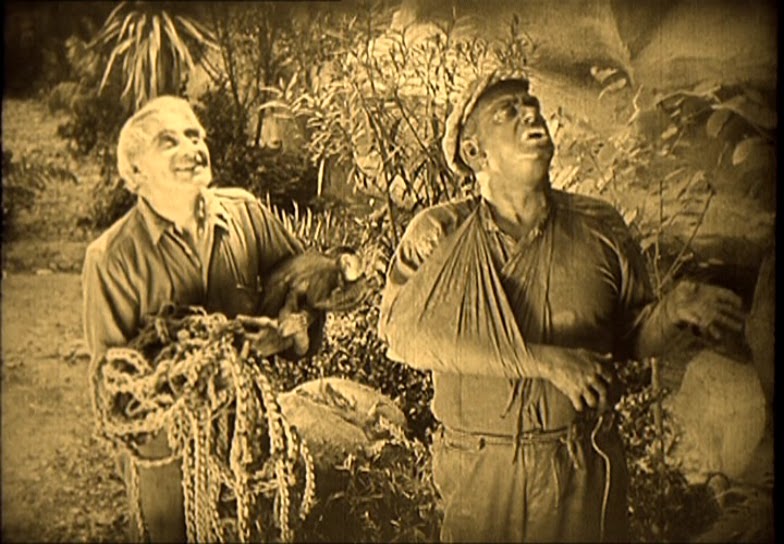
You can understand as Challenger is all for pure adventure even if here he’s opposed by the scientific establishment. He’s played by Wallace Beery complete with wildling beard and scatty fringe highlighting wide staring eyes as he’s laughed at by his peers. He’s looking for men to accompany him on an expedition to the Amazon to try and rescue Maple White whose journal suggests that dinosaurs still roam a plateau deep in the jungle. Noted adventurer and game hunter Sir John Roxton (Lewis Stone) offers to join him as does Professor Summerlee (Arthur Hoyt) who wants to prove him a fraud.

A young reporter, Edward Malone (Lloyd Hughes) also offers to join up much to Challenger’s disgust – he hates fake news – but Ed has a girl to impress with daring deeds, Gladys Hungerford (Alma Bennett). But, once then young fellow spies White’s daughter Paula (Bessie Love) we and he aren’t so sure of this prior commitment.

A US map of the Atlantic: Britain known by its proper name of Liverpool...
Cut to animation of ship skipping down a map from London to Brazil and the team are soon looking at a huge plateau with only one way up. They climb a rock tower and walk across a tree trunk to the plateau but their route is soon swiped away by the first of many huge new animals: the dinosaurs are here!

The stop motion is still impressive (thousands of movements over hundreds of painstaking days) and O’Brien worked a split screen with increasing confidence as he showed the “tiny” actors against a backdrop of dense forest and battles between Allosaurus, Brontosaurus, Triceratops and Stegosaurus (the last two my childhood favourite dinos). By the film’s spectacular conclusion, we see a Brontosaurus let lose in 1925 London… eight years later, O’Brien had a giant gorilla doing the same in New York.

Very smart split screens
If the story intensity drops on the plateau it’s because the adventure was all in seeing these great creatures live and move again and we’re all so used to seeing dinosaurs now. But there were moments when music and music hall helped us recapture the magic of discovery once again.

The Lost World was so nearly a lost film and is still being restored with a new 110 minute long Blu-ray due from Flicker Alley on 12th September. The version shown was the 93-minute restoration from 2000 used on the Eureka DVD which has perhaps 90% of the original content according to Doyle and Lost World expert, Roy Pilot’s commentary.

Reaction shots are key to believability.
It’s a classic bit of fun – pure cinematic pleasure! Wilton’s and the Lucky Dogs made sure we all had the best of it!

This was part of a short summer season from Lucky Dog at Wiltons including the magnificent Brit-com Shooting Stars and, footage of Irving and Malory’s fateful climb in The Epic of Everest. For details of upcoming show visit their website or follow them on the old social media.