
The river runs. The round world spins. Dawn and
lamplight, Midnight, noon. ... Night, stars, and moon. The day ends; The end
begins.
The magic of cinema is never more evoked than in this uncanny
masterpiece from Jean Renoir and many helping hands not least author and co-scriptwriter,
Rumer Godden, classical dancer and force of nature Radha Burnier along with a
host of local talent, financiers, cast and crew including an advertising
executive by day, assistant director at weekends name of Satyajit Ray.
The story of how the film was made is almost as
fascinating as the final product and this superb double-disc from the BFI includes
Arnaud Mandagaran’s “making-of” documentary Around the River (2008)
which includes interviews with Burnier in her mid-eighties, the film’s remarkable
producer Kenneth McEldowney, Ray and others who were there.
There is also an introduction by Kumar Shahani from 2006
in which the Indian director and screenwriter talks of the evolution of his
thoughts on the film, initial embarrassment – perhaps cultural cringe – turning
into admiration. In the booklet there is also an essay from Dina Iordanova, an historian
interested in transcultural film, who points out the inevitable political omissions
of Renoir’s post-colonial representation of a country that, according to Godden,
overwhelmed him.

It’s worth noting that Rumer Godden hated Powell and
Pressburger’s film of her earlier novel Black Narcissus calling it “terrible”
(oh, Rumer!!) and had resolved to resist any further attempts at
adaptation but when she heard that Renoir had stayed at her childhood nursery,
she began to change her mind. Needless to say, the two bonded and a fascinating
interview with the author and Thompson is reproduced in the booklet. She spent
two years working on the script with Renoir and they remained life-long friends
but, whilst she liked the film, she thought there was just too much in India
for him to assimilate and he was “a little bit lost”.
As Shahani says though, the process of making the film
changed the director who would continue to learn about India with the
intellectual Burnier as he stayed with her after the film at the inter-faith Theosophical
Society Adyar where her father was president, a role she later picked up. Renoir
did not make the film he first thought he would and who knows what his second
Indian film would have been like… As Shahani says authenticity is not so much
about the creator’s immersion in the culture but his respect for it.
So, I went to India and was convinced, no, that word
is too weak, I was conquered. It’s an extraordinary country with extraordinary
people, the least mysterious in the World…

Patricia Walters and Adrienne Corri
For Renoir The River was “… exactly the shock I
was needing after eight years in Hollywood…” a dispiriting experience that
left him struggling for creative control and commercial fulfilment. As David
Thompson says in his booklet essay, Renoir’s “… preferred working methods –
giving time and space to actors to develop their performances, shooting in
natural locations – clashed with the ‘professional’ prerogatives of a tightly
controlled studio system.”
Out in India circumstances conspired to slow down to
production and to enforce the perfect working regime for the director that and the
sheer impact of the country on the man as a three-month shoot turned into a six-month
one. What we see now evolved with the documentary style almost enforced by
having to shoot the Technicolor film silently to avoid noises off and meaning
that he had to get closer to his subject. This was the first film shot in India
with live sound but constant crowds made filming difficult with a shot featuring
two characters in a stream shown as being overlooked by hundreds of onlookers
in a production photograph.
 |
| Radha Burnier |
Another change was the introduction of a diary for the central
character of Harriet (a remarkable performance from un-trained local girl Patricia
Walters) which allowed a narration, voiced by June Hillman, that bound the
story together better. The rushes had to be developed back in New York and this
meant that editorial control was more difficult whilst test screenings revealed
weaknesses in cast and narrative. World War Two veteran Thomas E. Breen was
cast as Captain John, a replacement for star Mel Ferrer and whilst he was
actually as disabled as his character, his range of expression was not quite
there. The narration helped to establish his motivations more clearly and to
establish context over lingering takes of the locale and the Ganges – the biggest
character.
Harriet is the voice of Rumer and the tale is of her
first love, Walters was just 14-15 when the film was made and does a grand job imagining
her forlorn crush probably helped by the RADA trained Adrienne Corri (19) as
her friend and love “rival” Valerie, not to mention the thoroughly well-trained
Radha Burnier. Burnier plays Melanie the daughter of an Indian mother and an
Irish father (an excellent Arthur Shields) a character created just for the
film by Godden and Renoir who, is effectively a bridge between the cultures
literally born from both.
 |
| Suprova Mukerjee |
Melanie and her father, question her heritage in scenes Iordanova
describe as her most important in the film but I’d disagree and nominate her
incredible dance during one of the festivals. Now, some sitar players of my
vague acquaintance have rightly questioned the notion of “world music” and culture
but reproducing Indian classical dance in this way is a bold move from Renoir
and he also uses classical music for the soundtrack throughout. As a certain
James Ivory says in the documentary, this was the first time he’d heard the
sitar and it wouldn’t be the last. The music, as the dance, is thrilling.
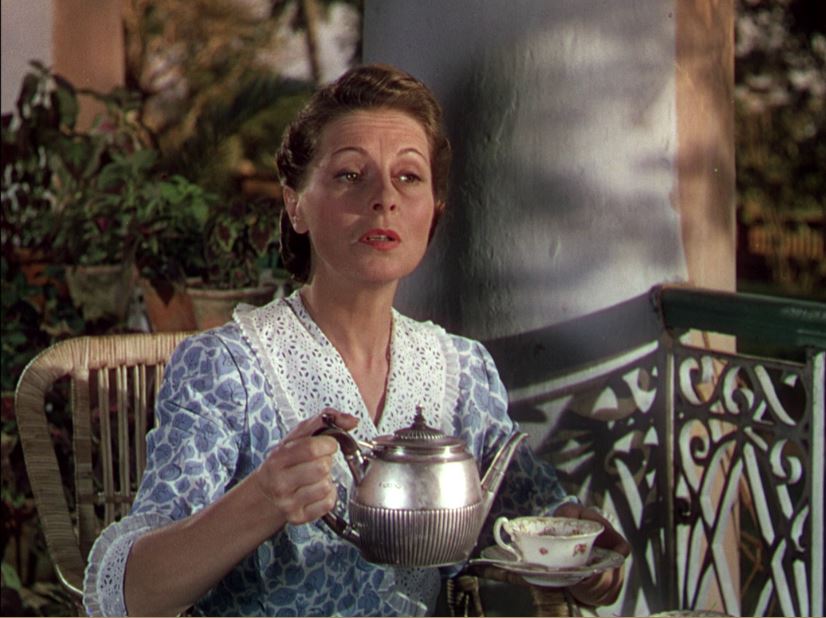
Harriet’s parents are played by the stalwart Nora
Swinburne and Esmond Knight and there is a superb turn from Suprova Mukerjee as
Nan to their five children, four girls and one boy who has an unhealthy fascination
with snake charming. A friend of mine grew up in India and was always told not
to pick up “sticks” from the end of their garden as… they might not always be
made of wood. Sound advice.
The story meanders around the girls’ affections for
Captain John as her visits and explores the country, at a lose end, disabled
and displaced by the war. Who he choses becomes less and less important as the
summer lingers long and the river flows… the round world spins.

Amazing lighting for this day-for-night shot!
The result is a triumph of Technicolored documentary drama
showing life around the river, spiritual and commercial – jute being one of the
areas main products. The balance is near perfect and was both a critical and
commercial success that re-established Renoir in Europe where he would continue
to work only with his own crew.
What Jean did with that film was to show the rest of
the world a side of India they had never seen before… Radha Burnier, 2008
This is another prestige project from the BFI with, in
addition to the documentary and introduction, a second disc of magnificent
extras:
India Matri Bhumi (1959, 90 mins): Roberto
Rossellini’s part-documentary, part-fiction portrait of India
Around India with a Movie Camera (Sandhya Suri,
2018, 73 mins): drawn exclusively from the BFI National Archive and featuring
some of the earliest surviving film of India
Villenour (French India: Territory of Pondicherry)
(1914, 4 mins): a travelogue by Pathé Frères with gorgeous stencil-coloured
images of French India
Manufacturing Ropes and Marine Cables at Howrah, Near
Calcutta (1908, 8 mins): an instructional film by Pathé Frères depicting the
jute industry

Radha Burnier enjoys the dance
After the film Renoir said: ‘After living in India, I
have become more peaceful. I would no longer worry if all of a sudden I had to
turn into a bum.’ There were no worries on that score but we should all
just sit down, switch off all devices and just focus on this beautiful magical,
real world, timeless emotions in an eternal landscape.
The River is out now and you can order direct from
the BFI online. Better be quick though as the two-disc edition is limited to
3,000 copies and every cineaste’s home should have one!




+colour.png)





