Wednesday, 9 October 2019

Gypsies, tramps and thieves... Le Giornate del Cinema Muto, Pordenone Day Four


“…ninety years from now, when all the war pictures and propaganda films and arty productions have been forgotten, some old white-beard is sure to mumble, ‘There was a girl named Marion who looked awfully cute in boy’s clothes.’” Delight Evans, Screenland, July 1926

Another epic day out here in the capital city of Friuli-Venezia Giulia with magnificently restored cowboys to start, followed by doctors, divas, death and Duck Soup, before a trio of women against the odds finishing at 1.00AM sharp… and all’s well!

In the Teatro Verdi the tone for the evening was set by the collective joy of seeing Laurel and Hardy in Duck Soup (1927) – a once-lost now found and restored by Lobster Films. There’s a new trend this year of applauding leads on screen but with Stan and Oliver our laughter is the salute and this early partnership is a hoot as the two boys, hoboes on the run who attempt to rent out a mansion to Lord and Lady Tarbotham (Madeline Hurlock classy and serene here and all too keen to take a bath as you’d expect from a former Mack Sennett Bathing Beauty).

There’s no greater comedy hit than one shared and, in this theatre and with this audience we were grinning like loons as a mass forgetting of the everyday took hold and we were sucker punched time and again.

And then came Marion.

This year’s poster girl is already established as one of the major stars of the Twenty First Century silent renaissance and in Beverly of Graustark (1926) she is gorgeously funny. Davis never made a seriously revered film (although Show People comes close: it is loved) but it doesn’t matter as she was the queen of romantic comedy drama for much of the Twenties producing a string of major hits that allowed audiences to laugh themselves out of the day-to-day and onto the screen in sympathy.

There’s no better sight than Marion’s looks straight to camera eyes twinkling with the latest daftness. Mabel started it and Stan followed but Marion took it to another jazz-age level; her face bubbling and alive, as knowing as anyone, with perfectly timed beauty, an irresistible smile.


Here she has many reasons to be comically shocked as she plays an American who has to impersonate her cousin, Prince Oscar of Graustark (Creighton Hale) after he injures himself in a skiing accident. If the Prince doesn’t make it to the Graustark coronation on time the deals off and the nasty General Marlanax (Roy D’Arcy who is always good to watch in this kind of role).

And so the Prince formerly known as Beverly has to dress as a man and convince the cabinet and court to save the throne and she does such a splendid job that even politically-active and military trained goatherd Danton (Antonio Moreno, “Sweet Santa etc…”) can’t see that, with that skin, those eyes and all the rest, that she’s less of a man than he’ll ever be.

It’s exquisitely daft but the timing is absolutely perfect throughout and, this was reinforced by a masterclass in sympathetic accompaniment from maestro John Sweeney on piano and the Gene Krupa of Stummfilm, Frank Bockius. They ripped through the narrative with such clarity of purpose and a collective flexibility that encompassed grandeur and pratfall almost within the same phrasing. The film informs the music and the music informs the response, we laugh and they pay back, performance enhanced by sheer delight.

I have literally got this t-shirt!
Now, getting back to the start of the day, it turns out that yer cain’t watch enough William S Hart westerns; they’re all different, pack a moral punch and he’s just so durned watchable! This is why the efforts that have gone into restoring and recreating one of his best films, The Gun Fighter (1917) are to be applauded and a parade should be run for Mr Kevin Brownlow, Christopher Bird and Fritzi Kramer. Kevin had found some 35mm elements in a French archive and this was mixed with a 9.5mm “home cinema” reduction and completed with new intertitles from Fritzi who, whilst being a famous silent film blogger by night is also a graphic designer by day.

The restored film is indeed very strong, a philosophical western which contained more moral conundrums than the earlier films screened today – both of which were good but not as complex. It showed how Hart’s work was developing rapidly and taking more risks with his character’s moral journeys; the actor/director seemed to know how far he could push his audience’s sympathy and, unlike other prominent directors of the time, he was more concerned with ambiguity. He’s a fantastic actor and clearly relished the greys and that’s why this film is so important.

On Monday we had seen French newsreel showing a studio of colourists working in their dozens with magnified images and a pantograph machine allowing them to precisely colour film stock and today we saw the results of this process with Gerolamo Lo Savio’s Otello (1909). We all love a bit of colour and Othello is one of the plays I’d most like to see at this running time… and, by the Bard, it works! That Iago though; what a get.

Elettra Raggio
We had two Italian films with impressive if lower league divas. The first was Il Fauno di Marmo (1920) directed by Mario Bonnard and starring the loverly Elena Sangro as Princess Maria married to the Duke of Helgoland (Ugo Bazzini). The narrative is convoluted and uncertain but the film looks fantastic from the outrageously opulent dresses to the sumptuous locations in and around Rome.

Elettra Raggio is striking too in her surviving film La morte che assolve (1919) which is a complex tale of redemption between estranged family members which deserves more attention. Luckily, it’s available on DVD and so I feel compelled to go on at more length later about this remarkable writer, director and performer. I always love seeing Diva films in Italy, even more than I like hearing classic era progressive rock still being played on Italian radio…

Quickfire round, your starter for ten: Oh, Doctor! (1925), Oh, Reginald Denny you are a funny one, a very enjoyable romp about feeling the fear and doing it anyway.

Pauline Frederick having trouble with useless men
The Moment Before (1926), Pauline Frederick looking absolutely stunning as a gypsy woman falling foul of her circumstances in a story told in flashback right at the moment of her death. Eat your heart out David Lynch! One of the strongest actors around in the silent age and another one of those timeless/modern faces. Ace.

It was so very late when John H Collins’ A Wife by Proxy (1917) came on and in spite of a clunky beginning it won me over with some smart direction and cracking character development. Mr Collins is for sure the Irish Lubitsch with some excellent touches in this tale of a young Irish lass, Jerry McNairne (Mabel Taliaferro – Viola Dana wasn’t available!) sent over to the America to work with her cousin Norton Burbeck (Robert Walker). Norton will inherit a fortune if he marries by November but his scheming cousin works with a crooked couple to distract him using the womanly allure of brassy Beatrice (Sally Crute).

I loved the performances from all concerned, good detailed direction, and the two women were standouts. You’ll never beat the Irish.


Tuesday, 8 October 2019

Horses and eagles... Le Giornate del Cinema Muto 2019, Pordenone Day Three

“Women! God, how he hated them!”
Mamas' don't let your babies grow up to be cowboys
Don't let 'em pick guitars or drive them old trucks
Let 'em be doctors and lawyers and such
Mamas' don't let your babies grow up to be cowboys…

That was Wayland Jennings advice but at this stage it’s way too late for those of us riding alongside William S Hart as he blazes his trails in a strand that celebrates this most accomplished of silent actors and a genre that seemed to emerge fully-formed from the get-go.

Today we had two of not-so-wild Bill’s films In the Sage Brush Country (1914) and The Aryan (1916) which, it has to be said took a surprising turn. Hart’s roles include a number where he was on the wrong side of the , only to be rescued by the love of a good woman but it’s interesting that’s heroes can be anti from this age of territorial opportunism; the USA was founded on men who sometimes broke the law as evidenced by Alphonso J. "Al" Jennings – a genuine cowboy and criminal who made films based – seemingly – on his exploits, such as The Lady of the Dugout (1918). Al received a full pardon from President Teddy Roosevelt in 1907 as he had fought against the Spanish as a Rough Rider. Is it any wonder we British struggle to understand some American Presidents when it is the land of the free, i.e. strong, where second chances are always available… for the right kind of man.


In Sage Brush..., Hart starts off as wrong ‘un Jim Brandon who robs the Wolf Creek stage of a payroll intended for The Lost Hope Mine owned by Frank Wilding (Herschel Mayall). Wilding decides to use his daughter Edith (Rhea Mitchell) as the next courier as the bad guys would never suspect a woman. Brandon overhears the plan and from then on it’s only a matter of time before chivalry kicks in, over is attained and forgiveness obtained through good deeds. Crucially Brandon’s bad guys are trumped (ha!) by *real* bad guys, Mexicans, and they are just that bit more naturally dastardly aren’t they…

This was only the second film Hart directed and his attention to detail is apparent through costume and set design. It’s pacey and he’s magnetic as usual – a man with a classical theatrical background, channelling the spirits of America’s ground-breakers.

Bill and Bessie
The Aryan (1916), is a relatively recent discovery from Argentina – the same store in which the missing parts of Metropolis were found – and is more overt on the subject of race with Hart being described at one point as leading “his people” – Aryans – on to the promised land of the West. He must also overcome a deepfelt aversion to the opposite sex… who he blames for the loss of his fortunes.

Hart’s Steve Denton is a successful prospector who falls for the combined evils of drink and gambling and, with the sensual distraction of Trixie, “The Firefly” (Louise Glaum) he gets ripped off. He drags Trixie with him as punishment – a bit extreme you say? – well, it is that kind of film. Trixie had intercepted a telegram for Steve saying that his mother was dying and he must race back to see her… a device Hart added based on his own experience of continuing to run his theatre in 1909 when in the same situation.

It adds extra motivation for his hatred of Trixie but his punishment is unusual and ill-founded. The years pass and Denton switches off compassion and when a party of starving travellers arrives he refuses them food and shelter: it’s every man for himself in his America. Well, it is until a Christian woman in the form of the impossibly pretty Bessie Love gets his attention: she is Mary Jane Garth and the clue’s in the name. A conversion occurs and morally refreshed by the spirit MJ has brought he not only helps this all-white convoy but leads them onwards to the promised land.

Promotional booklet for The Aryan
The scenario was co-written by one C. Gardner Sullivan who inserted the strands about the then-popular (cf a film by Mr Griffith…), pseudo-scientific racial philosophy which occurs in the latter part of the film whilst the more straightforward melodramatics of the first was down to Hart: bad women and greed all lumped together.

Gunter Buchwald and Frank Bockius formed a musical posse, riding side-saddle for the great man as he wrangled with his troubled conscience, women, men and bad fortune. The Western and the music so heavy with eternal emotional truth.


“Unforgettable are the extreme long shots of battles staged on the Värska military exercise fields. They evoke the Olympian visions of Griffith in The Birth of a Nation and America.” Antti Alanen

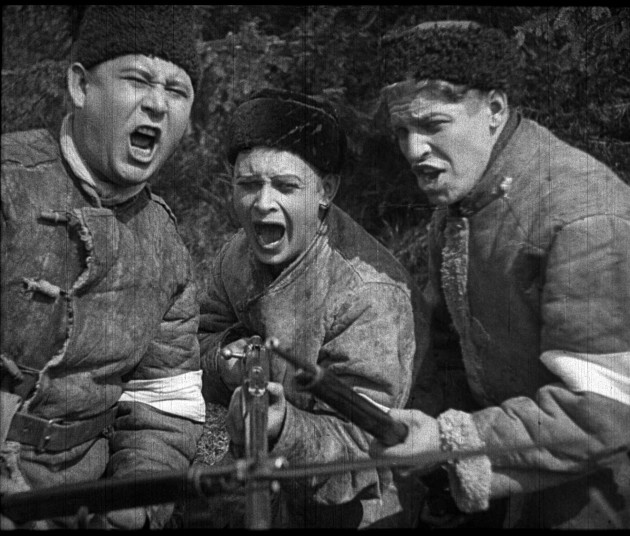
If it was all tumult out West, way, way out East we had war as Russia invaded Estonia in The Young Eagles (Noored Kotkad) (1927). Estonia declared independence from Russia following the 1917 revolution but they had to fight off both the Soviets and the Germans in the War of Independence, which lasted until 1920.

Today Estonia is about half the population of Wales and the fact it could martial a fighting force to fight off two of the strongest nations in Europe was remarkable. The story focuses on the “Young Eagles”: rich student Tammekänd (Arnold Vaino), blacksmith Laansoo (Juhan Nõmmik), and poor farmhand Lepik (Ruut Tarmo). All volunteer for the army and we see their journey through the ups and downs of what becomes a spectacular conflict near the climax with, as Alanen’s quote suggests, a huge battle scene filmed with the aid of the Estonian Defence League who provided both men and armaments.

Three eagles on their shirts...
The story is a bit flat initially and director Theodor Luts could have cut a chunk log the running time but it none-the-less a moving story and an educational one. This is one of the delights of Pordenone – it’s an education not just in the history of film but of the history in the films.  

For a young nation this film must have meant so much. At a time when my country constantly crushes its laurels with an arse-full of ignorance and assumptive authority, this film reminds us how hard some have fought to genuinely take back control.

Heroic accompaniment was supplied by Mauro Colombis on piano and Frank Bockius on percussion; positively aerobic!
What would Wm S Hart have said?
We were also showered with shorts today; I’m loving the animated Victorian Flipbooks sections and also the return to the Nasty Women shorts especially the eternally naughty Leontine as played by Sarah Duhamel here seen in Enfant Terrible (1911) and On Holiday (1910). Accompaniment was from Daan van den Hurk.

We also had the first of the Weimar Shorts stream which, actually now I mention it, did indeed feature a lot of streams and water in general including one nine-minute section of a ship at sea. There were some fascinating close-up sequences of bodily fluids too – Germanic versions of F Percy Smith’s microscopic landscapes. Accompaniment was from Jose Maria Serralde Ruiz.

There were other films but there was also wine to be drunk and conversations to be had… in Pordenone you have to get the balance right!

Monday, 7 October 2019

Waving not drinking... Le Giornate del Cinema Muto, Pordenone Part One

Ita Rina reclines in Estonia
Good morning, good morning, we’ve watched the whole day through good morning to you*… aka Watchin’ 9 to Half Midnight. Pordenone takes no prisoners and on my first full day I saw everything baring the odd break for comfort, coffee and an ice cream.

So, let’s start at the very ending because that’s a very good place to start*, smuggling booze from Estonia to Finland with Slovenian Ita Rina (Tonka of the Gallows, Spring Awakening et al) as a bombshell blonde in Waves of Passion (Kire Lained) and Estonian/German co-production from 1930. This film is part of the Estonian films strand and epitomises the wonder of this festival – something I’d never heard of yet which sprang to life on screen in emphatically entertaining ways; accomplished cinema muto – German angles, Russian cuts… that felt like a cross between a Bogart/Bacall or sixties crime caper with an, admittedly not quite convincing, rom-com tension between Rina and her teasing co-star/director Vladimir Gaidarov.

Rina plays Betty, the daughter of Mart Martens (Raymondo van Riel), a man being blackmailed by spirit king Jaan Kõlgis (Fritz Greiner – who bears an uncanny resemblance to Wallace Beery both physically and in spirit) into smuggling hooch up the coast to Finland. A writer Rex Ronney (Gaidarow) and his journalist pal Raimondo (Ernst Falkenberg) are tracking the crooks and Rex goes deep undercover in order to ingratiate himself with Kõlgis and bust the whole scam wide open… He reckons without Betty though and in spite of himself, falls hard and now needs to rescue her and her father from these drunken, dancing mobsters.

Ita and Vladimir
There’s fighting and sea chases a-plenty and events move on at some pace with Rina being the class act that anchors the reality whilst Gaidarow is not so good, possibly distracted by his dual role (he stuck to acting only in future). Austrian actor Fritz Greiner plays very nasty and brutish Beery well indeed.

Things were lifted by spirited accompaniment from Gunter Buckweld channelling his inner Gypsy/Grappelli on violin, Frank Bockius percussively perfect, and Stephen Horne on accordion and piano. It felt like a late-night improv in a Tallinn nightclub and the three improvised superbly with and around each other’s lines which is, after all, how they work with the shadows on the screen.

Sylvia Bremer & William S. Hart - The Narrow Trail (1917)
Before this we’d had the first in the William S Hart strand, The Narrow Trail (1917) which with its pacing, performance and glorious scenery – including San Francisco Bay, showed how much of the classic Western was in place by this time.

Hart is mesmeric in this film and, in spite of his 53 years, his Ice Harding is a believable leading man effortlessly shifting from heartless highwayman to a lovelorn loser in search of a perfect second chance, he covers it all with actorly grace whilst sitting in the saddle with the true conviction of a western soul.

He’s saved by the love of a good woman Betty Werdin (Australian-born Sylvia Breamer – the spit of Helena Bonham-Carter!) who has more in common with him than he knows. There’s an excellent fight sequence in which Ice takes on half a dancehall in something approaching method-brawling; it’s people like William and Lillian that brought authenticity to the early screen.

One of The Great Faces!
There was grand accompaniment from Philip Carli who brought dynamic delicacy to this typical Hart film, reflecting the man’s own persona. Before the film they screened a talkie introduction to his classic Tumbleweeds made in 1939, in which the 75-year old could still eulogise the old West with passion.

The day began with studio films promoting their stars and services and which not only gave us a glimpse of the likes of the Talmadges it also showed films being made on the huge lots. There was A Tour of the Thomas H Ince Studios (1920) in which the man who played a major role in setting up “factories of dreams” was shown to have an empowering fitness regime; all the better to manage and control the production process. We also learned how Paramount’s kit was the best at handling faults in spliced film… as if there was ever any doubt, they were “paramount” after all.

We did a bruising two rounds with Reginald Denny in the serial The Leather Pushers the story of a rich lad who resolves to win back his father’s business fortune through boxing. It’s perhaps not the obvious choice given his education and background but it was good fun – as will Hart and Westerns, the Boxing rags to riches – even with a broken right hand – trope was well in place by 1922.

I went down to the crossroads... RIP Ginger Baker
The Devil’s in the details of course as, erm Emil Jannings proved in Murnau’s Faust (1926) which I hadn’t seen since 2012 when it was screened at London’s Royal Festival Hall accompanied by a score composed by Aphrodite Raickopoulou. Donald Sosin performed the honours here and I think I enjoyed the film more; it’s so over-the-top and yet so compelling; Murnau and Jannings are surely brothers from another mother.

The local orchestre dell’Istituto Comprensivo di Pordenone Centro (Scuola "Centro Storico")
and Rorai-Cappuccini di Pordenone (Scuola “Pier Paolo Pasolini”) accompanied Hal Roche’s Little Rascals in Dogs of War (1923) and Baby Peggy (yay!) in Carmen Jr. (1923). This was very effective and some of the funniest films of the day were well supported musically showing that Pordenone is “growing its own” future generations of expert accompanists.

Music alone cannot guarantee success in silent screening and even maestro John Sweeney’s precision playing couldn’t keep me engaged with Albert Capellani’s La Glu (1913). The film starred the impressive Mistinguett as Fernande, a woman who marries a Doctor but just can’t stop saying no… her constant affairs become confusing and more to the point, perfunctory. Capellani’s good but even he struggles to digest the source motivations from the novel which begat the film.

Baby Peggy: no bull
The Pride of the Firm (1914) was directed by Carl Wilhelm and featured Ernst Lubitsch as Siegmund Lachmann a young man with retail ambition and healthy libido, who struggles to balance his “interests” in a work context. Like other film of his early period this one referenced Lubitsch’s own background as the son of a tailor who was less interested in retail than cinema. It’s more a series of situations/sketches than a feature narrative but it’s still fascinating to watch the director as an actor his eyes always so alive with mischief!

And that was the Sunday that was. Now, show me the way to the next coffee bar…

The dog remins Ernst of the films he may be missing... 

Saturday, 5 October 2019

A glorious feeling… Singin' in the Rain (1952), 18th October re-release for BFI Musicals! The Greatest Show on Screen


Donald O’Connor, Debbie Reynolds and Gene Kelly stare smilingly out from the screen directly at you as, their heads  almost still, their bodies move as one, arms rotating around with impossible precision as they confirm that they’ve talked the whole night through and the way to rescue The Duelling Cavalier, their first talking film from disaster is to turn it into a musical. No other form allows you to hotwire your heart with such joyous ambition and chorused changes in fortune.

Singin’ in the Rain cannot be denied, it’s a natural force, full of perfect moments that somehow avoids sweetness by being anchored in the naturalistic friendships of the most likeable and down-to-earth cast imaginable. The sole exception is the ethereal cameo from Cyd Charisse channelling Louise Brooks as the woman of Kelly’s dreams who is not to be confused with the woman of his waking hours.

The film was being previewed as a taster for the BFI’s unstoppable new season, BFI Musicals! The Greatest Show on Screen with a new 4d transfer due to screen at the Institute and nationwide from 16th October. Having never seen it on the big screen I can confirm that it is transformational: combining great tunes, movement and star power!


As a silent film fan there is lots to spot in the film with a story and song track picked from the era when silent transitioned painfully into sound. Jean Hagen’s Lina Lamont has the broadest of Big Apple accents mimicking the supposed accent of a Norma Talmadge (New Jersey) or a Clara Bow (Manhattan) who – by legend – struggled with sound but who, in reality, spoke just fine and had other reasons for fading away, in Clara’s case after a number of successful talkies and, for Norma, she just had better things to do.

Talking of Clara, there’s Rita Moreno as Zelda Zanders, the "Zip Girl" who’s not that far from the “It Girl” and Judy Landon as Olga Mara, a silent screen vamp not a million miles from Nazimova mixed with Pola Negri. These actors would still have been in the memory in 1952, no further away than Britpop is to now.

Most of the songs also hail from the late Twenties/early Thirties and, possibly written in 1927, Singin' in the Rain was first performed on screen by Doris Eaton Travis in The Hollywood Music Box Revue (1929) then by Cliff Edwards with the Brox Sisters in the early MGM musical The Hollywood Revue of 1929. Audiences would have associated the song with that era even as now we see it as an early 50’s creation.


The song was written by Nacio Herb Brown (music) and Arthur Freed (lyrics) and most of the pre-existing songs came from them including You Were Meant for Me from The Broadway Melody (1929) from which the title song along with Broadway Rhythm from Broadway Melody of 1936, provides the backdrop for Cyd and Gene’s balletic fantasy. Interestingly Talya Alon has argued that the other influence for this section was The Blue Angel (1931) so, whilst Brooksie was the look, Marlene was the attitude… and, unlike Emil Jannings’ professor, Kelly’s song and dance man makes it through to success: Gotta Dance, Gotta Dance, Gotta Dance...

This classic Kelly sidestep apart, the film’s narrative is, of course, mostly about Kelly’s silent actor Don Lockwood, adjusting to sound and pursuing Debbie Reynold’s ingenue Kathy Selden. Reynolds was just 18 at the time of filming and with a background in gymnastics not dance…she was obviously a quick learner matching the maestro and his energetic hoofer buddy step for step and her raw energy is ideal for the role.


But it’s now so hard to imagine anyone else in these roles so cemented in our personal cannon of great films has this film become. Jean Hagen’s Lina Lamont is one of the great “bad guys” with her shatter-glass vowels a joy: “Ah cain’t stayund ‘im!!” is a catch phrase for the ages.

Donald O'Connor as Cosmo Brown, Don's lifelong pal, and vaudeville partner, is quick-fire perfect and completes the perfect trio with Kelly and Reynolds – passing their lines around in a script-sprint relay of comic proportions. It’s a very inclusive approach that naturally plays direct to the watching audience. Millard Mitchell as RF Simpson (a reference to producer Arthur Freed) is also excellent as the grown up in the room trying to channel all these creatives in the most profitable direction.


Stanley Donan directed for the ages along with Kelly and their intelligence and improvisation was rarely equalled in the genre. But you can find out for yourselves as Singing in the Rain is being re-released nationwide by the BFI in October – there’ll be a run on the Southbank as well as cross country along with many others in this splendid season.

Full details of BFI Musicals! The Greatest Show on Screen is available on the BFI website along with showtimes for Singing in the Rain which, thanks to this new 4k transfer, has rarely looked this good in the last 67 years. It starts it's run on 18th October: not to be missed!!


Friday, 4 October 2019

Long-time no see… Love, Life and Laughter (1923), London Film Festival Archive Gala with Meg Morley


This was one of those occasions when you walk out onto the Southbank with a spring in your step, cracking a wonky smile with a shard of bliss warming your core courtesy of Britain’s Queen of Happiness and Australia’s Princess of the Pianoforte. Music and movie combining in a genuinely soulful way to utterly change my mood on a rotten Brexit Thursday… forget all that, let’s have a laugh; let’s live a little… is precisely what Betty Balfour urged. It was enough to pierce the hide of even the saddest social media cynic…

Love, Life and Laughter has not had a public screening since 1923 and as the BFI’s Bryony Dixon said in her introduction, we have a cinema owner in Holland to thank for not returning the film to the distributors: this  last remaining copy was discovered only in 2012 and has now been wonderfully restored by the Institute at L’Immagine Ritrovata, Bolgna with the collaboration of the Eye Filmmuseum and support from the Eric Anker-Peterson Charity who have supported so many restorations including Napoleon and The Great White Silence.

Writer and director George Pearson who, it’s fair to say, was besotted with Betty, proposing on multiple occasions, certainly gives us a whole lot of Balfour with the actress featured in a sparkling array of costumes as an early outlier for Glam years before Bolan and Bowie’s parents even met. It may have been dull outside but no one was failing to be dazzled inside the picture houses by this slight but intensely bright woman from Chester-le-Street. As always, I imagine my grand parents watching this film especially my Nan, a tough lady from Liverpool who had brought up her siblings as well as herself; she was one for frippery but I could see her respecting Betty’s honest energy.

Parlour party frolicks
Pearson had already directed Balfour in four Squibs films – Squibs had even been an MP in 1923 – and this film was perhaps an attempt to move her persona on a little; rags to riches with the chance to show Betty’s stage craft as well as her extraordinary expressiveness. She’s often compared to Mary Pickford but there’s also a similarity with Clara Bow who could turn on an emotional sixpence and both carry a feeling that they’re drawing on a deep hurt. I can understand why L’Herbier cast her in Le Diable au cœur (Little Devil May Care) in 1928: she had the range and wipes the floor with Jaque Catelain which I suppose was the point.

Back here in Blighty, Betty is Tip-Toes, a chorus girl with ambition who is renting a room in a run-down tenement owned by A Balloon-Blower - an excellent Frank Stanmore with want-away hair topping off his pitch-perfect gurns – and his wife (Annie Esmond).

Upstairs in this charming wreck of a building is not Charles Farrell but Harry Jonas as The Boy, a novelist with ambition as well as the looks and soul to capture Tip-Toes heart. The Boy dreams of writing great miserable dramas and plans out a book called Tears of the World which sounds like at DW Griffith film. Tip-Toes tries to cheer him up and there’s a marvellous sequence at a party where the guests sing and dance; The Boy struggles to forget himself and is much happier with contemplative classical music at his friend’s house.

Mr and Mrs Balloon Blower
Meg Morley superbly matched the tone for these scenes and was totally in sync as another boy sang an earnest love song and Tip-Toes lifted the room with Yes, We Have No Bananas. Meg filled her accompaniment with rich moods and maintained a joyous flow throughout; duetting with Betty’s emotional lines with a freedom that an expert jazz player naturally brings. All the best players have a starting place and Meg is a jazz musician – more details on her site – and the improvisatory grounding in a group context enables her to bring her own quality to these accompaniments and it’s lovely to see her distinct style evolving. As they say back home; “go you good thing!”

Back to the film, the plot’s as thin as yer Mam’s favourite dishcloth and as convoluted as your Da’s excuses for being late home on payday but it matters not because this is all about Betty. Does she get her man? Does she even need a man? As it happens… you probably know the answer; this was an independent woman deciding on what she wants to do with her life and when. On getting her first major break she agrees to meet her bookish beau at their garret in exactly two years’ time: how will their fortunes have changed and will there still be love to go with the light and the laughter?

This was emotionally driven cinema of the highest order all thanks to this amazing woman. We’re lucky indeed to have this film and to be able to celebrate the diligence and craft of the BFI and all those involved in its restoration, it’s not Murnau or Sjostrom but it is a precious social document – it’s not just about Betty it’s about all those who loved her and laughed with her shining light on screen.

All images ripped from the BFI site with apologies! Looks great though eh?!

Saturday, 28 September 2019

Almost lost in the mix… Tommy (1975), re-release for BFI Musicals! The Greatest Show on Screen


I'm free, I'm free
And freedom tastes of reality
I'm free, I'm free
And I'm waiting for you to follow me

Written in 1968, The Who’s Tommy was one of the first concept albums and, come 1975, maverick director Ken Russell took charge of turning Pete Townsend’s lyrics into a feature film. The result is a mixed bag so packed full of impact and ideas that its irresistible if occasionally irritating and, ultimately, a little inspiring.

For me Tommy is one of those double LPs that could easily make a decent single album and Quadrophenia is much more rewarding and thought through as a concept – as is Townsend’s complex and partly-abandoned Lifehouse project which formed the basis of their best album, Who’s Next and which has since been “completed” as a radio play. Tommy broke the mold yet has some ill-conceived episodes involving torture and abuse – sexual and pharmaceutical – which pad out the young hero’s “amazing journey” to becoming a pinball wizard and guru, and, some great riffs aside it feels under-powered overall.

The Acid Queen: Tina Turner
Six songs were added to the film score to reinforce the narrative and a host of guest singers including Jack Nicholson as The Specialist, Tina Turner as The Acid Queen, Paul Nicholas as Cousin Kevin and Elton John as The Pinball Wizard. It’s over-the-top in a way only Ken can manage and, as with many of his films, leaves itself behind on a number of occasions whilst still containing some moments of real impact.

Ann-Margret is astonishing and easily the most valuable player on screen, winning an Academy Award nomination as well as a Golden Globe for an extraordinary performance that has her stretch both sinew and vocal-chords as Tommy’s conflicted mother. This is a character far beyond anything you could pick from the original double LP and you can only guess how much of herself she put into her improvisations whether rolling around in baked beans (a nod to the cover of The Who Sell Out?) or howling her anguish at her damaged son.

Oh, not the beans Ken! Ann-Margret
Oliver Reed plays her good-for-little second husband, Frank who kills her first, Captain Walker (Robert Powell) … on his surprise return from the War in which he has been MIA presumed dead. This is the first time I start to see similarities with Pink Floyd’s The Wall as songwriter Roger Water’s father died at the Battle of Anzio and this formed the basis for his over-reaching double album’s worth of alienation later filmed by Alan Parker – he and the director argued ferociously and I wonder how Townsend got on with Russell?

Tommy sees his father’s murder and shuts down his eyes, ears and hearing: he cannot bear reality after what he has seen (Water’s character takes over two side to do the same). Twenty years later he has grown into Roger Daltry who’s vocal range is not matched by his acting although he’s a very strong swimmer. He’s also great at running through surf singing the above-quoted couplet.

Elton dresses down for the occassion...
His parents attempt to find a cure through Eric Clapton’s Marilyn Monroe-based faith – literally a cult of a celebrity - before Tommy is tortured by Tina Turner, knocked about by Paul Nicholas (how could you!) and fiddled with by Keith Moon as evil Uncle Ernie – Moon’s actually quite good on camera in a disturbing way. Tommy finds his way to pinball glory and bests Elton John’s Pinball King in the film’s most famous sequence. Then a specialist - classy Jack - offers a cure for his mental block whilst flirting with Tommy’s mother… she’s just a girl who can’t say no.

It all feels careless even when it’s powerful but it is an amazing journey with some spectacular sequences especially when alongside Townsend’s best songs. Standing highest is We’re Not Going to Take it and Listening to You which leads our hero towards sunrise on the Lakeland peak on which he was conceived by his parents in a more innocent time. You can see Catbells on the background making this somewhere over Derwent Water not far from Keswick.

Roger Daltry in the Lakes
The restoration is crystal clear and Tommy goes to show how vibrant and varied musicals can be; don’t miss it if you are a fan of any or all its wild and conflicting parts… there’s nothing quite like it.

This was an advanced screening as part of the BFI's Musicals programmes and there's so much to look forward to in perhaps the most uplifting season in years and further details are available on their website. Tommy is showing at the BFI and being re-released across the country from 22 November - if ever there was a time for Eyesight for the Blind it is now.
  
With the band, Pete Townsend, Ann-Margret and Keith Moon (Photo Joe Gaffney)


Saturday, 21 September 2019

Korean Autumn… Kokdu: A Story of Guardian Angels & London Korean Film Festival 2019 1st-24th November


Kokdu is the latest film from director Kim Tae-yong, probably best known for Memento Mori (1999) and Late Autumn (2010) and who also curated the restoration of Korea’s oldest surviving feature, Crossroads of Youth (1934) – as seen in London earlier this year.

It’s a charming mix of traditional Korean theatre based on the myth of the Kokdu, four supernatural spirits who guide the dead to their destination in the afterlife. The action is split between live action in “reality” and a spectacular theatrical production with the two gradually becoming one as the film progresses.

Two children, Su-min (Kim Su-an) and Dong-min (Choi Go) trade their grandmother’s flowery shoes for a puppy they discover at the market but when the latter (Park Jeong-suk), is taken seriously ill, they try to retrieve her shoes and take them to hospital. The children follow a trail to the junk dealers’ site and, spotting the shoes deeply buried, fall down after them only to emerge backstage at a theatre where their mother (Park Mi-hyen) is directing a Kokdu show.

In the grand tradition of Oz, the play’s the thing but Tae-yong keeps his fantasies balanced throughout maintaining a firm grip on his poignant narrative to the elegiac end.


‘I am an entertainer Kokdu. I’ll cry and laugh with you, comfort you through the journey.’

On stage the children are greeted by four Kokdu; the Caregiver (Cho Hee-bong), the Guide (Shim Jae-hyun), the Guard (Park Sang-ju) and Entertainer (Lee Ha-kyoung) all are new to their roles and so nervous about apparently having to escort children to their after-life they decide that the best policy is to fib a bit and play along with the pretence of finding grandma’s shoes which, no doubt, when clicked together under the incantation “there’s no place like home” may well return you to reality.

Traditional gugak music is used throughout and as per its stage origins, the story was originally performed live at the National Gugak Center in Seoul, generating record ticket sales, the film has spectacular theatrical routines as the children head towards Heaven or Hell and Grandma, waking in hospital, heads out towards them…

The children with Caregiver, Guide, Entertainer and Guard 
The two children give wonderful performances beyond their years and the Kokdu are excellent value too, especially Lee Ha-kyoung who dances superbly and Cho Hee-bong who's dynamically funny in any language. Entertaining for all ages, I found the film very moving – we never stop preparing ourselves for grief and processing it once it has arrived: and fairy tales have always served that purpose.

The film was screened as part of the programme launch of the London Korean Film Festival which runs from 1st to 14th November in London before touring across a further six cities from 18th to 24th. Now in its 14th year the festival will highlight 100-years of Korean cinema with UK and International premieres, guests and events across a diverse set of strands.

The Seashore Village
The festival’s Opening Gala on 1st November with a UK premier of a restored The Seashore Village (1965) a story of a young woman, Hae-soon, living in a village heavily populated by women who have lost their husbands at sea. The film’s director Kim Soo-yong is now in his 90s will be present to discuss the film, his career and the rich history of Korean film.

Special Focus: A Century of Korean Cinema picks up from the LKFF’s superb collaboration with BFI earlier this year featuring pivotal titles exploring the nation’s rich cinematic history and incorporating UK and European premiere film screenings of culturally-important retrospective titles, many newly restored, and introduced by leading filmmakers and critics from Korea and the UK, along with Q&As, forums, workshops and unique events. 

The oldest film to feature in the Special Focus programme is Yun Yong-gyu’s melodrama A Hometown in Heart (1949) and there will be a focus on films from the 60s including Aimless Bullet (1961)from Yu Hyun-mok, a key figure of the period, which I’m told is a powerful, downbeat view of postwar struggle told with style and substance. A Woman Judge (1962), the second ever film from a woman director, Hong Eun-won also looks another highlight featuring the struggles of a young woman to break the mould and become a judge.

Aimless Bullet
The strand continues with key films from the 80’s and 90’s an era when Korean cinema finally started to gain more international recognition with directors like Hong Sangsoo, whose The Day a Pig Fell into a Well (1996) sounds too good to miss, Lim Soon-rye, her debut, the satire Three Friends (1996) is on show, and Lee Chang-dong whose second work Peppermint Candy (1999), portrays a tragic personal story which reflects on Korean society as a whole. 

The Cinema Now strand showcases the best of contemporary Korean cinema with a diverse line-up including some of Korea’s finest recent titles, including festival sensations and domestic box office hits from the past year most of which are UK and European premiers.

Presented by the LKFF in conjunction with the Barbican’s Hidden Figures film programme, there is a celebration of renowned director Ha Gil-jong, one of Korean cinema’s most iconoclastic auteurs from the early 70s – when censorship was strict - to date. The March of Fools (1975), Ha’s best-known film, is among those screened and shows how he was able to use a college comedy to reflect on the prevailing dictatorship of the time.

The Day a Pig Fell in a Well
Women’s Voices celebrates the work of first-time women directors with four films: Cha Sung-duk’s Youngju (2018, UK Premiere), Ahn Ju-young’s A Boy and Sungreen (2018, International Premiere), Shim Hyejung’s A Bedsore (2019, International Premiere) and Young Sun Noh’s intimate documentary Yukiko (2018, UK Premiere).

The Documentary strand highlights the work of two of the country’s political film collectives which developed in the 1980s, the Seoul Film Collective, who from 1982 to 1987 produced a number of films that contributed to the collective social and political reform movement and the collective Jangsangotmae whose film The Night Before the Strike (1990) was banned and had to be shown illicitly.

The Animation strand will showcase a classic Korean animated film from Shin Dong-Hun, a pioneer in Korean animation, A Story of Hong Gil-dong (1967) one film Disney will not be re-creating as live action.

Full details of these and the other strands, Artist Video and Mise-en-scène Shortsare set out on the festival’s website: it’s going to be a richly rewarding November!