Showing posts with label Wesley Barry. Show all posts

Sunday, 31 January 2021

Do actors dream of electric sheep? The Creation of the Humanoids (1962), what Wesley Barry did next...


Mankind is a state of mind. Man is no more or less than he thinks himself to be.


This film was produced and directed by Wesley Barry who was a silent film child star featuring in films such as Dinty (1920) with Colleen Moore, Noah Beery and Anna May Wong. Four decades later he was an experienced assistant director in his mid-fifties having worked consistently behind the camera since his acting roles dried up in the thirties; not a “victim” of the switch to sound perhaps just growing up and the more competitive environment.


This film is one of those he’s chiefly remembered by as a director and, having expected a cheesy low budget generic sci-fi shocker, The Creation of the Humanoids turns out to be rather more thoughtful and interesting. It’s a very dialogue-heavy production and more than a tad slow, but the acting is of a fair standard, there’s plenty of strangeness including an electronic score from co-producer Edward J. Kay and it raises some interesting questions about artificial intelligence, the laws of robotics and the future of mankind. Philip K Dick wouldn’t publish Do Androids Dream of Electric Sheep? until six years later and it shares the central concerns of Jay Simms original story and script.


Wesley Barry worked on a budget and his experience shows in getting the most out of an obviously limited spend for sets and costumes; there’s the odd special effect – a robot arm flopping on a laboratory table – but mostly it’s just lighting and acting. Barry worked in TV a lot and it shows with a film that could easily have been condensed into an episode of The Twilight Zone. Still, it’s fascinating to see what the freckle-faced youngster from Dinty did next.


It’s the near-ish future and mankind has almost mutually assured its own destruction following a nuclear war. As birth rates decline scientists develop more and more sophisticated robots to fill the gaps in human capital. They make these more and more like humans in order to make integration easier but there are some who worry that this assimilation will lead to domination and The Order of Flesh and Blood has been set up to undermine the development of more “human” robots, resorting to terrorism and subterfuge in the battle against the so-called “clickers”.


You hold meetings. Wear ridiculous clothes. You tell yourselves how superior we are to the robots, because you know we're not.


Our nominal hero is Captain Kenneth Cragis (Don Megowan) a senior member of the Order who holds a high rank in society. The film plays with our expectations throughout; is this an “Invasion” from within by advanced humanoids and are they intent on replacing “us” or just enhancing our existence. Cragis is arrogant and forceful, certain of his mission to defend the purity of the human race against the advances of non-human science.


David Cross, Don Megowan and Frances McCann


At one point he discovers that his sister, Esme (Frances McCann) has formed a relationship with a humanoid and there’s a very odd discussion in her apartment as the three of them discuss this with the clicker, Pax (David Cross) switching between subservience and reasoning with his partner’s brother. All quite off hand in a way and yet quite astonishing for the time when you think of the mechanics…


The problem for the Order and Cragis is that the science is moving far to swiftly for them and a scientist, Doctor Raven (Don Doolittle, who’s shock of grey hair make him look like a boffin from EC Comics' Weird Science). Raven has worked out how to transfer the consciousness of recently deceased humans into advanced robots – a "thalamic transplant" – which creates a hybrid that, mechanics aside, is an exact replica of the person. With the humanoids, Dr Raven is secretly replacing the human population with these replicas; some of whom may not be aware of what they are…


Don Doolittle and Dudley Manlove

The leaders of the Humanoids are emotionless and see only the logical imperative for their actions as they convert more and more in their “temple”. George Milan is Acto and Dudley Manlove plays Lagan, both acting impassively through their blue/grey "synthe-skin", metallic contact lenses and grey body suits.


As if to emphasis Cragis’ “last man on earth” qualities he meets a young woman, Maxine Megan (Erica Elliot) and the two very quickly fall in love. What could be more human as Man fights for the survival of the race….


Don Megowan and Erica Elliot look to the future

It’s probably not too much of a stretch to see this film carry echoes of the civil rights movement of the time. A segregated society concerned with assimilation and an underclass that two objected to being nicknamed as the “clickers” were. It’s interesting to see what Wesley “did next” and, this film is worth watching for novelty value alone. Like all good science fiction/fantasy it’s not really about tomorrow, it’s about today.


Saturday, 30 January 2021

The gang’s all here… Dinty (1920), Edward Lorusso Kickstarter DVD


This was a vehicle for the remarkable young performer Wesley Barry and yet, it is perhaps more historically notable for providing one of Colleen Moore’s biggest breaks. Moore’s extraordinary energy comes through as she plays a young “colleen” (how many times? Etc…) who leaves Ireland for America where her new husband is making a new life. She’s striking and vibrant in these scenes but when fate takes a nasty twist and she falls ill with tuberculosis, she offers up one of the most believable performances in her sick bed. There’s a stillness to her expression, hardly the energy or will to even smile at her son and there’s no flicker of hope in her drained eyes. That’s acting and that’s range; and there’d be far more to come.


At the time 13-year-old Wesley was the star and he’s also very good, displaying a winning youthful pluck that would lead to a string of “our gang” type successes throughout the twenties. He was one of the leading freckled performers of the age, Marshall Neilan being one of the first to deploy them to full effect in Rebecca of Sunnybrook Farm – no grease paint and no credit in Mary Pickford’s film, but it got him noticed! Wesley grown up was less of a proposition for Hollywood and after the films dried up in the thirties he went behind the camera and was assistant director for a number of films including Roger Corman's 1967 film The St. Valentine's Day Massacre. Barry also directed films and his most notable effort was The Creation of the Humanoids (1962), apparently Andy Warhol’s favourite film, depicting a future society in which robots are persecuted by the fanatical humans of The Order of Flesh and Blood (1962) that’s gone straight to the top of my watch list!


Wesley Barry contemplates what he must do to impress Andy Warhol

Such things were probably far from Wesley’s mind in 1920 and he’s very engaging in a film that packs a lot of action and simple fun in with the melodramatic. Marshall Neilan created the film for his freckled friend with a script co-written by Marion Fairfax which allows the lad to show his own range.


Not quite knowing what to expect the early scenes in Ireland lead me to expect a romance in the old country as good catholic girl Doreen Adair (Colleen Moore), falls for protestant Danny O'Sullivan (Tom Gallery). Whilst her father disapproves of the Orangeman, he’s got plenty of get up and go and after getting approval marries Doreen and sets off to America, the land of Irish opportunity.


Colleen Moore knows the score

But as Doreen and their baby, Dinty, follow months later, she arrives in San Francisco just in time to find that her love has died in a car accident. Doreen works all the hours at menial jobs and brings up Dinty in a poor but decent way and we move forward twelve years we see her painfully ill in bed whilst the spunk kid is out selling newspapers as their breadwinner.


There’s a rival paper gang trying to muscle Dinty’s boys out of their corners but Dinty’s a determined lad and sets about the bigger bullies as you’d expect with superior vim and strategy. It’s all good fun and presages a more adult battle between local mobsters and the police. I do like Dinty’s multi-ethnic band of younger brothers with African American Aaron Mitchell as Alexander Horatius Jones and the Chinese American Walter Chung as Sui Lung, and, whilst it’s a precursor of Our Gang (1922–44), it also reminded me of the gang in Penfold and Sam (1923), itself a follow up to the now lost Penrod (1922) which starred Barry. It’s so interesting that the good guys are multi-racial whilst the bad guys are all bigger and white? Hollywood liberals eh? Hold on…


Noah Beery... bloomin' 'eck!!

Anna May Wong was just 15 and only two years older than Wesley Barry, yet she gets to play Half Moon, not the public house in Putney, but the wife of Wong Tai (an improbable Noah Beery) an opium smuggler and head of a Tong gang. Wong Tai – that leery, Beery look in his eye – is cruel and ruthless, employing a sharp-edged pendulum in his secret den to torture and otherwise ensure compliance with his commands. He can do nothing though when his son (Young Hipp) is sent down by Judge Whitely (J. Barney Sherry) but kidnaps his daughter (see-saw Marjorie Daw, … one of the great silent film stage names) with the intention of freeing his boy.


The police are involved but they need the help of Dinty’s newsboy legion who, through their work and cultural diversity have an insight into the workings of the Chinese underworld. It’s one thing for the baddies to take on the men in blue but when the youngsters get involved… things move too fast.


Anna May Wong was two years older than Wesley Barry


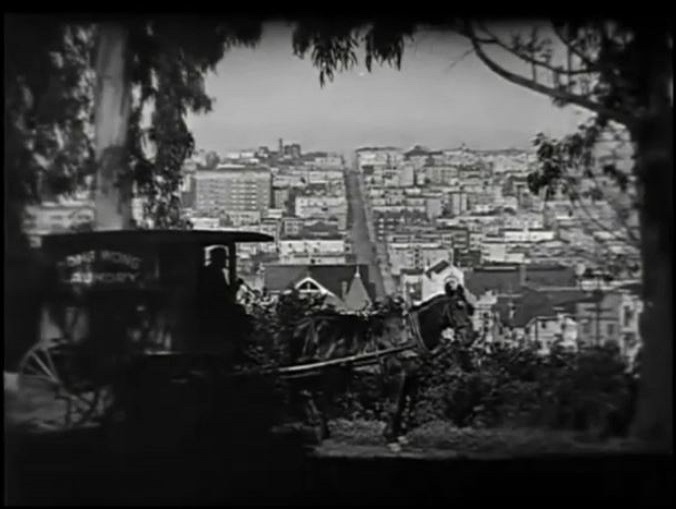
It’s "feel good" in excelsis and everything works out through collaboration and trust just the kind of message families and children most wanted to here in the land of second chances. Unsurprisingly Dinty was a success and one of the films of the year according to Photoplay magazine and box office returns. It also provides some excellent shots of contemporary San Francisco all of which add an element of realism to the film as well as glimpses of the city 100-years past.


This is Edward Lorusso’s tenth Kickstarter funded presentation and the source film came from a private collector. The print quality is very good and the experience is enriched by Ben Model’s practiced piano accompaniment which matches the flow of the film’s pace and tone to a tea.


Aaron Mitchell is ace too!


The production is now available from Grapevine Video on Blu-ray and DVD and you can buy direct from their site here. It comes with the comedy short A Two-Cylinder Courtship with Billie Rhodes and Edward Lorusso providing accompaniment.


Mr Lorusso is also on another project now, Marion Davies in Zander the Great, a new scan of the original 35mm nitrate print by Library of Congress. There’s still time to support this very worthwhile project and the link is right here… please support if you can!