These people don’t do things by halves, do they? Eight days
of almost ceaseless cine-muto reached a crescendo on Saturday evening with Ramón
Novarro, Norma Shearer and the Orchestra San Marco, Pordenone, conducted by
Mark Fitz-Gerald playing Carl Davis’ score.
The Student Prince in
Old Heidelberg is another I’ve saved for the big screen and live
accompaniment and Mr Davis’ score is one of his nest for this near-perfect
movie from Ernst Lubitsch – romantic, witty and so poignant… Davis works from
inside the film outwards and I have a feeling he and Herr Lubitsch would have
got on well!
Now then, Mrs Thalberg remains a slightly controversial and divisive
figure and there are those who favour Silent Shearer over Talkie Norma but I
like them both and here she is simply superb. Ramon is a very pretty boy and he
does well, but only Norma moved me close to tears (darn it Pordenone, that’s
three times you made me cry!!) with an intelligence pf expression that is
rarely equalled.

This is not the gung-ho tennis playing sophisticate of The Divorcee but a woman who finds true
love and then, heart-breakingly, has to let it go. Typically, she must decide
for her Prince; they will both love again and marry as their station and duty
demands but they cannot be happy. All of which reminds me of a conundrum I once
had with Princess Anne… but it was all worked out amicably.
Lubitsch too is a man of many phases and it was instructive
to compare The Student Prince… with
his Pola Carmen from earlier in the
week. The latter was energetic and game for a quick laugh but, ten years and a
whole continent onwards, his approach is more delicately-defined. This film has
plenty of evidence of his famous touch form the over-regimented raising of hats
for the prince to the lovely time he chases Norma’s humble hotelier’s daughter,
Kathi, along a series of arches; the camera follows them, anticipating their
arrival at the next arch until, suddenly, the don’t: the prince has caught his
girl and who knows what private passions are being expressed.
The pacing is so well handled – a real musician’s film – and
the overall tone is one of good humour even if the end-game involves balancing
duty against individual happiness.
 |
| Lovely composition. Cheers Getty Images! |
The programme notes reveal that The Student Prince… was an attempt to win back the mid-European
market by showing a more human side to Germanic characters – a similar problem
was faced with Herbert Wilcox’s Dawn (1928) about Edith Cavell. Here Lubitsch
is on safer ground but these men have honour as well as humour.
Appropriately enough for a Ramon Navaro film, this film was
M-GM’s second most expensive film after Ben-Hur (in which the actor starred). Apparently,
Norma fought off competition from May McAvoy, Marceline Day, and Fay Wray for
the role but I can’t see any of them playing the role as well. That said… there
were moments of tension with her director as he felt he initial performance was
too grand: ‘Mein Gott!’ he shouted. ‘I can get a waitress from the commissary
who will do better than you.’
That may well be Ernie but she’s got a guy called Mr
Thalberg at home and he’s quite important. IN the end, Irving superbly defused
the situation with the line: ‘Darling, I’m sure we can all learn a lot from Mr.
Lubitsch.’ I’m sure she did.
We also watched:
 |
| Karina Bell and Peter Nielsen in Morænen |
The Swedish Challenge
has been my favourite strand and shown me that there is far more to Scandinavian
silent film than Victor and Mauritz… today’s double maintained the quality and
in the case of the latter Anders Wilhelm Sandberg’s Morænen (1924), featured some of the best accompaniment of the week
from Stephen Horne on piano and various and Elizabeth-Jane Baldry.
Elizabeth-Jane
users her sonic pallet way beyond the confines of traditional playing much as
Stephen has pushed the piano; together they sounded like a dozen players and
produce music that is delicate and the with all the attack of more avantgarde
composition. In the end, the Teatro Verdi wouldn’t let them leave the
orchestra pit until they’d take a bow on the main stage: and well deserved too!
The film itself was quite dark with an overbearing father a
dying mother and a brain-damaged son. It’s interesting to see how mental
disability was treated at the time and – given the huge developments in
diagnosis and treatment over the years, very valuable social history.
Everyone seems to care for the boy in question, even the
father for whom he is a daily reminder of his "hateful" mother (IHAO), a man of unyielding selfishness his over-compensatoin was for his own failure.

Teuvo Puro and Jussi Snellman’s Anna-Liisa (1922) was no less challenging and this time involved
infanticide a woman unwittingly getting pregnant after an, un-consensual
liaison with a local ruffian. She has the child but kills it new born and as
she tries to move on and marry the man she does love; this past comes back to
haunt her. The answer is to come clean and accept both crime and punishment: another
scandi-redemption song and it’s true.
Gabriel Thibaudeau
wove some elegant lines throughout his piano improvisations, he seems to have
all the time in the world: The Eric “Slowhand” Clapton of accompaniment.
 |
| No, please... don't kill Creighton Hale! |
After all this Scandinavian seriousness, hearts were sinking
at the merest sight of Danish director, Benjamin Christensen in the credits for
Seven Footprints to Satan (1929). But, we needn’t have worried for it was an
absolute hoot that prefigures the comedy horror of Cat and the Canary and Universal’s funnier moments. It’s very well
done and whilst Creighton Hale rises to the occasion, Thelma Todd just
blows him off screen!! Screwball before screwball was invented.
Turns out
Christensen was far funnier than we thought… talking of which: don’t miss
Haxan, at the Pheonix Cinma on 31st October… Halloween Night, yes,
that’s right! Tickets available here!
Rising star Daan van den Hurk was on hand to have fun
accompanying this one.
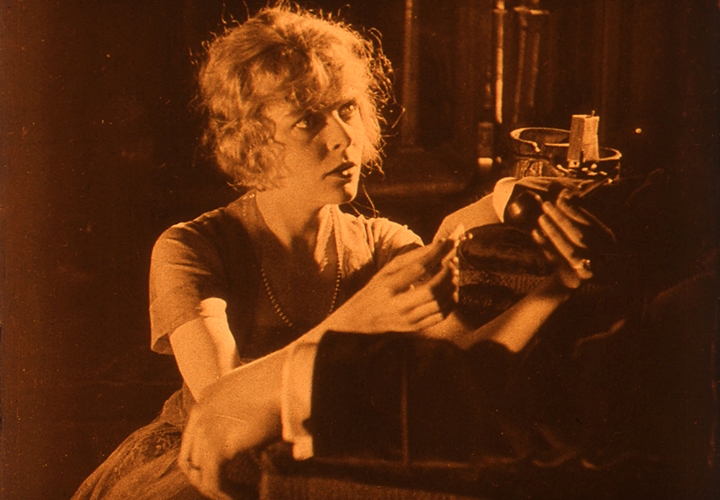 |
| Blanche Sweet |
Also funny and disturbing was The Deadlier Sex (1920) and the sight of Boris Karloff in pants
that looked liked they had been stolen from a New Romantics party in 1981!?
Thank goodness we didn’t see those in colour!
Robert Thornby directs and his two leads sparkle especially
Blanche Sweet as the daughter of an industrial magnate aiming to be just as
tough when “Wall
Street alchemist” Harvey Judson (Huntley
Green) tries to bully her Dad’s former business out to the market. Nothing a
bit of sedation and kidnapping can’t fix as she has Green transported to the
wilds to sink or swim.
Boris is hired to put
the frighteners on him but he takes his role a little too seriously. It’s fun and
Masterclass graduate, Bryson Kemp, played along with a spirit of adventure!
 |
| Georges Méliès: Le Rosier Miraculeux (1904) |
Then, just before The Student
Prince… we were treated to a
recently-discovered Georges Méliès: Le Rosier Miraculeux (1904) or The Wonderful
Rose Tree projected in almost immaculate
condition on the huge screen. It is truly amazing that his work is still being
discovered but it’s thanks to the dedication of the very people who attend,
program, perform and otherwise support Pordenone that all is possible.
So keep on being
passionate about cinema muto in all its forms. Enjoy it, discuss it, engage and
promote it and we will not only have more wonderful weeks like this one but so
much more.
Grazie Mille
Pordenone!! Vediamo l'anno prossimo per GCM37!
 |
A communication from the Mile-high Blogger Club (no, it’s
not what you think…)
|