
“… the expropriation of the kulaks is an integral part of
the formation and development of the collective farms. Consequently, it is now
ridiculous and foolish to discourse on the expropriation of the kulaks. You do
not lament the loss of the hair of one who has been beheaded. …they are sworn
enemies of the collective-farm movement …”
Josef Stalin, Problems of Agrarian Policy in the USSR,
27th December 1929
Even having seen the other two parts of Dovzhenko’s "Ukraine
Trilogy", Zvenigora (1928) and Arsenal (1929), Earth
comes as a surprise in terms of its sparse approach and almost dreamlike quality. The director is
so confident in his use of form that he appeals directly to the watcher and within a few minutes you
know this is going to be something of a "conversation" about nuanced visual expression. It’s a mindful experience that calls on the
viewer to understand the process of editing specific faces, acting or not, arranging moments and leaving spaces… the meaning is sometimes in the gaps between events and not defined by
title cards*. It’s also perfect for the soulful musical interpretation of one our
finest film accompanists...
Now, many party members would tend to disagree with what is
clearly an "ideologically vicious" waste of public funds which fails
to communicate the clear imperatives of collectivisation and de-Kulakization
but, as Dovzhenko’s later communications with Stalin would plead: “This is
my life, and if I am doing it wrong, then it is due to a shortage of talent or
development, not malice.”
It can be hard to second guess The Leader in matters of political sentiment and whilst it's impossible to know how much Dovzhenko was ever looking to "please", with Earth he was judged to have failed in his attempt to walk the line between indivdiual artistic expression and collective objectives. Pravda praised the film’s style yet claimed that its political message was “false” whilst Demyan Bedny called the film "counterrevolutionary" and "defeatist” in a poem decrying the director’s naïve philosophical attitude… he was probably right but Dovzhenko mined more truth than increasingly murderous political reality would allow and even if he was forced to re-cut.
 |
| Tractor boy, Semen Svashenko |
A few figures. none of which would have been known to the
film maker at the time. Stalin’s first Five Year Plan and its policy of dekulakization,
the removal of “wealthy” peasants/landholders, may have led to well over half a
million deaths between 1929 and 1932 from hunger, disease and mass executions. Some
1,800,000 peasants were also deported to the cities to support collectivization and
industrialisation with the aim of making the Soviet Union an industrial superpower
and to create a rural communism hence the need to remove all landowners no
matter how small their holdings.
Dovzhenko, from Ukrainian peasant stock himself, was one of 14
children born in a small village to uneducated parents. He managed to survive to
adulthood, when 12 of his siblings did not, and became a teacher. He then fought for
the Red Army in the post-revolutionary Civil War and joined the Borotbist
party – one of a number of leftist groups – before becoming a writer and film
maker in the mid 1920’s. Here, whilst welcoming the arrival of mechanisation and
modernisation, he could not fail to sympathise with those facing change but
clearly this was not the time to point that out, no matter how obliquely. Russia
was never an easy tale to tell as my endlessly patient tutor, Dr Robert Gildea, had to remind me with every essay.
 |
| Contented death, Mykola Nademsky |
The film starts with the gentle passing of one of the
village elders, Semyon Opanas (Mykola Nademsky) beneath a fruit tree and
surrounded by friends and family, old and young, in the midst of the natural
life he has loved. It’s an odd death as he briefly rallies in time to eat an apple, before falling gently back and drifting away surrounded by nature and family.
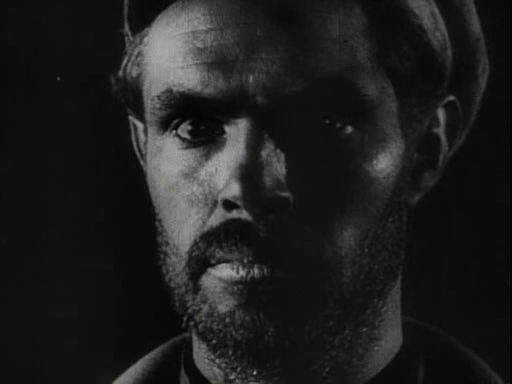
Then we see the reactions of various faces distorted first
by grief and then by anger as we segue to a party meeting, a member reads of
the sabotage undertaken by some Kulaks who we then see in a further meeting
with Arkhyp Bilokin (Ivan Franko), and his son Khoma (Petro Masokha) who is
intent on doing what he can to hold back process. Thus, Dovzhenko takes us
through transitionary close-ups to move from the loss of the old man, and his
ways, to the raging debate over the new. Here, as elsewhere, Danylo Demutsky’s cinematography delights in the capture of the grandeur and simplicity of nature and human
response.
 |
| This woman's not from Venus but from Mars... Yuliya Solntseva |
Talking of which, whilst I’ve heard Mr Horne accompany so many films, here he is
mining a particularly rich seam or, more precisely, ploughing a deep furrow. There’s a stirring
Russian march as the overture followed by some rolling lyricism to accompany
the old farmer’s gentle death in this bucolic setting, optimistic rising chords
counterpoint the last breaths drawn on the accordion which Stephen uses almost
as a human “voice”, an earthy sound against the piano’s upper register. Beguiling
flute lines float over both piano and accordion… then we return to that opening
theme, as the farmers discuss their friend’s life and uncertain legacy.
Now Father, the Kulaks are finished… When we have the
machines, we’ll take their land away.
The debate continues in the house of Opanas (Stepan
Shkurat) and his modernising son Vasili (Semen Svashenko, the fresh-faced hero
of Dovzhenko’s Arsenal) who is counting on a new tractor to convince his fellow
villagers of the need for change. Vasili’s sister, is played by Yuliya
Solntseva who was not only Aelita, Queen of Mars, but the director’s
long-term partner and wife. A director herself, Solntseva died in 1988 having lived
long enough to see Perestroika and Glasnost reforms, the beginning of the end
of the USSR.
 |
| Foppish young Kulaks, Petro Masokha in the middle |
The tractor arrives and as the villagers look on – the director focusing in closeups of locals cast, as per Eisenstein, for their looks, disaster strikes and the vehicle runs out of water. Then, in one of the funniest moments in soviet cinema, two men volunteer to fill up the tank using their own urine, they may strain but the flow eventually comes and the tractor is driven triumphantly into the village by Vasili. He drives the tractor over to his father who is scything the wheat by hand and tells him to throw his “crutches” away and, for possibly the only tine in the film, the older man smiles. Then we see the increased productivity as the tractor ploughs up more fields and allows a far quicker harvest and production. This is a moment of powerful transition and one that is to be celebrated by – nearly the whole village.
Later in the night-time, as the lovers hold each other and the
future looks tenderly bright… Stephen’s response to Dovzhenko’s lyricism is a
symphonic one, relishing the close-focus humanity and the connections between
the land and peace, whether individual or collective.
 |
| The last dance. Semen Svashenko |
The musical themes are weighted with their own meaning and whilst
they perfectly fit the action as you’d expect they also add (an) extra
character. As Vasili walks a drunken walk home, reflectively sozzled by the
success of the tractor only to take a pause and suddenly start dancing a hopak,
accompanied by accordion and a liquid turn of musical pace. There are so many
moments of immersed musicality which play with the director’s ultimate joy in
human thought. You don’t watch him dance you join in the dancing… irresistible sympathetic
syncopation.
And, what a fine dance it is too… but just as it looks like
it could carry on for ever, Vasili is struck viciously form behind and falls
dead to the ground as his assailant runs away.
In the moment following the murder, Stephen’s thin lines
from the top end of the accordion slice through the sadness and provide the
most fragile of carriers for the devastation on view. Extraordinary control
during the film’s emotional crescendo when the temptation might have been to
add thunder not this sad lightning. I also loved the repeated theme that
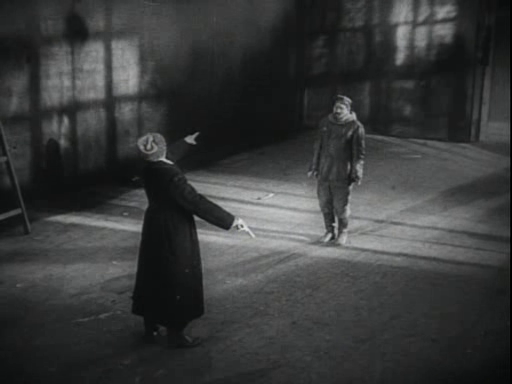
surfaces so prominently during the brief confrontation between Opanas and the
priest, the former’s sadness at the hurt he has given is reflected in the music’s
almost winsome despair; there is no God… and there are no priests.
 |
| Stepan Shkurat's extraordinary energy |
And we’ll sing songs about the new life…
Vasyli’s funeral provides the moments of the film’s dynamic
and magically real ending as the majority of the village marches behind his
opened casket on its way to a committal without priests or religious ceremony.
Meanwhile the local priest (Volodymyr Mikhajlov) rages for God to punish the guilty
and Vasili’s fiancée Natalya (Yelena Maksimova) strips naked in her house and
almost dances her anger and grief. Cutting between those two scenes, Dovzhenko
also shows us Vasili’s kulak killer tearing through fields and finally shouting
his confession at the funeral cortege… he is ignored as the local party leader
tells them that Vasili’s sacrifice will not be in vain.
There’s a lot to unpack in this final sequence and, even
though there are a number of different cuts of this most censored of films, the
director’s “cut” is always there for us to interpret. What the authorities saw
as wrong thinking was Dovzhenko’s ambivalence to the changes being made to his
community in “the breadbasket of the Soviet Union”. Yet, he did see a
collective solution with the secular unity and the determination to continue
Vasili’s work reflected in Natalya’s closing reverie, even if her naked grief
was excised from most cuts.
 |
| Yelena Maksimova's primal grief |
The director’s real issues with Stalin came after the film
culminating in his plea quoted above as the Georgian became more and more
unpredictable and ruthless in imposing a collective solution for Russia’s agrarian
economy. By the end of 1928 just 1% of the farms had voluntarily become
collectives and Stalin essentially imposed forced collectivisation not just on rural
Russia but also on his own regime with opposition outmanoeuvred or simply
removed. That’s a whole other story but here in 1929-1930, the fact that Dovzhenko
was able to make a film in which he showed the impact on everyone is proof
enough that, even as worse days were coming, there was still optimism and
diverse opinion.
I watched the film on Klassiki which is the only place in
the world where you can stream classic film from Russia, the Caucasus and
Central Asia! You need to be a member to access the content but at £9.99 a year it is an absolute bargain.
Watch it for one of the greatest of all silent films, for a
history primer and for one of the finest musical accompaniments I’ve heard in
some time!
*Earth exists in some nine different versions and whilst
this copy seems near complete – including the nudity – it’s possible that not
all the title cards from Dovzhenko’s original final cut survive.






.png)





