Showing posts with label Lewis Stone. Show all posts

Saturday, 19 August 2017

Tall tails... The Lost World (1925), Lucky Dog Picturehouse, Wilton’s Music Hall


Dunkirk and superpowered Amazons aside, 2017 has not been a vintage year for blockbusters but in 1925 it was a little different with The Big Parade being a huge $20 million hit followed by the likes of Ben Hur, The Gold Rush and The Phantom of the Opera. Also comfortably in the top ten grossers was The Lost World a science fantasy from the pen of Arthur Conan Doyle who swapped Baker Street for brontosaurus in his wildly successful book of the same name

We’re not so different 1925 and 2017, are we? Literary adaptions fuelling Hollywood invention and excess only in this case they knocked the ball right out of the Jurassic Park using techniques rarely seen before and on a scale that was to set the template for the next century of alien worlds from Kong all the way to Skull Island.

Sir Arthur abides... a snip from a contemporary documatary replaces his original intro.
For Harry and Mabel, Frank, Lil, Jenny Wren, William, Jessie and Jim, this would have been their first exposure to prehistoric animation a visual shock on a par with any technological leap seen since although I can’t see our Jessie being that impressed with such frippery.

Directed by Harry O. Hoyt and completely unlike anything he or anyone else had produced before, this was adventure cinema as adventure based on a concept that was far more believable in an age before satellites took some of the fun out of exploration. As recently as twenty years ago an expedition to a huge meteor crater in Africa was touted as possibly revealing a “lost world” of new and previously-extinct species… we live in hope and we want to believe.

But here the brave band of explorers discovers the past alive; mind-blowing wish fulfilment we cinemutophiles can completely relate to. And here in the restored stucco walls of our oldest music hall, we feel the same frisson as, with Emily O’Hara’s intrepid troop of musical adventurers to guide us, we simply connect with a lost world of nitrate wonderment.
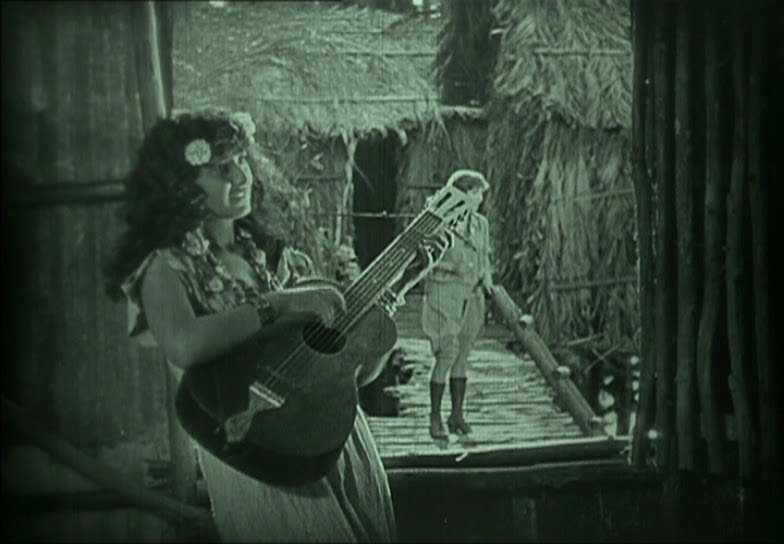
The indigenous sounds of the deep Amazonian rain forest.
The Lucky Dog players snuck on stage in character, pith helmets and jodhpurs along with an inflatable tyrannosaurus. Their music is witty and very tightly orchestrated with Emily on guitar, mandolin, cello and musical direction, Christopher Eldred on piano and clarinet, Daniel Tiberius Mays (parents, Star Trek fans?!) on woodwind – a deliciously poignant flute and Nicholas D. Ball on percussion and some very effective dino-sounds!

I loved their playful syncopations and when they were clicked off by Nick’s drums their ensemble playing is a real joy – is dancing allowed mid-film?! They also handled the thematic work well and I was especially entranced by Emily’s Spanish guitar lines and Mr Eldred’s way with the pianoforte: the bedrock of a score which not only included snatches of contemporary songs – the lovely What’ll I do? – but also a few notes from Jurassic Park (or was that just my projection?!).  It’s music that competes sometimes with the narrative but for this film and in this setting, that’s exactly what you need.

Hipsters go mad for silent film!
Wiltons is an interesting silent film gig and it was good to see so many young and unfamiliar faces and an audience who, inspired by the Lucky Dog verve, had a ball with the film: laughter is the gateway response to silents. Not that The Lost World is ever meant to be taken entirely seriously; as with its modern counterparts, there’s a rich mix of humour and action from the relationship between the squabbling professors to the convenient get-out for our main hero at the end: what happened in the jungle doesn’t always need to stay in the jungle!
                                
The Trachodon about to do battle with the Allosaurus!
We shouldn’t underestimate the impact stop motion techniques had on contemporary audiences, just as the CGI from the first Jurassic Park looks slightly awkward compared with Jurassic World over twenty years later, technology moves on and our perceptions follow. The film’s special effects maestro, Willis O’Brien had worked on stop-animation since 1918 and a short test film he made was shown by Conan Doyle a meeting of the Society of American Magicians, which included Harry Houdini in 1922. Doyle refused to discuss the film's origins but the audience and press alike were astonished… the New York Times declaring that if they were fakes they were “masterpieces”.

Sir Arthur is featured on his porch at the start of the film, he looks happy enough and I’m sure a good deal was arranged for the script as developed by Marion Fairfax. The author later declared that it was Lost World’s Professor Challenger who was his favourite character and not the Great Detective.

Wallace Beardy!
You can understand as Challenger is all for pure adventure even if here he’s opposed by the scientific establishment. He’s played by Wallace Beery complete with wildling beard and scatty fringe highlighting wide staring eyes as he’s laughed at by his peers. He’s looking for men to accompany him on an expedition to the Amazon to try and rescue Maple White whose journal suggests that dinosaurs still roam a plateau deep in the jungle. Noted adventurer and game hunter Sir John Roxton (Lewis Stone) offers to join him as does Professor Summerlee (Arthur Hoyt) who wants to prove him a fraud.

A young reporter, Edward Malone (Lloyd Hughes) also offers to join up much to Challenger’s disgust – he hates fake news – but Ed has a girl to impress with daring deeds, Gladys Hungerford (Alma Bennett). But, once then young fellow spies White’s daughter Paula (Bessie Love) we and he aren’t so sure of this prior commitment.

A US map of the Atlantic: Britain known by its proper name of Liverpool...
Cut to animation of ship skipping down a map from London to Brazil and the team are soon looking at a huge plateau with only one way up. They climb a rock tower and walk across a tree trunk to the plateau but their route is soon swiped away by the first of many huge new animals: the dinosaurs are here!

The stop motion is still impressive (thousands of movements over hundreds of painstaking days) and O’Brien worked a split screen with increasing confidence as he showed the “tiny” actors against a backdrop of dense forest and battles between Allosaurus, Brontosaurus, Triceratops and Stegosaurus (the last two my childhood favourite dinos). By the film’s spectacular conclusion, we see a Brontosaurus let lose in 1925 London… eight years later, O’Brien had a giant gorilla doing the same in New York.

Very smart split screens
If the story intensity drops on the plateau it’s because the adventure was all in seeing these great creatures live and move again and we’re all so used to seeing dinosaurs now. But there were moments when music and music hall helped us recapture the magic of discovery once again.

The Lost World was so nearly a lost film and is still being restored with a new 110 minute long Blu-ray due from Flicker Alley on 12th September. The version shown was the 93-minute restoration from 2000 used on the Eureka DVD which has perhaps 90% of the original content according to Doyle and Lost World expert, Roy Pilot’s commentary.

Reaction shots are key to believability.
It’s a classic bit of fun – pure cinematic pleasure! Wilton’s and the Lucky Dogs made sure we all had the best of it!

This was part of a short summer season from Lucky Dog at Wiltons including the magnificent Brit-com Shooting Stars and, footage of Irving and Malory’s fateful climb in The Epic of Everest. For details of upcoming show visit their website or follow them on the old social media.


Saturday, 11 July 2015

Shearer vs Shearer… The Divorcee (1930) and Their Own Desire (1929)


In 1930 Norma Shearer was nominated for two Oscars for her performances in each of these films winning on Divorce but losing on Desire. Sometimes too easily associated with her mighty husband Irving Thalberg, Ms Shearer deserves a lot of credit for evolving screen acting from silent to sound along with Greta, Joan and co.

I like her relaxed focus, her uncluttered expressiveness and the unconscious way she’ll pay attention to the granular details in order to reinforce the naturalistic surface. She has energy – literally – standing up against the men as well as a wit and native intelligence which transcends her characters.

Norma Shearer
Then there was her look… falling somewhere between Clara/Jean’s inherent sexiness and Garbo’s ethereality, Norma had a naturally-fascinating face, one you could see on many streets but one that came to life on screen animated by a gentle expressiveness that presents convincingly as real.
In these early sound  films her voice can come across as slightly shrill and high pitched but that’s technology as much as technique and is more noticeable in Desire than Divorce. She may not have had Greta’s range or Joan’s ferocity but she was a force to be reckoned with even for her husband.

Norma gives Robert Montgomery a piece of her mind
Famously, Joan Crawford was up for the part in Their Own Desire with even Thalberg doubting his wife’s ability to sex-up. Norma’s response was to commission a photo shoot that so emphatically proved her point that she got the part. That’s acting… and the assurance of the moral high ground at home for months.

The nominees include… Their Own Desire (1929)

Belle Bennett, Norma and Lewis Stone
Their Own Desire was directed by E. Mason Hopper, written by the ubiquitous Frances Marion based on the novel by Sarita Fuller. It was released just after Christmas in 1929 and is a slick early talkie with evident “pre-code” leanings…

Cue Norma in tight top and jodhpurs (the swim suit comes later…) taking part in a polo game, playing daughter Lucy - aka “Lally” - to her lovingly-competitive dad, Henry Marlett (Lewis Stone). She falls and there are anxious minutes as she recovers yet she won’t let a little winding slow her down.

A bit like my weekends...
Back home to see mother, Harriet (Belle Bennett) who seems old before her time, especially in comparison to the widow Beth Cheever (Helene Millard) a woman who hasn’t forgotten where the peroxide bottle is. She’s clearly on the lookout and, whilst Lally makes fun of this she doesn’t suspect that there’ be any danger…

Cut forward some months and the worst has come to the worst and Lally still knows nothing even after her parents have agreed to divorce which they are hoping to disguise by her and mother going off to Europe for a few months…

The other woman...
But Lally blunders across the truth when she walks into her father’s workshop to find him and Mrs Cheever in a compromising cuddle. She can’t take it all in and refuses to balance her father’s wish to spend time with “The one” against her mother’s misery.

Meeting Mr Wrong?
Team Mom heads off on their break and Lally meets a sparky young man called John (Robert Montgomery) whilst demonstrating a sleek swimsuit at the local Lido. He sneaks a sub-aquatic kiss and a romance begins. All is swimmingly-swell until a fateful moment when he reveals himself to be Mrs Cheever’s son.

Oh delicious pain… Can Lally be involved with the son of the woman who ruined her parent’s marriage? No spoilers… 


And the winner is… The Divorcee (1930)


This film was released just under four months later and, allowing for the Thalberg’s Christmas break and January skiing holiday, must have taken less than three months to produce.

Directed by Robert Z. Leonard from a novel by Ursula Parrott, The Divorcee is a “tighter” film and less obviously melodramatic than Desire. The drama comes out of the central couple’s relationship and the eternal questions of fidelity and communication between men and women.

The guests are all shocked in different ways...
It starts off with a gathered of NYC high-flyers at a large log cabin – large enough to include the wise-cracking housekeeper Dorothy (Judith Wood) and separate rooms all round.

As the jollity proceeds, everyone wonders where Ted (Chester Morris) and Jerry (Norma Shearer) are? Jerry’s former/nearly-love (?) Paul (Conrad Nagel) stands watch at the door; still hoping, still pining whilst a young woman Dorothy (Judith Wood) looks longingly at him: a daisy chain of the disappointed.

Ted and Jerry encouraged by a local youth...
We cut to Jerry and Ted enjoying some affectionate larks by a stream as he kind of pops the questions and she, kind of, accepts – it’s carefree as emphasised by a young boy urging her to say yes “for the love of Mike” as he waits to resume his fishing… They return to the party to congratulation and celebration led by Ted’s best mate Don (Robert Montgomery – again!) as Paul turns quickly to the bar with disastrous results. As everyone leaves he crashes his car disfiguring Dorothy for life and eventually marrying her out of the obligation of pity.

Shifting forward three years we re-join the crowd at a party to mark Ted and Jerry’s anniversary. All looks to have been blissful until an uninvited guest arrives: Janice (Mary Doran), a woman who seems on familiar terms with Ted.

Oops!
Now comes the test as Ted reveals to Jerry that he had a one-night stand with Janice…. Protesting that “it “doesn’t mean a thing…” Ted clearly isn’t able to admit or comprehend the huge misstep he’s taken and, with a business trip looming, he’s about to be away from two whole weeks before he and Jerry can really process the betrayal… and, by the time he gets back things have developed momentum.

Ted departs that night and one thing leads to another as Jerry  gets tipsy with kind, loyal Don and, as the curtains are drawn in his apartment Jerry decides to “balance the account”.

Jerry about to balance the account...
Jerry’s not really that kind of girl and on Ted’s return, as he tries to go back to normal she reveals the truth (careful to keep Don’s name out of it). Oddly enough Ted takes this badly and seems to have lost touch with the whole “meaning nothing” vibe... He loses it and Jerry, realising by now that she’s married to a narrow-minded hypocrite, decides to become the kind of lady that he imagines men to be: she will enjoy herself.

Ted turns to drink and runs off to Europe whilst Jerry enjoys a string of relationships smartly represented by various tableaux involving Jerry’s and a variety of suitors’ hands as they hit the towns… Are they punishing themselves or trying to run away? The escape is going well until Jerry finally runs into Paul again…


The Divorcee is a better film than Desires both technically and in terms of content but I think Norma Shearer’s performances are equally good in both and she is the main reason to view. For all the sexy pre-code accoutrements – infidelity, wine and skimpy – both films are ultimately morality tales that promote the values of loyalty, forgiveness and the importance of love over pride.

The Divorcee is available as part of the Forbidden Hollywood box set volume two whilst Their Own Desire is on Warner Archives DVD.

Tuesday, 8 January 2013

Betty and Lon go boating… Nomads of the North (1920)


Betty Blythe and Lon Chaney
Sometimes you have to work a bit harder to really connect with a silent film: they don’t always contain ground-breaking techniques or anachronistic naturalism. With Nomads of the North it’s more a question of just letting go and trying to enjoy it for what it was intended to be in 1920.

The film certainly caught the attention of my two teenage “critics” and that, if anything confirmed that it is still viable entertainment after almost 93 years: pet bears, forest fires and a good man wronged by the cheats around him… all that and will he get the girl?


Directed with economy and some flair by David Hartford, Nomads of the North was based on the popular novel by James Oliver Curwood – a purveyor of dramatic “pot-boilers” featuring similar themes of love, betrayal and decency in the end. Things change but maybe not that much… popular entertainment still requires skill and they can’t all be middle-brow Euro art films.

The film is set in the wilds of Canada, “God's great wilderness” (not a million miles from Nell Shipman’s latest adventure no doubt…) in a small community thriving on timber and trapping. 


Here the main draw is Nanette Roland - the film’s star Betty Blythe, Theda Bara’s nominal replacement at Fox and accordingly later to reveal a lot more as The Queen of Sheba and She. Nanette not only attracts the attention of the local Mountie Corporal O'Connor (Lewis Stone) but also the sleezeball son of the local business leader, Buck McDougall (Francis McDonald)

But Nanette is pledged to Raoul Challoner (Lon Chaney: all limbs still attached, his real face uncovered… playing the romantic lead…), a fur trapper who has long been missing. She dotes on her gravely ill father (Spottiswoode Aitken) who is too infirm to work leaving his family in debt to the McDougalls.

Lon Chaney and friend
One of Buck’s men reports that Raoul has been killed and, following the death of old man Roland, Nanette is forced into marriage with Buck. But…! Just as she’s about to pledge herself, Raoul arrives to save the day.

The couple only gain brief respite as Buck continues to try and remove Raoul, attacking him with his side-kick. Raoul is too strong and fights them off but in doing so accidentally kills the other man. Accused of murder, he is chained in the room below the McDougalls’ house awaiting the sheriff and a host of phoney testimonies from the family’s hired hands.

Betty Blythe is armed
Nanette will not accept this fate and bravely rescues her man and the two head off into the wilderness with his adopted pets a Grizzly Bear called Neewa and a dog called Brimstone. These two get quite a lot of airtime but were still able to impress my youngsters…

Melbourne MacDowell and Francis McDonald

Time passes and Nanette and Raoul are seen in domestic bliss with their two animals and their new child.

It’s been over three years but sadly they get recognised by Buck. He waits for his chance and tries to blackmail Nanette into leaving Raoul for him but she fends him off with the aid of the pets. Then Buck tells Corporal O'Connor who sets off to arrest Raoul...

Lon Chaney, Betty Blythe and Louis Stone
The climax of the film is pretty impressive, as a forest fire ranges all around and we’re not sure which way the protagonists will fall right to the close. Apparently both Blythe and Chaney were injured during this fire which was actually set up on the back lot using fake trees. It served the drama very well.

No spoilers, you really should watch this as it was intended: a wholesome drama about love and steadfast morality.


This is melodrama and that can be problematic for the modern sophisticate… but both the leads do well. The style is pantomime and whilst not as subtle as the likes of Pickford, Gish and Talmadge, Blythe does a decent job. Chaney has the most expressive face but he seems to be holding back in this role…  was that script or direction? Maybe I’m too aware of the range he was to demonstrate in later roles.

Francis McDonald makes a good baddy as Buck but Lewis Stone almost steals the show as the decent Corporal O'Connor… the Mounties may always get their man but perhaps not always their woman… Stone had a long career and was one of the Stars of Grand Hotel, Queen Christina and other successful talkies.

Louis Stone
I watched the Image Entertainment DVD which is produced from a pretty good 35mm print – no restoration just good preservation. It features a fascinating score performed by Robert Israel on a vintage Fotoplayer – a multi-roll piano/organ equipped with sound effects, which was used to accompany silent films at the time.

The second film on the DVD is The Shock, which is more typical Chaney fare and again features an Israel score, this time played by an orchestra.

Both films from when cinema was fun, cast aside your preconceptions and just enjoy…