Showing posts with label Brandon Hurst. Show all posts

Sunday, 9 October 2022

Down and out in London and Marseille... The Lady (1925), Daan Van Der Hurk, Le Giornate del Cinema Muto, Streaming Day 8


Now we have it, Norma Talmadge’s finest dramatic performance and a story in which she gets through two or three times the amount of work for a normal film and probably even more for Heart of Wetona. Directed by Frank Borzage, it’s tempting to visualise him coaching her through some of the heaviest emotional lifting, which occasionally stretches her technique but she always comes through, sometimes with cheeks soaked in tears, a dewdrop on her retroussé nose, working at a pace with even Gish or Garbo. It’s a remarkable film and it gives her the opportunities she often missed, partly through her own choice.


For most of her career, Talmadge called the commercial shots and as Jay Weissberg pointed out in his introduction, The Lady was too louche for middle American audiences and did not perform that well. As Talmadge herself said, quoted by Ben Brewster and Lea Jacobs in their notes on the Giornate site, she wasn’t going to follow up the film’s style “… I am not going to do any more like it for a time, anyway. Not that I don’t like to do characterizations – I love it. But what can we do? We must play to the box office… So, for a while I am going to do modern things. I think they want to see me in gowns, in style.”


To European audiences, there would have perhaps have been less of a negative reaction but maybe Norma was also typecast to a degree and the idea of her playing a character making a living as a prostitute, no matter how understated, was not the "Norma" her public loved.


Frank Borzage had already worked with Talmadge on the more successful Secrets (1924) and must have earned her trust for this bolder film. Adapted by Frances Marion from Martin Brown’s play of 1923, the narrative is unusually structured with an older Talmadge running The Brixton Bar, a “British” pub in Marseilles, during the Great War before a flashback which explains how she got there. Apparently, the play was the first in mainstream theatre in which the heroine announces she is pregnant, be that as it may, it’s less “announced” in the film and the child appears allowing inferences to be drawn.


Two Tommies wander, one a young private the other a rather drunken sergeant, very very arf’arf’an’arf, who staggers around before squirting the landlady, Polly Pearl (Talmadge) comically in the face. That ain’t no way to treat a lady she exclaims to general mirth from some of the regulars before settling down and talking with the kindly Mr. Wendover (Marc McDermott). Wendover comes from the same village as Polly although the pictures he shares are of Magdalen Bridge and the Radcliffe Camera in Oxford, rather bigger than a village!


You wouldn’t believe that 24 years ago I was knockin’ them off their seats in a London music hall…


She recounts her history and how she came from England to this moment… the camera pulls across a swarming theatre floor and we meet Polly Pearl, the Girl with the Glad Eye, entertaining the throng with a song and a dance. Watching intently is Leonard St. Aubyns (Wallace MacDonald) a proper swell who, only has eyes for his Pearl as she arranges for a cigar-chomping stage boy to rebuff other visitors.


Soon the fantasy is rudely interrupted by the arrival of St. Aubyns, Sr. (Brandon Hurst, lovable as always) who offers her money to leave his son alone but it’s too late old chap, the couple have already married and, as quick as Senior can say “you’re disinherited” they’re off to Monte Carlo for an extended/belated honeymoon with fellow dancer Fannie Clair (Doris Lloyd) and her man Tom the Bookie (Alf Goulding). All seems fine until Leonard, unlucky at the tables, starts taking an interest in a Countess Adrienne (Paulette Duval) and, in front of her very eyes, Polly’s live crumbles. There are two moments in the film when Talmadge absolutely lets rip and here she attacks Duval’s character, knocking her swiftly to the ground. I’m not saying Borzage encouraged proto method but you don’t often see silent actresses engage in a proper Bank ‘oliday (c.f. your Cockney Music Hall Dictionary).


Polly is Friendzoned in the cruelest way...


Down and out on the Riviera, Polly finds herself in a bar run by one Mme. Blanche (Emily Fitzroy), completely unaware that it’s a bordello. It’s at this point that Polly’s baby appears and, out of options she finds friendship and a way to survive in the bar, whether by performing on stage or other means… you can see how some would have been displeased with Our Norma’s predicament.


Polly has her standards though and has the boy christened by preacher John Cairns (John Herdman) who, along with his wife (Margaret Seddon, as featured in Just Around the Corner elsewhere in this Giornate). Who turn out to be crucial when St. Aubyns, Sr. arrives with the news that his son has died and that he wants to take possession of his grandson. He has the legal papers to do so and Polly has no option but to hand her baby over to the Cairns. Talmadge is at full stretch during the sequence, misery piled on misery and injustice. She launches herself at St. Aubyns, Sr… echoing the wishes of the entire audience.


The only gig in town?

Polly heads back to London in a forlorn search for her son, at rock bottom she’s shown in blue darkness trying to sell flowers and hoping beyond all reason to chance upon her boy. It’s desperately sad and, Talmadge judges it just right and there’s not a dry eye in our house… We fast forward another two decades and her old friend Mme. Blanche has helped set her up in this bar where she can life out what remains of her wasted life in relative comfort.


Wendover urges her to not give up, even as she displays every sign of having done so. But… well, you really have to seek this out and marvel at her final flourish!


The Lady thoroughly deserves its reputation and this restoration has balanced the meaning as far as possible given the state of the surviving materials. Now we can all see for ourselves what the reviewers and audiences of the time could see in this remarkable actress and I would echo Jay Weisenberg’s hope that this is just the start of Norma’s wider rehabilitation.


Wit's end?

As he said, Talmadge is also so generous with her co-stars, allowing them to shine alongside her; it was her production company after all but she knew the value of teamwork and of honest artistic expression as well as crowd-pleasing box office fare.


Daan Van Der Hurk accompanied with some gorgeous lines and the full measure of Talmadge’s ambitions here. This was delicately nuanced playing that, just like the star, never dropped into melodrama or over-expression. Wonderful stuff that, again, I really wish I could have been there to see live! Next year Pordenone, I’ll be Covid free and ready to buy round after round of Aperol Spritz… just you wait!


Talmadge’s career dénouement has long been a puzzle with legend having Constance reminding her that Ma’s trust funds meant that they didn’t need to work again and Norma saying to fans, "Get away, dears. I don't need you anymore and you don't need me." as quoted by both Anthony Slide and Denise Lowe. Jay suggests the words of her second husband George Jessel in his book Elegy in Manhattan (1961, after Norma’s passing), offer a clue with his poem, told from her point of view explaining that she’d never been a stage actress, only a silent one, and it was just too late to learn another craft. She’d done enough and now it was time to just live.


Norma Talmadge


Sunday, 5 July 2020

The silent family… Dr. Jekyll and Mr. Hyde (1920), HippFest at Home with Neil Brand


Catherine: I’m sure we’ve seen this… (we had)
David: How long is it exactly?
Beth: I love it when the playing switches to diegetic.
Paul: Ohh, that’s good, er… what does it mean?

Welcome to another sitting room Saturday evening, as the four of us gather round the TV to watch “one of Dad’s” which is only fair seeing as last night I had to endure Will Ferrell’s The Story of Fire Saga. Lockdown has brought back family viewing for us as we convene following days distributed around the house, working, reading or fighting droids on the PS4. But this was a gathering of a different kind as cinemutophiles from the four corners came together to enjoy a live stream with improvised accompaniment.

One of my biggest disappointment this year was missing the Hippodrome Silent Film Festival which was cancelled just as the lockdown began. The Hipponauts have stayed connected via social media though and after an earlier shared watch-along of Clara Bow’s It, this was the full Monty: a learned introduction from Pamela Hutchinson and the wonderful – properly diegetic – scoring of Neil Brand for one of the classics of the silent era, courtesy of Kino Lorber’s Blu-ray of the 2011 restoration. But this was also another of those “appointments to view” with so many of the silent film community also watching and commenting as the film played; from London, Bristol, Scotland, Europe and the USA… we were all in the room sharing the film just as we do in Festival. Sure, we had to bring our own drinks but this was a night when social distancing became merely a physical construct.

Pam in our living rooms
Lesley O’Hare, Culture and Libraries Manager, Falkirk Communities Trust set things rolling before Pamela of Walthamstow entertained and enlightened on the subjects of the story and the film. She provided everything you want from an introduction, not only explaining how Robert Louis Stephenson came to write The Strange Case of Dr Jekyll and Mr Hyde but also highlighting the themes of duality in this “timeless tale of weird science and moral absolution.” We played theme spotting throughout the film after this, with Beth and Catherine putting me to shame, as Jekyll’s deal with himself, undermines his soul in ways he did not foresee. Whether you can deal with your inner conflicts by physically isolating them remains a moot point and the addiction to scientific advance, medicated freedom and unlicensed freedom will need to be controlled within the whole man: your desires can’t write cheques your conscience can’t cash.

Any-way… Pam did warn against pop-psychology and taking all this away, this is still one of the finest silent horrors and features an uncanny performance from The Great Profile himself – or, Drew’s Grandad as Beth sees him. John Barrymore had risen through the twin tracks of theatre and cinema and this was one of the roles that got him recognised as a performer in serious roles after being mostly a comic player in his films from 1913 to 1919. Film Daily was not alone in being impressed "… it is the star's picture from the very outset, and it is the star that makes it… “, his performance “… a thing of fine shadows and violent emotions…"

Brandon Hurst talks to John Barrymore about temptation
Directed by John S. Robertson from Clara Beranger’s script based on Thomas Russell Sullivan’s 1887 stage play, filming was on stages constructed in the Amsterdam Opera House on 44th St. Manhattan,  so that Barrymore could carry out his stage duties on Broadway in the evening – no rest for the wicked: that was at least three roles he was playing.

Barrymore’s Henry Jekyll is a visionary doctor who fixes the poor during the day in his “human repair shop” and researches the furthest possibilities of human biology in the evening – more duality. He is romancing Millicent Carew (Martha Mansfield) the daughter of Sir George Carew (Brandon Hurst) a man who has experienced most things in life and uses his wiles to shelter his daughter and to cynically forge his way in the world. He thinks that Jekyll is too good to be true and sets out to tempt him to taste the forbidden fruit of naughty Nita Naldi or Miss Gina, “Italian artist” as she is known here, an exotic dancer in a seedy club, “gentlemen” frequent. Faced with Miss Gina, Jekyll can well see Carew’s point – as could a number of those (men) watching - but he breaks away integrity intact. Sir George tells the Doctor that the easiest way to get rid of a temptation is to give into it and this is one of a number of Wildean moments – a direct quote - in a film that draws on Dorian Grey as well as The Strange Case.

Nita Naldi showing The Great Profile her own
Back in his lab Jekyll muses on the possibilities of having cake and eating it: what if you could isolate the bad from the good in a separate persona? Writing before Freud, Stevenson’s allegory is based on a physical case of split personality. Mr. Edward Hyde makes his initial appearance without the assistance of too much make-up as Barrymore contorts face and body to disturbing effect, quite the most effective physical transition. Hyde goes back to find and debase Miss Gina and his pure malevolence kicking over inconvenient children as well as being generally unpleasant in personal hygiene and deed.

Jekyll has him under control initially and proposes to Millicent in the optimistic assumption that civilised life carries on but the door has been opened and his alter ego keeps on coming back and every time he is worse… so much happens off screen and yet the disturbing truth of these events comes through in Barrymore’s eyes and his snarled distortions.

Those eyes and the story just keep on getting darker and the scene in which Jekyll has a waking nightmare about Hyde transformed into a huge spider sets the tone for an unrelenting conclusion.  The tale is well wrought and overcomes our familiarity whilst Roy F Overbaugh’s cinematography is also to be commended for turning those Manhattan street sets into London after midnight.

Neil Brand showing what music can do to body and mind
Neil Brand’s playing set the controls for the heart of this thriller and was packed with plaintive gothic chords that enriched the atmosphere and deepened the mood. Tonight he channelled classic cinema scoring as well as a thorough understanding of the emotional narrative leading one person, a Mr Jazzy Lemon, to comment that “it’s like Neil is transformed and becomes the music and the music is him…” which raises the question of which piano player actually inspired Stevenson’s story in the first place?! But Neil’s playing was transformative and gave us that extra gateway of human expression through which we all connected just that bit more to the film. Soul music.

In all, simply one of the best nights out/in and our thanks must go to the whole Hippfest team for organising this as well as Neil, Pam, John and Nita. Let’s do this again sometime and next year, I hope that we will all of us be in Scotland.


Friday, 26 February 2016

It’s in the air… Love (1927) Aphrodite Raickopoulou, Vadim Repin and Philharmonia Orchestra, Royal Festival Hall

Well it was certainly love for Mordaunt Hall, with the New York Times critic almost lost for words in describing Greta Garbo as "a blonde Mona Lisa" who "outshines any other performance she has given to the screen".

I doubt he could have contained himself had he been here to hear Aphrodite Raickopoulou's stonking new score written for and played by Vadim Repin ably accompanied by the might of the Philharmonia Orchestra… “Paramedic for Mr Hall!”

Is often been said that the camera loved Garbo – watching Sky Arts Movie documentaries it seems that the camera also loved Ava Gardner, Lana Turner et al and so on: that Camera was pretty fickle. I think that the director, cinematographer and, subsequently the audience loved Greta and Mordaunt Hall of course…

Mordaunt loves Greta
She must have brought something powerfully new to the screens and perhaps her European ethereality topped off an earthy sexuality that the West had rarely seen. Theda and Pola were too deliberate whilst Lillian, Mary and even Clara were girls in comparison with this woman who operated on unknowable levels. She has more in common with Asta Nielsen and the great Italian Divas, especially Bertini: realism with just a silent touch of a short-fuse.

A Lyda Borelli reveal borrowed from Malombra?
Her only vulnerability was love itself and even she could be charmed by the wholesome wit of John Gilbert. Gilbert was the proof of accessibility and possibility and, pause for sigh, proved that ultimately neither of things actually applied in Greta Gustafsson’s case.

But all that was to come and tonight, as in 1927, the audience believed in their love and, in the love of a mother and son as well as the love of a soldier for his comrades in arms: there was a lot of love going round.


But first to feel it was off-screen, as Vadim Repin – described as the leading soloist of his generation – took to the stage to rapturous applause alongside conductor Frank Strobel wading through the eighty-strong Philharmonia. Aphrodite Raickopoulou has spent much of the intervening period between her splendid score for Faust – performed in the same venue in 2012 – on this new piece and it was worth every note.

Repin took flight almost from the first few bars of the overture before the film began and Raickopoulou’s themes began to reveal themselves against the well-travelled narrative of Tolstoy’s Anna Karenina. It is an interesting choice to follow up the more tonally extreme Murnau film but the score succeeded in adding flavour especially to Garbo’s almost mystical expressiveness. I probably said it before but she over-matches Mr Gilbert whose natural charm and earnestness simply washes over the swede’s hidden depths.

John Gilbert: at first sight
Don’t get me wrong, I do love John Gilbert and I would also agree with the rather leftfield suggestion from Hugo Vickers who in his introduction suggested that were he alive today, Gilbert would easily beat Donald Trump to the Whitehouse: well yes, him, Felix the Cat and Ben Turpin too!

Meanwhile, back in Tsarist Russia… as adaptations go, this one is remarkably economical with Director Edmund Goulding moving Frances Marion’s precis swiftly along and focusing on the aspects of love that bind the characters to their diverging paths: there is no easy way for any of them to follow their hearts. Such clever work Miss Marion!

John Gilbert also part directed, perhaps been given his head with his almost soul-mate – not for nothing did the publicists promote the film as “Garbo and Gilbert in… Love” although the original title was simple Heat which I’m less convinced about.

OK... it is a little warm in here...
Their first encounter is tantalizing as horse-drawn carriages career through frozen countryside. We only see Garbo’s face through a veil which delays the moment of her rescuer, Alexis Vronsky (Gilbert) seeing her face. After her carriage loses a horse he takes her to an n inn and after installing her in a double room wrongly assumed to be theirs, is transfixed when the big reveal happens: love at first sight!

But… it’s complicated: Anna is already married to the influential, rich and late middle-aged Senator Alexei Karenin (Brandon Hurst) and, worse still, they have a son, Serezha Karenin (Philippe De Lacy) who Anna adores more than life itself. The bond between the 10-year old boy and the 22-year old actress is a strong one but I’m pretty sure it’s meant to show the immensity of the maternal bond. True Vronsky is jealous in the selfish days of his passion but he comes to accept the boy’s position in her life.

George Fawcett does his Windsor Davies
But Vronsky is similarly compromised by his family connection to his regiment, led by the Grand Duke Michel (George Fawcett who is about as Cossack as Windsor Davies!). He faces being drummed out after generations of Vronsky family service if he doesn’t save face by giving up Anna.

Eventually the Senator intervenes, telling the lovers that they will destroy themselves. He is playing a long game and counting on the pressures of societal norms to keep them apart.

Ultimately Anna cannot leave her boy any more than Vronsky can walk away from his comrades and his familial history. Regretfully they give up their love and prepare for the misery of separation.

Anna gives her emotions away as she watches Vronsky's race
Famously two endings were filmed one based on Tolstoy’s and another crafted for local taste… you’ll have to watch it yourself to find out which one won.

Love is a very good film above and beyond G&G. There is some lovely cinematography from William H. Daniels who employs a good range of “European” camera mobility, following the characters through immense rooms and tracking John Gilbert during the soldier’s horse race – Anna’s heart is in her mouth and we respond in kind to the under-cranked danger of the equine dual.


It’s available from Warner Archives in a decent print but it would be good to see it released with this enormous, radiantly good-natured new score.

The concert launched the 2016 UK-Russia Year of Language and Literature and featured my pal Sarah’s live debut at a silent film – thanks for taking the chance SEG!

Monday, 2 November 2015

Primal screen… Dr. Jekyll and Mr. Hyde (1920), with Donald MacKenzie on the Troxy Wurlitzer


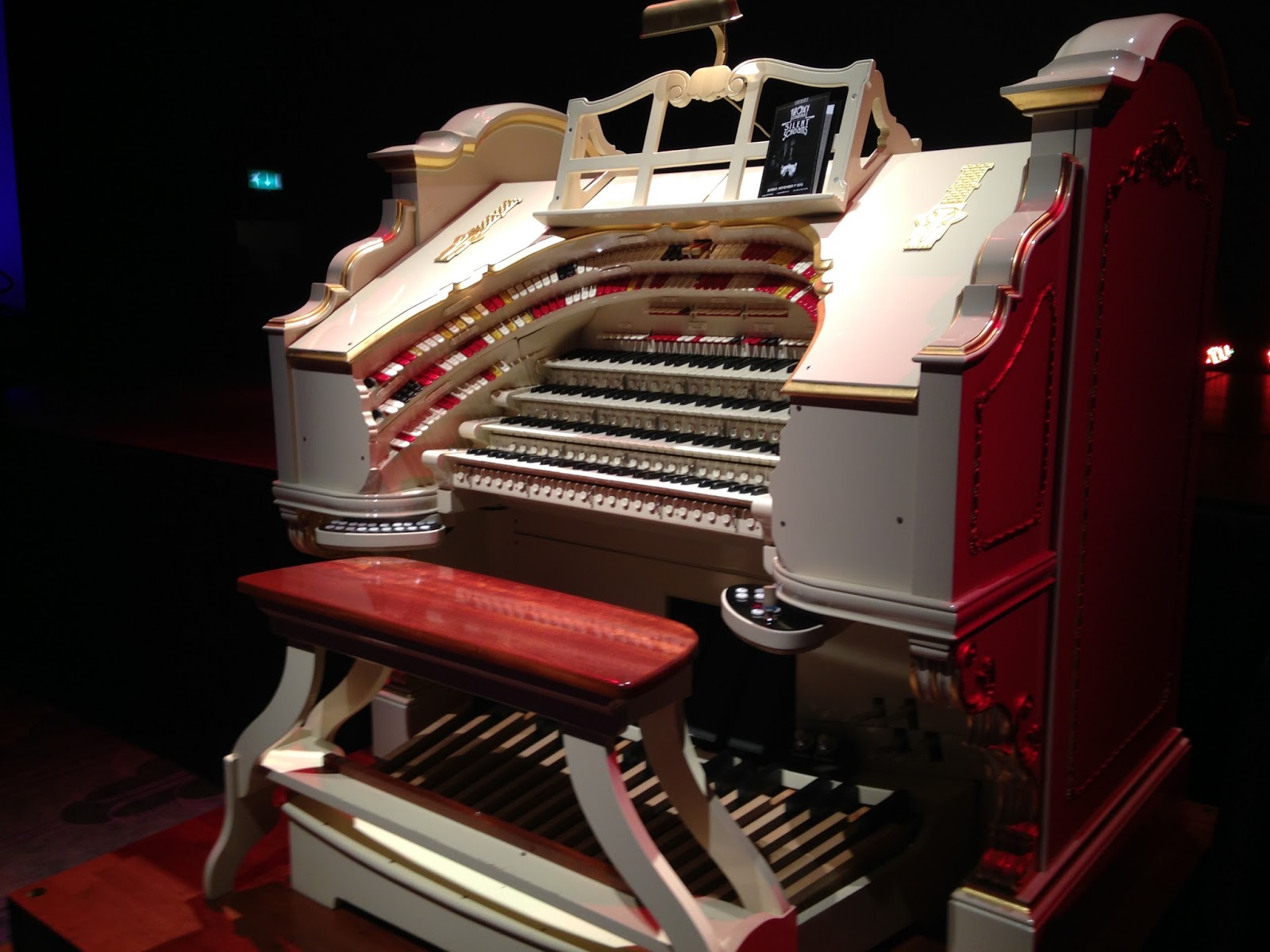
This was a first for me; the chance to hear a silent film accompanied by a Wurlitzer organ an instrument synonymous with the form. Being a native Lancastrian (in old money) I have, of course, seen organs rise up in front of cinema screens in Blackpool (certainly) and Liverpool (probably) but only as a lad and never playing a soundtrack. The Wurlitzer makes a sound queasily nostalgic and also undeniably genuine: the authentic sound of populist entertainment. If Hans Zimmer and Thomas Newman were around in 1920, this is how they’d make themselves heard…

The mighty machine at Limehouse’s Troxy was originally installed in its sister cinema the Trocadero cinema at the Elephant and Castle and has been relocated and restored over a six year period. It has four keyboards, 1,728 pipes and effects including – actual - drums, cymbals, xylophone, glockenspiel, marimba and piano. This is the silent sound pallet with, again actual, knobs on!


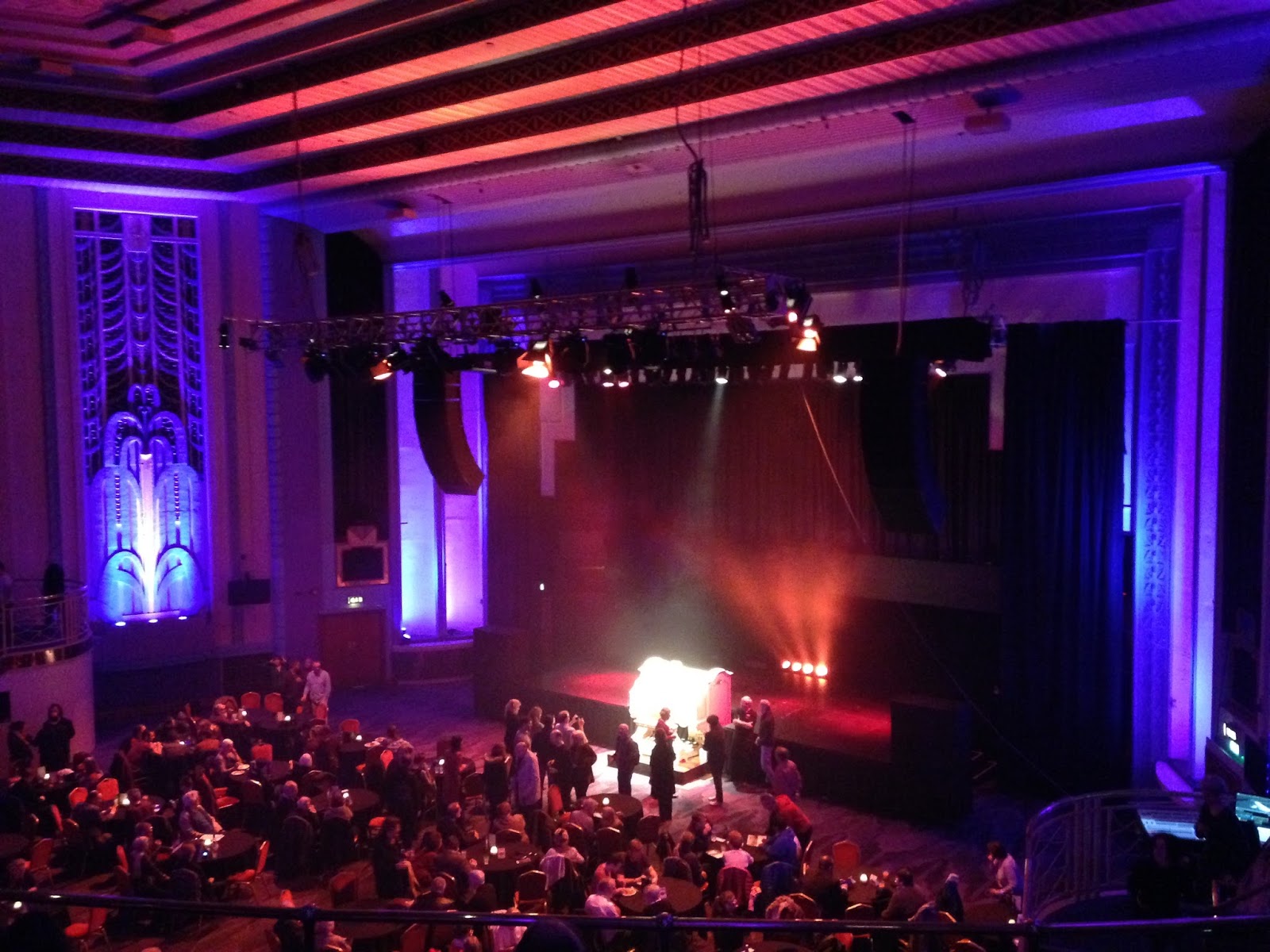
The Troxy opened with a film about a large gorilla in 1933 and organist Donald MacKenzie played the theme from King Kong in his introductory medley. It’s one of the great London cinemas – it had  3,500 seats – and has been used for a variety of cultural purposes in recent years  and, like Kentish Town’s Forum, Brixton’s Astoria (now the Academy) et al. as a venue for bingo and then that thing they call "rock" – I was here last to watch Canadian post-rock ensemble, Godspeed You! Black Emperor.

But now the flickers are back and tonight was the first time an organ had been played for a life time. The Troxy was set up in style with a proper queue, ushers in uniform (a bit like Emile Jannings in The Last Laugh) and pie and mash for the locals: it felt like an alternate universe combined with a time-slip… and the place was pretty full, and with an audience that respected the material.


Dr. Jekyll and Mr. Hyde has long been on my watch list and didn’t really disappoint aided by Mr MacKenzie’s mastery of improvisation organ which propelled the story to its breathless conclusion. There are some flat sections – not helped by over familiarity with Robert Louis Stevenson’s story – but John S. Robertson directs well and Barrymore is, of course, a monster.

Filming was on stages constructed in the Amsterdam Opera House on 44th St. Manhattan,  so that JB could carry out his stage duties on Broadway in the evening – no rest for the wicked: that was at least three roles he was playing.

Brandon Hurst tempts John Barrymore
John Barrymore plays Dr. Henry Jekyll a visionary doctor who fixes the poor during the day and researches the furthest possibilities of human biology in the evening – more duality. He’s romancing Millicent Carew (Martha Mansfield) the daughter of Sir George Carew (Brandon Hurst) a man who has experienced most things in life and uses his wiles to shelter his daughter and to cynically forge his way in the world.

Miss Gina, “Italian artist”
He can’t believe that Jekyll is the do-gooder he seems and sets out to tempt him to taste the forbidden fruit of naughty Nita Naldi or Miss Gina, “Italian artist” as she is known here, an exotic dancer in a seedy club “gentlemen” frequent. Faced with Miss Gina, Jekyll can well see Carew’s point but he breaks away integrity intact.

Sir George tells the Doctor that the easiest way to get rid of a temptation is to give into it… and this is one of a number of Wildean moments in a film that also draws on Dorian Grey as well as The Strange Case…


Back in his lab Jekyll muses on the possibilities of having cake and eating it: what if you could isolate the bad from eth good in a separate persona? It’s slightly flawed logic as the same person is still performing the acts but… it’s a near-perfect way of eradicating guilt and blame. Writing before Freud, The Strange Case… was published in 1886; Stevenson was writing an allegory partly based on an actual case of split personality. Modern amateur psychologists can have a field day…

Mr. Edward Hyde makes his initial appearance without the assistance of make-up as Barrymore contorted face and body to disturbing effect. Hyde goes back to find Miss Gina, kicks over inconvenient children and is generally unpleasant in personal hygiene and deed.

Martha Mansfield and John Barrymore
Jekyll has him under control initially and proposes to Millicent in the optimistic assumption that civilised life carries on but the door has been opened and his alter ego keeps on coming back and every time he is worse…

As the organ swirls every more violently the narrative whips up a storm and, well, you probably know the rest… The tale is well wrought though and Roy F. Overbaugh’s cinematography is also to be commended for turning those Manhattan street sets into London after midnight.

Mr Hyde busy ruining lives... in dives.
But it's Barrymore that makes you believe... that self-confessed mixture of "talent, a glass and some cracked ice" was most definitely heavily-laced with the former.

A Stan Laurel spoof, Dr. Pyckle and Mr. Pryde (1925) was shown before the main feature and was a slightly patchy affair that actually made a lot more sense after we’d seen the main feature. Must re-watch!

Doctor Pyckle
This was silent cinema returning to the people in a manner I’ve not seen before. We didn’t have the pie and mash but next time we’re down the Troxy we’ll go for the full-East End.

Watch the Troxy for details of up-coming events and check out Amazon for DVDs of the film – the Kino edition should be decent (?) but the print we saw could do with a restoration.

Donald MacKenzie's site has details of his busy schedule - he's playing the organ at Ally Pally soon.

A queue stretching around the block!