Showing posts with label Antonio Moreno. Show all posts

Thursday, 14 September 2023

Live Cinema lives… It (1927) with Cyrus Gabrysch, Kennington Bioscope 10th Anniversary


This was the Kennington Bioscope’s 10th Anniversary edition and the package was so sweetly wrapped it even had a Bow on it. Cyrus Gabrysch is, he said, often accused of starting the whole thing but what he and then John Sweeney thought would be a connoisseurs-only cinema club was transformed by a brave dog fighting his way up the stairs of a lighthouse to relight the beacon. Kevin Brownlow’s copy of a Rin Tin Tin film provided the moment when the audience erupted with applause for the heroic hound and Cyrus realised something special was happening.


Michelle Facey quoted Pamela Hutchinson’s famous description of the KB as a silent speakeasy and, Cyrus felt it was also like the Left Bank cinema groups that inspired Truffaut, Godard, and Rohmer; maybe the Cinema Museum screenings will also assume an historic position as the place where silent film – film always on film – was resurgent through the Teens and the new Twenties that began not with a bang but with a fever as all cinemas we closed and the Bioscope moved fearlessly online with MC Facey becoming the face and voice of the silent resistance on KB TV.


The Bioscope has always dealt with the material issue of cinema and tonight was no different with a first half dedicated to 28mm films introduced by Chris Bird, projecting 101-111 year old celluloid on 107-year-old equipment: film as history, history as film… moving history, it moves and it flickers even the hand-cranked 28mm projector Chris demonstrated on stage to audience applause. We should all be so functional after so long in the dark.


The Pathé-Frères 28mm KOK Cine Projector and Camera


We began with a couple of Pathé films, demonstrating French ingenuity in animation, Émile Cohl, one of the fathers of animation and then Méliès style trickery with Wonderful Armour?, as a devil and two women knights defied all logic and the evidence of our own eyes, as they detached body parts with a smile. Colin Sell did well to keep his head but, with the elegant Samantha looking on in silent support, he followed the action with all the concentrated control of a man who worked with Barry Cryer for decades.


Then to the USA for Lest We Forget a Mr and Mrs Sidney Drew film, in which the flowers of romance get very tangled and, as Chris stressed, the only copy, in the World, of Episode 30 (of 119) of the Hazards of Helen a very tightly wrought drama in which Helen Holmes appeared to swing off bridges, jump on to moving trains and dive into turbulent waters to retrieve stolen goods. We wondered if she used a stunt double, and John Sweeney too, who accompanied with fast-flowing lines and cliff-hanging drama all with no visible safety net.


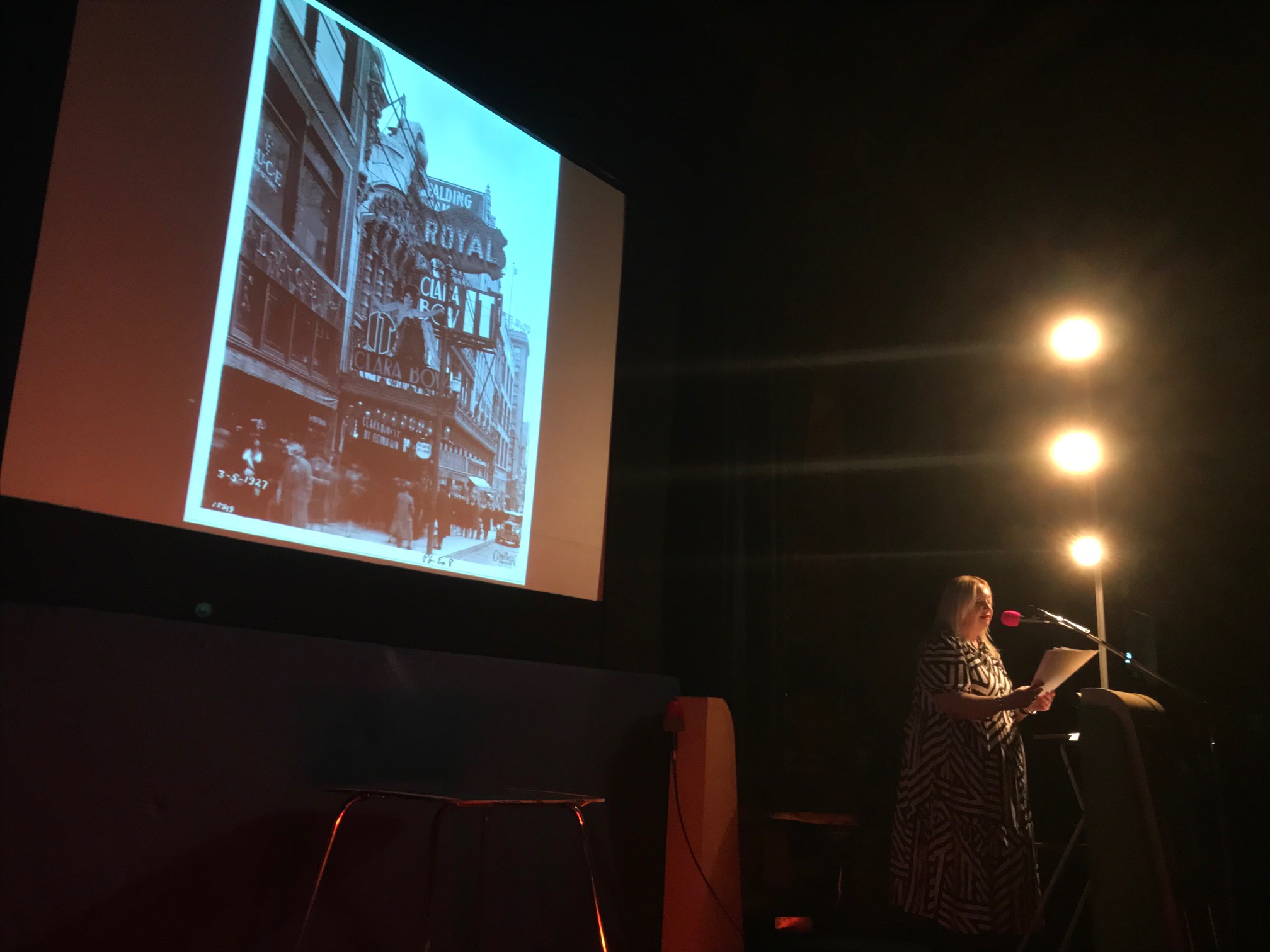
Follow that Clara Bow. And, of course, she did.


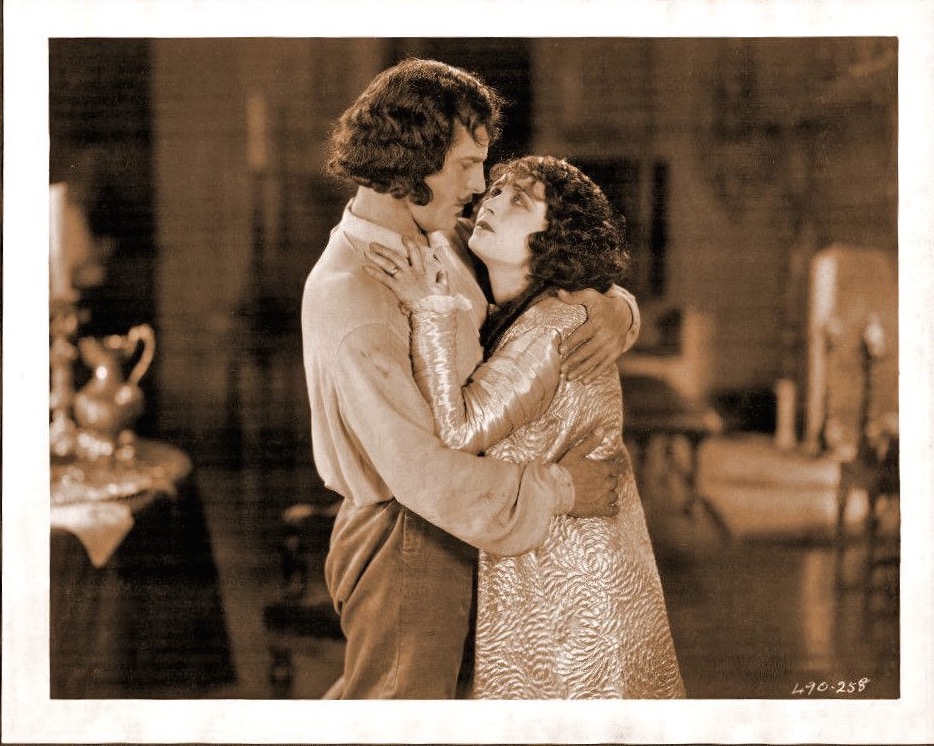
Clara in a business meeting with Antonio Moreno


This was a 35mm print from Photoplay – company by-line “Live Cinema” - which had the natural warmth of a pre-digital restoration and looked stunning on the big screen. I say stunning and I mean Clara Bow who, despite a cameraman buddy complaining how difficult her kineticism made her to catch on film, featured in close-up after close-up that left the watched hanging on her every smile. The discussion pre-screening with my neighbour was who would be a modern-day equivalent of Clara and we struggled to come up with anyone as naturally powerful and so exuberantly un-mannered on screen.


If ever an actress has transcended the sum of her parts and if ever a star has been completely under-estimated then that must be Clara Bow. In her career from a 17-year-old in Down to the Sea in Ships in 1922 to a wise-cracking, talkie comedienne in Hoop-la in 1932… Clara made only a few classic films, although relatively few were preserved as Michelle pointed out. She never had something like The Crowd, Pandora’s Box or The Wind, to show what she could do dramatically but, in every one of the films she did make, there is ample evidence that she was an actor of considerable ability. And this is true for It made in a period in which she made some 16 films in about a year, Paramount making as much as they could from their asset. 


There was indeed something about Clara, more than just acting; something genuine and heartfelt that, coupled with her looks, earned her the respect of a large part of the cinema-going audience through these years. Watching It years later, her eldest son Rex Bell Jnr, remarked that he could see all the expressions and feeling he had seen from “mom” on a daily basis: she wasn’t just acting she was giving part of herself to the watcher. When called on to cry she would call on a childhood memory of one of her friends dying in her arms after being consumed in a house fire: those huge shining eyes would well up with genuine tears of sorrow.


If It is one of the great films it is because it perfectly captures the essence of Clara. Clarence Badger directs well enough and makes the most of his star and story, you can’t take your eyes off her and this is not just the compulsion of trying to find new angles on that prettiness but because she’s radiating so much joy. She is It and she’s supposed to be. It’s a tough role when you think about it, no one ever had to live up to a billing founded on such an uncompromising premise: there’s no “it or miss” you just have to be on target with the casting. Tag, you’re it!!


Based on Elinor Glyn’s story, they paid the English writer some $50,000 to appear in one scene in order to clarify exactly what “it” meant and, needless to say, this was considerably more than the vastly underpaid main star had accumulated from her previous half dozen features.


Events are based in the large family-run Waltham’s department store where the heir to the business, Cyrus Waltham (Antonio Moreno), is about to take over following his father’s departure to spend more time with his gun. Junior’s best friend, Monty (William Austin), is reading an excerpt from “It” in Cosmopolitan and trying to interest his friend in this new conception of humanity although in his case he’s more “what?!” than “It!”. Talking of which there’s a young Gary Cooper flashing by as a journalist… Clara noticed him too.


Sweet Santa…


My second trip to Coney Island this week after The Crowd at the BFI...


Whilst Cyrus focuses on his new responsibilities, his pal scans the store looking for an assistant with “it”. His eyes alight on Clara’s character, Betty Lou, and he knows he’s found his woman but, try as he might, he cannot get Cyrus’ attention even though Betty already has him in her sights. She’s not about to let him out of her grasp though and this begins a game of It! and mouse as confusion and comedy mix with the odd dash of pathos and anything that gives Clara the chance to run through her extraordinary emotional gears.


It’s an absolute blast and Clara is well-supported by William Austin, nostrils flared like a Jazz-Age Kenneth Williams and Antonio Moreno who just about convinces as her love interest even though there’s no way he had the same amount of “it”! But who has?


Cyrus Gabrysch’s anniversary accompaniment was suitably celebratory, running wild with Clara and holding us aloft with the film’s dazzle and comic drama; that rare Wednesday evening atmosphere we’ve all come to treasure. Ten years after Cyrus and John started playing and Rin-Tin-Tin single-doggedly saved that lighthouse, so many others continue to create these magical evenings, I than you all and raise a glass to the next ten years of history being watched and being made!
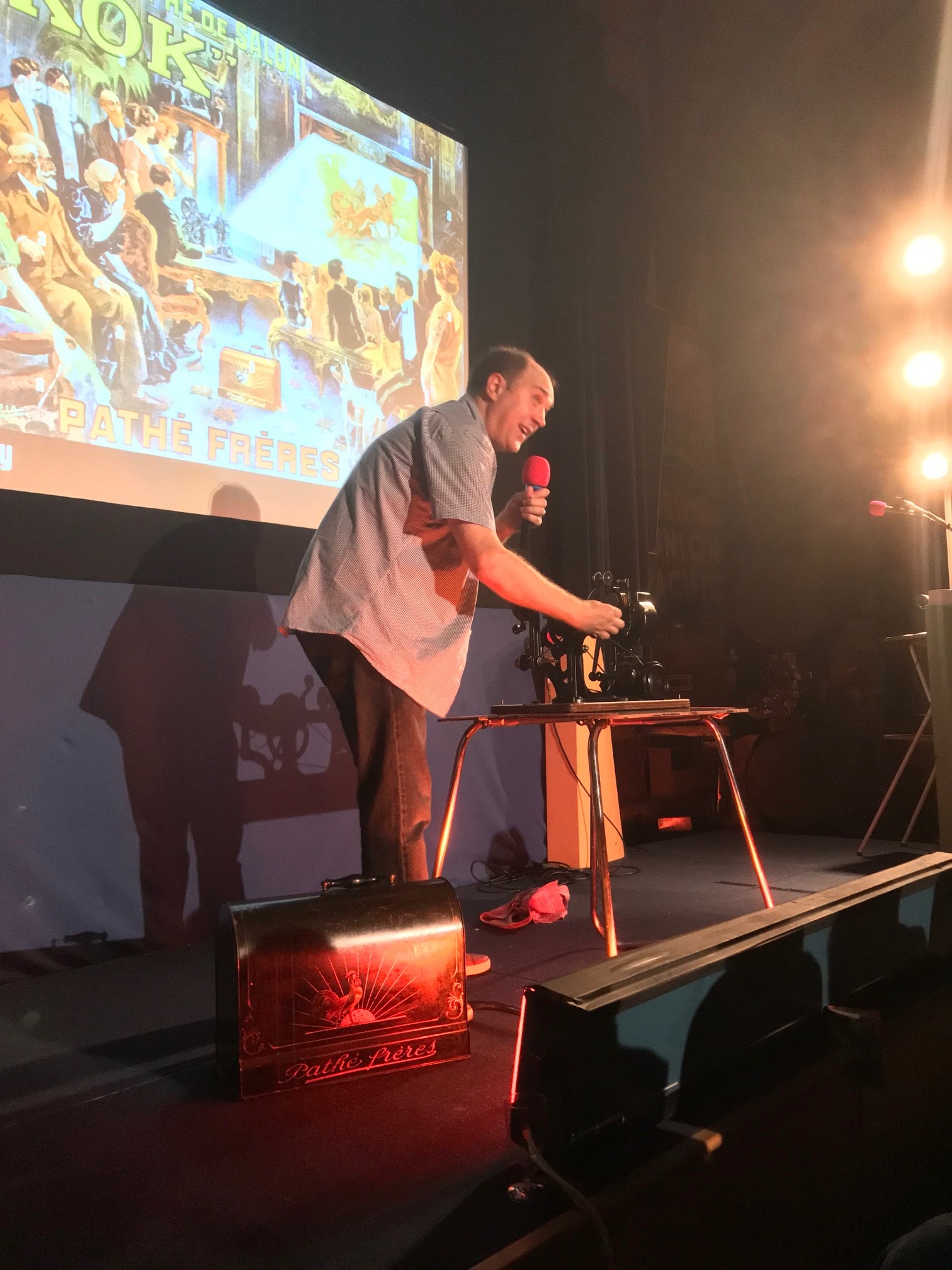

Chris Bird demonstrates the kit

Cyrus Gabrysch explains the Rin Tin Tin connection

Michelle Facey introduces It.

Clara in colour, a precious glimpse of Red Hair one of many Paramount carelessly did not preserve.


The KB is a little bit like this... 

Gratuitous extra Clara...

Are you being served?


Thursday, 9 February 2023

Girls will be boys… I Don’t Want to be a Man (1919)/Beverly of Graustark (1926), Kennington Bioscope and Vito Project


This was a glorious collaboration between the Kennington Bioscope and the Vito Project, a film club aimed at exploring cinema through a queer perspective, both meeting in elegant harmony with two silent films featuring two of the finest comedians of the period doing what they did best; challenging norms and making people laugh. This had to be one of the most celebratory atmospheres ever at the Cinema Museum with a meeting of minds from the two passion projects finding new aspects of appreciation, fresh angles to adore. There is always respect here for the context of century old cinema but there were new laughs to be had as the audience spotted patterns in the humour that some of us may have previously missed.


That said, some of us are clearly not that observant as I had completely forgotten the spectacular two-strip colour finale for Beverly despite having seen this restoration in Pordenone in 2019 with Mr Sweeney also accompanying. At the time I wrote about the importance of watching comedy with an audience and tonight this was proven once again with delicious new connections within the nuanced daftness that hold us all together in front of the world.


Marion’s a tonic and, as I put it in 2019, clearly hungover and heavily caffeinated, “…there’s no better sight than Marion’s look straight to camera eyes twinkling with the latest daftness. Mabel started it and Stan followed but Marion took it to another jazz-age level; her face bubbling and alive, as knowing as anyone, with perfectly timed beauty, an irresistible smile.”


Marion in colour!!


Vito supremo, Matheus Carvalho introduced and gave us an overview of Marion’s once misunderstood career…. Davis never made a seriously revered film (although Show People comes close: it is loved) but it doesn’t matter as she was the queen of romantic comedy drama for much of the Twenties producing a string of major hits that allowed audiences to laugh themselves out of the day-to-day and onto the screen in sympathy from When Knighthood was in Flower (1922), to Little  Old New York (1923) and onto this film. In all three, Marion dresses as a man to save the day and she does so in a manner, as Matheus quoting from Jeanine Bassinger in Silent Stars, aims at “comic androgyny”: she creates the physical sense of the male in her movements and attitude, with a grow-up, very meta sense, that anyone as feminine as she could every get away with really fooling anyone…


To this extent, Marion in drag is just an extension of her look to the camera and the audience, its’ a look of comic collaboration, we know and she knows but, strangely the rest of the cast don’t. We’re in on the joke and we can’t help but love her for it!


The story is brief on set-up and long on the situation. She plays a New York socialite, Beverly, called upon to impersonate her cousin, Prince Oscar of Graustark (Creighton Hale) after he injures himself in a skiing accident. If the Prince doesn’t make it to the Graustark coronation on time the deals off and the nasty General Marlanax (Roy D’Arcy once again fits the role of moustache twirling baddie to an evil T).


Marion just about a boy (screenshot from Movies Silently)


So, we literally have a Prince formerly known as Beverly having to dress as a man and convince the cabinet and court to save the throne and she does such a splendid job that even politically active and military-trained goatherd Danton (Antonio Moreno) can’t see that, with that skin, those eyes and all the rest, that she’s less of a man than he’ll ever be.


It’s exquisitely daft and the timing is absolutely perfect throughout and, this was reinforced by another masterclass in sympathetic accompaniment from John Sweeney on piano; the accompanist is the fourth element of the perfect silent mix: after film, location and crowd. Tonight, we were blessed with all round excellence from John and from Colin Sell on the first feature, an all-together more riotous affair.


Things getting out of hand...


The evening was also special one at the Bioscope as it was Michelle Facey’s birthday and, inundated with flowers, cards and gifts she celebrated her gift from Ernst Lubitsch and Ossi Oswalda in her introduction for the film. Ich möchte kein Mann sein (I Don't Want to be a Man) (1918) was one of the director’s last long-shorts made just before his first feature with Pola Negri, Die Augen der Mumie Ma (1918).  Oswalda is every inch as energetic as Negri and far more anarchic than Davies, or almost any American actor.


This was Weimar Germany and an initial post-war period that saw a flourishing of frank expression and, with no censorship for a year or two, some of the most forward-thinking sexual statements including, of course, Different from the Others (1919). Watching this film again there’s no doubt that the film does more than tease us with the implications of the cross-dressing; Ossi’s erstwhile counsellor Herr Brockmüller (Ferry Sikla) who she meets in a cabaret, dressed as a man, is in no doubt that he is kissing a he even if it’s a she. As he says later on about his new pal’s sister, “she’s a looker too…” Of course, what’s so great, what’s so free, is that Lubitsch makes very little of this… he leaves that to the audience in a tragically short lived permissive society.


Ossi is a rebellious tomboy, gambling, drinking and doing all manner of grown-up male things from which her uncle (Kurt Götz) and governess (Margarete Kupfer) forbid her if only to allow themselves to indulge. Lubitsch highlights the comic hypocrisy of both as she carries on smoking Ossi’s cigarette and he grabs a bigger glass to increase the rate of alcoholic intake.


Ossi’s like Iggy with a Lust for Life… or at least for eating cherries and gobbling candies in her window whilst a crowd of young men pleads to be fed like hungry penguins. She obliges only for Uncle to chase them away... what the girl surely needs is some discipline or maybe an adventure! Uncle is called away for the comically un-specific fact that “the institute he has set up is ready for him” but before he goes, he recruits a stern governor to make sure his ward is properly looked after: Herr Counsellor Brockmüller.


Brockmüller almost immediately brings Ossi to heel with his startling natural authority – he’s also a bit of a looker boys and girls! But Ossi is not so easily curtailed and she vows to resist whilst he promises to cut her down to size. The game is afoot! Ossi decides to play men at their own game and goes off to the gentlemen’s outfitters to order a dinner suit. The assistants fight over measuring her up and decide on splitting the work limb by limb. Men lust after Ossi in groups and make horrible obvious play of their intentions: but she’s in charge.


Kitted up in starched collar, bow tie, top hat and tails, Ossi sets off to have fun at the dance hall, catching the eye of a number of young women as she takes her pretty-boy swagger to the dance. She chances across someone familiar: Herr Brockmüller and tries to attract away his favoured escort and once she’s distracted by another man, the two get to know each other in the time-honoured rituals of male bonding: they get smashed.


Governess Margarete Kupfer enjoying forbidden fruit...


It’s a long night and by the time the two fall out onto the pavement it’s the morning and they’re struggling to think or walk straight, putting on each other's overcoats which happen to include their address cards. Confused by the cards, their driver takes them to each other’s houses but not before the above-mentioned drunken smooching. Cheekily subversive. the kissing has the audience running through the permutations: Ossi knows what she’s doing but Brockmüller is clearly a man of broad tastes…


Colin Sell accompanied with wit and the practices ease of a man who has worked with Graeme Garden and played up the storm Ossi’s anarchy deserved. In Germany as elsewhere, the War left an opportunity for gender equality and Ossi was here to grab that chance with both hands either in a suit or in a dress… for the continuation of the film’s title is clearly: I want to be a woman!


Back to Marion, Matheus quoted Cordelia D. "Delight" Evans writing in Screenland in July 1926 “…ninety years from now, when all the war pictures and propaganda films and arty productions have been forgotten, some old white beard is sure to mumble, ‘There was a girl named Marion who looked awfully cute in boy’s clothes.’”


Well, there were two awfully cute girls in boy's clothes here tonight, Miss Evans, it’s 2023 and my beard is indeed, mostly, white.


Antonio and Marion, he has no clue the sap!


Here's to more collaboration between the KB and Vito, a splendid time was had by all.


For further details of the Vito Film Club visit their Facebook page.


Bioscope details are to be found on the Cinema Museum website.


Thursday, 24 May 2018

Her name was Pola … The Spanish Dancer (1923), with Meg Morley, Kennington Bioscope


Pola dancing, Meg Morley playing… it’s enough to make you forget the Lambeth Walk and  flamenco down the Kennington Road.

In his introduction, Amran Vance quoted Jeanine Basinger on Negri’s ability to present emotion throughout form and here her every extension was balletically convincing in a story which sometimes almost put the pain in Spain. You can’t take your eyes of Pola as she ignites the screen with a power and cultured restraint sadly lacking from Wallace Beery’s boorish performance as King Philip IV.

It’s an odd mix of humour and drama that never threatens to take itself too seriously, although if you think the way to a woman’s heart is to shoot her husband and then seductively surprise her on her wedding night; then be my guest. There was the odd snicker at rather than with, but this tone was not unusual in a time of Fairbanks thrills and Barrymore blockbusters: see, how they laugh in the face of death!

Stitch that Pickford!
Any gripes are dispelled by the ambitious direction of Herbert Brenon and the majesty of Negri in a role that lets her dance, fight and love as only she can. Even in the spaces of a vast royal garden party you can see her movement as she leads an energetic group of gypsies in dancing for the Queen. Pola’s gypsy Maritana is distraught as she reads handsome Don Cesar de Bazan (Antonio Moreno) his fortune and faces him with a passion Moreno struggles to match. The story was originally written for Rudolph Valentino and was re-tooled for the female lead, but you can’t imagine even he matching the swash in Pola’s buckle. She’s fierce – Lubitsch fierce – and there’s even a scene nicked from Die Bergkatze (1921) in which she douses herself in cologne.

Herbert Brenon had clearly done his homework and, after two so-so films in Hollywood, the former Barbara Apolonia Chałupiec scored her first major hit, one compared favourably with her old pal Ernst Lubitsch’s work with Mary Pickford in the similar tale of Rosita. Brenon gives Pola every opportunity to show her physicality, dancing and fighting as well as riding a horse and it suits the grand scale of his film in ways few leading actresses could match.

Antonio and Pola...
 Brenon has a cast of thousands and in addition to grand garden parties, shoots a mass carnival scene which is given extra atmosphere by tonnes of confetti and expert depth of field from cinematographer James Wong Howe. There’s excellent tracking work which gives a real feeling of atmosphere as the screen is filled with movement.

Against this are the acute emotions of court intimacy as Adolphe Menjou’s Don Salluste tries to manoeuvre King Phil into betraying his French wife, Queen Isabel of Bourbon (an excellent Kathlyn Williams) who really does deserve better. I liked the way the royal characters are introduced as poor old Velasquez tries to paint Phil and his favourite midgets only to be repeatedly interrupted by every significant new arrival.

Then the gypsies run out at the castle of Don Cesar de Bazan (Antonio Moreno) who is about to fall instantly in love, be declared bankrupt and have to go on the run: a rough night on balance. Luckily his fortune-teller reciprocates and even seeks him out the following day to return a purse one of the gypsies had stolen; the only money he has left it turns out.

I can't watch Adolphe without imagining his Irish brogue and I can't watch Wallace without thinking, "poor Gloria..."
The same young gypsy boy who had stolen the purse, Juan (Robert Agnew who was 23 at the time) turns up next as an ill-treated apprentice to a bullying nobleman. Ironically, Don Cesar defends him from his tormentor and ends up breaking the royal decree: no swordplay on carnival day. Things get really complicated as King Phil decides only the gypsy dancer will do for him and all manner of callous enabling is provided by Don Salluste as events spin seriously out of control…

Making sense of all this was Meg Morley whose exuberant and assured accompaniment was filled with so much content all providing subtle tone and colour to the spectacle. Her understated Latin lines and energy kept pace with every sweep, stomp and throw of the hair, not only from Pola but from Señor Moreno too.

Gimme a break 2017, it's a comedy-drama!!
Another superlative spectacle from Lambeth and London’s finest and, as if all of the above were not enough we were treated to three rare and, in one case, possibly unique, 16mmm films from director and collector, Chris Bird.

The first of these was a Georges Méliès film, Paris to Monte Carlo in Two Hours (1905) – imagine having something like that in your collection!? Prince Leopold can’t be bothered with a 17-hour train journey down south, so a mad motorist gives him a lift at what Phil calculated to be 214 mph. It’s magic Méliès with only one confirmed casualty, a man flattened by the car who is blown up so much he pops.

The great race begins
Next up was a Cecil Hepworth film, Miss Deceit (1915) of which this may have been the only copy remaining – anywhere! It features Johnny Butt as Podgmore, a financial manager who competes with his clerk Whatley (Arthur Staples) for the love of Miss Elysia de Seete (Chrissie White - British film’s first leading lady?). Podgmore keeps Whatley working overtime but the roles are reversed when the latter signs up and becomes a Sergeant. All the girls love a man in uniform, don’t they? Maybe…


Lastly, we faced the real horror of director-to-be James Cruze acting in Dr. Jekyll and Mr. Hyde (1912) alongside the delectable Florence La Badie. There’s a lot of potion drinking and gurning as the white-haired Dr J turns painfully into his black-haired and dentally-wayward alter-ego. I also liked the way that not only must the hair change but so must the hat, Hyde purposefully beating it into a jaunty signifier of his up-to-no-goodness. It’s fun and a prime example of the many films Cruze and La Badie were making at the time.

All three were meat and drink to John Sweeney, who took us on a rigorous journey river deep mountain high, via bizarre British love triangles and onto the good, the ugly and La Badie!

Florence and James
Ken Bioscope, you do spoil us rotten sometimes!!

Hyde's bad hat-titude in evidence!
Flo-La-Bad was a stunner
So was Pola
Look at Antonio's hair.
...she was a dancer (classically trained)