Showing posts with label Alfred Abel. Show all posts

Sunday, 21 August 2022

Asta addicted… Laster der Menschheit (The Vice of Humanity) (1927), with Filmsirup, Bonn Silent Film Festival


Weimar films never cease to amaze and there was clearly a different tolerance for subject matter in Germany at this time. This film deals overtly with drug addiction and features graphic scenes of both cocaine use and its euphoric impact as well as the longer-term devastation. All this is done in a dramatically convincing way and without the moralising outrage of, say, Reefer Madness and more puerile efforts of American films to get audiences to just say no.


No, here we have one of the finest actors of her generation, Asta Nielsen, acting out the message as part of her character’s general tragedy; her failure to face down the weakness that led to her requiring the “prop” to support her acting career as well as her decision to abandon family for theatrical success. It’s an old, old story but in the hands of Die Asta we believe it all over again.


Part of the success is in the extended sequence showing her performing Salome on stage as, unbeknownst to her (and us) her daughter sits watching, astonished at her stage craft, as are we all. Asta could be a great stage actor as we see but, as the story progresses, we watch her character, Tamara, break down with the kind of visceral psycho-physical implosion, very few could match then or now. Those who saw the BFI’s wonderful season earlier this year will recognise the style of this closing sequence and also the fact that whilst it’s different every time, it’s also never less than moving. In dramatic terms, Asta was her own special affect.


Die Asta abides...


The film has been unseen for many years and this new digital restoration by Cinematek, Belgian Film Archive, is the most complete version since the censors first set eyes on the debauchery, based on their 1993 restoration, this has new title cards and is as crisp as human-digitally possible, with live accompaniment from Bonn-based Filmsirup, who mix electronics with a range of instruments to cinematic effect, this digital stream of the live screening the day before engaged this watcher, 415 miles away.


The film begins on All Souls Day as Baron Beythen (Charles Willy Kayser) and his family gather in gloom to remember his late wife. His daughter Marleine (Elizza La Porta) asks to hear one of her recordings and mournfully places the 78 on the record player, imagining again the woman she never met and yet who had such a special talent. But all is not as it seems as the Baron’s sister (Sybille Lerchenfeld) reveals her discomfort at the fact that the Baron’s wife is not dead at all, just erased form existence at his will, to “protect” his daughter.


“… to let her say prayers for the dead for a living person is a sin!”


Elizza La Porta's Marleine listens to her mother's voice


Their friends arrive in the form of Mrs. von Führing (Trude Hesterberg) and her children, Hannah (Carla Meissner) and Victor (Ekkehard Arendt) who want to take Marleine to the theatre to see the sensational opera star, Tamara (Asta Nielsen) in that stunning performance of Salome… can you see where this is going? The whole sequence is an interesting one with director Rudolf Meinert making the most of the chance to direct the opera and also the audience with Marleine and Hannah watching the action with binoculars that just as easily could be pointed at the audience. It’s a brief meditation on the relationship between the film’s main purpose and any baser interpretation – you, watch this, we mean it…


Sure enough, in a break between scenes Tamara, wearying, begs the newly-arrived Mangol (Alfred Abel) for a pick me-up before the finale. He duly hands her a sachet of white power, she sniffs it and the opera swings to it’s conclusion. Meanwhile Marleine, not used to being let free, drinks the whole story in, especially when Salome kisses the detached head of John the Baptist; she’s mesmerised by the power of the performance and can’t wait to get the star’s autograph.


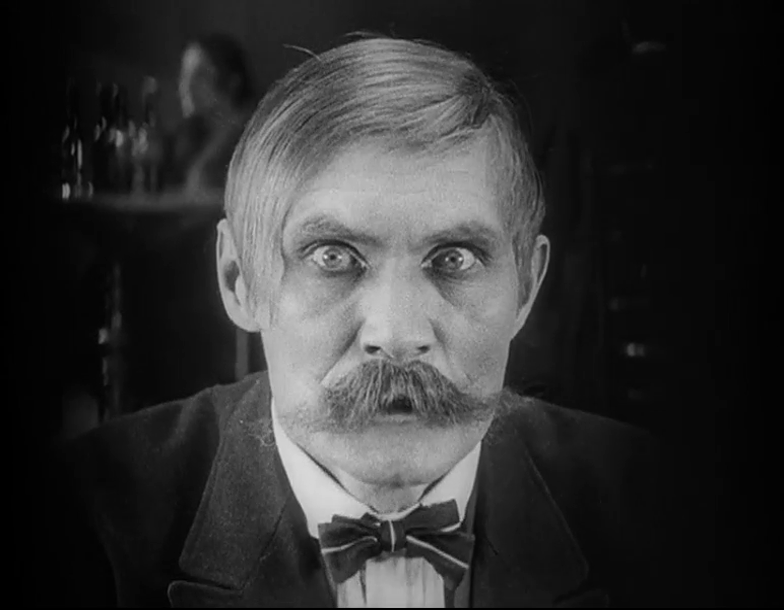
Alfred Abel is having a ball

We move on to an after-show party at Mangol and Tamara’s mansion where a number of revellers receive the former’s discrete packages in exchange for money and potentially a lot more. It’s not just the young but also an elderly man in tuxedo, no doubt a pillar of society – perhaps a conservative politician? - who needs some extra energy. Irises are fully dilated and Mangol passes through his society with a knowing smirk, master of most he surveys, controlling supply, creating demand. All this passes the youngsters by but Mangol stops dead when he sees Marleine, here’s someone new to pull into his orbit.


Tamara meanwhile is exhausted and strung out as Mangol’s maid Li (Maria Forescu in yellow face, the film being introduced with a trigger warning covering this and other "attitudes of the time") struggles to prepare her for her audience downstairs. She duly arrives like a pro and signs autographs including one for Marleine who, pestered by Mangol – Alfred Abel absolutely killing it as the embodiment of capitalist evil, he even twists his hair to give a demonic impression – is already vulnerable to his powers of persuasion.


But, almost immediately, there is a bond between Tamara and the young woman, especially after she sings… then, as Mangol makes his mischievous moves, a recording of Tamara sounds just like her late mother’s voice…


Mangol helps Marleine sniff his new oportunity...


I won’t spoil any further, but the action is well paced and Asta provides that operatic emotionality which lifts the story and the message over the closing parts of the film. Also present is Werner Krauss as a “cocainist” customer of Mangol’s who brings a strange physicality to the role of a man clearly hollowed out through addiction as he arrives in search of more drugs from the man who clearly has no further use for him.


Ludwig Lippert’s cinematography greatly adds to the mostly studio-based atmosphere and there are late period camera tricks aplenty including a lovely montage of night life and plenty of perfectly lit interiors that almost, but not quite, present as “expressionist” (Lotte Eisner would probably disagree).


I enjoyed Filmsirup’s score and it ranged occasionally towards post-rock whilst also including some Barrett/Gilmour type psychedelic slide guitar from Michael Hendricks. When the composition and players are this attentive, left-field accompaniments can work and the whole group contributed to a range of orchestration that properly matched the subject matter and the message. Hendricks also plays piano and provides tape loops whilst there’s Christian Carazo-Ziegler (xylophone, electro beats), Matthias André (bass, synth) and Matthias Kaufmann (cello, bass). I look froward to hearing more of their work!


Werner Krauss is haunted


Another quality presentation from Bonn in a week that has already seen the mighty Stephen Horne and Elizabeth Jane Baldry accompanying deMille’s Male and Female (1919) and Ellen Richter in Moral (1928) – recently screened at Pordenone - as well as solo Stephen on Francesca Bertini’s restored classic Assunta Spina (1915).


We’ve also seen Blind Husbands (1919) – an excellent restoration shown in Bologna as well as Fritz Lang’s Die Vier um die Frau/Four Around the Woman (1921) on which, more later.


You can still stream some of the performances and films up until the 24th but you be quick as the films are only available for two days after screenings.


Full details are here on the festival site.


Screenings are broadcast via wireless waves that cross the entire globe!!


Sunday, 26 May 2019

Organised crimes… Dr. Mabuse the Gambler (1922), BFI Weimar Cinema Season

“Expressionism! – it’s a game of make believe! But why not? Everything today is make-believe…”

270 minutes of Fritz Lang on a warm Saturday afternoon is probably the hardcore choice but, it must be done. My first time seeing this film and my hot take is that it’s starts like thunder, sags a little and storms back for the second part and an extended finale which wouldn’t be out of place in the gangster movies of the next decade. OK, maybe I sagged a little and not the film but it’s a lot to take in and the pacing wasn’t meant for single sittings.

After the first super-hero (of sorts) with Der Golem, now it was the turn of the first super-villain and Rudolf Klein-Rogge is mesmeric as Dr. Mabuse who can hypnotise at distance, project a hallucination into the minds of a theatre-full of people and disguise himself with all the alacrity of Eille Norwood’s Sherlock Holmes.  Given the bad Doctor’s ability with mass deception, it’s easy to see why this character was so tempting for those like Siegfried Kracauer, to see him as a foretaste of what was to come; but whilst this may or may not have been a particular feature of Germanic political culture, it is not a unique one.

Who shall I be today?
Mabuse is a one-man army, not just in terms of his protean qualities but also his ability to shape people and events. Klein-Rogge makes you believe in this indomitability with a fierce performance that burns through his exaggerated make up: he is genuinely scary and quite clearly capable of anything…

He had been married to Thea von Harbou but by now she was Lang’s partner and wrote the screenplay for the director’s first major success, based on Norbert Jacques’ popular novel and with the intention of creating a “portrait of the time”. Accordingly, we see Mabuse as master of a whole range of mischief from forgery, stock market manipulation – a disaster capitalist no less – murder, extortion, kidnapping, drug-dealing … you name it. All of this would have been very familiar to audiences suffering from post-war economic misery and a society bitterly divided by the “stab in the back” of 1918 and the failure of the old order.

Panic in the stock market
The opening act is audacious, as Mabuse’s gang rob an envoy taking key industrial documents to Switzerland and the threat of these being revealed causes a Bear Market in which the Doctor buys up stock. They deliver the document as intended though and the market starts to rise, allowing Mabuse to make a killing by selling. After this you wonder why he needs the money from all the other criminal activities but maybe he’s after more than just the money?

Like every supervillain, Mabuse has a colourful group of henchmen; sweaty Spoerri (Robert Forster-Larrinaga) who needs cocaine to function so nervous does his master make him, counterfeiter Hawasch (Charles Puffy), generic loose-cannon muscle Pesch (Georg John) and Fine (Grete Berger) who acts as a lookout and house cleaner. There’s also a dancer at the Folies Bergère – isn’t there always? - Cara Carozza (Aud Egede-Nissen) whose loyalty extends to love even though the object of her desire is clearly disinterested.

For his next trick, Mabuse he hypnotises a young industrialist Edgar Hull (Paul Richter) and makes him lose at cards for his own profit. This attracts the attention of state prosecutor Norbert von Wenk (Bernhard Goetzke – who has a look of Michael Shannon for me at least...) who has already spotted a pattern of similar incidents.

He's been to Hull and back...
To von Wenk and the authorities in general, there is just enough evidence to suggest a "Great Unknown", and Mabuse’s disguises mean that he is only seen as a psychoanalyst; cutting edge medicine at the time and a magical mix with the practice of gambling – luck and secret knowledge of the subconscious all gathered in one unsettling package with wild eyes and way too much mascara. It’s bordering on the science fiction Lang would follow up with and says a lot for the state of Weimar society in terms of people, how they appear and how they really are. The man of many faces hides his truth and there would, of course, be a lot more of this to come.

Von Wenk persuades Hull to show him the city’s underground to track down his unknown adversary and there are glimpses of nightclubs one of which features and uncredited performance from Anita Berber dancing in a tuxedo. Mabuse has already arranged for Cara to instigate a relationship with Hull and so the cat and the mouse are confused. There is an epic showdown at one card-club in which von Wenk, in heavy disguise, manages to resist Mabuse’s mind control… but, naturally the Doctor escapes.

Gertrude Welcker giving it plenty of "weary blood".
Von Wenk meets a bored countess, Dusy Told (Gertrude Welcker) married to a boring Count, Graf Told (played with foppish glee by Alfred Abel who looks like the Kemp brother’s Uncle – too old for Spandau, but he liked the style…). There are lots of juicy quotes from the Countess about ennui, she can’t even be bothered to join in the gambling and is looking for adventure: von Wenk can offer her that and, rather unprofessionally, falls in love with her…

“We have weary blood, Mr von Wenk! We need sensations of an altogether peculiar kind, to be able to endure life!”

Now all of the pieces are in pace for the grandest of chases and, with less than half the narrative covered, there’s no way I’m tellin’ you anything copper, it’s more than me life’s worth and the Doctor… he has ways of making sure secrets are kept!

It’s well-crafted but long – which is fine! – and there’s a compelling narrative with so many knowing contemporary touches… in 1922 audiences were in need of entertainment, "weary blood" infected so many. As with every true criminal genius, this wasn’t to be the last of Dr Mabuse, who returned with Lang in 1934 and 1960 (the director's last film).


Wednesday, 11 February 2015

Electric cinema… Metropolis (1927), Wilton’s Music Hall with Dmytro Morykit

The screen in the green
To be honest, I wasn’t sure whether the modernism of Metropolis would blend with the faded Victoriana of Wilton’s. Britain – the World’s – oldest music hall is a restoration in progress -  walls a turquoise mix of decades of undercoating, brick halls caked in the disturbed dust of continuous renovation and the ghost of Champagne Charlie haunting the space between the high chandeliers and the bare boards where once he stood… Fritz Lang’s masterwork, on the other hand, is still as shocking as on release: a glimpse of a future long passed but still a future all the same.


The film – the shorter restoration lacking the sections recently found in Argentina – was being shown with a live score composed and played by Dmytro Morykit which, according to the publicity flyer, promised to “bring the film to life”. Whilst this was a play on die mensch-maschine arising as the new Maria, it is an over-claim for such a vibrant creation: the music generated a new feeling with the film but Lang’s work is very much alive.


Dmytro’s score is part of a project to examine the effect of music on the experience of visual art and comprised a new score which partly comprised of a “re-imagining” of previous compositions which fitted with the story. Dmytro played the entire piece from memory with no improvisation a remarkable feet of power and precision – all this dressed in a smart suit and tie.  The result of this energetic dexterity was music that did succeed in creating a new emotional response to the film – a new duet between Fritz and Dmytro.


This was further aided by the warmth of the Wilton’s space - the antiquity acting to highlight the film’s modernity. Metropolis was in a sandwich in time between the almost equidistant past of the building and the future in which the music was being played. Silent film was designed for music and live music continues to help us connect with the emotional content on display.

Brigitte Helm
This was my fourth time with Metropolis and, even without the missing sections, I was seeing more especially in Brigitte Helm’s performance. This was Helm’s first starring role and it is remarkably assured in terms of her controlled expression and movement. She contorts herself in almost impossible ways as mad Maria, her twisted features atop a torso that appears to move independently of her legs and arms. She must have had extensive dance training (although was keen on becoming an astronomer after school)… and was certainly an expert mime with hands almost as expressive as her face.


In addition to featuring in the most iconic moments - the transfer of good Maria’s features to the robot and then the mad dancing that drives the rich boys wild – she is the  catalyst for the film’s major narrative shifts.  She kicks off Freder’s interest in the lives below after ascending to the Son’s Academy gardens with her class of worker children, shows him the way forward with her Christianity and then sets the city alight with her unbridled cabaret.

The audience gasped a laugh or two at her mime but did they really think there was never an element of panto about the film – its more fairy tale than science fantasy in spite of the amazing mise-en-scene – surely some of the most expressive and cohesive in all silent film.


Of the other performers Alfred Abel is seriously serious as Joh Federsen, carrying the weight of his City on his shoulders to the extent that he forgets all about the love of his son. Rudolph Klein-Rogge makes for an excellent mad scientist, tortured by the death of his and Joh’s joint love Hel.

Gustav Frohlich makes for a good-looking Freder but lacks Helm’s intensity and movement, hampered as he is by his satin jodhpurs.

Gustav Frohlich
Through it all Metropolis emerges as one of the most consistently enjoyable of the silent “greats” – sometimes laughable (Grot’s dance got me I’m afraid!) but overwhelmingly laudable: it still looks great and if you listen carefully you can hear the ghostly echoes of UFA’s accountants crying into their beers as the most expensive film in German cinema brings down the firm.

But, for all time, it stands as a unique testament to the artistry of the Weimer film industry and, with the romantic, insistent, pulsating piano work of Dmytro Morykit it did indeed find new life in the darky-lit stucco wonderland of Wilton’s Music Hall.


If you want the older, shorter Metropolis it is still available for completists from Amazon whilst the Eureka full Monty is on Blu-Ray and DVD in a metal box – natch – from the same lovable tax-flops.

But you knew that didn’t you…

Details of Dmytro Morykit’s music are to be found on his website including snippets of the score which he is touring along with the film until March: don't pass up the chance to see/hear it!

Up in the gods at Wilton's

Sunday, 6 April 2014

Bright lights, big city… Metropolis (1927)


Metropolis is probably one of the two or three silent films most people can name and for such an intensely evaluated film I feel a bit like Cordelia being challenged by her father to elevate her level of praise above that of her siblings: “…what can you say to draw a third more opulent than your sisters/fellow bloggers…” Maybe not much but I should have a go and I know King Lang isn’t fussed either way.

Robo women through the ages: Sophie May Williams gets silent on The Voice...
My teenage daughter asked to see the film, we’d just watched an episode of the BBC’s talent show, The Voice (Saturday night compromise TV...), which featured a staging drawn directly from Metropolis – proving the film’s enduring mainstream credentials almost 90 years on… Our Beth also wanted to understand more of the references to the film in Janelle Monae’s music. Both Monae’s two albums have looked back to Metropolis along with her early EP, called, erm, Metropolis: Suite 1 (The Chase)… The energetically eclectic, multi-talented Monae is obviously a woman of taste and discernment as, indeed, is my daughter.


How much she found connecting the concept albums with Fritz Lang and Thea Harbou’s story I’m not sure but The Electric Lady was certainly there for all to see with teenage Brigitte Helm’s amazing performance: she is mesmerising and gives a quite stunning physical performance as she switches from the graceful spiritualism of Maria to the body-popping kinetic madness of robo-Maria. Her energetic commitment is still genuinely shocking: she is the robot and she is infused with the nihilism of her creator laughing in the face of her own destruction.

Brigitte Helm
But the immediate dazzle of Metropolis is the city itself: a vision so powerful that you can trace its influence not just through to modern soul-punk but also through cinematic science fiction – Blade Runner even looks a little like it. Lonng before Philip K Dick Lang was telling us how badly the future can go wrong Lang was in there even if Aldous Huxley and HG Wells would already have agreed with him – although I'm not sure the latter was that impressed with the film: he called it silly… thank goodness he never saw the Giorgio Moroder version.

Lang presents a future world with amazing cohesion and style – and art deco heaven propped up by a Dadaist hell in which machines are oiled by the sweat of subterranean slaves who march in de-humanised desolation all unified in their defeat by a society that values only their number, not their individuality. Weimar Germany still lay crushed by the defeat/”betrayal” of 1918 and communist alternatives still found wide favour as did other developing ideologies that looked to redress the imbalances in German society.

Art deco heaven...
The Weimar was the first democratic government in Germany a country with no culture of democracy but of benevolent autocracy and political culture cannot be changed through process alone… if you are used to the Leader you may still look for a Leader (political scientist SE Finer is not alone in pointing out the ways in which changed systems must evolve and not just be imposed).

It’s not too much of a stretch to see Metropolis attempting to find answers to the question of how to rule and how to manage capitalist diversity… Then again it may just be a simple fable.

Greasing the wheels...
But the film also clearly portrays Modernism and by implication Americanisation, as a threat… albeit a good-looking one! Lang claimed later that his first trip to New York had inspired the film’s look and feel even though its stunning designs had already been completed by this time. Then again he could hardly have been unfamiliar with high-rise…. There are glimpses of San Francisco in The Spiders (1919-20) apart from anything else.

But again, is Metropolis any less of a fable than Die Neibelung – one looking forward the other looking back? Above all else Lang dealt in adventure and human drama and both films deliver mightily on both scores. What gives Metropolis the edge though is the scale of its forward-thinking fantasy: it was a step change in how the future was going to look and move from the airborne vehicles flying between the mile-high towers to the slow-moving traffic on crowded fly-overs.


The opening segment has the audience looking up at the sheer scale of the future city and then marvelling at how those at the top tier live, gymnastics in roof-top stadia and arboreal pleasure gardens: they appear to be free from the everyday, Earth-bound concerns.

That is until one of the playboys, Freder (Gustav Fröhlich) notices a young woman with a group of children clearly out of place in their rags. She is Maria (Brigitte Helm), a teacher who has bought her class of children to see the gardens above the ground.

Captivated, Freder, follows Maria as she returns below, he has no inkling that anyone lived under the city – having only ever seen the pristine environs of the elevated. He is the son of The Master of Metropolis, Joh Fredersen (Alfred Abel) and has no inkling that his father maintains the city in ruthless fashion…

Gustav Fröhlich and Brigitte Helm
As Freder explores the world below he finds a dispirited mass of workers regimented to the level of machines used to feed the immense foundries that bring light to the gleaming spires above.

Maria is one of those who bring hope, imploring her fellow workers to pray for their saviour: someone who will provide the heart to link the head in the clouds to the hands in the dirt. They meet in darkened caves as she preaches in front of a collection of crosses: has religion been outlawed in the future… driven underground.

Herr Rasp and Alfred Abel
But Joh Fredersen has no intention of sharing power or loosening his grip on the populace – he rules with authoritarian efficiency using a network of spies and secret policemen such as the sinister Thin Man (Fritz Rasp… has ever an actor been so perfectly type-cast by their name?). They rely on surveillance and betrayal to keep order… sadly this was to be the real future.

But order starts to break down as Freder becomes radicalised by what he sees underground and driven by his growing love for Maria returns to the underworld. Realising this, a desperate Joh Fredersen enlists the aid of Rotwang (Rudolf Klein-Rogge) – the maddest of mad scientists who still mourns the love of his life Hel, the woman who died giving birth to Joh’s son Freder.

Jon and Rotwang hatch a plan
Rotwang has built a robot – Maschinenmensch - intended to give some kind of life to his beloved but which he now turns to another purpose: the corruption and destruction of the City. He will turn the worker’s hope into a catalyst for their hate whilst at the same time using her facsimile to push those over ground into a frenzy of lust and greed.

It’s going to be a long night.


I watched the BFI Blu-ray which features the Argentine footage found in 2008 which makes the story almost complete and much more understandable. The original score from Gottfried Huppertz is revived in stirring form and it’s wonderful to hear the original soundtrack for a silent film of this magnitude.

The most expensive film ever made by UFA and one to rival Hollywood’s excesses, Metropolis turned out to be a flop at the time – even 7500 extras couldn’t guarantee success… but this wasn’t entirely the fault of Lang’s vision. The American’s cut it down for being too long whilst certain, more communistic sections were excised in Germany. The Argentine film was a complete copy but two scenes featuring a monk preaching in the cathedral and the fight between Rotwang and Joh Fredersen were too badly damaged to resurrect.


What remains is now almost whole and one of the genuinely great silent films: a fable about the future from the past that says so much about the present in which it was made. By 1933 Thea von Harbou had joined a party intent on mediating from the head through the heart to the hands… She and Lang divorced and he headed off the America: the land of the free and the home of the high-rise.

The BFI Blu-ray/DVD is readily available direct or from Movie Mail and those Amazons… but you’ve probably already got it.