
Pola dancing, Meg Morley playing… it’s enough to make you forget the Lambeth Walk and flamenco down the Kennington Road.
In his introduction, Amran Vance quoted Jeanine Basinger
on Negri’s ability to present emotion throughout form and here her every
extension was balletically convincing in a story which sometimes almost put the
pain in Spain. You can’t take your eyes of Pola as she ignites the screen with
a power and cultured restraint sadly lacking from Wallace Beery’s boorish performance
as King Philip IV.
It’s an odd mix of humour and drama that never threatens
to take itself too seriously, although if you think the way to a woman’s heart
is to shoot her husband and then seductively surprise her on her wedding night; then be my guest. There was the odd snicker at rather than with, but this tone was
not unusual in a time of Fairbanks thrills and Barrymore blockbusters: see, how they laugh in the face of death!
 |
| Stitch that Pickford! |
Any gripes are dispelled by the ambitious direction of Herbert
Brenon and the majesty of Negri in a role that lets her dance, fight and love
as only she can. Even in the spaces of a vast royal garden party you can see
her movement as she leads an energetic group of gypsies in dancing for the Queen.
Pola’s gypsy Maritana is distraught as she reads handsome Don Cesar de Bazan
(Antonio Moreno) his fortune and faces him with a passion Moreno struggles to
match. The story was originally written for Rudolph Valentino and was re-tooled
for the female lead, but you can’t imagine even he matching the swash in Pola’s
buckle. She’s fierce – Lubitsch fierce – and there’s even a scene nicked from Die Bergkatze (1921) in which she douses
herself in cologne.
Herbert Brenon had clearly done his homework and, after
two so-so films in Hollywood, the former Barbara Apolonia Chałupiec scored her
first major hit, one compared favourably with her old pal Ernst Lubitsch’s work
with Mary Pickford in the similar tale of Rosita.
Brenon gives Pola every opportunity to show her physicality, dancing and
fighting as well as riding a horse and it suits the grand scale of his film in
ways few leading actresses could match.
 |
| Antonio and Pola... |
Brenon has a cast of thousands and in addition to grand
garden parties, shoots a mass carnival scene which is given extra atmosphere by
tonnes of confetti and expert depth of field from cinematographer James Wong
Howe. There’s excellent tracking work which gives a real feeling of atmosphere
as the screen is filled with movement.
Against this are the acute emotions of court intimacy as
Adolphe Menjou’s Don Salluste tries to manoeuvre King Phil into betraying his
French wife, Queen Isabel of Bourbon (an excellent Kathlyn Williams) who really
does deserve better. I liked the way the royal characters are introduced as
poor old Velasquez tries to paint Phil and his favourite midgets only to be
repeatedly interrupted by every significant new arrival.
Then the gypsies run out at the castle of Don Cesar de
Bazan (Antonio Moreno) who is about to fall instantly in love, be declared
bankrupt and have to go on the run: a rough night on balance. Luckily his
fortune-teller reciprocates and even seeks him out the following day to return
a purse one of the gypsies had stolen; the only money he has left it turns out.
 |
| I can't watch Adolphe without imagining his Irish brogue and I can't watch Wallace without thinking, "poor Gloria..." |
The same young gypsy boy who had stolen the purse, Juan
(Robert Agnew who was 23 at the time) turns up next as an ill-treated
apprentice to a bullying nobleman. Ironically, Don Cesar defends him from his
tormentor and ends up breaking the royal decree: no swordplay on carnival day. Things get really complicated as King Phil decides only the
gypsy dancer will do for him and all manner of callous enabling is provided
by Don Salluste as events spin seriously out of control…
Making sense of all this was Meg Morley whose exuberant
and assured accompaniment was filled with so much content all providing subtle
tone and colour to the spectacle. Her understated Latin lines and energy kept
pace with every sweep, stomp and throw of the hair, not only from Pola but from
Señor Moreno too.
 |
| Gimme a break 2017, it's a comedy-drama!! |
Another superlative spectacle from Lambeth and London’s
finest and, as if all of the above were not enough we were treated to three
rare and, in one case, possibly unique, 16mmm films from director and
collector, Chris Bird.
The first of these was a Georges Méliès film, Paris to Monte Carlo in Two Hours (1905)
– imagine having something like that in your collection!? Prince Leopold can’t
be bothered with a 17-hour train journey down south, so a mad motorist gives
him a lift at what Phil calculated to be 214 mph. It’s magic Méliès with only
one confirmed casualty, a man flattened by the car who is blown up so much he
pops.
 |
| The great race begins |
Next up was a Cecil Hepworth film, Miss Deceit (1915) of which this may have been the only copy remaining
– anywhere! It features Johnny Butt as Podgmore, a financial manager who
competes with his clerk Whatley (Arthur Staples) for the love of Miss Elysia de
Seete (Chrissie White - British film’s first leading lady?). Podgmore keeps
Whatley working overtime but the roles are reversed when the latter signs up
and becomes a Sergeant. All the girls love a man in uniform, don’t they? Maybe…

Lastly, we faced the real horror of director-to-be James
Cruze acting in Dr. Jekyll and Mr. Hyde
(1912) alongside the delectable Florence La Badie. There’s a lot of potion
drinking and gurning as the white-haired Dr J turns painfully into his black-haired
and dentally-wayward alter-ego. I also liked the way that not only must the
hair change but so must the hat, Hyde purposefully beating it into a jaunty
signifier of his up-to-no-goodness. It’s fun and a prime example of the many
films Cruze and La Badie were making at the time.
All three were meat and drink to John Sweeney, who took
us on a rigorous journey river deep mountain high, via bizarre British love
triangles and onto the good, the ugly and La Badie!
 |
| Florence and James |
Ken Bioscope, you do spoil us rotten sometimes!!
 |
| Hyde's bad hat-titude in evidence! |
 |
| Flo-La-Bad was a stunner |
 |
| So was Pola |
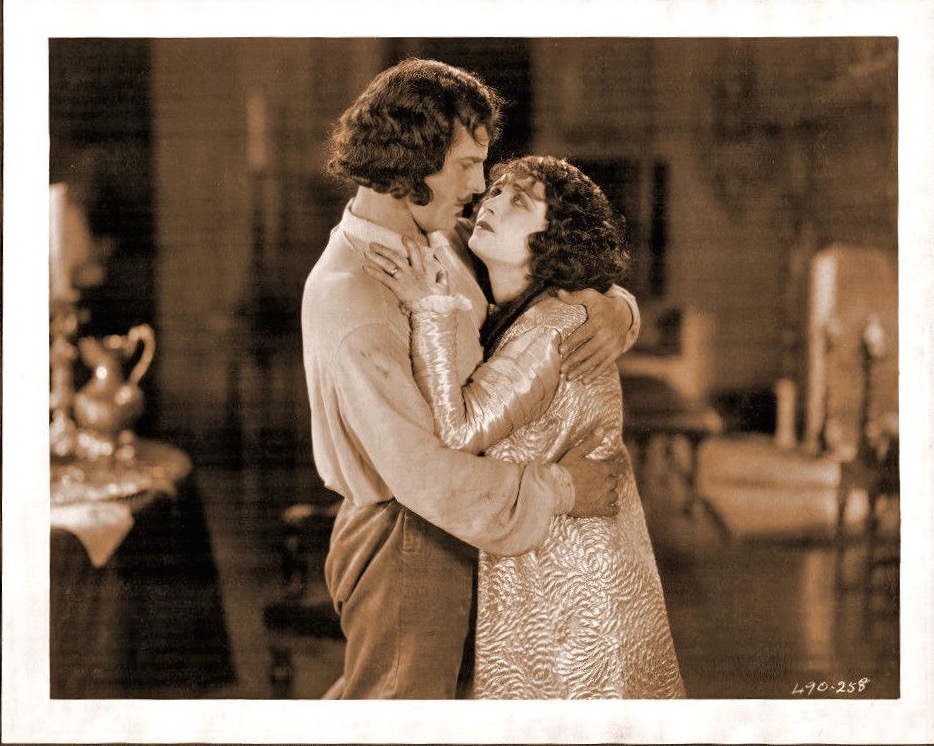 |
| Look at Antonio's hair. |
 |
| ...she was a dancer (classically trained) |





