Showing posts with label Alfred Hitchcock. Show all posts

Wednesday, 18 June 2025

Star-filled and velvet black - Film on Film 2025 (Part Two), BFI


When people ask me what’s the difference between watching a nitrate print and another… I commonly use the analogy of a photocopy of a picture compared to a stain glass window…


Bryony Dixon was describing the nature of nitrate on this day in which we would see four films which, literally showed us more on screen. There is more luminosity and translucence with nitrate film and greater depth and clarity; you can see details in the velvet-black it doesn’t have the block-blacks you can get with even the highest quality digital and celluloid.


Nothing in this fantastic festival of film on actual film comes easy and the love that dares to speak the name nitrate was in full effect as the programme director James Bell, BFI’s Senior Curator of Fiction, lined up on stage with colleagues to explain the process of selecting, testing and projecting those that have made the cut to be shown in the only UK cinema capable of screening nitrate – a projection box made out of Durasteel – asbestos sandwiched between two sheets of steel in 1953.


The BFI hold some 44,000 films on nitrate stock but as Sonia Genaitay, Curatorial Archivist pointed out, not all are in screen able condition. Age withers and curls nitrate and finding films that can be projected is a detailed progress involving testing and eyeballing with Dominic Simmons, Head of Technical, providing the ultimate projector-accepted testing of the films we were to watch. Some 50 titles were considered this year with just five making the cut.


James said that they hoped to screen more nitrate throughout the year and we can only be thankful for the efforts made to preserve and present these special shows. Talking of which, a tip of the hat to today’s projectionists: Mark Kennedy, Mick Fife and Lauren Feyderline without whom we’d be staring into space.


The BFI team explain the wonders of nitrate


Un Chien Andalou (1928), 35mm nitrate


"NOTHING, in the film, SYMBOLIZES ANYTHING. The only method of investigation of the symbols would be, perhaps, psychoanalysis."


It was only just lunchtime when DJ Christopher Bird hit the decks in NFT 1 to replicate the original accompaniment to Dali and Bunel’s 1929 surrealist masterwork, An Andalusian Dog (Un Chien Andalou) a film they were determined would not mean anything although as Breton’s Exquisite Cadaver exercise had proven, everything has some meaning even and especially unintentionally. Luis Buñuel intended to “mash up” – as The Kids now say – Argentinian Tango music with Wagner and all but invented Classical Lounge Core without knowing it and Chris was tasked with cutting from one to the other by playing contemporary pressings on two 78 rpm turntables, one of which was a top of the range EMG machine from 1932 which produced remarkable clarity and range.


Introducing, Bryony said that the first surrealist film was founded on two dreams that Dali and Bunel had had with the condition that no idea or image that might lend itself to a rational explanation of any kind would be accepted… and so it proves with Dali’s ideas and ants (finally sourced from Spanish mountains after a fruitless and ant-less search of Paris by taxi) masterfully expressed by Bunel. Pierre Batcheff, who I now recognise from other French silent films, and Simone Mareuil add their own levels of un-meaning amongst the “situations” and as per usual, I still don’t know how the eye-cutting scene was done, not that I can look at it.


This could have been the fragile prints final projection and the accompaniment from DJ Bird made for a fitting last hurrah!


Spanish ants on Pierre Batcheff's hand as Simone Mareuil looks on.


Partie de campagne (1936), 35mm nitrate


Backgrounds are as important as foregrounds. Flowers, faces and mountains are not just placed side by side. They constitute a collection of elements all rolled into one, amalgamated by a love stronger than their differences. Jean discussing his father Auguste Renoir.


Jean Renoir seems to have been fascinated by waterways and, in addition to The River (1951), he also directed his first feature, La Fille de l’eau (1925), just a few kilometres away in Marlotte from Partie’s location on the banks of the Loing and the Essonne rivers, left tributaries of the Seine some way out from Paris. The river is life, it is unpredictable and yet it can rush us to our destiny whilst the trees at the water’s edge can bind lovers together but they can also hide and confuse. As much as the river is ever present, it keeps on moving the narrative and characters’ choices can be lost in the swirling momentum.


Partie de campagne is based on a short story by French “realist” Guy de Maupassant (author of Bel-Ami (1885) and Pierre et Jean (1888)) published in 1881 (set in 1860 during the reign of Emperor Napoleon III) and offering a shock of bitter fate amongst the bucolic dreaminess.


Parisian hardware store owner, Dufour (André Gabriello) takes his wife (Jane Marken) and daughter Henriette (Sylvia Bataille) along with his dishevelled clerk, Anatole (Paul Temps) into the countryside where they stop at an inn run by a manager played by Jean Renoir. Two young men, Henri (Georges d’Arnoux) and Rodolphe (Jacques Brunius), are bewitched watching Henriette and her mother (Jane Marken) on the swings and resolve to try their luck. All innocent fun but things get rather more serious when the two couples head out on the water… just a simple day in the country, what could be less innocuous?


Sylvia Bataille and Georges d’Arnoux


Blanche Fury (1947), 35mm nitrate


English melodrama done with same sort of conviction that Bette Davis and Joan Crawford brings to their films…

Jympson Harmon, London Evening News 19th Feb ‘48


Now it was time for British technicolour nitrate on and Valerie Hobson in all her auburn glory alongside the moodiest Stewart Granger for whom we needed all the depth and visual subtlety of nitrate to see the shadows within. He reminded me a Paul Newman in yesterday’s Hud, a man so obsessed by the perceived wrong done to him by careless parents, that he couldn’t see a way out. This was a Brit gothic romance almost without the romance but with vengeance at its heart, a very dark film for 1947 but then it had been a very dark time. Amongst the velvety shadows we were afforded glorious views of Miss Hobson’s costumery, designed by Sophie Harris from theatrical costumers Motley and as the story darkens so too do the textures change colour as the reds and darker hues of passion replace her earlier calculations and manners.


Jo Botting, the BFI’s Curator of Fiction, introduced and gave a flavour of the impact of the still relatively rare Technicolor. Miss Hobson’s pale skin and auburn hair benefited from the process being especially striking in the daylight whilst the Daily Mirror reviewer probably watched a late showing after closing time… “the colour camera seems to be kinder to Valerie Hobson than most other actors, she always looks good in black and white film but in colour what a smasher!”


Won’t disagree with that and Mr Grainger looks well too as French director, Marc Allégret respects the material and creates and engaging psycho drama that, with standard generic tropes still persuades through the elegance of composition and force of performance. It makes Saraband for Dead Lovers (1948) look drab and tame in comparison.


Jo quoted the Mirror again: Emphatically a woman’s picture… for every man who scuttles off to the nearest bar at least five women will remain to revel in someone else’s unhappy and illicit love story! Not a single fellow left for the bar, well, not until the film was over to thunderous applause. We were lost in mid-Victorian reveries in the layered gloom.


Valerie Hobson abides...

The Man Who Knew Too Much (1934), 35mm nitrate


The Man Who Knew Too Much (1934) may have been the film that established the talkie Alfred Hitchcock but after a largely witty and energetic start it descended into an extended shoot out with its easy-going capers replaced by a rising body count of police and Germanic rebels with an unknown cause: almost The Film That Slew Too Much? Still, there was no Doris Day to sing Que Sera Sera as in the 1956 remake and absolutely a smaller budget along with some excellent performances especially from Leslie Banks and a deeply disturbing Peter Lorre, hooded eyes accentuated by a dyed streak in his hair and his tendency to laugh in the face of anything: jokes, murder, infanticide and certain death.


Hitchcock told François Truffaut that "… the first version is the work of a talented amateur and the second was made by a professional." I’m not entirely buying that, especially as this was his 20th feature film and clearly has some of the hallmarks of his most engaging work – an “invasion” of normal family life by lethal forces, witty dialogue from leading characters unaware of the threat at hand and an almost likeable villain… In the midst of life, we are in death or, in this case, the midst of a dinner dance as a man is shot and passes on a key message on which the rest of the film’s story will rest.


Peter Lorre, Leslie Banks and Nova Pilbeam

The Lawrences Bob (Leslie Banks) and Jill (Edna Best) are on a holiday in Switzerland with their daughter Betty (Nova Pilbeam) and their dog (actor unknown). Jill loses a clay pigeon shooting contest thanks to her impatient Betty with the Germanic Ramon (Frank Vosper) gracious – and suspicious in victory. At the dance that evening their French friend Louis (Pierre Fresnay) – a skier with whom Edna flirts unrelentingly – is shot dead but manages to pass on a note to be passed onto the British Consulate… The couple read the details, it’s a warning of an international crime about to be committed but before they can do anything, Betty is kidnapped and they are under strict instructions not to say anything to anyone.


A classic Hitchcock set up with ordinary – wealthy middle class – heroes stuck between the good and bad guys, in this case led by the aforementioned grinning Abbott (Peter Lorre). Events move at some lick until the aforementioned final sequence involving the Royal Albert Hall, a hide-out at a sun-worshipping church (?!) and a mass shoot out. It’s Hitch 22 as the Lawrences must not let on what they know even as they must find out more to save their daughter.


So ended another breathless day on the Southbank and it was not just our imaginations that received these films in a deeper way than usual, we literally saw more, but by no means “too much”!


Thank you BFI and… till the next time!


Christopher Bird at the EMG gramophone (picture from Lynne Wake)


Sunday, 13 October 2019

The Avenger: Endgame… Le Giornate del Cinema Muto, Pordenone Day Eight


Watching Alfred Hitchcock’s The Lodger, a Story of the London Fog (1927) for the third time on the big screen, I can’t help wondering about the director’s political thinking. It’s probably been said before, but in the context of the late twenties, a film about hysteria roused by frenzied media coverage and leading to vigilantism and mob justice is not just about a serial killer… then again, it has been a long week; your mind is prone to wonder in Pordenone.

The real issue is how the public respond to the feeling of a murderer in their midst, an “other” set to destroy their way of life and someone who could be any one of them… This is the self-imposed terrorism of the newspapers we buy and the gossip we make and it is of course as old as the hills and always current. As Neil Brand said in his introduction to the 2017 premier at the Abbeydale in Sheffield, Hitchcock has made voyeurs of us all: we’re as obsessed with the vicious fantasy as the folk on screen and we lap it up all the same.

The story is not really about the murderous Avenger but how someone is perceived based on prejudice and human weakness. Ivor Novello’s lodger, Jonathan Drew is a jazz-age Man Who Fell to Earth, an alien in style and manners who is both “queer” and “doesn’t like girls” according to the title cards and this is more about his strangeness than any sexual statement. Who else to have cast in this role but a man with the same androgyny as David Bowie, whose Thomas Jerome Newton fifty years later, was scarcely more alien in the context of the earthy East End.

Ivor the Alien
Then there is June Tripp’s character who is positively seeking otherness, bored with her plodding boyfriend, over-eager copper Joe Chandler (Malcolm Keen) … she’s a feisty character and not given to hysteria and you know she’d be the practical one in any future relationship for her lover is deep in grief and needs her support – in every sense she saves Jonathan.

There’s an intimacy established with The Lodger’s characters so quickly, from the girls backstage at the Golden Curls show – reference in the opening montage and at the close – as the gobble up the news, to the Bunting household with father (Arthur Chesney) and especially mother, the peerless Marie Ault who’s Irish accent you can almost see on screen!

The Lodger is a bold creative enterprise from the title cards right through to the shot-making, story and performances. It needs a score to match… and Neil Brand has delivered something Alf would thoroughly approve of.


This is the second time I have seen the film with Neil Brand’s orchestral score and I have to say it is even better than the first: this is a soundtrack “in love” with this film’s characters and narrative and which works through the core of the film via a joyful osmosis; a duet between old and modern in totale simpatia. As with all of Mr Brand’s scoring, there’s a wealth of knowledge at work about the practice and those who have perfected it and one can hear echoes of Hitchcock’s future and past in the music.

This is one of the most re-watchable of silent films and the music recognises that and works with it; it’s composition that pays due diligence to audience expectations and is simply fearless in respecting the source and our ability to interpret the musical signals. The music is without pretence and is an honest, daring tribute to the watched and the watchers; it completes Hitchcock’s project goals by working on our voyeuristic involvement in the sensational story, June’s bath and the chess match by the fire that makes ‎Steve and ‎Faye’s Thomas Crown affair look like a bored game.

As the last act of Le Giornate it’s pretty much the perfect choice; beyond meta as a cinematic experience and, whilst it works on an immediate level, it’s a connoisseur’s delight: good vintage, delivered at the perfect temperature in the best silent restaurant in town.

The Joker
Before the end, there was still some interesting business to take care of. Sadly, I missed Colleen Moore’s rags to cinema comedy, Ella Cinders (1925) but I did make myself acquainted with “The King of Clowns”, Swiss-born Adrian Wettach in Son Premier Film (1926). Wettach – stage name Grock - had extraordinary physicality, a dynamic athleticism gained from his circus days and here, even at 45 his athleticism and energy are impressive as is his range of expression; positively Chaney-eque.

This first feature, natch, had him chasing his inheritance to Paris and getting involved with show people after his things are stolen. It’s French Whimsy alright and I have to say I prefer him without the make-up… too many clowns and Jokers this year.

William S Hart wasn’t joking though, certainly not in Blue Blazes Rawden (1918) when the high plains drifter was cast as a fierce woodsman in the “forest frontier” of the Canadian northwest of the 1880s. Jim Rawden is as wild as the wind, and when he comes into town for a good tie m with the boys he immediately comes head-to- head with the crooked English bar owner,  “Ladyfingers” Hilgard (Robert McKim) who tries to cheat him at cards and then gets an accomplice to empty Jim’s gun and sets up a fight he can’t lose…


As the two men face off, and Jim realises he’s firing blanks, his sheer rage puts Ladyfingers off and too frightened to shoot straight he falls. English to the last though, Hilgard asks Jim to lie to his mother and tell her he was a good man.

Thus it is that when she (Gertrude Claire) and her other son arrive, Jim goes out of his way to do the decent thing and tell her what she needs to know. Once again, his character have been “saved” by an honest white woman and this one of his own age too… (I wasn’t joking on that point M!) – Claire was only 12 years older than Hart.

Maude George plays the wilful Babette DuFresne, half French-Canadian, half-native American who loves Jim and wants him away from these people. As the Diane Koszarski notes in her film notes, Maude “…had been cast as morally suspect foreigners and vamps at Universal, Triangle, and Selig…” and was therefore ideal for the role.


It’s been quite a week for Hart and also for Reginald Denny whose final film was perhaps his funniest. Skinner's Dress Suit (1926) is that rare thing, a genuinely charming comedy featuring two vibrant leads – Denny and the lovely Laura La Plante who cuts a rug almost as sharp as her platinum bob. In thrilling style, the two dance the Savannah Shuffle…. a variation on the Charleston – before leading a host of society types in trying to learn the steps.

Denny has such an affable presence and is a precursor of the pre-code talkies to follow with his measured, realistic emoting and perfect sense of timing. And he can also dance, the Savannah Shuffle needs to be brought back; someone needs to tell Strictly/Dancing with the Stars…

As I type, I’m at Venice airport waiting for my delayed flight back to Britain… more time for coffee and reflection on another special week with silent pals on and off screen. Grazie molto Pordenone and let’s do it all again in 2020 however long the passport queue has become by then.

 Let's Dance.


PS Many, many thanks to PH: Britain's Queen of Bloggin'. Her daily updates have been so stylish and informed, you can read then all on her Silent London site.

If blogging is like jogging then this has been a marathon. But a fun run all the same!

Friday, 26 July 2019

The spaces between… Notorious (Hitchcock, 1946), BFI re-release restoration


“Of all its qualities, the outstanding achievement is perhaps that in Notorious you have at once a maximum of stylization and a maximum of simplicity… “ Francois Truffaut interviewing Alfred Hitchcock

This sparkling new 4k restoration was one of the hits from this year’s Cinema Ritrovato festival in Bologna and is being screened at Bristol’s Cineredis before nationwide re-release starting at the BFI on 9th August.

Hitchcock’s response confirmed Truffaut’s assertion and that he was aiming to make an espionage story without the usual violence but with as much insecurity and menace as possible. He also achieved this with baddies who have depth, love and fear of their own: Claude Rains’ Alexander Sebastian loves Ingrid Bergman’s Alicia Huberman every bit as much as Cary Grant’s Devlin and yet, whilst Alicia reciprocates the latter’s feelings she is also not without sympathy for Sebastian. We fall for the shocking intimacy between the double agent and the spy as much as for the “goodie” and for a while there is doubt.

Ingrid talking to an unidentified man: it's a full two minutes before we see Cary's face
This is one of the many things that continue to engage the modern viewer in this a-typical and quite gripping post-war spy story. The three leads are mesmerising with Bergman, inevitably, the centre of attention radiating a vivid spectrum of emotion and yet always holding something back. It’s in the tilt of her head as she nuzzles up against Cary Grant in one of innumerable close ups from Ted Tetzlaff’s camera, that we search to find her true meanings. Sometimes the screen is filled with a slow-motion waltz between the two lovers as their heads touch or, famously, kiss for three minutes… which may or may not have been the longest kiss in screen history or a virtual ménage a trois as Hitchcock later suggested with his notoriously crude humour.

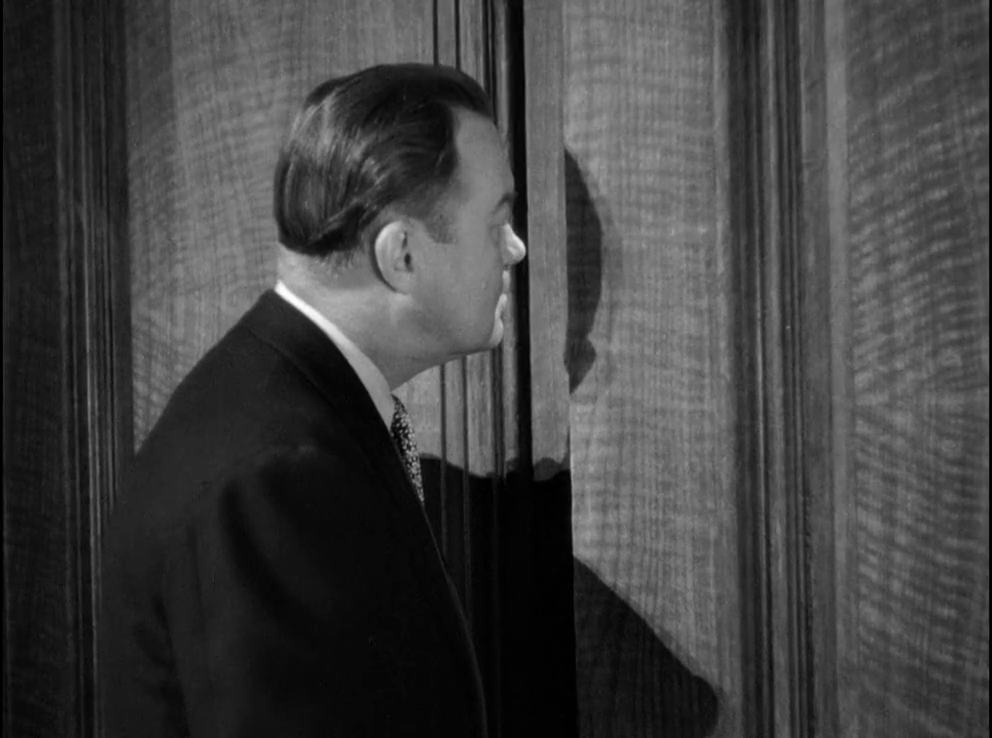
Notorious approaches the genre from the most acute of angles from the start when Alicia sees her German father convicted of treason by a US court; even this is witnessed form the point of view of a court official looking through the courtroom doors as her father learns his fate.

We're all Peeping Toms for notoriety
After avoiding the press outside court we’re back at Alicia’s apartment for the drowning of sorrows 
and the rare sight of watching Ingrid Bergman getting drunk. There’s one man she doesn’t recognise and we don’t either as only the back of his head is shown. Its only after the party has broken up and the handover lands that we see the full face of Cary Grant’s FBI agent. She takes him drunk driving and only finds out he's a cop when she's stopped by a traffic cop.

More great camerawork greats Alicia's massive hangover the following morning arguably one of the Director's finest portrayals of the pained disorientation of over-indulgence; Cary appears at an out-of-focus angle whilst Ingrid stares desperately at her orange juice, barely able to track the man as he crosses over her room to stand over her: we've all been there although not with these two in the room. 

Under over hung
 There’s an instant connection between Alicia and Devlin – we expected it – but he’s there to do a job and she’s, frankly, a little bit out of control. Devlin persuades her to fly down to Rio and to do a job for the Bureau… she accepts with little to lose only to find that she has to romance a former admirer, Nazi sympathiser and friend of her father, Sebastian (Rains).

Love and loyalty are soon to be sorely tested as Sebastian truly falls for Alicia and, in order to obtain the information required, she agrees to marry him… Devlin is in too deep to accept this dispassionately and begins to distance himself from Alicia almost encouraging her to act the wife more than the spy… human nature undermining objectives.

The rapport between Rains and Bergman is real enough and we feel for the jilted agent until Alicia starts to spot the clues among Sebastian’s friends even though pretty much the only one acting like an anti-American is his beyond stern mother (Leopoldine Konstantin), who sees through Alicia and everyone else with the x-ray eyes of demented conviction.

Three minutes of breaking the Code's three-second rule
As Hitchcock plays with our heart strings – jealousy and betrayal are so potent – there is the further tension of Alicia’s double and possibly triple turn. The director builds new, awkward spaces between his two main lovers who are so intertwined when sure of their love whilst slowly applying the pressure of Alicia’s mission. The camera swoops down over a dinner party at Sebastian’s to show her holding the keys to his mysterious cellar among the Nazi’s surrounding her; one slip and she’s uncovered.

But those keys… the tension is almost unbearable as Alicia and Devlin search the cellar for clues among the bottles as the bar man upstairs gradually runs out of champagne: a trip downstairs is inevitable and, as usual Hitchcock has us flying by the seat of his pants.

The film is so well timed and balanced and follows a narrative full of threat but low on physical threat: there was so much fear in 1946 that it was simple a question of plugging in. Hitchcock’s choice of nuclear plotting was, ever so slightly too close to the bone and he aroused suspicion among the FBI…

Claude Rains comes between...
I can understand how it became one of Truffaut’s favourites, so well balanced throughout, lean and graceful just like its amazing stars. And, with that 4k restoration, it is simply irresistible!

Notorious is back in cinemas UK-wide from 9 August at BFI Southbank, Watershed Bristol, IFI Dublin, Filmhouse Edinburgh, Glasgow Film Theatre, Tyneside Cinema, Belmont Aberdeen, HOME Manchester, Broadway Nottingham, Arthouse Crouch End and selected cinemas UK-wide.


It will also be one of the highlights of BFI Southbank’s two-month Cary Grant season that begins on 1 August. It all looks great so here's some more of that...


Sunday, 7 May 2017

Silent Sheffield… The Lodger (1927), Neil Brand, Orchestra of St Pauls, Ben Palmer, Abbeydale Picture House, Yorkshire Silent Film Festival


This is only the second year of the Yorkshire Silent Film Festival and already you can sense it gathering momentum and a personality all its own driven by organiser-in-chief Jonathan Best. This year’s edition is a month-long celebration of silent film played out across that big county to the right of Lancashire, featuring a roster of key silent films all played by some of the most vibrant musical minds in the country, on their own or in ensembles.

Tonight was a major-league kick-off with a World premiere of Neil Brand’s sparkling new score for Hitchcock’s ground-breaking The Lodger as played by the Orchestra of St Pauls conducted by Ben Palmer. It was part of a weekend of silent spectacles in Sheffield’s amazing Abbeydale Picture House – one of the city’s oldest cinemas and one saved for film projection by a kindly benefactor who realised its communal significance far outweighed initial plans to re-work it as a climbing space.


The Abbeydale opened in 1920 but rarely can it have played host to such an intoxicating blend of on screen atmospherics and such refined accompaniment, emphatically performed by a truly World-class ensemble.  For me at least, this score far out-ranks the previous orchestration provided for the Hitchcock Nine restorations by Nitin Sawhney: that was musically interesting and inventive but doesn’t synchronise emotionally or narratively as well as Neil’s work. It’s the difference between Rita Hayworth trying to match Fred Astaire’s movement for their first feature, You'll Never Get Rich (1941), versus Ginger Rogers on their ninth: you’d still enjoy watching Rita dance but...

Here there’s a coherence that speaks of an obsession with replicating the emotional nuance of the source material and gifting supremely able players with a chance to fully immerse their sonic output with the sights on screen: from the grand moments of fear and dread murder to the sexual splash as Ivor Novello stands outside the bathroom listening as June Tripp taking a dip to a rising cluster of notes as she raises a laugh: it’s an emotional ballet written in response to Hitchcock’s 90-year old choreography.


Sat in the second row, feet away from the violins in the Abbeydale’s plush green seats, you’re swept up under the combination of giant Ivor face and mesmerising musicality… all weekly woes dissipate and the cinema takes you on a strange journey just as it would have done your grandparents… just as the director intended when, as Mr Brand said in his introduction, he decided to make voyeurs of us all…

It starts with as scream and as newspapers report all on the Avenger’s murderous spree and the people on and off screen lap it up – we can’t help ourselves. This man who only murders blondes – already with this Alfred? – has a dressing room full of show girls fascinated and so are we; both with the story and with the girls… By the by, am I correct in noticing the ultra-short trim of scouser Peggy Carlisle lapping up the gossip?


The film looms large on the Abbeydale’s huge screen imposing itself on the audience from the opening dramatics as Germanic shadows are cast over a suffocating, studio-bound London: “a story of the fog…”

Inside the cosy home of The Bunting Family all is clear with mother (Marie Ault – who is just magnificent), father (Arthur Chesney) and their daughter Daisy (June Tripp here referred to as Miss June). They are in the basement of a townhouse not far from the Houses of Parliament and are entertaining Joe Chandler (Malcolm Keen), a policeman who is romancing Daisy although as her treatment of his pastry heart reveals – a very Lubitsch touch – isn’t as keen as the cop.

Here's Ivor!
They are disturbed by a knock on the door and Mrs Bunting goes upstairs to find the strangest fellow standing on their threshold: Jonathan Drew (an unearthly Ivor Novello), a tall stranger, with scarf wrapped over his face, has come looking to rent their spare rooms. Why is this so clearly-moneyed man looking for accommodation and, why is he so strange…?

Hitchcock piles on the clues that begin to implicate Drew in the Avenger killings… his scarf is worn in the same manner as the murderer, he nervously hides a mysterious briefcase in his room and then asks for the surprisingly plentiful portraits of blonde woman to be removed after turning them one-by-one against the wall.

Miss June
He is indeed a “queer fellow” as one of the characters observes, intense and detached and not conforming to social norms. He is hiding something but we don’t know what.

None of this distracts Daisy who takes an immediate shine to the new arrival. Daisy’s a “mannequin” and with broader horizons than her family and boyfriend… whilst Drew is something new and interesting. They start to relax in each other’s company and play chess in his room. She glances at this strangely handsome man whilst he gazes intently at her blonde locks… Hitchcock contuse his playful tone as Drew, looking intent, reaches for the poker only to cut away and casually return after the fire has been stoked.

Marie Aultgives a great performance
But we have doubts about Drew and when he leaves the house late in the evening, Mrs Bunting wakes and peers out of her window as he enters the night. There’s great light and shade in this sequence with Drew descending the darkened staircase and the dim light of the street lights illuminating Mrs B as she begins to wonder if this man may be even stranger than he appears.

And, as every Tuesday, there is another murder that night…

Staircase mystery...
Drew attends one of Daisy’s fashion shows and buys her one of the dresses she parades. This is too far for the Buntings and father returns it with some straight talking. Drew creeps out towards the bathroom where Daisy is bathing and we’re treated to a proto-Psycho moment as Daisy’s supreme vulnerability is set against the presence of a potential killer.

By now Joe has also had enough and distraught, the policeman begins to put two and two together as it looks increasingly likely that the lodger is the killer… or is that just what he and we want?

Your move...
It’s masterful story-telling and almost all in the mind of the viewer who is a clueless as Joe in terms of interpreting the evidence Hitchcock supplies. As with the story so with the score and Brand’s music keeps us guessing right until the end as the tension becomes almost unbearable…

A thrilling ride all round and an excellent start to the festival!

Flying the flag: the Abbeydale
The films continue in silent Yorkshire throughout the month and full details can be found on the festival site. You can also find out what's happening at the Abbeydale Cinema on their Facebook page here.

Neil’s score will be available on the up-coming Criterion DVD/Blu-ray release, played by the Orchestra of St Pauls with Ben Palmer conducting. It’s released on 27th June and you can pre-order here.

Oh, silent film obssessive... is that Peggy from Hindle Wakes (right) in The Lodger (left)?

Monday, 13 July 2015

Concerto for the conscience… Blackmail (1929), Saffron Hall with Timothy Brock, BBC Symphony Orchestra


When the Hitchcock Nine restorations were premiered through 2012 this is one I managed to miss – the big one! The film was screened with a full orchestra playing Neil Brand’s score at the British Museum but I was on holiday… I thought about cancelling, but, you know…

Anyway, patience is its own reward, especially if a second chance comes your way, which is why I set off in search of Saffron Walden (no, you can’t really turn straight off the M11, you need to go via Stansted Mountfitchet… or at least print out a map Paul!) to see the film being screened with Timothy Brock conducting the mighty BBC Symphony Orchestra in playing Mr Brand’s score and… I don’t think things could have been any better at the Museum.

Impressive, isn't it?
Saffron Hall is a purpose-built concert hall tacked onto Saffron Walden County High School; it has a generous stage with more than enough room for an 80 plus piece orchestra, excellent acoustics – we were wrapped in sound – and very comfy chairs. We kicked back and re-watched Blackmail in a new context as Anny Ondra’s gaze drew us in once more.
  
Blackmail shows how massively an evening can go wrong and how anyone can be dragged into a new world in an instant - a world that floods your very being with the sickness of guilt and the dread of consequence. It is also clearly about desire – Miss Ondra is at the centre of almost the whole story – and the danger of following you primal heart too far, as Cyril Ritchard’s character, the artist Mr Crewe, finds out.

Every aspect of Alice's life is changed...
It is also a morally open film that challenges the audience to adjust their expectations even 86 years after release – we’re all guilty and complicit by the end with the director putting us all in the picture. 

We root for Anny’s character Alice White (see what he did..?) and we hope she and her policeman Frank (John Longden) will find themselves after the twist of hate that leaves the more clearly-defined bad-guy, Mr Tracy, the blackmailer of the title, conveniently in the frame. But the ending is purposefully ambiguous – you can escape “justice”, even get away with murder but in the end, the characters will judge themselves and each other. That much is clear when Frank’s previously supportive hand, drifts slowly away from Alice’s hand…

Tracy applies the pressure...
The restoration is of course superb leaving the images as spic and span as when they were first projected and from our vantage point we were eye-level with the sequence of marvelous location shots, close-ups and interplays that make this film one of Hitchcock’s most visually pleasing. Everything that was to come is pretty much in this film and it is one of the most disciplined of British silent films that almost needs no titles cards to explain itself.

All of which has been a gift to Neil Brand  and his composition manages to amplify the film’s emotional content whilst carefully under-scoring the narrative by matching the director’s pacing. There are powerful Herrmann chords and huge emotional shifts that well up in tune with the tears at the corner of Anny’s eyes. There are also interjections that sum up the re-assuring, yet humorous presence of a policeman even in the moments leading up to Alice’s crisis. These details are the essence of Hitchcock’s very British appeal and Neil obviously knows him very well!

Music and role-play what could possibly go wrong?
Timothy Brock’s orchestration brings out the full flavour of Brand’s score and the orchestra was simply irresistible creating that unique meld of sound and vision that can make silent film the most truly immersive of all cinema – yes, even without IMAX, 3D and maximum volume. It is “hot media” alright calling on the instinctive 90% of our communication that does not rely on spoken words and filling that missing 10% with a sweet overload of sounds in sympathy.

Donald Calthrop
This succeeds in adding flavour to the expression on view with great performances brought into new focus. Cyril Ritchard’s artist is a typically-nuanced creation: was he intending to go all the way with Alice, maybe not at first but certainly after she’d put on the ballet dress and subsequently re-buffed him. Even in these desperate moments we still expect him to back down and to be the gentleman he appeared to be.

Donald Calthrop’s Tracy is a mean man, preying on the vulnerable and living off other’s misfortune. Nothing will prevent him from trying to take advantage of Alice and Frank’s situation and yet when the tables are turned his own fear is brought to the surface, bringing out Alice’s compassion even when it may cost her dearly.

John Longden
John Longden’s Detective Frank Webber, is all action in the opening sequence and appears to be pure metropolitan police blue-blooded. He’s dedicated to his work and often leaves his girlfriend Alice waiting, she is seeking more adventure and dumps him for the artist and yet he is still willing to help. Doubts appear at the end making Frank feel even more real.

But it’s really all about Anny as Alice runs the full gamut from bored tease to a girl who will fight for her life and then condemn her own actions: she was well-brought up in that news agent! We saw it all and as a modern audience have no doubt it was self-defence but how did contemporary audiences feel. Perhaps the clue is on Anny’s face as she walks out of the police station at the end: eyes glazed and in a daze.

Anny...
Hitchcock’s later films were more specifically about blood and horror here the fear is so much more effective for being contained: there is no blood, just repeated images of the knife, knives, the dead man’s hand resonating in others' hands: Alice is haunted by her actions and we can only hope Fred or someone else will help relieve her burden.

Blackmail is available but, frustratingly and unlike The Lodger, the restored version has not yet been released. As with that film it really does deserve a dual-disc release with Neil and Timothy’s music on it. OK, who’s in charge? When do we start the petition!?