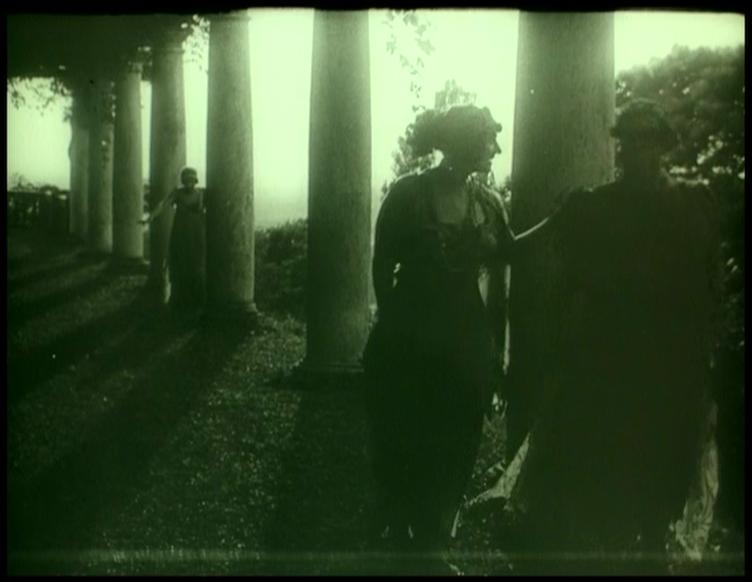
Showing posts with label Mario Caserini. Show all posts

Monday, 7 September 2015

Everlasting love... Ma l'amor mio non muore! (1913)


Ma l'amor mio non muore! was specifically written for Lyda Borelli, one of Italy’s leading stage actresses and featured her performing two of her most famous roles on stage: Salome and Zaza in front of an undoubtedly star-struck audience of extras. It’s one of the moments; historical film as history in itself; the actress and her effect.

Lyda Borelli on stage
As Ivo Bloom notes in the booklet for the Cineteca di Bologna DVD release, it’s also a document of La Borelli finding her way with the new medium: her first time on screen, developing her film acting style and so instinctively well, even from the modern viewpoint. Next to Asta Nielsen, Borelli’s acting is amongst the most naturalistic you’ll find in 1913. Yes there are a few moments of over-wrought arms-aloft, hand-jiving but look closely and you’ll notice an incredible range of expression: fleeting moments of anger, and even disgust that wouldn’t be found on the face of many.

Borelli didn’t care about her “look” so much as her expression, it seems, even though the look took care of itself... and her storytelling is in many ways well in advance of the film’s narrative.

Borelli often shows emotion through poise alone...
Mario Caserini directs well with lots of similarities to contemporaries in Italy as well as elsewhere in Europe – Bauer, Christensen, Blom, Perret et al. There is, as Bloom notes, less editing than in American cinema but long takes on huge sets which provide their own “cuts” in the story.

The vast "playing area" of the Colonel's house
 In Colonel Holbein’s house, the parlour leads off to his study on the right and the dining room on the left which is initially covered by curtains. The characters move around in long takes and are choreographed to move the narrative around the space: Ida’s character Elsa being romanced by Sthar the spy at her piano whilst the traitor looks over to the study to see the two colonels examining the war plans he must steal. The colonels leave and whilst Elsa says farewell, Sthar sneaks across to the study and takes his prize.


No doubt Lois Weber or DW Griffith would have done this differently but it works all the same whilst also looking altogether more splendid and grandiose than they might have made it. It’s probably a bit lazy to say that the Italians favoured style over substance but there are some rich textures in the mis-en-scene and so many huge floral displays.
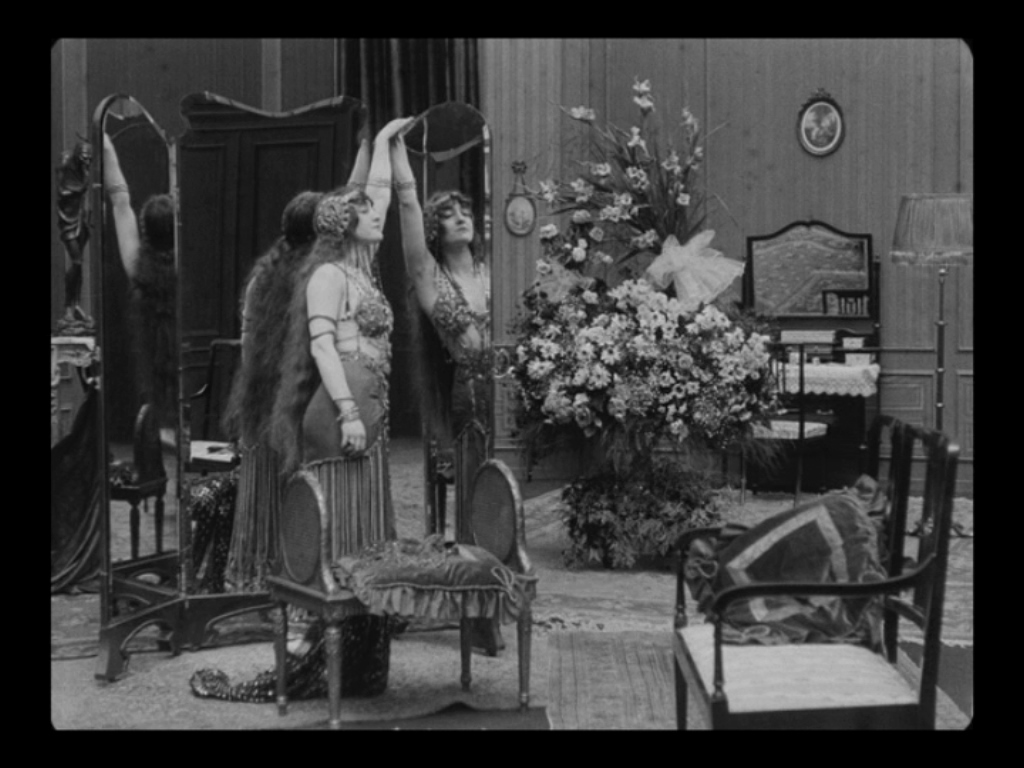
Salome?
La Borelli also has more costume changes than Lady Gaga or even Lady Miss Kier (anyone remember DeeLite: a costume change for almost every song if memory serves!?) and this film is a must for dedicated followers of Mariano Fortuny and the rest. And, of course she wears it all well, with a practiced physicality developed over a decade on stage and yet with granular emotional control that belies her cinematic experience: she sucks the viewer into these improbably large spaces and you completely overlook some of the hams surrounding her (Improbable spaces? Impossible beards!).


The film starts with information being handed to the spy Moise Sthar (Gianpaolo Rosmino); he reads the instruction then furrows his brow working out how to achieve his goal to steal the secret war plans of the Wallenstein army.

The Rotter!
Next we cut to the army’s chiefs of staff, including Col. Julius Holbein (Vittorio Rossi Pianelli) who returns home to his daughter Elsa (Lyda Borelli) and their massive drawing room. They are entertaining Colonel Theubner (Emilio Petacci) tonight and he is greeted before the surprise arrival of Sthar who’s fiendish plan is to go to the colonel’s house and steal the plans!

The camera pans and follows Lyda...
The cur makes up to Elsa who politely demonstrates her skills on piano for him as he prepares his audacious robbery. Mission accomplished and the Holbein family are in ruins: the Colonel does the honourable thing leaving the blameless Elsa to be exiled. Harsh, as the young people now might say…

Elsa may be down but she is not out and, having made her way to the Riviera, soon secures a gig at the opera where her song and dance begins to ensure sell-out audiences. She’s the toast of the town and pestered by male admirers in a manner that must have been all too familiar to La Borelli.

Mario Caserini moves his characters with geometric precision
Surrounded by men in dinner suits, Elsa has never been more alone until she catches the eye of another sad-looking individual. We know, but she doesn’t, that this is Prince Maximilien of Wallenstein (Mario Bonnard) who has been sent to the coast to recuperate from illness, his father the Grand Duke of Wallenstein (Dante Cappelli) having been the same man who signed the order to exile Elsa…

The Prince and the showgirl... get a little too close for the censors
Fate has thrown the two together and soon they fall in love after Maximilien hears Elsa’s playing in a village church: just so we’re all clear - she might be an actress but she’s a soulful one.

Queue some moments of happiness and a quite convincing canoodle on a yacht which would never have got passed the powers that be in the US: passion.

But... even this new reality cannot escape the couple’s collective past and they are spotted by Sthar (what a spy he is!) who, having already done so much damage, is still intent on “revenge” and sets about revealing their relationship.


You know this will not play well in Wallenstein but will obligation and shame tear this love apart?

I watched the 2013 restoration which looks quite unreal for a 102 year old film (that’s as old as my Aunty Lil – who still looks grand!) with hardly a blemish. This makes the close-ups immensely rewarding as the Italians appeared to use far less make up than the Americans: Borelli lives!


There’s a choice of two soundtracks, a collection of contemporary works and an excellent new score from Francesca Badalini who plays on piano accompanied by Aurora Bisanti on violin and Guilia Monti on cello.

The disc is available direct from the Cineteca di Bologna or from Amazon (who bizarrely have it listed in books) – an important part of Italian film history and crystal clear view of one of the greatest performers of the era. Oh, I forgot to mention that she was a diva? Of course she was, but she was an actress more than anything else and her work is still fascinating.

Thursday, 18 April 2013

Epic tableau… The Last Days of Pompeii (1913)


Let's be honest, some pre-war films can be a touch… challenging. You don’t always get whisked away by the magic and forget that you’re watching a hundred-year-old film and one that might, actually, just be bad.
It’s supremely condescending to not expect a film of any vintage to entertain and to move you: the techniques may have changed but people haven’t and neither has the drama.

Ultimi giorni di Pompeii, Gli  was directed by Eleuterio Rodolfi and Mario Caserini, who also wrote the screenplay based on the famous novel by Edward George Bulwer-Lytton. It is one of the last great “tableau” films, so called as they consisted of a series of, often quite intricate, single takes using a largely static camera.

Fernanda Negri Pouget, Ubaldo Stefani and Vitale Di Stefano
Caserini and Rodolfi’s stretch the possibilities of this form to the limit with supreme invention and clever direction that makes the most of elaborate mis-en-scene along with some huge outdoor set pieces. Needless to say, there’s also an actual cast of thousands… gladiators, lions and horses and an exploding mountain.

It is not the breakthrough of the following year’s Cabiria but it must have been one of the pinnacles of this particular form, three years after the stunning L’Inferno raised Italian film's level of ambition many notches higher.

Eugenia Tettoni Fior
Rather than the relatively static camera giving rise to only surface involvement from the viewer, the depth of field and character choreography sucks you into this world of masters, slaves, witches and bad haircuts…

The story revolves around Glaucus (Ubaldo Stefani) – one of Pompeii’s most eligible, who opens the film walking down the main street with his friend Claudius (Vitale Di Stefano). They are chatted to by a couple of young ladies but Glaucus only has eyes for Jone (Eugenia Tettoni Fior) one of the city’s great beauties.

Jealousy
We are shown exterior shots of the two lovers enjoying a picnic in the lagoon but they are observed from the shore by Arbace, Egyptian High Priest (Antonio Grisanti) who, when not plotting to increase the popularity of Isis and other “new” Egyptian gods, is trying to force Jone into his arms… by foul means or fair.

Against this upper-class backdrop is introduced, a poor blind girl, Nidia (Fernanda Negri Pouget, who maintains her eyes in an excruciating upward tilt for the whole film… method miming!). She sells flowers when she isn’t slaving away at one of the local taverns.

More jealousy...
Glaucus, appalled at her miss-treatment, rescues her and buys her from the landlord. He sets her up as a handmaiden in his splendid villa... a very mixed blessing as it turns out.

Nidia falls very quickly for her rescuer but she’s quickly in misery following a visit from his true love… and we see her agonising against the curtains while Glaucus and Jone make love down stage.

We know who Jone would rather be with...
But all is not clear in love and Arbace summons Jone to pay homage to Isis at the temple. He tries to force her obedience and a striking split screen shows her torment as Arbace stands over her convinced he’s won whilst she imagines her happy day on the boat with Glaucus.

But Jone is saved by the intervention of Apoecides (Cesare Gani Carini), a Disciple of Arbace who doubts his master’s sincerity. Arabace swears revenge…

Nidia follows Jone and Glaucus
Back at Glaucus’ villa, the lovers re-unite and walk through the dusk pursued by a forlorn Nidia – great camerawork here as the directors shoot against the setting sun.

Nidia goes to Arabace for help – surely a love potion can help win her the heart of her master? Seeing a way of killing two birds with one stone, the priest makes plans…

Caught in the storm
Glaucus and Jone go walking on the slopes of Vesuvius and are forced to seek shelter with a mountain witch after a fierce storm breaks. The old crone is helpful until Glaucus kills her pet lizard mistakenly thinking it was about to bite Jone…no mammals were harmed in the making of this film but the reptile wasn't so fortunate.

After they have left, Arabace arrives looking for that love potion and the aggrieved witch concocts a brew that will rob Glaucus of all reason…

The scene of the crime...
Nidia duly delivers the potion but is appalled to see how it drives Glaucus mad… he runs off in terror and is framed by Arabace for the murder of his troublesome sceptic, Apoecides. Unable to think straight, Glaucus cannot defend himself against the charges and as Arabace has locked up Nidia, the only witness who “saw” what actually happened, he looks doomed.

He is duly sentenced to death in the Coliseum whilst Nidia rots away in her dark cell… is all hope lost?

A cast of thousands....
Rodolfi and Caserini make great play of the Coliseum and really show how inadequate the term “tableau” is for this film as a casts of thousands teams around a convincing replica stadium, welcoming gladiators and horsemen. Arabace is shown in the VIP area, celebrating his impending victory…

It's never over till the final whistle...
Spoilers ahead… As you’d expect, things are about to be interrupted by an unavoidable geological event. Before the volcano goes off though, the resourceful Nidia is able to trick her way to freedom and enlist Claudius to clear his friend’s name. But, just as he points the finger at Arabace… the sky turns red and priorities shift.

Nidia imprisoned
Here again, the directors, belie the limitations of their form by cutting quickly from scenes of escalating chaos on set to actual volcanic hillsides. Convincing scale models erupt over head as the cast run wild.
Amongst it all justice is done and our heroes are lead to a sea-borne escape by the blind girl who can see just as well in the volcanic gloom as in daylight…

Chaos erupts
I enjoyed this film far more than I expected and was impressed with the way Rodolfi and Caserini made the absolute most of what was possible. Within a year there was Cabiria and the camera has never stopped moving since, but this film was a significant step forward in terms of movement within the field of focus as well as the ability to translate an epic novel onto screen.

Eugenia Tettoni Fior menaced by Antonio Grisanti
The actors perform well if not as naturalistically as say contemporary Danish performers (or Gish and Pickford for that matter…) with only Antonio Grisanti taking the villainy a bit over the top. Otherwise Ubaldo Stefani makes for a likable hero (in spite of his challenging haircut), Eugenia Tettoni Fior has Romanesque elegance and Fernanda Negri Pouget convinces as the blind heroin who's love transcends her own needs.

I watched the Kino DVD which is available direct as well as Rakuten and, yes from those tax-avoiding Amazonians.

The End