Showing posts with label Ernest Torrence. Show all posts

Monday, 22 September 2025

Never lands... Peter Pan (1924)/The Thief of Bagdad (1924), BFI Anna May Wong: The Art of Reinvention


Two blockbusters on a scale that influenced the next century of film right up to the mighty world of extended universes and modern franchises most specifically in the impact the former had on a certain Walter Disney but also in the incredible scale of the latter. Surely impressive appearances in both would help establish Anna May Wong as a rising star in Hollywood but in spite of her extraordinary ability to shine through and energise even the most confined role, it was not to be although she worked as hard as anyone could to maintain her own momentum and if it wasn’t going to be at home it would have to be away or even, far, far away. Still, she was noticed in Europe, especially in Britain and Germany, second star on the right, straight on till morning…


In the USA both films were amongst the most successful in 1924 with Thief bringing in $1.5million in 4th place and the Christmas released Pan, eventually getting more than $600k. They were two of the six films Anna made in 1924 and the following year she made just two with four in 1926 and then a mixed bag of eight in 1927. Her last Hollywood film of 1928 was the Joan Crawford vehicle, Across to Singapore and she was uncredited but, for her first Anglo-German film she got star billing for Song (1928) and of course Piccadilly and Pavement Butterfly in 1929.


But these two films were spectacular and high impact proving her abilities in top-level company especially the phenomenon Fairbanks – so kinetic he makes Tom Cruise look like late period Ralph Richardson – and the mighty Betty Bronson who if ever there was a female equivalent to Doug, demonstrates it in Neverland. This was an afternoon of the highest quality with two major silent works that I had been saving up for the big screen with splendid accompaniment and a passionate informed audience. One of those special BFI days.


Mary Brian sews on Betty Bronson's shadow: this may hurt!

Peter Pan (1924,) with Costas Fotopoulos


Betty Bronson was a pocket rocket and was selected by JM Barrie over 100 others tested for the role1 and we can absolutely see why. She made quite the impression on Fairbanks’ son Doug Jnr as he had later admitted she was his first crush on watching her in Peter Pan; she was 17 when she made the film and he was 15 when it was released and they were friends afterwards, the actor recalling in his autobiography that It was not fully requited. She only flirted with me…. No worries champ, you’ll be married to Joan Crawford within five years!


Betty is certainly full of Fairbanks’ zip in every single scene of this film, radiating health and laddish enthusiasm as the boy who never grows up. JM Barrie’s seminal Edwardian fantasy began as a play in 1904 before being novelised as Peter and Wendy in 1911. The first performance was at the Duke of York's Theatre in London on 27 December 1904 with Nina Boucicault in the title role and so Peter was always played by a woman on stage which is noteworthy in itself in terms of the British drag tradition and the “trouser role”.


Anna May Wong brings the noise
 

The story and the film despite their fantastical nature are about parenthood and also loss with Peter possibly being inspired by the death of David the 14-year-old son of Barrie’s friend Sylvia Llewelyn Davies, a “Lost boy” who would never grow old and yet was happy to stay in Never Never Land. The character first appeared in the 1902 novel The Little White Bird, written for adults. The author ended up adopting Sylvia’s children after she and her husband died and this too is reflected in the story with Mrs Darling taking in the Lost Boys.


The film is a pure delight and a celebration of childhood with opening title cards explaining that viewers need to connect with their childish selves – no problem personally – in order to understand the photo play. It was lovely to see a number of children in the audience too, some very responsible parenting in evidence! The film has more of the intentions of the play along with a portion of the dialogue and is quite different to Disney’s 1953 cartoon which smooths out the sense of loss and the overt celebration of motherhood as well as the romantic frisson between Wendy and Peter. Disney, as ever, uncomfortable with reality.


Esther Ralston is key to setting the tone as Mrs. Darling, a woman of compassion and unconditional nurturing love. It is she who first encounters Peter in the children’s nursery and accidentally cuts off his shadow closing the window on him. She puts it in a draw and sees Peter again as he tries to retrieve what is perhaps a metaphor for his memory, soul and/or his loving existence on Earth… he recognises her but he can’t remember why, an extension of the same amnesia the younger Darlings experience after time in Never Land. Philippe De Lacy is boorish Dad Michael Darling who pranks his children and won’t keep his end of the bargain in taking his medicine instead feeding it to Nana the Dog, an extraordinary creation played by George Ali a puppeteer and animal impersonator who was incredibly flexible for a 58-year-old. He also plays lion and a crocodile… animal magic!


Mother Esther Ralston

Nana may only be a dog but is the children’s nursemaid making sure they get to bed on time and take their bath. Grumpy Dad chains her to the garden kennel meaning she is not on hand to protect the children when Peter and Tinkerbell arrive and, after Wendy (Mary Brian) sews Pan’s shadow back onto his feet, whisk them into the air and off to the island of Never Never Land. Wendy’s brothers John are played by Jack Murphy and Michael by Philippe De Lacy who went onto play the young prince in Lubitsch's The Student Prince in Old Heidelberg, before becoming a producer and director once he grew up!


They land in the Forest of Make-Believe and the fun really begins with mermaids, pirates and native Americans – not for nothing did this film come with a warning about the screening containing “racist attitudes, language and images, including red face”, it’s a document of its time. Here we find Anna May Wong as Tiger Lily, one of a group of “red Indians” who inhabit the forest, she’s not in many scenes but obviously brings the required pep to everyone although her band are unable to defeat the evil pirates led by the infamous Captain Hook! Ernest Torrence leaves no parts of the scenery unchewed and is spectacularly nasty as the pirate with the heart of lead… he’s the archetypical villain from Lex Luthor to Dr Doom up against a boy that can fly and knows no fear.


Peter and the Pirates... Ernest Torrence is terrfic.

We watched a 35mm copy from George Eastman House which ran at just over two hours with Costas Fotopoulos, seeing the film for the first time as well, filling his accompaniment with playful inventions suitable for an audience Barrie implored to go back to the nursery and once more believe in fairies as the play moved on.


Today was the 55th anniversary of NFT2 and what better celebration than an audience clapping along as Betty Bronson urged us to signal out belief in magic and save poor Tinkerbell. Wonderful!


Doug on a magic carpet over a cast of thousands, still not sure how this was done?


The Thief of Bagdad (1924), with Neil Brand


Follow that and the BFI did with the shock and awe of Douglas Fairbank’s and Raoul Walsh’s epic adaptation of One Thousand and One Nights which was based on a story written by the actor under the pseudonym of Elton Thomas according to Kevin Brownlow and David Gill whose Photoplay restoration we watched. It is perhaps the ultimate Doug surpassing even Robin Hood (1922) and we had fabulous accompaniment from Neil Brand whose orchestral score for the former film demonstrated such an uncanny connection with the star and screen. Here, Neil was The Orchestra and for 164 minutes, albeit with a very short intermission, bringing his singular style and understanding of motion picture composition to the fore as the picture and the action towered over the rapt audience sat in NFT1.


The film’s sets were bigger than Hood’s and even Intolerance and were the work of William Cameron Menzies and they were so spectacular that Fairbanks fitted the action around them: there’s no elaborate staircase Doug can’t ascend with bounding flamboyance, no wall he can’t climb or descend or window he can’t slide down. He is his own special effect and, with his 21st Century physique on topless display he is the epitome of health and efficiency – no chocolate on top of his cappuccino or cheeky pastry before the screening in the RFH for him… he reminds me of the moving statue in My Grandmother (1929).


Doug plays Ahmed, the Thief of Bagdad who starts the film off as self-interested and faithless taking whatever he wants whenever he wants to and laughing in the faith of authority of any kind. All of this changes when he chances to see and fall in love with The Princess of Bagdad (Julanne Johnston) and, after his cheeky ways lead him into more trouble than he can bear, he resolves to win her heart through honest endeavour. It’s interesting to see quotes in the intertitles from the Quran and to see Ahmed making peace with the Imam (Charles Belcher) who tells him, naturally, to follow his heart… try making this film these days and screening it in our flag-infested high streets?


Julanne Johnston and Fairbanks Snr


Against this regal and religious Bagdad stands Cham Shang, Prince of the Mongols (Japanese actor Sōjin Kamiyama) who wants to invade and enslave the kingdom and to have the Princess for his own. He has a spy in her handmaidens in the form of Anna May Wong who as you’d expect makes the most of her role especially in the scene in which Ahmed first breaks into the royal quarters and pushes a very phallic knife against her back, at least in the interpretation of filmmaker Michelle Williams Gamaker in her introduction.2


Ahmed must compete with the Mongols and also the princes of the Indies and Persia to bring home the greatest wonders from the furthest reaches of the world a grand quest involving flying carpets, flying horses, crystal balls and a box of delights. It is perhaps the most spectacular silent film ever made and certainly one of the most thoroughly enjoyable especially with Mr Brand’s flying accompaniment.


Both films are glorious and I am glad I waited to see them first on the big screen in a live setting. Now I can’t wait to watch my Blu-rays and work out exactly how the magic is wrought.


Meanwhile, plenty more Anna May Wong to come over the next three weeks... details on the BFI site.


Anna May Wong a spy in the house of love?


1.       According to The New York Times, 16th August 1924 who reported that Bronson had sent a thank you telegram to the author: "I feel like a new Cinderella, thanks to you. I realize the importance of your trust in me and my tremendous responsibility. I am the luckiest girl in the world. Betty Bronson."


2.       Michelle Williams Gamaker featured a clip from her film Thieves (2023) part of her Fictional Activism initiative which is concerned with “… the restoration of marginalised film stars of colour as central figures, who return in her works as brown protagonists to challenge the fictional injustices to which they have been historically consigned.” Details on her website here.


Sunday, 16 October 2022

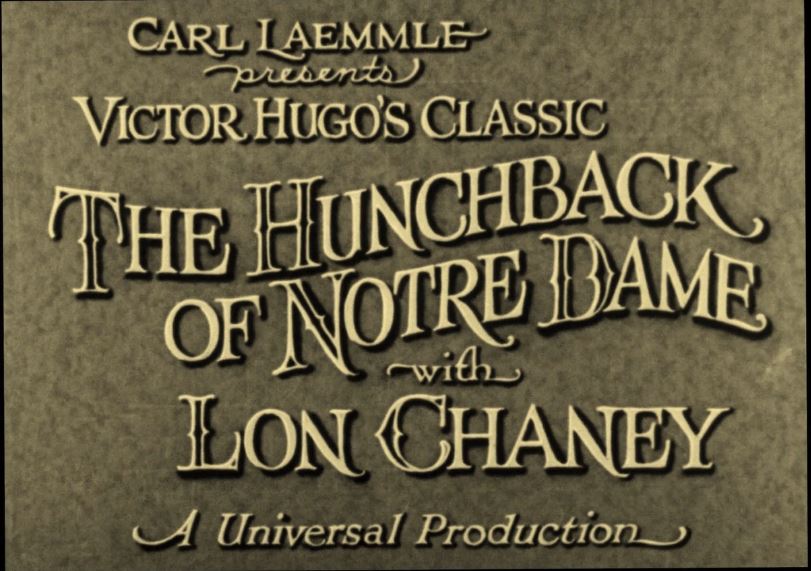
Sanctuary much… The Hunchback of Notre Dame (1923), Eureka Masters of Cinema Blu-ray, Out Now


To the towns people he was an inhuman freak, a monstrous joke of nature – and for their jeers he gave them scorn and bitter hate.


This is the UK Blu-ray debut of this Universal classic and it is a 4k transfer of the recent restoration from NBC Universal from two 16mm prints, which looks fabulous and really carries across the scale and daring of this huge feature – a million-dollar super-production. Surprisingly, I haven’t seen The Hunchback of Notre Dame before and so this disc held and extra fascination. Lon Chaney’s transformation is under more scrutiny than ever envisaged for the original screening experience but, once again, it is his performance and not the make-up that convinces and you soon forget the all too obvious prosthetics and just become submersed in this classic tale.


Victor Hugo’s novel of 1831, Notre Dame de Paris was, according to Kim Newman, as much about history and architecture as the hunchback. Then, as now, the building was under threat and Hugo’s novel helped to raise interest in the cathedral and, indeed, the author took part in restoration that helped preserve the building. According to Newman, the book helped create a social movement… but still has a lot more humour than the film, with Esmeralda charged with enchanting a goat, a satire on the French justice system. More on that goat later…


From an era of epic set design... the star of the film?

The film changed more than the story with a number of characters flipping from good to bad and a revision of the ending. This is a primal story that is clearly malleable in terms of meaning, sense of place and dramatic sweep with the cathedral the biggest character and narrative device, a place to hide, to haunt and to swing down from as well as being the ultimate sanctuary. There is nowhere else that Quasimodo can be and when Esmeralda is falsely accused, he carries her there shouting “sanctuary, sanctuary!”. But Notre Dame is also a place hiding the shadowy plotting of Jehan (Brandon Hurst) although the main villain in the book was his brother, the Archdeacon Claude Frollo, here played by Bristol’s finest Nigel De Brulier, as a good man.


It's also a refuge from the poverty beyond with the film retaining some political overtones, bemoaning “the King’s justice” and the struggle of the 15th Century poor more reflective of Hugo’s time – during the early reign of King Louis Philippe I after the revolution of 1830, all far removed from the days of the Republic. Hugo was elected to the National Assembly of the Second Republic after the 1848 revolution calling for the end of misery, poverty and the death penalty as well as other 19th Century concerns such as universal suffrage and free education. By 1923 all of these things were recognised as undeniably good so writers Perley Poore Sheehan, Edward T. Lowe Jr. and Chester L. Roberts were preaching to the converted.


The film starts with The Festival of Fools, the one day of the year when those “crushed by tyranny” could give themselves to unrestrained pleasure… His Majesty King Louis XI (Tully Marshall, who I always associate with the Clara Bow comedy Mantrap (1926)) rides through the throng, “a crafty oppressor of his people, whose dungeons were always full… “ which may be a little harsh on "Louis the Prudent" as he was called in the 1480s who founded what became the French postal system, built roads and unified France under a more administratively solid monarchy. It’s not my period but the needs of the story must…


Torrence, Chaney and De Brulier

We also see the poor of Paris huddled in the cavernous Court of Miracles … led by King of the Beggars, Clopin (man-mountain Ernest Torrence, who I also always associate with the Clara Bow comedy Mantrap), the enemy of kings… 400 years early.  He too is at the festival, watching from the steps of Notre Dame as the revelry gets wilder, he is chided by the Archdeacon before his brother Jehan crosses over to plot with Clopin… the downfall of Louis and a new world he can mould with the help of his lucky hunchback.


That freak is my slave, he will be useful to us…


There, high above the crowd, is Quasimodo, the “ugliest man in Paris” who will this evening be crowned King of Fools. He looks down on the crowd, pulling tongues and dangling precariously off the buttresses. Lon Chaney makes most of these moves himself, physically transformed so much that the outlandish prosthetics are barely necessary.


Patsy Ruth Miller

In his video essay, film historian, Jonathan Rigby describes the impact the film had including its blockbuster two-month stint at the Empire Leicester Square, which featured an “Impersonate Quasimodo” competition featuring seventeen contestants designed to encourage British acting talent. As Charles Laughton, Quasimodo in 1939, later said, Chaney wasn’t just a great actor but a magnificent dancer and clearly this physicality was an influence although we don’t know if Laughton entered the competition.


Having danced onto the screen, we get to meet the other main players, the newly promoted Captain Phoebus de Chateaupers (Norman Kerry, playing slightly gormless here) and his fiancée Fleur de Lys (Winifred Bryson) who watch the festival from across the cathedral square. Fleur’s attention is caught by a dancing goat – told you – who is being coached by a pretty gypsy called Esmeralda (Patsy Ruth Miller) who, even from a distance of a hundred metres, takes de Chateaupers’ mind completely off goat dancing.


Esmeralda is the most connected character in this film, being not only the adopted daughter of Clopin, who bought her off some gypsies because he always wanted to adopt but couldn’t be bothered with all the paperwork, as well as the object of Jehan’s wicked desires, not to mention her new admirer, who is forgetting all about his fiancée. Later in the day after Quasimodo’s coronation as King of Fools, he sees Esmeralda dancing and then he too has lost his heart to her fresh face and regular features, not to mention high-level armography and syncopation.


The kindness of Esmerelda

Passions run fierce and Jehan orders his man to kidnap Esmeralda, as that is the surest way to any woman’s heart, only for Quasimodo to be arrested and sentenced to a lashing. Before that, Esmeralda meets de Chateaupers, who takes her to a tavern before discovering that she’s not that kind of girl, suggestive moments when he pulls down the strap of her dress to reveal her naked shoulder before edging it back up again as she reveals her true heart.


From this point Esmerelda motivates the central characters and not anachronistic revolutionary thoughts. She shows mercy to Quasimodo as he calls for water after a brutal lashing in front of the cathedral… and if he didn’t know she was the girl for him beforehand he does now and his loyalty will not waver.


De Chateaupers takes Esmerelda to a nobles’ party only for Clopin to raise an army of beggars in order to go and “rescue her”, forcing her to intervene and go with her stepdad, to be with her own people. Minor character and coded gay poet, Gringoire (Raymond Hatton), rescued by Esmerelda after accidentally ending up in the Court of Miracles, brings the captain a note arranging a meeting with her in Notre Dame. She intends it as a last farewell and it almost is for De Chateaupers who is stabbed in the back by Jehan, who implicates Esmerelda.


No you don't Norman...

Will her Captain live to tell the truth or will Esmerelda fall victim to Louis XI’s lousy justice with a public hanging at Notre Dame? So many questions for the final part of the film and director Wallace Worsley masters his cast of thousands and stunning sets to full affect for a dynamic denouement. But it is his players that really bring the action with Chaney peerlessly acting through his make-up, dancing his feelings and ringing those bells for all he’s worth with a frightening intensity. Patsy Ruth Miller is also second MVP with a charismatic performance most of the others struggle to match, several roles perhaps being under-written given the need to squeeze so much into a single film from the epic source material.


The Blu-ray is released on 17th October in a Limited-Edition O-Card Slipcase* and has the usual Masters of Cinema extra special features:

·         1080p presentation on Blu-ray from a 4K restoration conducted by Universal Pictures

·         Music by Nora Kroll-Rosenbaum & Laura Karpman (presented in uncompressed LPCM stereo)  

·         New audio commentary with author Stephen Jones and author / critic Kim Newman

·         New interview with author / critic Kim Newman on the many adaptations of Victor Hugo’s novel |

·         New interview with film historian Jonathan Rigby

·         A collector’s booklet* featuring a new essay by journalist Philip Kemp, richly illustrated with archival imagery


*Both the booklet and the slipcase are limited to the first 2000 copies so I would urge you to order your copy now and you can do sodirect from the Eureka site.

It’s another important silent release from Eureka, an essential part of any silent film fan’s shelf and one that has not looked or sounded better since the 1920s!

A feast for your eyes...


Saturday, 6 October 2018

My ship is coming in... Captain Salvation (1927) with Philip Carli, Orchestra San Marco, Pordenone Giornate del Cinema Muto


This was my film of the day without a doubt as it was the only film I saw today (thanks London fog etc) but others would be hard-pressed to compete with the visceral visuals of a larger than life Lars Hanson, massive Marceline Day, super-sized Pauline Starke and the gigantic sounds of Philip Carli with a full orchestra.

Lars Hanson, was the poster boy for last year’s festival but, presumably, got lost at sea, soon made up for lost time by forging ahead in the festival's glamorous opening gala. Was it worth the wait… but of course! The Swede’s tardiness was soon blown away by the forceful squals of this film – minds thrown to the elements and survival more than salvation the driver as Lars’ self-doubting preacher rediscovers himself with the help of a bad woman.

Worse things happen at sea and, if this film is anything to go by, that is entirely the case. But all the elements combined to magnificent affect in the Teatro Verdi: perfect, pure Pordenone on day one, just like last year with The Crowd.

So, began my second year at Pordenone’s unique Giornate del Cinema Muto … My debut is so still fresh that this year I barely looked right to see Venice, so intent was I on the Festival. One of tonight's comperes quoted David Robinson saying “welcome home”, but it’s not just the familiar, it’s a week-long Christmas full of unopened presents, all with World-class live musical accompaniment… It may be raining gatti e cani but who cares: no outdoor screenings are planned.


Captain Salvation was pleasing viewing as a Warner Archives DVD but tonight it was a genuinely uplifting combination of Carli’s sympathetic score and a story that is at least as much of the need for forgiveness and understanding as of spiritual concerns. You don’t have to believe in an ancient deity to want to treat people fairly and Anson Campbell stands up for what he believes as the local community turns on him for defending a fallen woman. This may well speaks to us as much now as in 1927 as our collective conscience tumbles backwards, grasping more at negativity as a way of defining a morality largely missing from every day.

Hanson’s Anson Campbell is young, vibrant and on the verge of priesthood and yet, he is always drawn back to the sea despite expectations. Lars’ sweetheart, Mary Phillips (the impossibly wholesome Marceline Day), is the daughter of the local priest and she looks forward to the time when he preaches from her father’s pulpit.

As its title suggests Captain Salvation deals with themes of Christianity and the sea - faith lost and regained on the edge of the world. Directed by John S. Robertson the film was based on the 1925 novel by Frederick William Wallace, a maritime journalist who had commanded a First World War Q-Ship. Not surprisingly, there's an authentic feel to the maritime action and if you like sailing ships, this film has some good ones.


The opening sees the return of Anson from seminary as the locals in a small coastal town gather to greet him. Robertson uses his locations well as Mary runs from her house to greet her lover but as his ship rolls into the quay he is also met with disappointment by his stern Uncle Peter Campbell (Sam De Grasse) who views his sea-going passions with disdain.

Anson is not dressed in a manner befitting the clergy and clearly enjoys the sea air far too much... The small God-fearing community follows Peter's lead and generally disapproves of Anson’s resistance to the call of the cloth, but Mary is head over heels and can only see the good in her man. The two share some lovely naturalistic moments on the beach as Anson presents Mary with a ring and proposes marriage… this section looks scripted (not all silent film was...) and Day can clearly be lip-read… you can almost hear them. Day is so freshly naturalistic and counterpoints the more intensely-expressive Larson well.


The weather changes and they both know a storm is on the way. They make it back to Anson’s friends’ house in time but are called out along with the rest of the village as a ship runs aground and survivors are hauled onto land. It’s a grim scene – a foretaste of what’s to come. One of these poor souls is that of Bess Morgan (Pauline Starke) a fallen woman who one crew mate blames for the wreck. There’s little sympathy form the locals with Uncle Peter suggesting that she recuperates in the jail “where she belongs”. This angers Anson who demands that she be treated like everyone else as a “person”.

Battle lines of compassion are drawn across the community as Bess stays with Anson and his reputation is ripped to shreds… even Mary cannot stand it and is finally unable to resist the pressure of her simple-minded kin – all too eager to judge rather than help. Reader, it’s pretty much like social media out there…

Pauline Starke
There seems nowhere left to turn and Anson follows Bess onto a schooner and a new life beyond the poisonous village. They board and are greeted by the larger than life Captain George Fawcett (all six feet and four inches of Ernest Torrence… Clara Bow’s co-star in Manhunt and brother of City Girl’s David as well as being an opera singer as I was reliably informed by a man from Bristol!). But, from the frying pan they have fallen through the fire and straight into Hell. This is a prison ship whose warders are more brutal than their inmates, each of whom is branded and treated like animals. Anson soon becomes dragged into the hideous depths of the hold whilst Bess must contend with the lecherous advances of the not so good Captain.

Torrence is great as the relentlessly callous officer and Starke is incredibly moving as the woman who’s hard-heart softens. Anson’s faith in her has given her belief in good even as Anson’s faith falls away as all around him look lost and without hope of charity. He is driven almost mad by the extent of the cruelty and the depths of their despair until he gains courage in return from the woman he has saved.

Now, make what you will of the film’s Christianity but there’s no denying that Captain Salvation is a powerful story. It’s specific on the nature of Bess’ wrong-doings – she chides one man for leaving before paying… and unflinching in the brutality of the prison ship… as Anson says, this is Hell.

Ernest: not singing
Pauline Starke is more of a clear match for Hanson than the winsome Day and she goes from hard-hearted pragmatism to compassion and Christian sacrifice. It’s a journey that could be so cliched but one that she makes convincingly and there were some moist eyes in the hall.

Philip Carli’s score as played by the Teatro San Marco’s house orchestra was gigantic, not overwhelming the film but enhancing it with some compelling melodies and rich, satisfying orchestration. As I said at the top: pure Pordenone and a great start to the week!

And now it's tomorrow and in a few hours my first full day starts. It's Cine-muto-Christmas!

Marceline (Sunny) Day

Wednesday, 6 February 2013

Really free… Mantrap (1926

"Well well - a big boy from Away Back!"
There are no rules for this blog but if there were, they wouldn’t prevent me from writing twice about films of particular note.

Mantrap I covered in the “early days” (2011) and didn’t really go into much detail – I had seen a VHS copy and it wasn’t great... no more than a bootleg view of a great concert.  But now the film has been cleaned up and released as part of the Treasures from the American Film Archives: Volume 5: The West (1898-1938) box set, it’s worth another, clearer, look: you can certainly see more.

Clara Bow
Directed by Victor Fleming, Mantrap is a vehicle designed to allow Clara Bow to dazzle as she flirts with all around her… but far from showing a woman exploited, Mantrap actually shows a woman in control.

Watching with my blue stocking mother–in-law (she takes pride in that term!) confirms this and we got to considering how much 20s film helped in liberating women or at least changing perceptions. After all, even the 60s looked back to icons of the earlier decade, Greta, Louise and, of course, Clara. It wasn’t just their looks or their style it was their intelligence and self-determination.

Ernest Torrence
Clara snags herself a husband from the middle of nowhere but this is what she wants – it’s not an escape but a choice. Joe Easton played by Ernest Torrence (the bad prison cap’n from Captain Salvation) isn’t everyone’s idea of a leading man but he’s steadfast and smart and will just about do for Alverna. The intervention of disaffected city lawyer, Ralph Prescott (Percy Marmont) provides only a temporary destabilisation.

Percy Marmont
For a while he takes Alverna’s fancy but he’s not strong enough to see through her “rescue” and she’s already bored with him when hubby arrives to sort things out. Initially the two men are bargaining amongst themselves but after Alverna threatens to take off in Joe’s boat they quickly realise that the situation is not theirs to dictate.

Throughout Clara Bow is genuine and energetic: she is thoroughly naturalistic and effortlessly powers through this film with ease. Mantrap was one of her favourite films and you can see why. She has the central role, in spite of all the male introspection, and emerges with her free will intact at the end.

It’s a very entertaining film with first rate support from the wildly expressive Torrence and  the uptight sophisticate Percy Marmont (who I’d last seen getting bumped off by Peter Lorre in Hitchcock’s Secret Agent).

The film starts with Marmont’s character driven to the point of ennui by an endless succession of lucrative divorce cases and their endlessly needy divorcees. He’s had enough and needs to escape from woman kind.

Getting away from it all...
His friend, (Eugene Pallette, on the right), suggests a fishing trip to the wilds to clear the air and cement their friendship. Cut to the two men looking miserable sat drenched outside their tent as the rain falls hard on their parade.

Meanwhile, back-woodsman, Joe, has headed up to the big city where he is in a whirl of disorientated surprise. His eyes fall on a shapely ankle and the camera follows his gaze up to the owner… it’s Clara of course.

Clara Bow and Ernest Torrence
He follows the legs into a barber shop and orders everything on the menu just so long as Alverna is the one serving it up. The moment when Clara enters the salon and strolls majestically towards camera, drawing the eyes of all around her is the mark of a player at the height of her powers. So casually commanding and always with a twinkle in her eye that says, you’re in on this and we’re going to have some fun.

Alverna accepts Joe’s invitation to dinner and the two end up marrying and returning to Joe’s home. This is where they encounter Ralph who has been rescued by Joe from his miserable fishing trip. Ralph immediately recognises that he’s in trouble…

Clara Bow - City Girl or Lady of the Wildwoods?
You’d be surprised if either Ralph or Joe could win Clara’s heart under normal circumstances, but then this was part of the Bow phenomena – if these guys stood a chance with Clara then maybe you could too? Reciprocation might might – just might – be a possibility. All you needed was the chance and to be yourself… How many stars had this affect on their audiences?

You can measure Clara Bow against all the other stars but she was uniquely grounded in the reality of the everyday. In fact, she’d probably had it much tougher than you, so dust yourself down, pick yourself up and keep on… Energising and empowering what more can you expect from a true star?

Mantrap is available as part of the Treasures from the American Film Archives: Volume 5: The West (1898-1938) which also includes Al Jenning's Lady of the Dug-out as covered here.

Saturday, 22 December 2012

The young man and the sea... Captain Salvation (1927)


As you delve deeper into the depths of silent film, you start to follow a daisy chain of actors and directors who impress and lead you into seeking out more of their work. So it was that a film I wouldn’t have given a second thought to a couple of years back, became compelling viewing due to the presence of one of the stars of The Saga of Gosta Berling (Lars Hanson) and another from The Cameraman (Marceline Day).

Captain Salvation was released in 1927 and features Hanson as Anson Campbell a young man on the verge of priesthood and yet who is always drawn back to the sea… his sweetheart, Mary Phillips (Day), is the daughter of the local priest and she looks forward to the time when he preaches from her father’s pulpit.

Lars Hanson
As its title suggests Captain Salvation deals with themes of Christianity and the sea - faith lost and regained on the edge of the world. Directed by John S. Robertson the film was based on the 1925 novel by Frederick William Wallace, a maritime journalist who had commanded a First World War Q-Ship. Not surprisingly, there's an authentic feel to the maritime action and if you like sailing ships, this film has some good ones.

Marceline Day
The opening section sets the scene very effectively as the excitement rises with the return of Anson from seminary. Robertson uses his locations well as Mary runs from her house to greet her lover but as his ship rolls into the quay he is also met with disappointment by his stern Uncle Peter Campbell (Sam De Grasse) who views his sea-going passions with disdain.

Anson is not dressed in a manner befitting the clergy and clearly enjoys the sea air far too much... The small God-fearing community follows Peter's lead and generally disapproves of Anson’s resistance to the call of the cloth but Mary is head over heels and can only see the good in her man.


The two share some lovely naturalistic moments on the beach as Anson presents Mary with a ring and proposes marriage… this section looks scripted (not all silent film was...) and Day can clearly be lip-read… you can almost hear them. Day is so freshly naturalistic and counterpoints the more expressive Larson well.

The weather changes and they both know a storm is on the way. They make it back to Anson’s friends’ house in time but are called out along with the rest of the village as a ship runs aground and survivors are hauled onto land. It’s a grim scene – a foretaste of what’s to come.

One of these poor souls is that of Bess Morgan (Pauline Starke) a fallen woman who one crew mate blames for the wreck. There’s little sympathy form the locals with Uncle Peter suggesting that she recuperates in the jail “where she belongs”. This angers Anson who demands that she be treated like everyone else as a “person”.


Thus battle lines of compassion are drawn across the community as Bess stays with Anson and his reputation is ripped to shreds… even Mary cannot stand it and is finally unable to resist the pressure of her simple-minded kin.

There seems nowhere left to turn and Anson follows Bess onto a schooner and a new life beyond the poisonous village. The board and are greeted by the larger than life Captain George Fawcett (all six feet and four inches of Ernest Torrence…Clara Bow’s co-star in Manhunt and brother of City Girl’s David).

But, from the frying pan they have fallen through the fire and straight into Hell. This is a prison ship whose warders are more brutal than their inmates, each of whom is branded, brutalised and treated like animals.
Anson soon becomes dragged into the hideous depths of the Hold whilst Bess has to contend with the lecherous advances of the not so good Captain. 

Ernest Torrence
Torrence is great as the relentlessly callous officer and Starke is genuinely moving as the tart with a new-found heart. Anson’s faith in her has given her faith in good and the strength to stand up to this man. Her relationship with Anson is always platonic and before they departed, she was at pains to tell Mary how good a man she was spurning: even if she wanted to she will not take Anson from his love.

But Anson is paying a heavy price and his faith falls away as he sees all around him lost and without hope of charity. He is driven almost mad by the extent of the cruelty and the depths of their despair.


Spoilers… It is Bess that truly becomes the captain of their salvation. She will not succumb to the Captain’s will and ends up fatally wounding herself when left with no other option. Anson charges at Fawcett in a rage and their ensuing battle is thrillingly filmed high up amongst the rigging as they trade blows in a messy and naturalistic scuffle to the death!

The Captain topples to his fate and Anson rushes to comfort Bess in her final moments. She asks him to prey and, to his surprise he finds the will and the words to lead the liberated in a last call to save her soul. Hanson occasionally over-emotes but he’s a powerful actor and this scene left not a dry eye in the living room.


Time passes and we’re back at the village as, once again, Anson returns from the sea. He sails the schooner right up to the docks and all can see that she has a new name Bess Morgan. He addresses the entire village from on high and tells them the tale of Bess’ conversion… it is a powerful moment and he finally wins them over in recognition of the woman’s bravery and Christian charity.

Welcomed back into the fold Anson is reunited with his contrite Uncle and free to marry his true love. But he will return to the ocean as master of the first “Faith Ship”… spreading the good word amongst the shipping lanes.


Now, make what you will of the film’s Christianity but there’s no denying that Captain Salvation is a powerful and quite gritty story. It’s fairly specific on the nature of Bess’ wrong-doings and unflinching in the brutality of the prison ship. It’s one of those surprises silent film can still offer – work that is less couched in period politeness than you’d expect. They kept it reasonably real.

Pauline Starke
Another surprise for me was Ms Starke who takes the acting plaudits – she goes from desperation and hard-hearted pragmatism to compassion and Christian sacrifice. It’s quite a journey but one that she makes convincingly. Someone else to follow up on.

I watched the Warner Archives DVD which is from a decent print and features a suitably stirring new orchestral score from Philip Carli.