Showing posts with label Esther Ralston. Show all posts

Monday, 22 September 2025

Never lands... Peter Pan (1924)/The Thief of Bagdad (1924), BFI Anna May Wong: The Art of Reinvention


Two blockbusters on a scale that influenced the next century of film right up to the mighty world of extended universes and modern franchises most specifically in the impact the former had on a certain Walter Disney but also in the incredible scale of the latter. Surely impressive appearances in both would help establish Anna May Wong as a rising star in Hollywood but in spite of her extraordinary ability to shine through and energise even the most confined role, it was not to be although she worked as hard as anyone could to maintain her own momentum and if it wasn’t going to be at home it would have to be away or even, far, far away. Still, she was noticed in Europe, especially in Britain and Germany, second star on the right, straight on till morning…


In the USA both films were amongst the most successful in 1924 with Thief bringing in $1.5million in 4th place and the Christmas released Pan, eventually getting more than $600k. They were two of the six films Anna made in 1924 and the following year she made just two with four in 1926 and then a mixed bag of eight in 1927. Her last Hollywood film of 1928 was the Joan Crawford vehicle, Across to Singapore and she was uncredited but, for her first Anglo-German film she got star billing for Song (1928) and of course Piccadilly and Pavement Butterfly in 1929.


But these two films were spectacular and high impact proving her abilities in top-level company especially the phenomenon Fairbanks – so kinetic he makes Tom Cruise look like late period Ralph Richardson – and the mighty Betty Bronson who if ever there was a female equivalent to Doug, demonstrates it in Neverland. This was an afternoon of the highest quality with two major silent works that I had been saving up for the big screen with splendid accompaniment and a passionate informed audience. One of those special BFI days.


Mary Brian sews on Betty Bronson's shadow: this may hurt!

Peter Pan (1924,) with Costas Fotopoulos


Betty Bronson was a pocket rocket and was selected by JM Barrie over 100 others tested for the role1 and we can absolutely see why. She made quite the impression on Fairbanks’ son Doug Jnr as he had later admitted she was his first crush on watching her in Peter Pan; she was 17 when she made the film and he was 15 when it was released and they were friends afterwards, the actor recalling in his autobiography that It was not fully requited. She only flirted with me…. No worries champ, you’ll be married to Joan Crawford within five years!


Betty is certainly full of Fairbanks’ zip in every single scene of this film, radiating health and laddish enthusiasm as the boy who never grows up. JM Barrie’s seminal Edwardian fantasy began as a play in 1904 before being novelised as Peter and Wendy in 1911. The first performance was at the Duke of York's Theatre in London on 27 December 1904 with Nina Boucicault in the title role and so Peter was always played by a woman on stage which is noteworthy in itself in terms of the British drag tradition and the “trouser role”.


Anna May Wong brings the noise
 

The story and the film despite their fantastical nature are about parenthood and also loss with Peter possibly being inspired by the death of David the 14-year-old son of Barrie’s friend Sylvia Llewelyn Davies, a “Lost boy” who would never grow old and yet was happy to stay in Never Never Land. The character first appeared in the 1902 novel The Little White Bird, written for adults. The author ended up adopting Sylvia’s children after she and her husband died and this too is reflected in the story with Mrs Darling taking in the Lost Boys.


The film is a pure delight and a celebration of childhood with opening title cards explaining that viewers need to connect with their childish selves – no problem personally – in order to understand the photo play. It was lovely to see a number of children in the audience too, some very responsible parenting in evidence! The film has more of the intentions of the play along with a portion of the dialogue and is quite different to Disney’s 1953 cartoon which smooths out the sense of loss and the overt celebration of motherhood as well as the romantic frisson between Wendy and Peter. Disney, as ever, uncomfortable with reality.


Esther Ralston is key to setting the tone as Mrs. Darling, a woman of compassion and unconditional nurturing love. It is she who first encounters Peter in the children’s nursery and accidentally cuts off his shadow closing the window on him. She puts it in a draw and sees Peter again as he tries to retrieve what is perhaps a metaphor for his memory, soul and/or his loving existence on Earth… he recognises her but he can’t remember why, an extension of the same amnesia the younger Darlings experience after time in Never Land. Philippe De Lacy is boorish Dad Michael Darling who pranks his children and won’t keep his end of the bargain in taking his medicine instead feeding it to Nana the Dog, an extraordinary creation played by George Ali a puppeteer and animal impersonator who was incredibly flexible for a 58-year-old. He also plays lion and a crocodile… animal magic!


Mother Esther Ralston

Nana may only be a dog but is the children’s nursemaid making sure they get to bed on time and take their bath. Grumpy Dad chains her to the garden kennel meaning she is not on hand to protect the children when Peter and Tinkerbell arrive and, after Wendy (Mary Brian) sews Pan’s shadow back onto his feet, whisk them into the air and off to the island of Never Never Land. Wendy’s brothers John are played by Jack Murphy and Michael by Philippe De Lacy who went onto play the young prince in Lubitsch's The Student Prince in Old Heidelberg, before becoming a producer and director once he grew up!


They land in the Forest of Make-Believe and the fun really begins with mermaids, pirates and native Americans – not for nothing did this film come with a warning about the screening containing “racist attitudes, language and images, including red face”, it’s a document of its time. Here we find Anna May Wong as Tiger Lily, one of a group of “red Indians” who inhabit the forest, she’s not in many scenes but obviously brings the required pep to everyone although her band are unable to defeat the evil pirates led by the infamous Captain Hook! Ernest Torrence leaves no parts of the scenery unchewed and is spectacularly nasty as the pirate with the heart of lead… he’s the archetypical villain from Lex Luthor to Dr Doom up against a boy that can fly and knows no fear.


Peter and the Pirates... Ernest Torrence is terrfic.

We watched a 35mm copy from George Eastman House which ran at just over two hours with Costas Fotopoulos, seeing the film for the first time as well, filling his accompaniment with playful inventions suitable for an audience Barrie implored to go back to the nursery and once more believe in fairies as the play moved on.


Today was the 55th anniversary of NFT2 and what better celebration than an audience clapping along as Betty Bronson urged us to signal out belief in magic and save poor Tinkerbell. Wonderful!


Doug on a magic carpet over a cast of thousands, still not sure how this was done?


The Thief of Bagdad (1924), with Neil Brand


Follow that and the BFI did with the shock and awe of Douglas Fairbank’s and Raoul Walsh’s epic adaptation of One Thousand and One Nights which was based on a story written by the actor under the pseudonym of Elton Thomas according to Kevin Brownlow and David Gill whose Photoplay restoration we watched. It is perhaps the ultimate Doug surpassing even Robin Hood (1922) and we had fabulous accompaniment from Neil Brand whose orchestral score for the former film demonstrated such an uncanny connection with the star and screen. Here, Neil was The Orchestra and for 164 minutes, albeit with a very short intermission, bringing his singular style and understanding of motion picture composition to the fore as the picture and the action towered over the rapt audience sat in NFT1.


The film’s sets were bigger than Hood’s and even Intolerance and were the work of William Cameron Menzies and they were so spectacular that Fairbanks fitted the action around them: there’s no elaborate staircase Doug can’t ascend with bounding flamboyance, no wall he can’t climb or descend or window he can’t slide down. He is his own special effect and, with his 21st Century physique on topless display he is the epitome of health and efficiency – no chocolate on top of his cappuccino or cheeky pastry before the screening in the RFH for him… he reminds me of the moving statue in My Grandmother (1929).


Doug plays Ahmed, the Thief of Bagdad who starts the film off as self-interested and faithless taking whatever he wants whenever he wants to and laughing in the faith of authority of any kind. All of this changes when he chances to see and fall in love with The Princess of Bagdad (Julanne Johnston) and, after his cheeky ways lead him into more trouble than he can bear, he resolves to win her heart through honest endeavour. It’s interesting to see quotes in the intertitles from the Quran and to see Ahmed making peace with the Imam (Charles Belcher) who tells him, naturally, to follow his heart… try making this film these days and screening it in our flag-infested high streets?


Julanne Johnston and Fairbanks Snr


Against this regal and religious Bagdad stands Cham Shang, Prince of the Mongols (Japanese actor Sōjin Kamiyama) who wants to invade and enslave the kingdom and to have the Princess for his own. He has a spy in her handmaidens in the form of Anna May Wong who as you’d expect makes the most of her role especially in the scene in which Ahmed first breaks into the royal quarters and pushes a very phallic knife against her back, at least in the interpretation of filmmaker Michelle Williams Gamaker in her introduction.2


Ahmed must compete with the Mongols and also the princes of the Indies and Persia to bring home the greatest wonders from the furthest reaches of the world a grand quest involving flying carpets, flying horses, crystal balls and a box of delights. It is perhaps the most spectacular silent film ever made and certainly one of the most thoroughly enjoyable especially with Mr Brand’s flying accompaniment.


Both films are glorious and I am glad I waited to see them first on the big screen in a live setting. Now I can’t wait to watch my Blu-rays and work out exactly how the magic is wrought.


Meanwhile, plenty more Anna May Wong to come over the next three weeks... details on the BFI site.


Anna May Wong a spy in the house of love?


1.       According to The New York Times, 16th August 1924 who reported that Bronson had sent a thank you telegram to the author: "I feel like a new Cinderella, thanks to you. I realize the importance of your trust in me and my tremendous responsibility. I am the luckiest girl in the world. Betty Bronson."


2.       Michelle Williams Gamaker featured a clip from her film Thieves (2023) part of her Fictional Activism initiative which is concerned with “… the restoration of marginalised film stars of colour as central figures, who return in her works as brown protagonists to challenge the fictional injustices to which they have been historically consigned.” Details on her website here.


Thursday, 2 March 2023

More please… Oliver Twist (1922), with John Sweeney, Kennington Bioscope


8 Great reels that make you ask for more. Will Hays says Jackie Coogan Films are the sort the World needs…

Print Advert - Wyoming County Times, 20th December 1923


Introducing the screening of four films from his personal collection Christopher Bird delighted us with an evening of films connected with Charles Dickins and, to a lesser extent Lon Chaney.


First was Mrs Lirriper’s Lodgers (1912), an almost complete film previously considered lost and rescued by Chris from a pile of rubbish at the end of a antique collector’s garden. Painstakingly restored with over 400 manual fixes, the film, based on a story from Dickens, was a delight, telling a moral tale in limited time with the constant thought in our heads that this very nearly didn’t exist but for a collector’s endless curiosity.


Next up were three short 35mm films exchanged for a reassuringly expensive pint of lager – we all have our price and clearly the seller was happy to offload these potentially explosive nitrate curios. Included was a precious glimpse of a young Lon Chaney, looking dashing in one of the few elements of his early films still extant, this from Tangled Hearts (1916). Back to the Dicken’s theme and another previously lost film, Oliver Twisted (1918) starring Fred Evans, aka Pimple, as an actor playing Bill Sykes who seems to stagger over the fourth wall as he feels his way through an approximation of the story from our main feature clutching a wooden club and a three-legged toy dog. To watch Fred at work is to marvel at the consistency of British humour, always daft, always knowing.


Last of the shorts was Hello Hollywood (1927) a fascinating look behind the camera at eth sprawling estates and backlots of the major studios. Lon Chaney was mentioned in one intertitle and we also saw the set of Paris used in The Hunchback of Notre Dame.


You've got to pick a pocket or two...

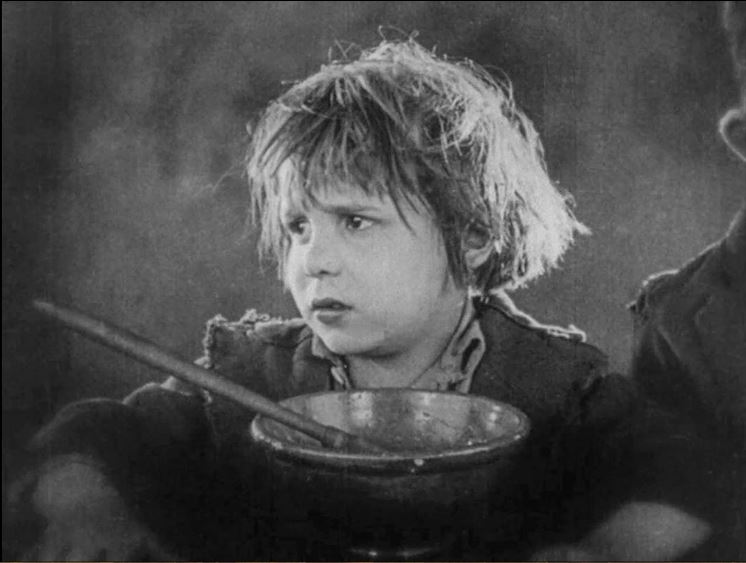
Containing roughly equal parts Dickens and Chaney was the main feature, Oliver Twist (1922) which was shown from a 16mm print again from Chris’ collection. This is another lost and found which on rediscovery in Yugoslavia in 1973, had to have intertitles inserted with help from star Jackie Coogan and producer Sol Lesser for Blackhawk Films restoration. The film is close to complete, missing perhaps a reel out to the original eight, but making total narrative sense and more.


Directed by Frank Lloyd, the film makes light of the complexity of Dickens’ original work – some 370 pages and 170,000 words, rather more than you need for a film. That said, like so many early films, it was based on a story that most people knew very well as the Pimple short further proves, including Nancy’s horrific demise – so fearful that Pimple has to change actress twice.


This feature was made just before Lon Chaney really hit the big time but, as with every one of his films that I’ve seen, he is submerged in character and all you see is Fagin, not a man heavily made up and radically adjusting his body shape to present the image of an older man, twisted by poverty and the evil that men do in picking a pocket or two. It’s fascinating how so many of the characters are recognisable in look and feel even at this early stage but Fagin is not as semitic as the Ron Moody portrayal.


The well meaning and well-to-do see the good in the boy... mostly.

This is not a starring role for Lon though, that privilege goes to eight-year old Jackie Coogan who had already made four features since his debut in The Kid and was looking good on it. It’s rare to find a child actor this accomplished but this is even more striking given the vintage. His expression is flexible and controlled and he knows how to hold himself even when there’s no dialogue or action directly involving him. He too is completely submerged in his role and is a very impressive Twist… not without an instinctive humour that places him apart from the more obviously terrorised Mark Lester! This is a tough role for a junior.


Elsewhere there is sterling work in bringing life to Dickens’ – genuinely iconic – cast of characters from the cheeky tea-leaf The Artful Dodger (Edouard Trebaol), the corpulent Mr. Bumble (James A. Marcus) to the battered but brave Nancy (Gladys Brockwell) and her loathsome man Sikes (George Siegmann); ultimately brought down by his own fears… Dickens was writing well before Freud but very few of his characters can escape from conditioning and context.


On the other side of the tracks there are a series of well-to-do saviours including the Maylie family with Rose (Esther Ralston) and a Mr Brownlow – no, not that one – all seeing the good in Oliver even when fate and his companions sometimes work against his fortune and character.

Jackie Coogan and Esther Ralston on the right


Talking of Mr Brownlow, our version, Kevin, interviewed Jackie Coogan extensively for his Hollywood series and also used the rushes of the full meeting for Lon Chaney: A Thousand Faces (2000), on which Christopher Bird worked as Editor. Two degrees of Kevin Brownlow and beyond. Coogan was very impressed with Chaney’s contribution in spire of his father’s warnings that the elder actor would try and steal scenes… well, good luck to anyone trying to distract from young Jackie and I reckon Lon did a great job.


John Sweeney put in a marathon shift and accompanied the whole programme with the seemingly endless variation of light and tone he has at his finger tips. In spite of the circumstances, Oliver remains good whilst so many around him are made bad through situation and malice, John sort out the enduring truths of Dicken’s social morality and gave them full voice as we watched the shadows on screen. Classic and classy all round.


Another Bioscope super show and with tea and Tunnocks tea cakes, who could ask for anything more?


Saturday, 4 February 2017

Clara's baby… Children of Divorce (1927) on Blu-ray


“Gary’s such a big boy, so strong, so manly and so bashful, I always wanna rumple his hair an’ listen to all his troubles.” Clara Bow

Clara Bow in Blu-ray high-definition and the clearest possible view of her soon-to-be-stellar co-star, Gary Cooper; what could possibly go wrong?!

Even in her annus mirabilis when every single film topped the charts from Mantrap, Kid Boots to It! – it was recognised that Miss Bow needed better scripts to fully reach her potential. Sadly, much as it tries, Children of Divorce was not to be it... Joseph von Sternberg was brought in to re-shoot and re-direct the ending and whilst elements of the work received high praise – Clara’s soon-to-be-ex, Victor Fleming saying that the final sequence was amongst the greatest in cinema – overall the audience is left unsatisfied by characters with obscure motivations. The film tries to make a serious point about the importance of family life and the damage done by un-committed parenting but… it feel half-hearted and more concerned with the big dramas of duty.

Clara
All this said, what it does have is the magical realism of Clara Bow – an “expression-engine” who could break the heart of the most cynical viewer with a quicksilver intensity possessed by few other performers. Next to her, the ridiculously handsome Coop struggles to get beyond mildly forlorn or slightly distracted… he’s eye-catching alright but not really enough to draw your focus from Clara.

Stories abound of Bow getting her beau-to-be the part in this film and/or fighting for him to keep it after a stinker of a start. There is still no denying his own potent star appeal but Clara’s was in full burn and Coop was still learning the ropes alongside this sexual superpower. As he said in an off-set interview: “…you couldn’t steal scenes from Clara Bow. Nobody could… She just naturally walks away with every scene she’s in.”

Mr Cooper
He was also up against the equally lovely and capable Esther Ralston.

Esther is so polished and focused and knows exactly how to present face to camera whereas Cooper is often at unflattering angles. The big galoot has charm to burn possessing what Colleen Moore called “that peculiar personality, that intangible quality that communicates on camera…” Yet here, in terms of craft, he’s miles behind Ralston who glides with effortless sadness through the film. Her Jean is the only character really sure of herself around whom Bow’s impulsive Kitty and Cooper’s confused Ted struggle to make the right choices.

Ralston knows how to pose for intense close-ups and works the camera so well throughout. There was a lot for Coop to learn.

Esther Ralston
The film had five writers and it shows with a wayward central message about damaging divorce and also the need for socially convenient marriage getting in the way of emotional fulfilment: we – or rather the upper set – marry for money and do not always follow their hearts. Sadness and despair can be the only result.

The film starts in a de-facto orphanage for the sons and daughters of divorced ex-pats living in Paris and it is here that a young Kitty (Joyce Coad) is dropped off by her mother, (Hedda Hopper in her acting days), who tells her she’ll see her in the Summer – that’s a long time out of the way. She is befriended by the young Jean (Yvonne Pelletier) who provides the unqualified affection her parents cannot. Soon they meet a fiery young boy, Ted Larrabee, who forms a strong attachment to Jean…

Soul sisters
Fast-forward some years to a party at a country house where Kitty (now Clara) entertains the smart set including the titled but broke Prince Ludovico de Saxe (Einar Hanson) who loves her but cannot afford to marry her. Sailing impressively over a hedge on horseback is Ted (now Coop) who lands impressively to gulp down a glass of champagne from Kitty. This scene took some 23 takes according to Bow biographer David Stenn and almost got Cooper fired.

Enter the grown-up Jean (Esther), now very wealthy and a target for any cash-strapped socialite but wealth is the furthest thing on Ted’s mind as is transfixed. Kitty bounds over, as she will many times, to push herself between the two and poor Prince ‘Vito dies a little more inside.

Vito dying a little more...
Jean still loves Ted but wants him to make something of himself before they can consummate their childhood pledge to wed. Kitty loves Jean but also wants to marry into success and if she can’t afford have the man she loves, that’s the Prince, she’ll take the next best thing once Ted has become a success as a bridge-building architect.

Kitty arranges a party starting at Ted’s office and ending up the following morning with the biggest hangover imaginable for, even though Ted struggles to remember, the two got married at the culmination of the previous night’s revels.

WHAT a hang-over!
It’s the worst of timings as Jean has written to Ted saying that maybe they should marry but chance has gone and she sentences herself to noble exile in Paris in order to give Kitty a chance at happiness…

Some years later Kitty and Ted along with their well-cast daughter – the spit of a juvenile Bow -  arrive in Paris and this convoluted quadrangle of love is about to come crashing down around their sad heads.

There are some bold images in the closing segment – perhaps from von Sternberg – but… no spoilers! Overall the main director Frank Lloyd works competently with the narrative in spite of a repeated need to flash back to the younger versions of Jean and Kitty as if to remind us that the child is mother to the woman.


But the restoration is super quality and you can’t fail to be moved by the three leads especially and of course, Clara Bow. When those sad eyes open wide and Klieg lights giving her ample tears a powerful glow, you’d have to be made of stone not to feel more than a little welling up of your own.

There a cracking score from the Mont Alto Motion Picture Orchestra which incorporates contemporary songs within a carefully crafted whole: for instance, JS Zamecnik’s Heart of Dreams is a recurring theme beginning as the youngsters become friends and returning for every key moment.

To top it all the set also includes the Discovering the It Girl documentary narrated by Courtney Love which, if you haven’t seen it features contributions from David Stenn, Diana Serra Cary (Baby Peggy) and Clara’s son, Rex Bell Jnr.

Children of Divorce in excellent production from Flicker Alley and is available direct. It deserves to do well and let's hope for more Blu-ray Bow in the near future!

Buy it! Buy it NOW!