Showing posts with label Jackie Coogan. Show all posts

Thursday, 2 March 2023

More please… Oliver Twist (1922), with John Sweeney, Kennington Bioscope


8 Great reels that make you ask for more. Will Hays says Jackie Coogan Films are the sort the World needs…

Print Advert - Wyoming County Times, 20th December 1923


Introducing the screening of four films from his personal collection Christopher Bird delighted us with an evening of films connected with Charles Dickins and, to a lesser extent Lon Chaney.


First was Mrs Lirriper’s Lodgers (1912), an almost complete film previously considered lost and rescued by Chris from a pile of rubbish at the end of a antique collector’s garden. Painstakingly restored with over 400 manual fixes, the film, based on a story from Dickens, was a delight, telling a moral tale in limited time with the constant thought in our heads that this very nearly didn’t exist but for a collector’s endless curiosity.


Next up were three short 35mm films exchanged for a reassuringly expensive pint of lager – we all have our price and clearly the seller was happy to offload these potentially explosive nitrate curios. Included was a precious glimpse of a young Lon Chaney, looking dashing in one of the few elements of his early films still extant, this from Tangled Hearts (1916). Back to the Dicken’s theme and another previously lost film, Oliver Twisted (1918) starring Fred Evans, aka Pimple, as an actor playing Bill Sykes who seems to stagger over the fourth wall as he feels his way through an approximation of the story from our main feature clutching a wooden club and a three-legged toy dog. To watch Fred at work is to marvel at the consistency of British humour, always daft, always knowing.


Last of the shorts was Hello Hollywood (1927) a fascinating look behind the camera at eth sprawling estates and backlots of the major studios. Lon Chaney was mentioned in one intertitle and we also saw the set of Paris used in The Hunchback of Notre Dame.


You've got to pick a pocket or two...

Containing roughly equal parts Dickens and Chaney was the main feature, Oliver Twist (1922) which was shown from a 16mm print again from Chris’ collection. This is another lost and found which on rediscovery in Yugoslavia in 1973, had to have intertitles inserted with help from star Jackie Coogan and producer Sol Lesser for Blackhawk Films restoration. The film is close to complete, missing perhaps a reel out to the original eight, but making total narrative sense and more.


Directed by Frank Lloyd, the film makes light of the complexity of Dickens’ original work – some 370 pages and 170,000 words, rather more than you need for a film. That said, like so many early films, it was based on a story that most people knew very well as the Pimple short further proves, including Nancy’s horrific demise – so fearful that Pimple has to change actress twice.


This feature was made just before Lon Chaney really hit the big time but, as with every one of his films that I’ve seen, he is submerged in character and all you see is Fagin, not a man heavily made up and radically adjusting his body shape to present the image of an older man, twisted by poverty and the evil that men do in picking a pocket or two. It’s fascinating how so many of the characters are recognisable in look and feel even at this early stage but Fagin is not as semitic as the Ron Moody portrayal.


The well meaning and well-to-do see the good in the boy... mostly.

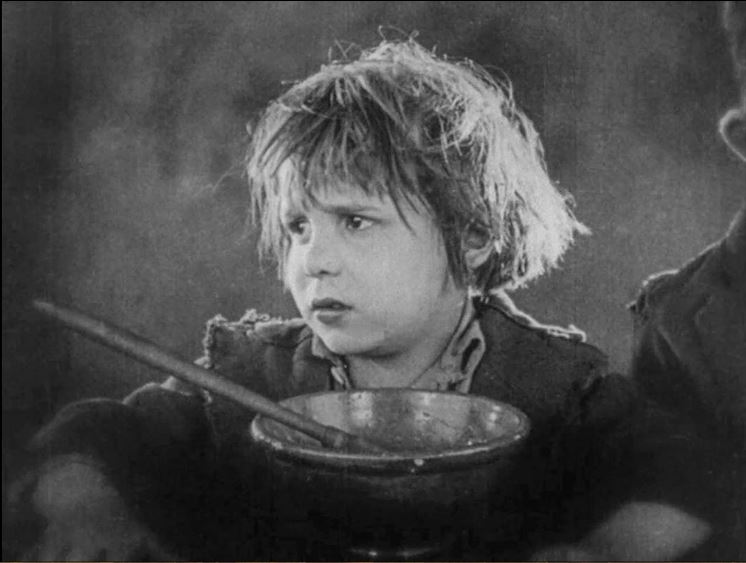
This is not a starring role for Lon though, that privilege goes to eight-year old Jackie Coogan who had already made four features since his debut in The Kid and was looking good on it. It’s rare to find a child actor this accomplished but this is even more striking given the vintage. His expression is flexible and controlled and he knows how to hold himself even when there’s no dialogue or action directly involving him. He too is completely submerged in his role and is a very impressive Twist… not without an instinctive humour that places him apart from the more obviously terrorised Mark Lester! This is a tough role for a junior.


Elsewhere there is sterling work in bringing life to Dickens’ – genuinely iconic – cast of characters from the cheeky tea-leaf The Artful Dodger (Edouard Trebaol), the corpulent Mr. Bumble (James A. Marcus) to the battered but brave Nancy (Gladys Brockwell) and her loathsome man Sikes (George Siegmann); ultimately brought down by his own fears… Dickens was writing well before Freud but very few of his characters can escape from conditioning and context.


On the other side of the tracks there are a series of well-to-do saviours including the Maylie family with Rose (Esther Ralston) and a Mr Brownlow – no, not that one – all seeing the good in Oliver even when fate and his companions sometimes work against his fortune and character.

Jackie Coogan and Esther Ralston on the right


Talking of Mr Brownlow, our version, Kevin, interviewed Jackie Coogan extensively for his Hollywood series and also used the rushes of the full meeting for Lon Chaney: A Thousand Faces (2000), on which Christopher Bird worked as Editor. Two degrees of Kevin Brownlow and beyond. Coogan was very impressed with Chaney’s contribution in spire of his father’s warnings that the elder actor would try and steal scenes… well, good luck to anyone trying to distract from young Jackie and I reckon Lon did a great job.


John Sweeney put in a marathon shift and accompanied the whole programme with the seemingly endless variation of light and tone he has at his finger tips. In spite of the circumstances, Oliver remains good whilst so many around him are made bad through situation and malice, John sort out the enduring truths of Dicken’s social morality and gave them full voice as we watched the shadows on screen. Classic and classy all round.


Another Bioscope super show and with tea and Tunnocks tea cakes, who could ask for anything more?


Sunday, 24 January 2016

Slapstick and Bristol fashion… The Kid (1921), Colston Hall, Slapstick Festival Day Two


There was a moment during this gala screening when I looked along the line to see the faces of my family lit up with smiles. Both generations had already been laughing at Buster Keaton chased by hundreds of cops and Charley Chase pursuing a woman he doesn’t know is his wife but then Charlie Chaplin comes along to offer something more complex: a comedy about poverty, loss and fragile chance.

If Charlie had been set a test to cope with this scenario without being mawkish… he couldn’t have passed it better. The Kid is a sentimental film but Chaplin steers perfectly clear of the obvious dangers and those moments, and there are those moments, when the emotionalism is switched dangerously high, are handled with exquisite ease. There's a look between mighty five-year old Jackie Coogan and his surrogate father that is searing and not soppy. It is the look of a man who knows parental loss and a supernatural performance from young Jackie.


But then... there is a dream of a dog flying on angel wings as Charlie and his angels fly around the Slums of Heaven with manic abandon. It comes just at the right moment in the film a sequence designed to undermine overt sentimentality.  So, right back 'atcha 21st Century Cynics: this is mad fun and our Charlie deliberately flies towards the Sun on waxen feather wings but he doesn’t crash or burn he glides straight to the heart of funny.

I’d never seen The Kid, on purpose, holding off for a live screening and tonight the Colston Hall, the Bristol Ensemble, ably conducted by Timothy Brock and the fulsome support of an open-minded and good-humoured Bristol audience delivered wonderfully well.


If today’s sessions at the Slapstick Festival proved one thing it is that watching comedy is always – always – better as a group exercise. Live music creates new connections with the films and a joke shared is often laughter squared.

In the splendid, care-worn, space of the Colston Hall, the European Silent Film Ensemble played along to Keaton’s massed Cops (1922) and Charley Chase’ Mighty Like a Moose (1926) – what a title! Then came the main feature with the Ensemble playing the UK premier of Charlie’s own score, conducted by Mr Brock.


The most striking thing about the main feature is how cinematic the writer, director and star’s vision was. The film is told with supreme economy - a narrative that could be convoluted and strained is perfectly paced and key moments fall as lightly as feather’s dropped from dog angel’s wings…

The performance of Coogan is like that of a man four times his age – his father was on hand to help gear him up for the emotional moments but he winked at Charlie and told him he knew what he was doing. Edna Purviance as the mother who gains a career and loses her child, shows just why Chaplin rated her so highly whilst Chaplin himself is not the focus of the film you might expect – he’s almost ever-present but is smart enough to under play and generous enough to let the other leads and some super support actors take the limelight.


Compere Robin Ince had said he’d once been asked to write an article on whether Charlie was still funny: his response was that it could be a very short piece beginning “Yes…”. Of course he is, and my family and the two thousand-strong audience proved it.

The Colston Hall
This was my first day at the Slapstick Festival – now in its 12th year – and it was a rewarding one – work commitments meant I missed out on the opening day a mistake I won't make next year!

I arrived left foot still hot from the M4, just in time to see David Robinson’s session on Mack Sennett – a man who made over a thousand films and who brought so many talented comedians to screen. Robinson focused on “four and a half” plus a few more…

Ford Sterling and Mabel Normand
First up was Mack himself in heavy disguise playing a French interior designer (of sorts) intent on delivering the eponymous item in D. W. Griffith’s A Curtain Pole (1909) – Dutch Talmadge’s  climactic chariot charge from Intolerance clearly had its origins here although she never worked out how to put the horse into reverse.

Then we had marvellous Mabel Normand bouncing her way through a choice of racers in The Speed Kings (1913) with “father” Ford Sterling trying to force her to choose his favourite for some un-specified reason. Everything feels improvised but Sennett films the - actual – races very well. He learned with DWG at Biograph and knew how to throw a film together, ad hoc and energised thanks to his dynamic performers.

Charlie as a Cop: Ford's not in this one as well?!
We had the one and only glimpse of Charlie Chaplin as a Keystone Cop in A Thief Catcher (1914) again featuring Ford Sterling – David Robinson warned that it wasn’t the best film but conceded that John Sweeney’s piano improvisations turned it into something more: audience plus expert live accompaniment equals pure joy!

Don’t Weaken (1920) again featured Ford Sterling just as I had probably seen enough of the ham of the hour but this was a different side to Sterling who played a convincingly-graceful dance teacher trying to impress newly-enriched Charles Murray’s daughter played by Harriet Hammond. The two men box and Murray is getting pasted until the Dancing Master is distracted by Harriet’s pins. Way more sophisticated than Benny Hill.

Hurry up Harry... 
Finally there was Harry Langdon in His Marriage Wow (1925) with the deeply-unsettling Vernon Dent as A Pessimist - Prof. Looney McGlumm trying to dissuade him from marrying Nathalie Kingston. I’m still haunted by Dent’s soul-sucking stare of disapproval…

Next up was a session on writer Anita Loos from Lucy Porter who bounded on stage with all the energy of a Mabel Normand clutching a handful of written notes and Loos’ two autobiographies. Loos played fast and, er, loose with the facts but was spot-on viscous in her observations on contemporaries – especially poor Norma Shearer.

Anita... there's one huge flaw in your argument...
 In her defence, Anita could be just as hard on herself plus she could write! We watched The New York Hat (1912) with accompaniment from harpist, Elizabeth – Jane Baldry who played in complete sympathy with the emotional cadence of Mary Pickford’s performance – I’ve never been so shocked by a father’s demolition of a feathered hat.

Then we were treated to the inexplicable The Mystery of the Leaping Fish (1916) written by Tod Browning with intertitles by Anita Loos. Here again the redemptive power of a comedy audience was proved as – having previously been a bit Home Counties about the drug taking, I just saw  a stoner comedy performed with self-depreciating zest by Douglas Fairbanks and Bessie Love as the little fish blower…

Coke Ennyday's on the case!
Only Fairbanks could possibly follow that and so he did in Wild and Woolly (1917) written by Anita Loos and directed by her water-carrying husband-to-be John Emerson and filmed by some bloke called Victor Fleming.

It is a splendid romp about a rich boy wannabe cowboy who gets sent out to scope out an investment opportunity for his pa. The western townsfolk get wind of the greenhorn’s delusions and make like it’s 1880 all over… Plans are set to entertain his fantasy with a train robbery and an Indian uprising but soon the fake bullets turn real and, delightfully, Doug turns out to be just as brave as he wants to be…


Tip of the ten gallon hat to Mr Sweeney – westerns must be murder on the keyboards with the relentless rhythm of trains and horses always interrupted by contrapuntal gun fights and saloon brawls!

Then came the evening and the pun-fight at the Colston Hall…

Cops on the run
Buster’s Cops! (1922) was a massed symphony of un-policed chaos that builds exponentially towards one of the most existentially bleak comedy climaxes in silent film.

But then what could be more post-structurally challenging than the battle Charley Chase has with himself in Mighty like a Moose (1926)… one to watch our Charley: a reputation on the rise!

The Mooses: Vivien Oakland and Charley Chase
Superb accompaniment was provided by the European Silent Screen Virtuosi comprised of Gaunter a Buchwald on piano and violin, Romina Todisco on double bass and Frank Blockhouse on percussion.

There was also a surprise appearance from St Helen’s favourite son (sorry Johnny), Bernie Clifton who, in the spirit of Slapstick, not only showed that comedy is for life and not just Christmas (he’s 79) but also sang Charlie’s Smile – two minutes in which the World slowed and Chaplin again reminded us that humour is often the only hope we have.

The Slapstick Festival continues until 25th but watch their website for 2017…