What a day, ladies and gents, what a day! The Yorkshire Silent Film Festival is going from strength to strength and the Sheffield “all-dayer” at the 100-year old Abbeydale saw everything from drama to documentary with thrills spills and heartaches and a feast of musical accompaniment including percussion, strings and piano not to forget gravel, concrete slabs, banana and old suitcases…
From Hardy and Laurel to Harry Lloyd we laughed a lot and
we also saw genuine history with the documentary bravery of Frank Hurley who
was in the Endurance with Ernest
Shackleton’s ill-fated expedition to cross the South Pole. There was evocative
continental experimentalism alongside a very British detective and, for those
who stayed late, Lon Chaney throwing daggers at Joan Crawford using just his
feet.
A varied and enriching programme with a lot more to come
as the month unfolds in Silent Yorkshire… there’s something in the air.
 |
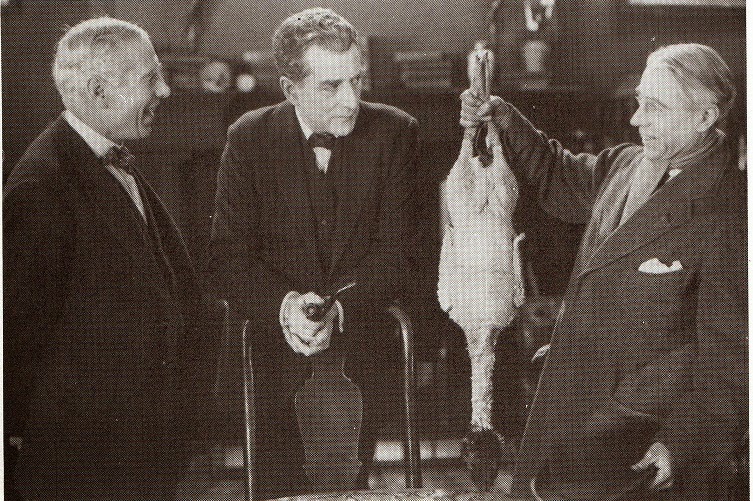
| The Finishing Touch (1928) |
Another Fine Mess
– Laurel and Hardy Triple Bill with Neil Brand
Few have the silent back-story of Neil Brand and hardly
anyone can convey wit and wisdom from the silent age with such avuncular ease
and all before he even sits down to start playing. Neil is also a great champion of the next
generation and encourages new players as well as new audiences alike.
Laurel and Hardy are amongst the most effective gateway
experiences for silent film and here we had three of the best, my personal
favourite being Angora Love (1929) in
which the boys are adopted by a four-legged friend who really gets their landlord Edgar Kennedy’s goat! That said, is
there any more perfect comedy violence that that visited on Jimmy Finlayson’s
house by the boys in Big Business (1929)
– the worse they get the more he demolishes their unseasonal Christmas Trees
and their poor car.
Here and in their “housebuilding” escapade, The Finishing Touch (1928) the boy’s
relationship is already clearly established and that’s what adds an edge to their
slapstick. We know them so well and ask Neil says, you can almost hear them
talking in these films… that was all to come.
 |
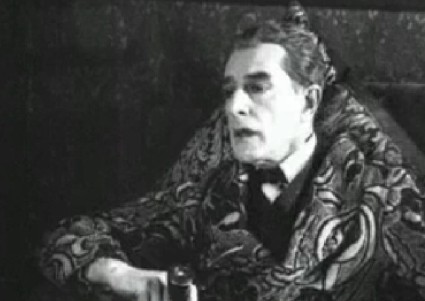
| Eille Norwood and his Watson, Hubert Willis |
The Hound of the Baskervilles (1921)
with Jonny Best (piano), Trevor Bartlett (percussion) and Liz Hanks (cello).
The advantage Eille Norwood has over subsequent Sherlocks
is that he had the personal seal of approval from the great detective’s creator
with Sir Conan Doyle so impressed with his obsessive attempts to bring every
detail of Holmes to light that he enthused about his “brooding eye” and his “rare
quality, which can only be described as glamour, which compels you to watch an
actor eagerly even when he is doing nothing.”
It’s hard to disagree and Norwood had lots of practice in
45 shorts and two features made by the Stoll
Company from 1921 to 1923. Many were directed by Maurice Elvey and on reasonable-to-fair
budgets much in evidence in The Hound which
is largely studio-based although it does feature some atmospheric location shots
too.
In the huge darkness of the Abbeydale – opened in 1920
just in time for the start of the series – the film generated a
convincingly-spooky atmosphere, much aided by the players with Liz Hanks’ cello
adding sinuous and sinister lines to Jonny Best’s piano and Trevor Bartlett’s
percussion. The film is not just a procedural “who chewed it?” and there’s
mystery among the people and place and these three worked so well with Elvey’s
atmospherics.
 |
| The Endurance breaking the ice |
South (1919), Neil Brand (piano), Liz Hanks
(cello)
Sometimes we watch film as history and sometimes history
as film and it never ceases to amaze me that Ernest Shackleton, Captain Scott
and Mallory/Irvine took cameras with them on their adventures. The fate of the
last two adds extra poignancy to the films of Herbert Pointing (The Great White Silence) and Captain
John Noel's (The Epic of Everest) but
here Frank Hurley was part of the adventure in ways he couldn’t have
anticipated as he survives to tell the tale of near disaster and recovery.
Shackleton’s ship, The
Endurance becomes trapped in the ice as he attempted to work his way
closer to the pole and Hurley records the attempts to free the ship and its
ultimate fate as, overwhelmed by ice and cold it is crushed to splinters by the
weight surrounding it. The men, and dogs, abandon ship and make camp before
starting a push North… it seems hopeless, but the unlikely escape is achieved
through “pluck” as the intertitles have it and indomitable will.
Neil Brand and Liz Hanks helped us share in the
jaw-dropping endurance as well as the spirit of wonder – this was like a trip
to another planet in 1914-16 and the recording of penguins and seals
fascinating to those back in the real world…
 |
| Nadia Sibirskaïa in Ménilmontant |
French Cinema
Double Bill
L’invitation au
voyage (1927) with Jonny Best (piano) and Irine Røsnes (violin)
A complete change of pace now and a trip across the channel
for two experiments in narrative as alien to the British sensibilities above as
a King Penguin waddling down The Strand.
Germaine Dulac’s films use elements of Avant Garde
technique but around a defined narrative and so it is with this film in which a
married woman (Emma Gynt) visits a nightclub and enjoys a moment with a young sailor
(Raymond Dubreuil). So much is said through look and gesture with no title
cards.
Jonny Best’s duet with violinist Irine Røsnes passed
poignant comments of love’s possibilities and the ever-present sadness of
opportunities missed.
 |
| L’invitation au voyage (1927) |
I’ve seen Dmitri Kirsanoff’s classic a number of time but
never like this. Normally with silent film accompaniment the tone has to be
right and sound effects are reserved for the clang of a bell or the bang of a
gun but imagine if you had to keep pace – literally – for almost 40 minutes.
To add extra spice, imagine rehearsing your accompaniment
to the nearest milli-second only to find out that the print – in this case the
BFI’s 35mm copy – is significantly different from the one you practiced to… We
were told this afterwards, but it did not show in the slightest as piano, concrete,
gravel, banana, water bowl, cabbage and two old packing cases kept in total
sync with the action.
 |
| The banana and other instruments... Sue and Reecca's portable studio |
Sue Harding and Rebecca Glover performed live Foley,
without a safety net and their eyes glued on the action on screen as they
followed the ethereal Nadia Sibirskaïa’s journey from the violent death of her
parents to the depths of the Parisian sub-culture. Anchored by Jonny Best’s piano
it was a fascinating act of composition and perfectly in keeping with the style
of a story that demands the audience improvise their own response.
The banana was there to provide the sound of sausage skin
being pulled off by the kindly old man who shares his picnic with Nadia’s
character, in the end it wasn’t needed as other events had taken sonic
precedence. The audience declared the experiment a success and I think we’d
like to see more live Foley please!
 |
| The subway today... Ann Christy and Harry Lloyd makee their way. |
Speedy (1928)/Liberty (1929) with Neil
Brand (piano) and Trevor Bartlett (percussion)
I have the Criterion DVD and would rate this as one of
the best comedies (ever) and indeed films of the twenties. Nothing prepares you
for seeing it on the Abbeydale’s huge screen and accompanied by Neil Brand on
blistering form accompanied by his partner in sophisticated syncopation, Trevor
Bartlett.
Manhattan is the co-star in Lloyd’s film and Neil threw
in so many sumptuous New York moments – Gershwin and all the trimmings – in what
is an amazingly-clear view of the city as it was with Lloyd’s horse drawn tram
rocketing around long-demolished streets. Neil revealed that the two mighty
horses pulling the tram also worked on Ben
Hur and there’s also a third, if you look carefully, used as ballast inside
the speeding tram.
Speedy has immense
good humour and a strong story based on the last-horse drawn tram as electrification
and big business took over in the name of progress and profit. In the end the
community is too strong for commerce and everyone rallies round to beat off the
bullies.
My sister Diane, who lives in Sheffield, thought this the best
film of the day (alongside South) not
just because of the stunts and scenery but because Lloyd, his co-star Ann
Christy and others looked like they’d walked straight off the Abbeydale Road: they
and the film felt modern and naturalistic.

We were also treated to the Laurel and Hardy short Liberty which clearly owes a lot to
Lloyd’s thrill-comedy only, as Diane said though, it’s not quite as funny when
it’s juts a situation; Lloyd’s predicaments always have a reason behind them.
That said, this was one of those combinations that lifted
the entire room not least because of the musicians who both played a blinder!
The Unknown (1927) with Jonny Best
(piano) and Trevor Bartlett (percussion). will be introduced by Vanessa
Toulmin, University of Sheffield.
You can’t see them all, and I had to miss Joan and Lon in
a farewell to arms…
I like this bonkers little film not least because it
shows Chaney’s commitment to his roles: binding his arms back as his character
does, would have been very painful and yet he took the knocks for his films. He
was also more than generous as Joan Crawford later attested referring to the
advice he gave her during the making of this, her first feature as lead.
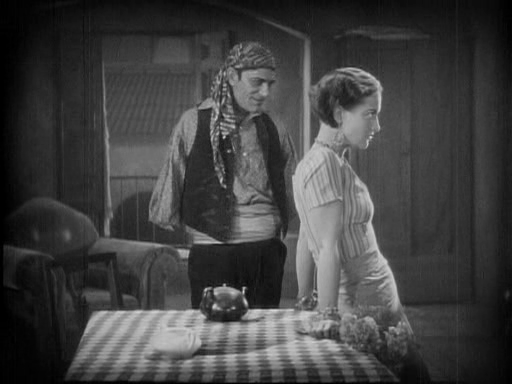 |
| Lon and Joan: look, no hands! |
Another great choice for an unforgettable day. ANother was to come as I headed out for Sunrise in York... more to come.
The Yorkshire Silent Film Festival continues across the
county through May and I am so tempted to nip back up for some more… There are two of Louise Brooks' best films for a start. Further details on the website.
Thanks to all the players and those who make it happen
and to Mr Jonny Best whose baby this is!


.jpg)