+violin.jpg)
We were warned before the performance to expect some vintage British racism and a high-speed motorboat chase – and the film didn’t disappoint.
The Sign of Four was released some months after the third and final series of shorter
Sherlocks from Stoll films and, as the audience clearly knew, their hero’s fall
from Cheddar Gorge in The Final Problem (1923)
was far from fatal.
It marked the return of Maurice Elvey as director and his
deft touches ensure a thrilling end to the franchise as Eille Norwood exits in
style being much more at the centre of things than in the first Stoll feature
when the Baskerville hound tended to dominate as The Great Detective went deep,
deep undercover. Here, as in the three shorts shown earlier this month at the
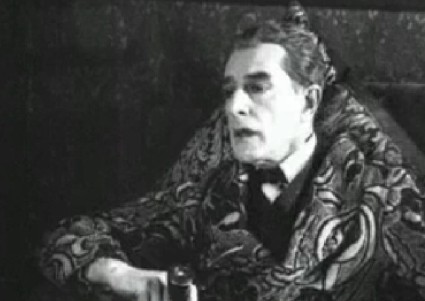
Barbican, Norwood emphatically demonstrates what Conan Doyle described as: “…the brooding eye which excites expectation”
along with his “… quite unrivalled power of disguise."
%2Bdisguise.jpg) |
| "...unrivalled power of disguise..." |
Norwood explained his Sherlock method in the Stoll
newsletter in 1921: “My idea of Holmes is
that he is absolutely quiet. Nothing ruffles him, but he is a man who
intuitively seizes on points without revealing that he has done so, and nurses
them with complete inaction until the moment when he is called upon to exercise
his wonderful detective powers…”
Norwood is indeed a remarkably “still” presence and his
darting eyes, hooded by decades of actorly observation, never reveal all they
have clearly seen…
Now for the awkward part… The film is over 90 year’s old
and the story even older…when the Orient was often associated with dangerous
mystery. The film starts with the arrival of Prince Abdullah Khan (Fred Raynham…
yes; Fred!) at 222 Baker Street who spooks the life out of Mrs Hudson (Madame
d'Esterre) with strange and intense looks. He also bothers Sherlock and Watson
(here played by Arthur M. Cullin following the untimely death of Mr Willis after
the end of the last series) by pretending to be Russian before Sherlock exposes
him as an Indian… The nuances are lost on modern viewers but in the early
Twenties the former could be heroic White Russians and the latter rebellious
nationalist-terrorists.
The Prince has come to enlist the detective in finding a
missing woman but is sent away with a flea in his ear for his deception, coincidentally
passing the woman in question on her way in as he skulks off into the
pearly-grey bustle of Baker Street.
 |
| Isobel Elsom |
The woman is one Mary Morstan (Isobel Elsom soon to be
the third Mrs Elvey) who wants Holmes to investigate the murder of her father –
killed by a most un-British poisoned dart - and the pearls she receives
every year from an address in Twickenham. She also has a mysterious set of four
signs found on her father’s body: what do they mean for his death?
Holmes looks to camera and the title card reads “This should be exciting!” The boys are
back in their well-honed routine and Eille and audience couldn’t be happier.
Sherlock soon deduces that the signs indicate a
conspiracy between four men and that, whilst Miss Morstan’s father was almost
certainly one of the four, another must have broken away and, through guilt,
started sending the gifts to his daughter. Clearly the Prince is also connected…
Mary receives a message asking her to rendezvous at the
American embassy at 7.45 pm, where she will learn more of her father’s demise. She
keeps the appointment with Holmes and Watson in tow. There’s a function on at
the embassy and Elvey creates a fascinating scene with ordinary London faces
gawping with envious curiosity at the bright young things arriving in their
rich attire – it feels like a pointedly political moment.
 |
| Man of mysteries |
A man approaches Mary and takes her, Holmes and Watson to
a large run-down house on the river bank at Twickenham. The boys soon disarm
the man and discover he is Doctor Sholto (Humberston Wright) part of the conspiracy
of four and in fear of his life from the two others.
The scene shifts to what looks convincingly like location
shooting in India where the plot was hatched by prisoners who knew the location
of stolen treasure. Mary’s father was the governor and he was included in the
scheme… but Sholto made off with all of the loot himself leaving the other two,
the Prince and Jonathan Small (Norman Page) to suspect and kill the Governor as
their prime suspect.
Sholto goes to another room to fetch the treasure but is
killed before he or his assailant can locate the treasure… and the game is truly
on…
Sherlock gets to try a few disguises as the plot turns
slightly procedural and the police arrive to jump to the wrong conclusions.
This is, of course, normally Watson’s role but when he’s not paying close
attention to Mary he’s being tortured by the baddies about that lost loot.
In spite of the police contribution, Sherlock gradually
establishes the actuality and everything culminates in a genuinely thrilling race
between motorboats and cars during which Elvey ticks off London locations from
bridges Kew, Hammersmith and Tower to Fleet Street and the Strand: like one of
those contrived “races” on Top Gear only better and without that Yorkshire bloke.
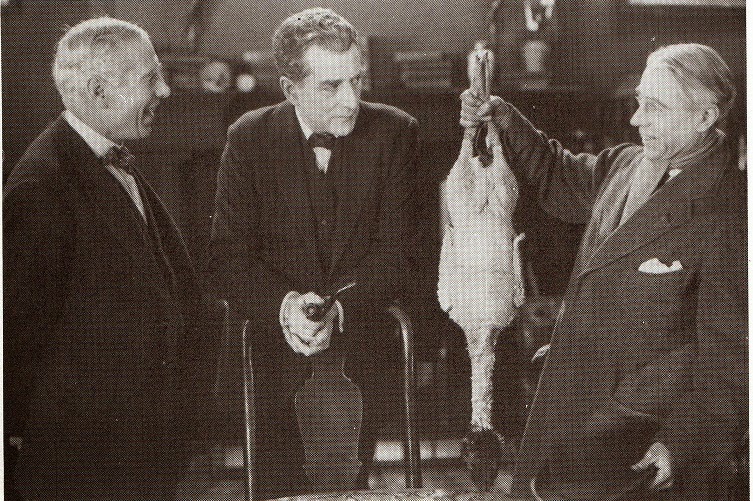
.jpg) |
| "Help" from the Police |
Elvey cuts quickly throughout and this last passage has smoothly
multi-tracked perils like DW Griffith on fast forward – and yet this is a very
British application of the technique being used to move the story along with maximum efficiency.
A fitting end to the series and one that felt thoroughly modern.
John Sweeney was seen warming up his hands before kick-off
and he needed considerable dexterity to keep pace. His improvisations expertly
supported the story and, along with Messrs Brand and Horne he shows what a
difference individual style makes to the silent experience. Every live
performance is unique and this adds musical tales of the unexpected to every “fixed”
silent text… Excellent entertainment for a windy Sunday afternoon!
The Sign of Four
is only available from the BFI archives but hopefully these Barbican screenings
will help it and the other Elvey/Norwood films get greater recognition.
Meanwhile, there’s more! Stephen Horne will be playing along
to three Stoll shorts at the Phoenix Cinema on Sunday 5th April - details on their website.


.jpg)