Showing posts with label Hubert Willis. Show all posts

Sunday, 15 February 2015

The Silent Detective... The Hound of the Baskervilles (1921), Barbican with Neil Brand


In these days of Sherlock the sociopath (UK) and a female Doctor Watson (USA) it’s hard to imagine the impact of the original stories on contemporary audiences. This film was the first feature produced as part of the Stoll series and was well received by Arthur Conan Doyle who was still writing his character at the time – this was six years before his last The Adventures of Shoscombe Old Place.

It seems that Doyle was particularly impressed with Eille Norwood who played his master detective. A vastly-experienced stage actor, Norwood so impressed the author with his obsessive attempts to bring every detail of Holmes to light that he gushed about his “brooding eye” and  his “rare quality, which can only be described as glamour, which compels you to watch an actor eagerly even when he is doing nothing.”

First edition Hound from 1902
Even though the films had moved Holmes into the modern age of telephones and motorcars, Doyle remained a fan of the forty five shorts and two features produced by Stoll and mostly directed by the great Maurice Elvey (George Ridgwell was brought in for the second “series” in 1922). All of which renders them the only author-approved televisual adaptations… what would he have made of Messrs Cumberbatch and Millar, would he consider them to have the same level of “mastery” as Mr Norwood?

This was the first in the series of screenings at the Barbican timed to coincide with an exhibition on the great detective at the nearby Museum of London. It featured Mr Neil Brand on piano who gave his all with full-on polychromatic flourishes that spiced up the action with dynamic chords of which Bernard Hermann would have been proud.

McDougall, Norwood, Raynham and Willis
The film doesn’t compare with Elvey’s 1918 Lloyd George biography or his sublime Hindle Wakes (1927) but this is to misunderstand the context of the Stoll films: rapid turn-around populist serials that were low on budget and time. There are some wonderful exterior shots and some rapid cutting as the action hots up with parallel perils whilst there are a few sequences that, given more time, the director would have perhaps refined better. It matters not, The Hound of the Baskervilles is great fun as it was always intended to be.

Eille Norwood’s Sherlock Holmes is possibly more understated than I expected but this too is a factor of the production context: he’d honed his character over the previous 15 shorts in 1921 and, by now, was both well known as and well used to his detective. You have to view his performance in the context of the broader series and thankfully we have three shorts and another feature to go.
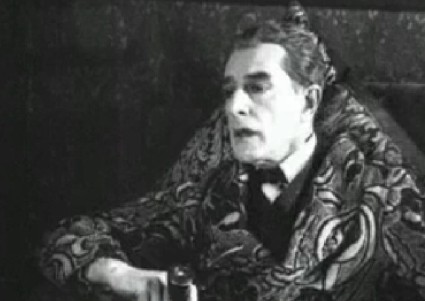
https://bioscopic.files.wordpress.com/2010/08/eille1923.jpg
Eille Norwood
He is indeed a magnetic presence on screen and his Sherlock remains unflustered by stories of mythical hell-hounds and goes about his new case in calmly-innovative fashion.

Dr. Watson is played by Hubert Willis who was in all of the series save the last film following his untimely passing. He is a dogged (pun intended and there may be more…) and brave companion and is sent by Holmes to investigate the characters in and around Baskerville Hall following the suspicious death of Sir Charles Baskerville and to help protect the inheritor of the title, Henry Baskerville (Rex McDougall) an almost overlooked relative of Sir Henry returned from the United States.
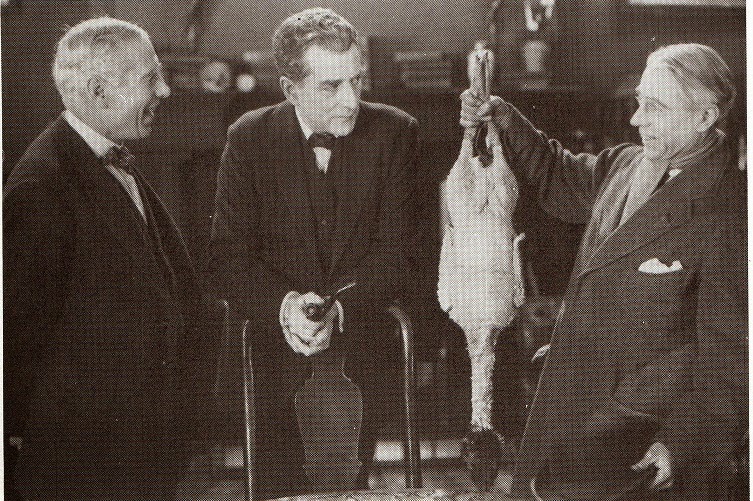
Hubert Willis and Eille Norwood on another case...
Sir Charles’ physician, Dr. James Mortimer (Allan Jeayes), tells of his client’s last night and how he was terrified of the family curse:  a flame-charged hound is said to roam the moors before the death of every Baskerville! Sir Charles was found dead from a heart attack but… what caused it?

Watson observes the rather suspicious family butler, Barrymore (a splendidly wide-eyed comic turn from Fred Raynham) as well as the brother and sister from the neighbouring mansions, Roger Stapleton (Lewis Gilbert) and his nervy sister, Beryl (Catina Campbell). To be honest, a large number of people are behaving suspiciously, suspicious…

We see the dog rampaging across the moors, head seemingly engulfed in supernatural flames whilst the mystery deepens when an escaped convict is known to be nearby and a mysterious figure is seen pacing the moors in the midnight hours…

Did the butler actually do it?
Everything is set for the re-entry of the formidably forensic detective as Beryl faces peril, Roger gets cross, Barrymore signals danger and Henry almost shows his pedigree, chum, as that dog just won’t lie down.

The Hound of the Baskervilles is an, all too rare, example of popular early 20’s British film and one based on great indigenous fiction.  This is the stuff our great grand-parents lapped up (pun etc…) in their rare time and we’re not so different today as the success of the Sherlocks continues world-wide.

The film is also pretty hard to see and given that the print used was in such good quality, surely it’s ripe for the box-set treatment? Maurice Elvey presents Eille Norwood as Sherlock Holmes... it has a ring doesn’t it?

In the meantime,there is a DVD-R with three of the shorts available from Amazon.com - The Man With The Twisted Lip (1921), The Dying Detective (1921) and The Devils Foot (1921).

Tuesday, 16 December 2014

The bringer of peace… A Message from Mars (1913)


Science fiction has always been more about Right Here rather than Out There and the late-Victorian/Edwardian vogue for the genre often focused on the military threat from other worlds. There may be a line between War of the Worlds, imperial expansion and the boom of the 1950s which was arguably more about the insidious threat of creeping communism than invasions from space. Get to the sixties and, well, the enemy was definitely our own governments as the new wave of Philip K Dick, Harland Ellison et al struck out against totalitarianism in our name.

Alien races could also use their advanced states to help rather than humble… as this recovered relic from 1913 demonstrates. Aliens were to be admired, better versions of ourselves and proof that improvement can be continuous: our conscience… reminding us of social responsibilities and of the gap between the rich and the deserving poor.


E. Holman Clark and the orginal Charles Hawtrey
A Message from Mars is Britain’s first feature-length science fiction film – maybe even her first feature film - and has now been restored to full length following painstaking restoration based on two shorter versions and a tinted print by the BFI National Archive. The film simply hasn’t been seen in its original length and format for a century and makes for strangely familiar viewing… Mars is studio-based and looks a little like ancient Rome with Martians dressed in the kind of clothes favoured by Alistair Crowley for his weekend hobbies whilst there are stunning shots of Trafalgar Square and London streets more of the nineteenth than twentieth century: a window on a lost world.

The silent streets of London
The film was based on a popular stage play from 1899 by Liverpool-born writer Richard Ganthony and adapted for the screen by director J. Wallett Waller. The film’s star, popular theatre player Charles Hawtrey (no relation to the Carry On star who changed his name for the association…) recreates his stage role with relish playing Horace Parker a self-obsessed gentleman about town who has no time for anyone but himself.

Events begin on the Red Planet where the court of Mars is about to find Ramiel (E. Holman Clark) guilty of transgressing one of their most sacred laws. Using a viewing device the court looks down on their neighbouring planet to observe Parker’s repeated acts of un-kindness as he barges a poor match seller away at Trafalgar Square, refuses to pay after watching a Punch and Judy show and spurns the pleas for help of a worthy tramp (Hubert Willis) who has fallen on hard times.

Such a mean old man...
As punishment Ramiel is sent to Earth to change the course of Parker’s lamentable existence… he must get the Earthman to act out of kindness in order to win back his place in Martian society.

Parker is so self-engrossed he refuses to make himself ready to take his pretty fiancé Minnie Templer (Crissie Bell) to a party but when she arrives with her Aunt Martha (Kate Tyndale), Minnie lets him off and makes sure he’s comfortable… you can see how their relationship works (even though he looks twenty years too old for her). Things backfire as smoothie Arthur Dicey (Frank Hector) arrives and offers to take Parker’s belle to the ball… but he’s too lazily complacent to notice.

Busy doing nothing
Cue Ramiel’s timely apparition at Parker’s front door… he looks around then disappears again to re-appear in the corner of Parker’s study. Parker tries to bluster his way past the Martian with a mission but is buffeted by telekinetic waves – a smart special effect from Waller that still looks pretty cool today.

Ramiel uses the Force
Ramiel forces Parker outside and in the direction of unfortunates… he begrudgingly buys a posy from a tearful flower-seller, gifts a tramp some money and eventually – reluctantly – gives a wad of cash to aid a man mown down by a motor vehicle: he looks like a lost cause.

Summoning the spirit of Christmas present, Ramiel shows him the impact of his selfish ways on Minnie who is beginning to enjoy Dicey’s company at the Clarence’s shindig… but he still doesn’t look like budging.

Parker is shown Minnie dallying with Dicey
No spoilers… In desperation Ramiel transforms Parker into a pauper – a tramp just like the man he refused to help. Hungry and with his wealthy sheen removed will this be the move that finally changes his thinking? Can he win back Minnie, find his compassion and help Remiel recover his own place back on Mars?

A Message from Mars is clearly of its time but from A Christmas Carol through It’s a Wonderful Life to Groundhog Day (even The Lego Movie!) we all love a little magic realism that holds a mirror up to our own guilty lives: a quick fix – well an hour or two – that shows us that even though we’re bad we’re not all that bad.


It’s fascinating to watch a British feature from this period and Waller shows himself to be up to speed with the latest innovations in his choice of shots – the narrative flows seamlessly as characters’ eye-line’s lead onto each scene shift, the camera pans and the actors use the framed space to maximum effect. There’s even a superb shot of a fire engine tearing through Edwardian streets.

The acting is a little stagey but very well done with Hawtrey the stand out as the puffed-up Parker – a rich man fighting for his right to go through life with the snooze button switched full on. He has range though and he’ll get to show it.


E. Holman Clark is grumpily ethereal as Rameil – a man-Martian intent on rescuing an alien’s life rather more than his own (we never find out what it was he did to deserve this) whilst Crissie Bell fizzes as the patient Minnie somehow infatuated with London’s laziest…

The restoration looks stunning given the age and there are some frames that are so clear it almost looked like this was some kind of practical joke – a modern pastiche – but no, that’s what you get for six months of painstaking diligence. There’s a short feature on the work on the BBC arts page: a frame-by-frame labour of love.

Chrissie Bell: Edwardian elegance
The film also features a new score from Matthew Herbert, Creative Director of the New Radiophonic Workshop. Herbert used a genuine 1913 piano to create scratchily ambient music along with a welter of “found sounds” from motor cars to burning wood. It’s not to everyone’s taste perhaps but it works well for me in highlighting the uncanny extra-terrestrial intervention: another red world...

A Message from Mars was released on 12th December on both the BFI and BBC Arts players and is available to watch for free! So, go ahead and fill your boots and thank both organisations for this early present: A Merry Christmas to us all; God bless us, every one!
