Showing posts with label Gustaf Molander. Show all posts

Sunday, 30 June 2024

Re-building Jerusalem… Ingmarsarvet (1925)/ Till Österland (1926), Il Cinema Ritrovato XXXVII


These films were screening as part of the Gustaf Molander strand featuring seven of his works from the silent era to the fifties a period of huge change in the Swedish film industry. Indeed, in his introduction, Jon Wengström of the SFI, talked about Molander’s two films adapting the bulk of Selma Lageröf’s Jerusalem as representing perhaps the last echoes of the golden age of Swedish cinema before so many major talents left for Hollywood. Fitting then that these should be about an attempt to find the promised land by a group of swedes not all of whom thrived once they arrived...


Till Österland (1926) with Neil Brand


Starting at the ending, Till Österland (To the East) the fourth film adapted from Selma Lagerlöf’s two-part epic Jerusalem which was published in 1901 not long after she had visited the Holy Land. A Swedish-Soviet-German co-production it featured extensive location filming in Jaffa and Jerusalem as well as Borane, Dalarna in Sweden in order to replicate the sweep of the author’s themes of love, land, faith and fortune.


It’s quite astonishing that what remains of Till Österland include some of the film’s major dramatic turns and takes us to the emotional finale. The first reel is entirely missing but all of the title cards survive along with about a quarter of the moving images for which we should be very thankful were spared by the Gods of Silent Cinematic Destruction… As a consequence, the relationship between the leads is very well covered with pleasing amounts of Mårtenson, Hanson and Hasselqvist performance time there to bring something I thought I’d never see to a very satisfying close.


Lars Hanson and Ivan Hedqvist

The film quality is also very fine indeed for this restoration/reconstruction which was completed only a few weeks ago, and matches that of the first film – in fact it’s colourways were used as a guide to re-tinting the almost-complete Ingmarsarvet (1925). You never know what to expect from this kind of recreation and it was a series of surprises as the parts of the film you most hoped still survived, kept on appearing; the main human story felt emotionally intact!


We also get to see some of the excellent cinematography of Julius Jaenzon - as well as Carl-Axel Söderström – given a totally different landscape to capture. For the man who shot so well against the Sun in Victor Sjostrom’s first adaptation of the work, The Sons of Ingmar (1919), it was indeed fascinating to see.


What’s missing would appear to be more coverage of the events in Jerusalem where the colonists struggle to survive in the unfamiliar conditions although it is very pleasing to see Lars Hanson actually in the Holy Land and the recently-added “Whirling Dervish” scene adds so much weight to the realisation of who the man who looks like Jesus really is. That said, Lagerlöf had described an altogether more brutal story:


“This is the Jerusalem of soul-hunting, this is the Jerusalem of evil-speaking, this is the Jerusalem of lies, of slander, of jeers. Here one persecutes untiringly; here one murders without weapons. It is this Jerusalem which kills men.”


Lagerlöf had made the same arduous journey to the Holy Land in 1899, inspired by the migration of 37 Swedes from the village of Nås in 1896. According to Swedish writer, Ingrid Carlberg, their photographs can still be found in the American Colony Hotel along with Selma’s. Reviewing the book in The Independent, Carlberg tells of the impact Lagerlöf’s “effortless storytelling” and prose had on her and, of course, being a Brit, I’ve previously had to rely on Velma Swanston Howard’s contemporary translation which has had mixed reviews in terms of its maintenance of authorial respect. That said, the story is still compelling and at times you’re wrong-footed by the shifts in tone, the magical reality and the visions that may or may not be real.


Mona Mårtenson


From this reconstruction we don’t see the broader struggles of the Dalecarlians community who left for Jerusalem at the end of the previous film. The first part of the book is merciless with characters being bought to life only to be extinguished by the heat, the light, shame and starvation. One man dies in disappointment after the golden vision of Jerusalem he saw on first arrival is not matched by the reality of dirty streets, beggars and lepers. Gunhild, one of Hellgum’s early converts, suffers after the group are demonised by other missionaries, who view them as immoral for their refusal to sanction marriage. The shame reaches back home where her mother dies in grief leading to the young woman’s decent into misery, she is soon gone herself, faith ill-rewarded. Hellgum himself is barely mentioned now that they are where he asked them to go and Conrad Veidt was also absent from the film which was made back-to-back with the first.


The leader of the mission is an American woman, Mrs Gordon, who, in the book, was inspired to form the new faith by the sinking of L’Univers, not Hellgum as in the film. She is based on Anna Spafford, the wife of a well-to-do lawyer and Presbyterian church elder, who was travelling to Europe on the SS Ville du Havre with her daughters when it collided with another ship and sank, with Anna being one of the few survivors. The Spafford’s established a Christian utopian movement eventually travelling to establish a commune in Jerusalem where they hoped good works would hasten the Second Coming of Jesus. They were treated with suspicion and they did indeed encourage the exodus from Nås. Truth is stranger than fiction, even Selma’s.


Gertrude is nursed back to health by Ingmar’s cousin  Hök Gabriel Mattsson, (Harald Schwenzen), who has held a candle for the schoolmaster’s daughter even since he attended her father’s school. He doesn’t think he has a chance, assuming Gertrude still loves Ingmar, and yet she has moved on from her old passion ever since her vision of Christ and their arrival in the Holy Land. The two form a close bond but Gertrude doesn’t want to be unfaithful to her Lord and Hök doesn’t want to get in his cousin’s way.

Mona Mårtenson, Jenny Hasselqvist and Ivan Hedqvist


Back home and Ingmar has grown to love his wife Barbro (Jenny Hasselqvist who relishes the chance to play this complex character) whilst at the same time being bound to Gertrude by his promise. Barbro has revealed herself to be a forgiving and principled individual who not only is beloved by the peasants of Ingmar’s Farm but also provides financial support for the family of the man who jilted her. She too feels a responsibility to Gertrude and wants to divorce Ingmar so that he can be with her.


That unbearable moral conundrum at the end of the first volume and Ingmar’s Inheritance has twisted itself even further out of joint and there’s a tremendous tension in the final furlongs of the narrative as each character slowly understands the reality of their feelings for each other. Selma is not going to let any of this go though and there’s an excess of human complication which she and now we can see, Molander, makes light work, which in comparison with Sjostrom is really his stock in trade!


Neil Brand gave the film full cinematic themes and dynamics, it must be so hard to accompany a reconstruction like this with the moving picture sections suddenly shifting to extended intertitle or stills but Neil held and enhanced the remains and played a significant role in making it feel like a whole film again. He’s had some considerable practice at this sort of work and it showed in emphatically stirring ways!


Mona Mårtenson and Conrad Veidt

Ingmarsarvet (1925) with Andre Desponds and Frank Bockius 


I’ve written about Ingmar’s Inheritance/ Ingmarsarvet (1925) before but this is much longer than the film I saw at 114 minutes as well as being tinted and looking, post digital restoration, as good as it’s done since the initial release. It really does support Jon Wengström’ s suggestion that this was the last of the “golden age” with a clarity and depth of detail that allows the audience to appreciate the landscapes – so important to the story after all – as well as the players. In terms of the source material, Sjöström followed his author’s text more closely and made two feature films out of less than 105 pages of Jerusalem whereas Molander crafted one from the remaining 240 of Volume One and another from the 400 of Volume Two (see above) including adding some of his own inventions.


Ingmar’s Inheritance (Ingmarsarvet) steps back a few chapters and starts with Strong Ingmar (Ivan Hedqvist) taking young Ingmar (Arne Lundh) to the death bed of his father and telling him of the family’s ranking and importance. Elias (John Ekman) is married to Karin Ingmarsdotter (Märta Halldén) and his decent into an abusive alcoholic wastrel is shown again but, unlike book and Sjostrom film, he causes his own demise by riding his trap too hard, hiding what remains of his wife’s wealth – little Ingmar’s inheritance - in the pillow on his death bed.


The years pass and Ingmar (now Lars Hanson) is fully grown and a teacher at the school run by Schoolmaster Storm (Nils Aréhn), looking longingly across at the old homestead, which is managed by Karin and the man she was always destined to marry, Halvor (Mathias Taube). Ingmar himself has his eyes set on Storm’s daughter Gertrude (Mona Mårtenson) who is almost despairing of his romantic instincts until he agrees to accompany her to the village dance. At the dance, Ingmar impresses not only Gertrude but Strong Ingmar who challenges him to honour the family traditions of farming and hard work. He takes him to the fast-flowing river at Langforsen’s Gap and persuades him to build a sawmill there which he can use to make a fortune and thereby buy back the family farm.


Conrad Veidt, for my daughter the film's standout performer. Yes, ahead of Lars!

Across the village, the faithful have gathered to pray, not dance and Pastor (Albion Örtengren) leads his fragile flock in hymns and routine religious rhymes at the missionary house. A storm is brewing and will bring unexpected fantasy and glamour in the form of Conrad Veidt’s wandering preacher, Hellgum, who takes refuge from the wind and rain and immediately takes command of the pulpit. In the book Hellgum is married to one of the women in the village but here he is more sensationalised with a not entirely trustworthy magnetism and religious passion – I’m not sure that Selma would have approved; her Hellgum is far subtler. Still, this is Conrad Veidt, and he’s absolutely the man for this gig and plays the febrile duality for all it’s worth every second on the screen as the “lone wanderer who brought a message from the Holy City of God…”


Meanwhile, the storm begins to terrify the revellers at the dance as Strong Ingmar talks about the myth of the wild hunt of Odin come to reap the souls of the unwary and Molander indulges in some very folkloric fantasies as ghouls, gods and wild animals sweep unnaturally through the woodlands. Ingmar returns and looking from the window appears to see the ghost of his father looming large in the darkened sky telling him to honour the family traditions.
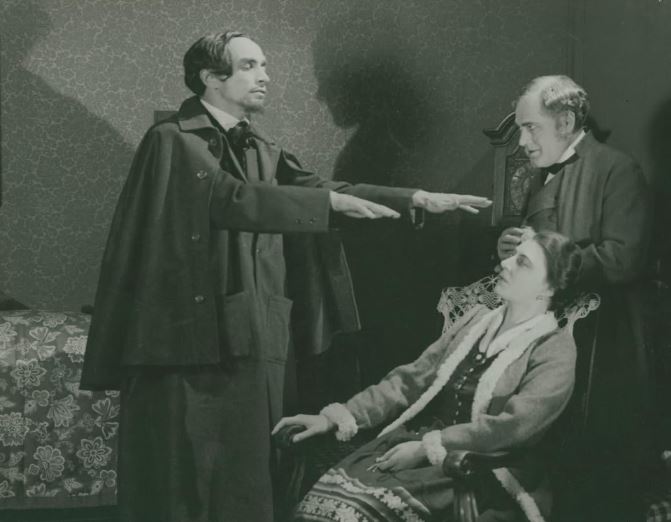

Conrad Veidt, Märta Halldén and Mathias Taube

It is a very effective change in pace and signals Ingmar’s pursuit of both his family farm and Gertrude’s love as well as the beginning of Hellgum’s religious conversion of many in the village. The storm stops as Hellgum speaks – is he/isn’t he a prophet? - and he tells them of the faith that will bring safety during the storm… a new belief he acquired during the sinking of the liner Universe. This is another well-directed segment and harrowing still as men try desperately to pull women and even children off the lifeboats after the ship goes down, there’s little nobility on show and the fight to survive is grim.


Hellgum volunteers to jump off the lifeboat to save the women and children and survives after a vision from God showing that unity, brotherhood and sacrifice will save the world. He is moved to gather brethren and follow a path to a life in Jerusalem in a new Christian community. Undoubtedly, the notion of powerful new faith was something much closer to the contemporary audience, indeed, Lagerlöf partially based the story on an emigration that took place in 1896 from Nås in the Dalarna County.


Mona Mårtenson and Lars Hanson

Ingmar and Gertrude are much more convincing to modern eyes in their love and in his desire to restore his birth-right. But the path to true love must never run smooth and, as Ingmar is off building his water mill, Gertrude attracts the not entirely holy interest of Hellgum…  Once again Strong Ingmar is on hand to set things in motion and after he warns Ingmar, the young man races back home to confront his sweetheart. He duly gains the wrong impression and appears to have assaulted Hellgum only for the preacher to explain that Ingmar fought off two attackers. Ingmar forgives Gertrude’s momentary doubt and their balance is restored but for how long?


The story turns as Karin, so practical and therefore previously resistant, is cured of her unexplained inability to walk during one of Hellgum’s gatherings at Ingmarsfarm… she agrees to sell the farm to fund the Hellgumists’ exodus to the Holy Land thereby leaving an opportunity for Ingmar to buy back the family farm. Sadly, the farm is slightly out of his price bracket and it is here that we find Sweden’s multi-talented superstar Jenny Hasselqvist as Barbro the daughter of rich Berger Sven Person (Knut Lindroth) who was once a farm boy for the Ingmars. Barbro has been disappointed in love and looked on with considerable interest in the direction of Ingmar, so Dad does what all fathers might and offers to loan Ingmar the money as dowry for Barbro’s hand in marriage.


So now we have a classic Lagerlöf moral conundrum and Ingmar is not just driven by familial pride, he feels a responsibility to all those workers on the farm, especially the elderly who look on him with pleading eyes as he wrestles with his conscience. If you don’t want to know the result, please look away now.


Lars Hanson. Ingmar imagines...

Spoilers!!!


Ingmar follows his head and not his heart and, although neither solution would give him peace, he feels he has betrayed Gertrude who is devastated. His ensuing wedding with Barbro is not a happy occasion and he can barely look at his new bride, but his misery is about to be compounded as his former love, flees to the woods in desperation, has visions of putting his eyes out in revenge before seeing a vision of Christ and undergoing a conversion.


The real kick in the tale is when, seeking rest at a peasant’s cottage, Gertrude sleeps on a pillow bought at auction from the Ingmar’s Farm… she finds the money hidden by Evil Elias and a note explaining that it’s Ingmar’s inheritance. In a heart-breaking final meeting, Gertrude calls Ingmar away from his wedding to tell him that she has transferred her love to Jesus and that she has found his money. Realising that this find could have enabled him to have his love and his farm, he collapses in a sad rage… but the worst is that Gertrude is in a rapture beyond his earthly love.


Lars Hanson and Jenny Hasselqvist


So, we see various conflicts, Ingmar’s love for Gertrude and for the land, his true inheritance is farming and not necessarily the farm or money. He makes most sense as a many working the land as he will prove in the final part. His inheritance is also steadfast loyalty and a willingness to do the right thing. He faces tough choices but I couldn’t help but think of the more complex world that would arrive in the future. In capturing the way of life in old Varmland Lagerlof and her directors were unaware of the biggest challenges of the new century; you wonder what happened to the Ingmars in the time of mechanisation and the post-industrial world?


Taken together these two films come in a 114 plus 42 minutes so just over two and a half hour combination; it would make for an interesting screening with a break in the middle perhaps. Here excellent accompaniment was provided by Andre Desponds on piano and Frank Bockius on  percussion; the two under-pinned the lyricism and romance whilst also driving beats into the more dramatic passages. Frank demonstrated elsewhere his command of tone and tempo and here he was a gift for yet another piano player!


Congratulations to the SFI Jon Wengström and to Magnus Rosborn who worked on the Molander as well as Jörgen Viman who did the same for the Stiller!


For more information on Selma's trip to Jerusalem there's an interesting post on the National Library of Israel's The Librarians' website from Hadar Ben-Yehuda.


Jenny Hasselqvist


Monday, 27 May 2024

All you need is Lagerlöf… Bologna Preview – Swedish Restorations


Not one but three restored films based on Selma Lagerlöf’s novels to screen at Il Cinema Ritrovato Festival.


Gösta Berling saga (1924)


It was probably in 2018 that I first heard of the restoration of Mauritz Stiller's Gösta Berling saga (1924), and a few years after I’d started my fascination with the story, its original writer and its stars after viewing the Kino DVD… Sure it was Greta Garbo’s breakthrough role, but it also featured vital performances from Lars “Handsome” Hanson, Gerda Lundequist - "The Swedish Sarah Bernhardt" – and Jenny Hasselqvist, Royal Swedish Ballet prima ballerina and an actor in so many European films: has anyone ever managed to combine both careers so well?


The initial restoration was screened in San Francisco pre-pandemic but now, at last, next month’s Il Cinema Ritrovato will screen the film as part of the 1924 selection. This new digitally restored Gosta will be unlike any other I’ve seen and is based on the analogue reconstruction from 2018, but with some changes in the editing work according to the Swedish Film Institute. The film now has a running time of 206 mins (simulating 18 fps) which is a good 22 minutes longer than the Kino version. It was originally measured by the Statens Biografbyrå in March 1924 at 4534 meters, which with a display speed of 18 frames per second would correspond to 221 minutes. The film has subsequently been shortened and re-cut several times over the years, and so this latest reconstruction moves it as close to the original release as it’s been.


As Jon Wengström, Senior Curator of the SFI’s Filmarkivet / Archival Film Collections explained:“The main sources for the restoration was an existing duplicate positive from our collections, and tinted nitrate print from the collections of Cinemateca Portuguesa (Lisbon). A brief scene was also added from a safety print in the collections of Gosfilmofond (Moscow).”


Gerda Lundequist, whose grand-daughter is rock singer Sonja Kristina... 


Jörgen Viman was the SFI’s Film Archivist on the restoration or “recreation” as he puts it, of the film explains further that tinted nitrate prints were also borrowed from the Cinémathèque française in Paris and the Deutsche Kinemathek in Berlin, as a reference for the film's continuity. Having just re-read Paul Norlen’s 2009 translation of Selma Lagerlöf’s extraordinary debut from 1891 it will be fascinating to compare Stiller’s focus. Lagerlöf creates such a powerful, magical-reality and seems to write from inside her subjects… I wonder what Powell and Pressburger would have made of her work and the interpretation of Stiller, Sjöström and Molander are all so tonally different.


The film's subtitles have also been recreated based on the wording in text lists submitted to the Statens Biografbyrå. These intertexts have now been based on Alva Lundin’s original designs - only three of the 405 text boxes have survived and another three were found reproduced in a trade journal from the time. Sadly, Lundin’s original painted illustrations of the text have not survived but you can read more about her work on the Women Film Pioneers Project website!


The film’s colour ways have been recreated though using the tinting scheme of the Portuguese nitrate print. The colour shading of the intertexts is also based on a description in another trade magazine article – bless these secondary sources!


Jenny Hasselqvist and Lars Hanson in Till Österland 


Till Österland (1926)


At the start of the pandemic, I read Selma’s epic Jerusalem Parts I and II (1901-2) as translated by the American Velma Swanston Howard in 1915. The story was set in the traditional rural heartlands of Dalarna and involves a group of villagers who gain a new faith and emigrate to Jerusalem as happened in the parish of Nås in 1896. It gave rise to four cinematic adaptations with Victor Sjöström making the first two films, The Sons of Ingmar (Ingmarssönerna) (1919) followed by Karin Daughter of Ingmar (Karin Ingmarsdotter) (1920) which failed to repeat the success of the first film leading the director to turn his attention elsewhere. Gustaf Molander picked up the project and completed the story with his brace, Ingmar's Inheritance (Ingmarsarvet) (1925) and Till österland (1926).


The two directors had many differences in approach with Sjöström’s narrative much closer to Lagerlöf’s text and more focused on the interior life of her conflicted characters whilst Molander broadened the palate, taking more liberties and setting up more action. Sjöström made two feature films out of less than 105 pages whereas Molander crafted one from the remaining 240 and another from the 350 pages of Volume II, including adding some of his own inventions. The feeling is much the same but the pace has changed and the cinematic vision of the narrative is one aimed at creating a hit film with hot actors, most of whom feature in both films.


Mona Mårtenson and Conrad Veidt

Ingmar's Inheritance has Lars Hanson, Mona Mårtenson and Jenny Hasselqvist as well as a powerful turn from the non-recurring Conrad Veidt. It’s still extant but the follow-up has long been incomplete and unscreened. Not any more as Till Österland has been restored, as far as possible, to create a 42 minutes long mix of the surviving film and other elements; it’s narrative structure now intact.


One additional scene, showing the dance of the dervishes, was found in a compilation film but the main thing is that the existing footage is now properly put in context, with the film’s original intertitles accompanying the surviving footage, and some stills and explanatory titles where footage is missing. All in all, the fragment now has a running time of 42 mins (simulating 20 fps), and the surviving footage is now shown with recreated tinting.


Filming in Jerusalem

Magnus Rosborn was the archivist working on the film and his summary is… “The surviving scenes have mainly been taken from a duplicate negative made from a duplicate positive which in turn was produced in 1977 from the film's then fragmentarily preserved – but now lost – original negative. In addition, another scene has been taken from a duplicate negative for the film Selma Lagerlöf 80 år (1938), which has been preserved in Sveriges Television's archives.”


The intertitles have been taken from the film's preserved original text boxes and the colours of the film have been reconstructed using handwritten tinting and toning notes copied into the duplicate positive. The missing scenes have been reconstructed with the help of those text boxes, production stills and newly made explanatory texts.


Before the premiere in 1926, the film was measured at the censorship review at 2587 meters which corresponds to a playing time of 113 minutes, so whilst approximately three quarters of the film's moving image material is still missing, we are now able to finally see what becomes of the characters in what was Volume II of Jerusalem. Fasten your seatbelts, it’s going to be a bumpy ride…


Victor yes, Mauritz maybe and Gustaf.. well!?

What did the author think of these films? According to Paolo Cherchi Usai in The Oxford History of World Cinema, it was the Selma’s admiration for Sjöström’s films that led her to sign over the film rights for all her books to Svenska Bio and he adds that the director “found in her work the ideal expression of the active role played by nature in the destiny of characters torn between good and evil.” The author was certainly not low on opinion and was initially unsure about The Phantom Carriage (although pleased with the result) and berated Mauritz Stiller for his adaptation of The Gosta Berling Saga calling it “cheap and sensational”.


Well… we can see more clearly for ourselves in just one month’s time! Bring it on!


Details of Il Cinema Ritrovato can be found on their website.


The Swedish Film Institute website is here.

Friday, 10 April 2020

See Jerusalem and die… Till österland (1926), Selma Lageröf Part III


“This is the Jerusalem of soul-hunting, this is the Jerusalem of evil-speaking, this is the Jerusalem of lies, of slander, of jeers. Here one persecutes untiringly; here one murders without weapons. It is this Jerusalem which kills men.”
  
Till österland (To the Eastland) is the last of the four films adapted from Selma Lageröf’s two-part epic Jerusalem II: In the Holy Land (Jerusalem II: I det heliga landet) which was published in 1901. A Swedish-Soviet-German co-production it featured extensive location filming in Jaffa and Jerusalem as well as Borlänge, Dalarna in Sweden in order to replicate the sweep of the author’s themes of love, land, faith and fortune. Production shots also show cast and crew on a detour to Egypt to see the pyramid of Giza and the Sphynx.

UPDATE May 2024: Only a part of the film survives in the Swedish Film Institute archive however they have now been able to construct a restoration that will enable us to see the completion of the Ingmar family story and the resolution of Ingmar Ingmarsson’s complicated love triangle (which becomes a quadrangle or even a pentangle if you add Our Lord…). The restored film, featuring a mix of stills and text to plug the narrative gaps, will be screened at Il Cinema Ritrovato 2024 and I can't wait!

This post was originally written when all we had was Selma’s book, a stack of production shots and the previous film, Ingmar’s Inheritance (1925) along with familiarity with the key performers; Lars Hanson, Mona Mårtenson, Ivan Hedqvist and Jenny Hasselqvist. The script is still extant but it’s in Swedish so I’m making assumptions about how much of the story script writer and director Gustav Molander included.

Some of the locals...
The first half of the novel focuses on the difficulties faced by the Dalecarlians community who left for Jerusalem at the end of the previous film. There is little mention of Ingmar until almost half way through as he journeys out to make good on what he sees as his obligations to the woman he pledged his heart too only to betray her trust when he mad to marry to buy back the family farm.

Lageröf had made the same arduous journey to the Holy Land in 1899, inspired by the migration of 37 Swedes from the village of Nås in 1896. According to Swedish writer, Ingrid Carlberg, their photographs can still be found in the American Colony Hotel along with Selma’s. Reviewing the book in The Independent Carlberg tells of the impact Lageröf’s “effortless storytelling” and prose had on her and, of course, being a Brit, I’ve had to rely on Velma Swanston Howard’s translation which has had mixed reviews in terms of its maintenance of authorial respect. That said, the story is still compelling and at times you’re wrong-footed by the shifts in tone, the magical reality and the visions that may or may not be real.

At one point, Gertrude – played by Mona Mårtenson – has a vision of a man who looks exactly like the Christ she saw in the woods which made her a convert. This time though, the “nameless messiah” turns out to be a Muslim and one who operates at a less cerebral level than the man of God she expected. It’s a reality check and yet Selma moves in mysterious ways… Ingmar, Lars Hanson again, travels to Jaffa on foot only to break down with an injured foot, imperceptibly the narrative shifts into a dream and he completes his mission; it’s only after being woken by the person he was seeking does he realise that his dream was real to her.

Mona Mårtenson and Harald Schwenzen as the Swedes arrive
“It is you who have killed her. Your slandering tongues sent her to her death!”

Lageröf’s precise agenda is complex and the first part of the book is merciless with characters being bought to life only to be extinguished by the heat, the light, shame and starvation. One man dies in disappointment after the golden vision of Jerusalem he saw on first arrival is not matched by the reality of dirty streets, beggars and lepers. Gunhild, one of Hellgum’s early converts, suffers after the group are demonised by other missionaries, who view them as immoral for their refusal to sanction marriage. The shame reaches back home where her mother dies in grief leading to the young woman’s decent into misery, she is soon gone herself, faith ill-rewarded. Hellgum himself is barely mentioned now that they are where he asked them to go and Conrad Veidt was also absent from the film.

The leader of the mission is an American woman, Mrs Gordon, who, in the book, was inspired to form the new faith by the sinking of L’Univers, not Hellgum as in the film. She is based on Anna Spafford, the wife of a well-to-do lawyer and Presbyterian church elder, who was travelling to Europe on the SS Ville du Havre with her daughters when it collided with another ship and sank, with Anna being one of the few survivors. The Spafford’s established a Christian utopian movement eventually travelling to establish a commune in Jerusalem where they hoped good works would hasten the Second Coming of Jesus. They were treated with suspicion and they did indeed encourage the exodus from Nås. Truth is stranger than fiction, even Selma’s.

Gertrude is taken ill at the Wailing Wall
Horatio Spafford died from malaria and so too do the Dalecarlians start to succumb, even Gertrude who is nursed back to health by Hök Gabriel Mattsson, Ingmar’s cousin played in the film by Harald Schwenzen, who has held a candle for the schoolmaster’s daughter even since he attended her father’s school. He doesn’t think he has a chance, assuming Gertrude still loves Ingmar, and yet she has moved on from her old passion ever since her vision of Christ and their arrival in the Holy Land. The two form a close bond but Gertrude doesn’t want to be unfaithful to her Lord and Hök doesn’t want to get in his cousin’s way.

Talking of whom, it’s now page 175 and Ingmar is finally arriving now the scene has firmly been set. A lot of water has passed under the bridge back home and Ingmar has grown to love his wife Barbro (Jenny Hasselqvist) whilst at the same time being bound to Gertrude by his promise. Barbro has revealed herself to be a forgiving and principled individual who not only is beloved by the peasants of Ingmar’s Farm but also provides financial support for the family of the man who jilted her. She too feels a responsibility to Gertrude and wants to divorce Ingmar so that he can be with her.

That unbearable moral conundrum at the end of the first volume and Ingmar’s Inheritance has twisted itself even further out of joint and there’s a tremendous tension in the final furlongs of the narrative as each character slowly understands the reality of their feelings for each other. Selma is not going to let any of this go though and there’s an excess of human complication which she makes light work of with a distinctive style that pushes through the fug of Americanisms used by Mrs Howard.

Ingmar arrives (Lars Hanson)
The beauty of reading the book after watching Ingmar’s Inheritance is that you can imagine how the actors would play these roles, Lars Hanson powerfully stubborn and Mona Mårtenson so fresh faced and open against the onslaught of ill-fortune. It’s Jenny Hasselqvist I’d most like to see though, especially in the dynamic final sequences where, having secretly had Ingmar’s baby, and fearing it to be possessed of her family curse of blindness and mental defects, Barbro considers following the same route as Big Ingmar’s wife, Brita, who killed her baby and then herself. That’s a powerful bookend to complete the family’s story arc and Hasselqvist would have dealt with the impossible mix of self-loathing and emerging motherly love with her usual grace.

 
The stills give some idea of how the film would have looked and again we would have had the excellent cinematography of Julius Jaenzon - as well as Carl-Axel Söderström – given a totally different landscape to capture. For the man who shot so well against the Sun in The Sons of Ingmar (1919), it would be fascinating to see.

Ivan Hedqvist and Jenny Hasselqvist
The stills also show where Molander’s story was focused and that is the on aftermath of Ingmar’s arrival. Ingmar gives the Dalecarlians an immediate lift – he is a representation of their old certainties and has qualities of leadership too. That said, his sister Karin (Märta Halldén) is appalled to hear of his impending divorce and that it was requested by Barbro. She imagines what their father would say and Ingmar responds with a weary, “The dead are better off than the living…” a sentiment straight out of the pages of Lagerlöf’s first novel, Gosta Berling.

Ingmar writes a letter to the Parson back home, one he wants forwarded to his wife,  which neatly sets out how they have become estranged in spite of themselves; it’s what we expected after the last film but for different reasons and with feelings which add a whole new level to their situation. As with Big Ingmar and Brita their route to love is all the stronger for being unexpected and founded on an almost unearthly force. Both are driven be a sense of duty and that must outweigh their feelings for, as Barbro’s father dies, she feels relieved of her responsibility to remain married to a man she believes still loves another.

Out in Jerusalem, Ingmar is aiming to bring back Gertrude to complete on his promise but when he senses her change of affection, he can see a plan that might just work. He finds out about a plan to undermine the colony and makes his journey to Jaffa to warn Mrs Gordon, after this supernatural episode he wins favour enough to be allowed to manage an unused mill – the Colony won’t work for pay and the owner won’t have them work for no money but Ingmar has no qualms.

Mona Mårtenson and Lars Hanson
“Every miller knows that there is a good deal of magic about a mill…”

Ingmar’s efforts bring a healthier balance to the Colony, perhaps this is the kind of endeavour these farming folk have been missing; the hard work draws them in and reinforces their purpose. By autumn “the whole colony was alive with the spirit of enterprise and activity…”

Ingmar is injured trying to stop the desecration of a Jewish grave and develops and eye infection – he must return to Sweden to save his sight and after Gertrude agrees to accompany him he manages to persuade Hök by letting him and Gertrude, read his confessional letter… the section in which he spies on their realisation of his true feelings is precious.

Hasselqvist and Hanson
But Ingmar’s not out of the woods yet, and as he returns home, he finds Barbro with a new-born baby – she is so determined not to force his hand that she is lying about the date of birth and refusing to name the father. Will Barbro’s stubbornness prevent the couple’s happiness? Step in our old friend, Strong Ingmar (Ivan Hedqvist) for the most satisfying and poetic of conclusions.

Even with the translation, these books stand the test of time and are remarkable commentaries on Swedish society. As for the films, the first two Sjostrom films are emotionally epic whereas Molander’s are the more commercial, crowd-pleasing epics. Maybe there’s a complete copy of Till österland out there and the chance to see these performers against the backdrop of changeless Jerusalem.

I read the Leopold Classic Library edition of the 1918 Velma Swanston Howard translation, nice laminated cover - available via Amazon et al.

All photographs from the Swedish Film Institute online archive here.


For more information on Selma's trip to Jerusalem there's an interesting post on the National Library of Israel's The Librarians' website from Hadar Ben-Yehuda.

Filming outside Jerusalem
Filming the arrival at Jaffa
Cast and crew take a trip to Giza...
 

Sunday, 5 April 2020

When Connie met Jenny (Mona and Lars) … Ingmar's Inheritance (1925), Selma Lagerlöf Part II

This Hanson man
We’re back in Sweden and five years after the second of Victor Sjöström’s planned adaptations of Selma Lagerlöf’s epic two-part novel Jerusalem failed to meet expectations, director Gustaf Molander picked up the thread with a different cast and agenda. Whilst the English translation of the books I’ve been reading have been criticised for too much authorial intervention from well-intentioned but over fussy, Velma Swanston Howard, which of these two directors translated the author’s meaning to best effect?

According to Paolo Cherchi Usai in The Oxford History of World Cinema, it was the author’s admiration for Sjöström’s films that led her to sign over the film rights for all her books to Svenska Bio and he adds that the director “found in her work the ideal expression of the active role played by nature in the destiny of characters torn between good and evil.” The author was certainly not low on opinion and was initially unsure about The Phantom Carriage (although pleased with the result) and berated Mauritz Stiller for his adaptation of The Gosta Berling Saga calling it “cheap and sensational”.

With that in mind, you wonder what she made of the changes made to the latter part of her first volume of Jerusalem by Gustaf Molander who had form in this respect having co-scripted Sir Arne’s Treasure (1919) with Stiller and made a number of alterations to Lagerlöf’s original. It was ever the case in film making and the public houses would need to be re-opened and with a very late licence to allow a fuller discussion of the relationship between books and their films. Sjöström followed his author’s text more closely and made two feature films out of less than 105 pages whereas Molander crafted one from remaining 240 including adding some of his own inventions. The feeling is much the same but the pace has changed and the cinematic vision of the narrative is one aimed at creating a hit film with hot actors (in terms of box office and, oh yes, all that….).

Mona Mårtenson
Ingmar’s Inheritance (Ingmarsarvet) steps back a few chapters and starts with Strong Ingmar (Ivan Hedqvist) taking young Ingmar (Arne Lundh) to the death bed of his father (not Victor in this case) and telling him of the family’s ranking and importance. Elias (John Ekman) is married to Karin Ingmarsdotter (Märta Halldén) and his decent into an abusive alcoholic wastrel is shown again but, unlike book and Sjostrom film, he causes his own demise by riding his trap too hard, hiding what remains of his wife’s wealth – little Ingmar’s inheritance - in the pillow on his death bed.

The years pass and Ingmar (now Lars Hanson) is fully grown and a teacher at the school run by Schoolmaster Storm (Nils Aréhn), looking longingly across at the old homestead, which is managed by Karin and the man she was always destined to marry, Halvor (Mathias Taube). Ingmar himself has his eyes set on Storm’s daughter Gertrude (Mona Mårtenson) who is almost despairing of his romantic instincts until he agrees to accompany her to the village dance.

At the dance, Ingmar impresses not only Gertrude but Strong Ingmar who challenges him to honour the family traditions of farming and hard word. He takes him to the fast-flowing river at Langforsen’s Gap and persuades him to build a sawmill there which he can use to make a fortune and thereby buy back the family farm.
Ivan Hedqvist, Mona and Lars Hanson
“Let us sing a hymn to make the Devil angry!”

Across the village, the faithful have gathered to pray, not dance and Pastor (Albion Örtengren) leads his fragile flock in hymns and routine religious rhymes at the missionary house. A storm is brewing and will bring unexpected fantasy and glamour in the form of Conrad Veidt’s wandering preacher, Hellgum, who takes refuge from the wind and rain and immediately takes command of the pulpit. In the book Hellgum is married to one of the women in the village but here he is more sensationalised with a not entirely trustworthy magnetism and religious passion – I’m not sure that Selma would have approved; her Hellgum is far subtler. Still, this is Conrad Veidt, and he’s absolutely the man for this gig and plays the febrile duality for all it’s worth every second on the screen as the “ lone wanderer who brought a message from the Holy City of God…”

Meanwhile, the storm begins to terrify the revellers at the dance as Strong Ingmar talks about the myth of the wild hunt of Odin come to reap the souls of the unwary and Molander indulges in some very Germanic fantasies as ghouls, gods and wild animals sweep unnaturally through the woodlands. Ingmar is missing amongst all this … probably held back by Selma appalled by this unscripted insertion, but he returns and looking from the window appears to see the ghost of his father looming large in the darkened sky telling him to honour the family traditions.

Conrad Veidt makes an entrance as only he can...
It is a very effective change in pace and signals Ingmar’s pursuit of both his family farm and Gertrude’s love as well as the beginning of Hellgum’s religious conversion of many in the village. The storm stops as Hellgum speaks – is he/isn’t he a prophet? - and he tells them of the faith that will bring safety during the storm… a new belief he acquired during the sinking of the liner L’Univers. This is another well-directed segment and harrowing still as men try desperately to pull women and even children off the lifeboats after the ship goes down, there’s little nobility on show and the fight to survive is grim.

Hellgum volunteers to jump off the lifeboat to save the women and children and survives after a vision from God showing that unity, brotherhood and sacrifice will save the world. He is moved to gather brethren and follow a path to a life in Jerusalem in a new Christian community. Undoubtedly, the notion of powerful new faith was something much closer to the contemporary audience, indeed, Lagerlöf partially based the story on an emigration that took place in 1896 from Nås in the Dalarna County.

Ingmar and Gertrude are much more convincing to modern eyes in their love and in his desire to restore his birth-right. But the path to true love must never run smooth and, as Ingmar is off building his water mill, Gertrude attracts the not entirely holy interest of Hellgum…  

Conrad Veidt and Mona M
“It’s true, he’s captured you too with his gaudy words!”

Once again Strong Ingmar is on hand to set things in motion and after he warns Ingmar, the young man races back home to confront his sweetheart. He duly gains the wrong impression and appears to have assaulted Hellgum only for the preacher to explain that Ingmar fought off two attackers. Ingmar forgives Gertrude’s momentary doubt and their balance is restored but for how long?

Spoilers ahoy!

The story turns as Karin, so practical and therefore previously resistant, is cured of her unexplained inability to walk during one of Hellgum’s gatherings at Ingmarsfarm… she agrees to sell the farm to fund the Hellgumists’ exodus to the Holy Land thereby leaving an opportunity for Ingmar to buy back the family farm. Sadly, the farm is slightly out of his price bracket and it is here that we find Sweden’s multi-talented superstar Jenny Hasselqvist as Barbro the daughter of rich Berger Sven Person (Knut Lindroth) who was once a farm boy for the Ingmars. Barbro has been disappointed in love and looked on with considerable interest in the direction of Ingmar, so Dad does what all fathers might and offers to loan Ingmar the money as dowry for Barbro’s hand in marriage.

So now we have a classic Lagerlöf moral conundrum and Ingmar is not just driven by familial pride, he feels a responsibility to all those workers on the farm, especially the elderly who look on him with pleading eyes as he wrestles with his conscience. If you don’t want to know the result, please look away now.

The Ghost of Ingmar Past
“Ingmar, as long as your heart is bound to earthly matters, it is bound to sorrow.”

Ingmar follows his head and not his heart and, although neither solution would give him peace, he feels he has betrayed Gertrude who is devastated. His ensuing wedding with Barbro is not a happy occasion and he can barely look at his new bride, but his misery is about to be compounded as his former love, flees to the woods in desperation, has visions of putting his eyes out in revenge before seeing a vision of Christ and undergoing a conversion.

The real kick in the tale is when, seeking rest at a peasant’s cottage, Gertrude sleeps on a pillow bought at auction from the Ingmar’s Farm… she finds the money hidden by Evil Elias and a note explaining that it’s Ingmar’s inheritance. In a heart-breaking final meeting, Gertrude calls Ingmar away from his wedding to tell him that she has transferred her love to Jesus and that she has found his money. Realising that this find could have enabled him to have his love and his farm, he collapses in a sad rage… but the worst is that Gertrude is in a rapture beyond his earthly love.

As the Hellgumists leave for the Holy Land, the young woman joins them, a blissful expression on her face and, in the book, Ignmar swears to somehow win her back setting things up for the finale in Jerusalem II and Molander’s second film, Till österland (1926) of which more later…

The under-used Jenny Hasselqvist
So, is it any good?

Ingmar's Inheritance is a dynamic and entertaining film from Molander who, whilst he takes liberties with the source material, condenses the sweep of the book into a faster-moving film of faith and fantasy. The cinematography from Åke Dahlqvist and maestro Julius Jaenzon is superb and I’d love to see this one the big screen. The key performers do not disappoint and it’s good to see Conrad Veidt playing alongside Lars Hanson, two of the finest leading men in silent Europe. Molander’s expansion of Strong Ingmar’s significance also gives us an opportunity to see more of the excellent Ivan Hedqvist, a very authoritative presence at a time when Swedish film had some of the finest naturalistic actors.

Young Mona Mårtenson is also impressive and shows real subtlety beyond her striking good looks, especially among so many powerful and more experienced players. Sadly, the genius Jenny Hasselqvist has less to do other than look longingly at Lars, triumphantly haughty, and then massively depressed but there’d be more demanding work to follow in the sequel… Which makes it all the more upsetting that the film is mostly lost with only some 600 metres – around half an hour – surviving. Still, needs must, and with Jerusalem II in hand and a stack of publicity stills, I’ll make what I can of that next time.