Showing posts with label Louis Feuillade. Show all posts

Tuesday, 7 October 2025

Electric Gypsy… Le Giornate del Cinema Muto Day Three


Let’s start at the big finish shall we, let’s begin with the pure diva pomp and circumstance of Italia Almirante Manzini playing the Queen of the Gypsies in Zingari (IT 1920) which brought the Teatro Verdi to its feet with a combination of on-screen energy and the startling accompaniment from a super group comprised of Günter Buchwald, Elizabeth-Jane Baldry and Frank Bockius, let’s call them Baldry, Buchwald and Bockius or BBB for short (or B3 for even shorter). I appreciate that gypsy is an archaic term now and that Romani is now favoured, but this film is called “Gypsy” and no offence is meant (certainly not to my wife’s family, who have the heritage).


My Uncle played violin for the Royal Liverpool Philharmonic Orchestra for 30 years and I remember him giving me a list of violin music to help understand the development of the modern style from Paganini to Jascha Heifetz as he also stressed the influence of Romani music on classical style. It wasn’t just Brahms who used to frequent "Zum Roten Igel*" (The Red Hedgehog) tavern in Vienna to listen to the gypsy musicians’ ferocity and dexterity and he was far from alone in being influenced by the techniques and sentiment.


And our pulses did quicken when Günter Buchwald unleashed the “gypsy” in his violin playing tonight, sure he can play the piano but this was him letting rip with glorious runs, double bowing and tapping (? I still don’t know how these things work?!) an instrument that is as vocal as any, with guttural scratching, lighting quick phrasing and pure tonal power. Not for nothing have I previously described Elizabeth Jane Baldry as the Hendrix of the Silent Film Harp and she matched the pace with startling runs of her own, again showing the flexibility and tonal variety of her harp. Elizabeth also sang as Günter played piano and Frank Bockius had, as usual, come to the party to swing and bring order and the beat to even the wildest improvisation.


It was the accompaniment that this spirited adaptation of Ruggero Leoncavallo’s opera Zingari (Gypsies), which was a huge success across the western world after its 1912 London debut and which was based on Alexander Pushkin’s narrative poem The Gypsies (1827). The film was directed by directed by Mario Almirante and is essentially an extended exercise in showing off Italia Almirante-Manzini. Shot throughout with huge rings of mascara with dark lipstick, there must be a close-up of the actress every minute, with lighting and camera angle centred on her full regular features, head normally tilted with an imperious angle.


Italia Almirante Manzini has a regal moment

As Vielka, daughter of the Gyspy King Jammadar (Alfonso Cassini) she is fierce and unruly, determined to sacrifice everything for the man she loves, Sindel (Amleto Novelli… who is a total miva!) even though he is from a rival clan and physically puts the old man in his place when challenged, starting the feud that runs the entire narrative. Vielka is supposed to marry Gudlo (Franz Sala), whose not a patch on Sindel so no wonder she burns their farmhouse and gets herself exiled. Will there be any happy ending, do operas ever have happy endings?


Feelings run high but then they always do in opera and in diva film even though there were claims in contemporary reviews that Almirante Manzini was distancing herself “ever further from the art… of certain divas, and marvellously moves toward reality and life itself…” (La Rivista Cinematografica, 11th October 1921). I don’t think that’s sustainable when you look at the actual proto-realism of Francesca Bertini or even the elevated theatricality and movement of Lyda Borelli who just had more range… but this is a very impressive performance that utilises so much of the diva art!


Brava!!


Suzanne Grandais in Le Coeur et L’Argent (1912)


Louis Feuillade shorts with Daan van den Hurk, Elizabeth-Jane Baldry


The hardest working harpist in Northern Italy was also on call for a wonderful quartet of Louis Feuillade shorts in the morning session… I don’t want to be mean to David Wark but his French colleague had clearly advanced the art in a number of ways in the years following the Biograph shorts we’re seeing. All three of the films demonstrate a lighter touch in terms of both the narrative, the subject matter and the performance, communicating their purpose with fewer grand gestures and perhaps with the expectation of more audience empathy.


The films were part of a series, La Vie telle qu’elle est (Life as it is) made on reduced budgets with fewer actors, designed to be £modern and intimate” as Bernard Bastide says in the catalogue notes. Sadly, according to Bastide, whilst the series started well, it was not ultimately successful although for me at least the settings, more naturalistic performances and – crucially – using the same stock of actors, gives the films a continuity of tone and quality.


les vipères (FR 1911) was very much a film for today with a bailiff taking pity on an evicted servant (Renèe Carl) and asking her to look after his sick wife (Alice Tissot) and her domestic duties. Soon rumours spread like a meme on social media and before you know it the spark of doubt has grown into full-on outrage. As with now, nothing is learned and pain only ensues as the poor woman leaves the village for the sake of her good Samaritan and his wife.


Le Nain (FR 1912) is a startling take on a form of disability with more than a nod to Cyrano – these programmes don’t just form themselves you know! Delphin (later in Zero for Conduct (1933)) is a successful playwright who falls for the beauteous star of his latest success, Lina (Suzanne Grandais) but cannot dare tell her the truth that although he is an adult he has only the stature of a boy and still lives with his mother (Renée Carl again). He conducts a correspondence with the actress and they form a virtual relationship via the phone with a clever shot showing them talking, each at home and with a split-screen showing Parisian roads between them. It’s as brief as Saturday’s Cyrano was colourful and long but poignant all the same.


Suzanne Grandais is also the female lead in the next two Le Coeur et L’Argent (1912) and Erreur Tragique (1913) when she survives an assassination attempt by means of horse after her husband believes she is seeing another man after seeing them in the background of a movie: honestly, how much more meta do you need!?


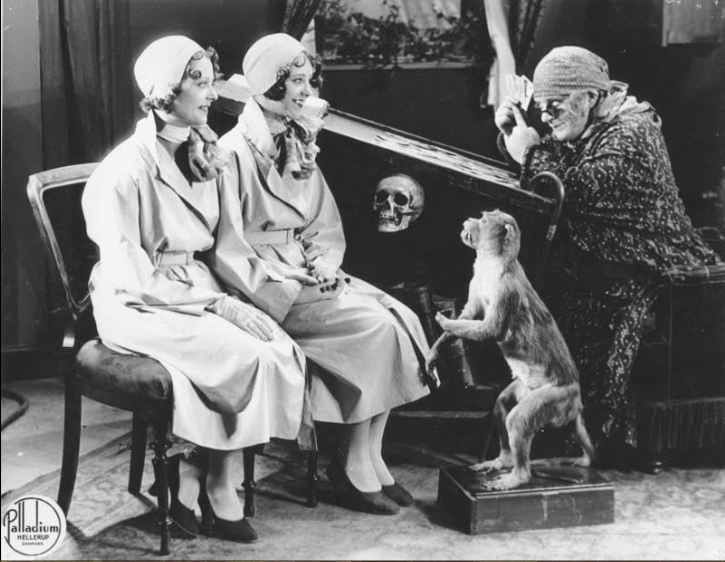
"Fought in the war did you young Arlen, I ran away to sea as a boy!!"


 The Blood Ship (US 1927) with Donald Sosin


It was time for some bitter sea shanties and the unique ultra-violent stylings of Mr Hobart Bosworth by now getting on in years but still more than capable of leering with psychopathic rage out from the screen. The Blood Ship is based on the 1922 novel of the same name by Norman Springer and is very much tailor-made for a Hobart Bosworth blood bath. The star of the unforgiving Behind the Door had earned his sea legs at a young age after apparently running away from home at 12 then working as a cabin boy on a sea clipper for three years before work on an artic whaler. The son of a Civil War naval captain, he clearly heard the call of the sea but he became involved in theatre aged 18 when invited to work as a stage manager helping to produce backdrops, work he hoped would enable him to study art. Quite the shift for a man who, in Norman Springer’s words, looked like the sort of “hard case” you would find working the toughest seas… because, he actually was.


The Blood Ship was one some two dozen nautical films he made and it gives him full rein to bring his weather worn features and remarkable sensitivity for both red-hot fury and despair, to the role of a man robbed of life and liberty who is seeking revenge for more than he knows… and he ramps up the righteous anger with emphatic force as the full extent of his betrayal is revealed.


Directed by George B. Seitz it concerns The Golden Bough, a trading ship run by the brutal Captain Angus “Black Yankee” Swope (Walter James) a man who in the late 1880s was “cursed from Liverpool to Singapore as the cruellest master that sailed the Seven Seas…”. We find him ordering the lashing of a would-be mutineer aided by his equally unforgiving First Mate, Fitz (Fred Kohler who would play so many henchmen – he had a face for cruelty). The other crew seethe silently and only the Captain’s daughter Mary (Jacqueline Logan) tries to help the poor man.


Swope is a cynical abuser and he knows that treating his crew mean will keep them in line and that they’ll escape the first chance they get without his having to pay them and as the ship’s hull touches the dock they’re all off. Meanwhile at Knitting Swede’s Lodging and Beds, where sailors are parted from their money and new “recruits” shanghaied, the handsome, some might say too handsome John Shreve (Richard Arlen) takes it all in before out muscling the Swede’s henchman (our own Syd Crossley). Then he tries to protect Mary when she attempts to escape her father’s ship and meets the mysterious brooding figure sat smoking a pipe at his table…


Both men volunteer for Swope’s ship though, John because he wants to protect Mary and the latter for reasons all of his own. This being a Hobart Bosworth production you just know there will be a hate-filled battle at the end of the film and few actors could match his convincing ferocity and righteous indignation. There is good support from Arlen and all including Blue Washington who is gifted with a dramatic role that doesn’t entirely rely on the usual racial stereotypes of this era – he has agency and isn’t the butt of the usual jokes, until the very end that is…


Donald Sosin accompanied as he has on this restorations recent Blu-ray release.


In addition, we saw a number of shorts that influenced our Charlie of which Max Linder’s Le Renez-vous (FR 1913) was the slickest and funniest as our handsome hero uses his charm to somehow secure a date with two different women at the same house… a victim of his own success one could say. Neil Brand accompanied this section and he has refined a slapstick technique all of his own with well timed and forceful lines that bring out the full flavours of the Verdi’s mighty Fazioli.


God’s Half Acre (US 1916) with John Sweeney


This film was impressive but also confusing as a missing reel left most of us wondering what had happened to whom and why? Still… it all worked out fine in the end even though we had to check the catalogue to find out why? Well made and on the sentimental side with a nursing home and a care home for children it provided a glimpse into the welfare provision of the United States at this time – TLDR: fine if we have the room and the generosity of spirit.


Henry Norman (Jack W. Johnston) is a novelist who travels to a care home called Rainbow’s End in search of inspiration for his next novel he finds it in the form of the bullying manageress and one of the young women who volunteer, Blossom (Mabel Taliaferro) who he terms as “a dear little mite of wonderment”. Blossom falls for him, initially ignoring his intellectual superiority but then running away after finding both an excerpt of his writing and the fact that he is married. Oh, I do hope this misunderstanding can be somehow rectified in time?

The film also uses the phrase “Pink tea talk”… which suggests a non-caffeinated intellectual preaching to the masses or perhaps someone using herbal tea for mischievous ends?


It was left to The Belgians to confuse us even more but then we had come prepared for their surrealist larks – Impose No Meaning, hold back conscious thoughts and just be in the moments watching the whirl. Henri Storck’s Op de boorden van de camera (1932) was a skilful montage of pleasing images passed more pleasurably than Charles Dekeukeleire’s Histoire de detective (1929) in which a detective called H investigated the activities of a suited man in hat called Jonathan who wandered around with his own purpose and his own thoughts and reached his own conclusions about which we cannot speculate.


Mauro Colombis’ role on the piano carefully followed a similar brief.


There were two shorts from the increasingly pleasing Fleischer brothers to keep us grounded in the realities of pen and ink! Fortune Teller lining up the evening’s big finish perfectly


*My mate Jon Banks is a member of a group inspired by this period called ZRI after the tavern – they are virtuosi and highly recommended if you want your classical music to quicken the pulse and even get you dancing! Details are on their website here!


Wednesday, 6 November 2024

Watching the detectives… Louis Feuillade: The Complete Crime Serials (1913-1918), Blu-ray


Louis Feuillade not only popularised the dramatic serial as we still know it, he did so during a period when his country was at war with the majority of these four epic series made during the Great War either in and around Paris or in the relative safety of Nice. In truth the form had many parents across the cine-world with America providing The Perils of Pauline starting in 1914 and Edison's – or someone’s - What Happened to Mary in 1912 then Germany, Viggo Larsen's Arsène Lupin contra Sherlock Holmes in 1910 and even earlier, in 1908, the French with Victorin-Hippolyte Jasset launching his series of six Nick Carter films: le roi des detectives! Carter le roi? Je ne pense pas, messieurs... cet homme vit à Baker Street!


Anyway, using the same techniques as these great and not so great detectives, Feuillade evolved the cinematic style across four series, Fantômas, Les Vampires, Judex and Tih Minh all of which left their mark and established motifs that have been used ever since. Some have been available on Blu-ray overseas but for the first time in the UK Eureka’s Masters of Cinema series has now pulled all together in one luxurious and absolutely essential box set celebrating the birth of the box set in many ways!


The films have all been transferred from 4K restorations from original 35mm nitrate originals where possible and the results create such an immediacy and connection with the material, it almost feels like you’re clambering on a roof top with Irma Vep, with the distant sounds of German guns only 70 kilometres away at one point, with the First Battle of the Marne, in September 1914.


René Navarre in disguise as Fantômas, the master criminal!


Fantômas (1913)


Adapted from a series of popular novels by Marcel Allain and Pierre Souvestre, Fantômas stars René Navarre as the eponymous criminal mastermind. Across the serial’s five episodes, Fantômas is pursued by Inspector Juve (Edmund Breon) and newspaper reporter Jérôme Fandor (Georges Melchior) as he carries out his nefarious schemes. As Kim Newman says in his video essay on the set, Fantômas is a supervillain, a “fusion of Professor Moriarty and Sherlock Holmes…” He’s certainly a master of disguise with each episode opening with Navarre in the disguise he will use in each story and, as Newman observes, we never really find out exactly who he us. He’s a universal and uncatchable master villain.


Each episode features Detective against Villain… and cliff-hangers are the order of the day. Fantômas is relentless and Juve is always one step behind. The serial was hugely successful and spawned many impersonators in print and on screen with both the public and, Newman again, the intellectuals, the surrealists attracted by the anarchy and the anti-establishment agenda.


Feuillade filmed so often on location, here at Avenue Junot...


Les Vampires (1915-1916)


Most people’s first introduction to Feuillade and probably the best and most entertaining of this set, the ten-episode Les Vampires tells of a group of vicious criminals who terrorise Paris, stopping at nothing to gain money and to disrupt the powers that be. They are led by the Grand Vampire (Jean Aymé) who adopts different guises and disguises in most episodes and his key operative (possibly even superior?) is the anagrammatical Irma Vep, played with such vibrant menace by Musidora (the rightfully legendary Jeanne Roques*), who helps to infiltrate elegant society, financial institutions and even the hero’s household for the Vampire cause. She is, as Newman says, the first female super villain, years ahead of Cat Woman and in every way transgressive – a challenge to audience and mankind from her first appearance on stage rousing the gathered gang members.


The hero in pursut is not a policeman but an intrepid reporter – one of the first of his kind - Philippe Guérande (Édouard Mathé) who is mostly helped (occasionally hindered) by the comic Mazamette, knowingly played by the fourth wall busting Marcel Lévesque who moves from working with the criminals – his family being under threat. It’s not the first example of characters’ mutability in the free-running serial that sees an ever-changing battle between the forces of order and disorder.


Les Vampires also had to contend with costumes of silk and wool with elasticated fabric still scarce...


As film scholar Elizabeth Ezra says in her video essay, the serial included a number of references to the ongoing conflict beyond with code breaking, gas attacks and other weapons of war such as the canon in episode seven and the exploding ship in episode eight all to redolent of events so close and yet, cinematically, so far. So many men were mobilised too and the original Vampire leader had to be called off, after the actor playing him, Louis Leubas, was called up.


Another fascinating observation from Ezra relates to the multiple personalities each character potentially presents, with this being an extension of paranoid delusion, Capgras Syndrome patients traumatised by the loss of loved ones belived that those around them had been killed and replaced by imposters in their bodies. Les Vampires is therefore full of people who are not quite as they seem, and there is frequent reference to loss, the serial may not specifically mention the conflict but it’s “haunted by the war” in Ezra’s words.


René Cresté, Édouard Mathé and Louis Leubas in Judex; secret lair


Judex (1916-17)


Judex is probably the first Masked Avenger – essentially a good version of Fantomas/Musidora possibly after an official reaction to the criminality of the first two serials. At this year’s Il Cinema Ritrovato Festival in Bologna, I was able to watch the screening of the entire series – 12 episodes plus prologue - with live accompaniment which really brought out the full flavour of Feuillade’s sense of drama, his eye for dynamic framing, and his team building and his ability to keep the narrative ball rolling even when you think he’s backed himself into a dramatic dead end.


It's not quite up there with Les Vampires but it does have the essentiality of Musidora playing Diana Monti aka Marie Verdier, a scheming opportunist who becomes more and more dominant the longer the story unwinds. Judex himself as played by René Cresté, is a goodie version of Fantômas, part Sherlock Holmes, maybe part Eugène-François Vidocq – an actual French criminal turned criminalist - certainly an outlier for The Shadow, Doc Savage and even The Batman. Feuillade had been criticised for glorifying his evil masterminds and so here was one of good intent even if he does kidnap and fake the death of the businessman responsible for his father’s death and many others, Favraux (Louis Leubas) before imprisoning him for life in a remote castle.


Judex has worked a very long game, disguised as Favraux’s secretary, to infiltrate his business dealings. His plan is soon complicated when he falls in love with the banker’s daughter, Jacqueline (Yvette Andréyor) who is soon targeted by the evil Monti! There’s great support from Vampires’ alumni Édouard Mathé as brother Roger and Marcel Lévesque as the comedic Cocantin whose swimming-costume clad fiancée Miss Daisy Torp (Lily Deligny) helps save the day. The kids are alright too and Le petit Jean (Olinda Mano) and The Liquorice Kid (Rene Poyen) deserved their own series!


René Cresté and Mary Harald
 

Tih Minh (1918)


Tih Minh is a change of pace - and technically the most polished - with a new cast of characters and a number of Feuillade’s regular cast playing them again. Set in the South of France the focus is on the goodies again with explorer Jacques d'Athys (René Cresté) who has returned from the Orient with a new fiancé from Laos, Tih Minh (Mary Harald) – a half Vietnamese heroine, interesting in itself - to be greeted by his mother (Madame Lacroix), sister Jane (Lugane) and maid Rosette (Jeanne Rollette) who is romancing his faithful, cheeky, manservant Placido (Georges Biscot).


The baddies are the mysteriously bearded “Asian” Kistna (Louis Leubas), Doctor Gilson (Gaston Michel) and the La marquise Dolorès (Georgette Faraboni) who has the real dash of stylish super-vixen, biting a rose with menace in the introductory segment. What they’re about is disrupting the old order… undermining the British Empire and controlling minds with chemical concoctions. They also hold a cellarful of chemically controlled young women… for what purpose we can only guess but there is some nudity revealed at this point… and, whilst you’d never see that in a British or American film at this point, it is a reminder that down the same avenue as entertainment is the darkened rue latérale of exploitation.


This serial looks stunning and it’s rare to see such detail and to feel the century melt away as you watch the performers inhabit their roles and the familiar spaces of Nice, with such clarity. The Palais de la Jetée and the beautiful Crystal Casino may be long gone but this is very much a travelogue for the jewel of the Riviera, magnificent views, glorious mansions and the warm breeze of a Mediterranean mistral running through the relentless, narrative parkour, pace of the storyline.


Without doubt as film historian and author David Kalat says in his commentary, Feuillade’s crime serials had a huge impact on Fritz Lang who responded with Dr Mabuse, Spies and much more not to mention Alfred Hitchcock and everyone that came after. The influence spread also to pulp magazines – The Shadow – as well as comic books, radio, television and one of the most successful Caped Crusaders also known as Bruce Wayne.


Musidora in command, hands on hips, sleeves rolled up...


Join me in investigating these suspiciously special features…


·         Limited Edition Hardcase Box Set [2000 copies]

·         Set includes all four serials across 9 Blu-ray Discs, all presented in 1080p HD from stunning 4K restorations courtesy of Gaumont Film Company, with uncompressed LPCM 2.0 audio on all serials

·         Fantômas – audio commentaries on In the Shadow of the Guillotine and Juve vs Fantômas by film historian and author David Kalat

·         Les Vampires – new audio commentaries on The Red Cipher and The Spectre by film historian and author David Kalat

·         Judex – new audio commentaries on the prologue, The Mysterious Shadow, Atonement, The Water Sprite and The Forgiveness of Love by genre film expert and Video Watchdog founder Tim Lucas

·         Tih-Minh – Brand new audio commentaries on The Potion of Forgetfulness, The Mysteries of Circé Villa and Justice by genre film expert and Video Watchdog founder Tim Lucas

·         Casting a Long Shadow –  new interview with critic and author Kim Newman

·         Pamela Hutchinson on Musidora –  new interview with critic, film historian and silent cinema expert Pamela Hutchinson on the star of Les Vampires and Judex

·         The Spectre of War in Les Vampires –  new video essay by film scholar Elizabeth Ezra, editor of European Cinema and France in Focus: Film and National Identity

·         Feuillade in Context – a new interview with writer, composer and silent film accompanist Neil Brand

·         A Closer Look at Feuillade – Brand new interview with critic, writer and film commentator Tony Rayns

·         Fold-out poster – yay!!

·         A limited edition 100-page collector’s book featuring new writing by Louis Feuillade experts Jonathan Rosenbaum, Calum Baker, Annette Förster, Wendy Haslem, Robin Walz and Leon Hunt on the filmmaker and his crime serials alongside select archival imagery


The set is released on 11th November and can be ordered direct from Eureka, not home should be without it. As Neil Brand says in his video essay on the director, not only are these lengthy series with their lose plotting – “one damn thing after another” – enthralling and still engaging, they’re also a social document of the Third French Republic, the war years and the development of one of the most enduring genres in cinema. Where would The Avengers be without HYDRA or James Bond without SPECTRE? And just where would Netflix, Apple TV and everyone else be without crime and punishment? Where would any of us be? This is one to binge and relish. But you know that already.


*For more information on Musidora visit the Womens Film Pioneers Project pages and follow on from there. Pamela Hutchinson’s video essay on this Eureka set is also thoroughly recommended!


Friday, 13 October 2023

Climb every mountain*… Le Giornate del Cinema Muto 42, Day Six


We finished off day six climbing every stairway, late after dinner and relegated to the Gods for the spirited but slightly odd Poker Faces (1926) featuring Edward Everett Horton and Laura La Plante in a winning combination of cheeky chappie and Universal’s top star for much of the Twenties who didn’t manage to achieve his career longevity, retiring as a movie star at just 30 in 1935 by which point Horton was pushing 50 and with years of success ahead.


Horton plays Jimmy Whitmore a man whose face gives nothing away expect, he’s Edward Everett Horton so, of course, there’s a lot of comic meaning flashing across his face, he’s no Buster Keaton in this regard. If anything, La Plante as his wife Betty is better at stoneface especially frustrated by his glacial career advancement – and consequent lack of new rug – and then stone-cold furious as his big break turns into a farce – a little forced compared with say Marie Prevost’s Up in Mabel’s Room, but still funny and with the charm of these two leads.


Jimmy gets offered a promotion so long as he can close a big new deal with out-of-town big shot George Dixon (George Siegmann) who he has to meet at the station. By this time Betty has stormed off to get a job of her own after Jimmy nixes the new carpet and thinking he sees her about to leave town, wearing a veil with similar luggage (of course) pursues her and starts to remonstrate. This attracts the attention of Big George who chivalrously steps in to defend the woman who, veil lifted, turns out to be of Chinese origin so, of course, she couldn’t be Jimmy’s wife… and our collective cringe went up a gear as an intertitle of Chinese appeared. That was 1926 that was.


Edward's way with women.


Jimmy and George don’t know who the other is though, despite having unknowingly got off on bad terms Jimmy’s boss Henry Curlew (Tom Ricketts) invites them to his house for dinner to finalise the deal. He also invites Jimmy’s wife which is an issue as the latter thinks he’s been deserted by his inconveniently ambitious spouse and has to hire a woman to act as his wife (Dorothy Revier). She’s married to Pug (Tom O'Brien) a prize fighter… not someone you’d want to upset in any way. Can you guess where this is going?


Naturally chaos erupts at Curlew’s house as the men find out who each other is and the old man’s new secretary is unveiled… it’s Betty who is probably more surprised about his new “wife” than Jimmy is about her new job. There follows extended confusion and confrontation as Jimmy tries to protect the honour of this young woman as George takes a shine to her. It’s well played by everyone, and the direction is well timed by Harry A. Pollard.


It’s a farce. sometimes you’re in the mood sometimes you’re not and tonight I was.


The daftness was enlivened considerably by a new score composed and conducted by Juri Dal Dan performed live by Zerorchestra, Pordenone’s finest and who played for this on the tradition GCM eve screening. The band were swingling and tight, turning musical direction on the flip of a dime and with short solos highlighting and reinforcing the comic energy. No wonder the Verdi was packed out to the rafters where we sat!


Hannes Schneider

Before our evening exertions we were on top of the world with Arnold Fanck and his intrepid mountaineering filmmakers for Der Berg Des Schicksals (Mountain of Destiny) (1924), the film that reputedly inspired dancer Leni Riefenstahl to get in touch with its pioneering director, Arnold Fanck, who then featured her in The Holy Mountain. I love Fanck’s films, the scenery obviously, the sense of actual adventure filming at these altitudes and the bravery of the leads taking on the actual crags and scrambles.


The “destiny” is for the son to follow the father in conquering the peak which he tried but failed to climb. Inspired by the fatal attempt of climber Carlo Garbari to summit the Guglia (“spire”) di Brenta in the Dolomites, Winter Olympian Hannes Schneider plays Bergsteiger who is haunted by the peak and his son is Alpine expert Luis Trenker who would star in other Fanck films and who looks like he was hewn from the granite of these mountains (was he Married to the Mountains?!).


Fanck would start by shooting footage of dangerous climbs and incredible landscapes and then evolve his stories later and sometimes there’s more climbing than character but there’s good support from non-climbers like Erna Morena as the climbers’ wife and mother as well as Hertha von Walther as Hella who Trenker has to go to rescue on a stormy night. She climbs well and looked familiar to me as she’s an uncredited actor in Pabst’s Joyless Street (1925).


Airy accompaniment was provided by Mauro Colombis and the ubiquitous Frank Bockius who is no doubt familiar with these Germanic hills! Stunning visuals on screen and hard-hitting, syncopations on stage!


Harald Madsen charms Marguerite Viby and Nina Kalckar

The Slapstick programme brought us down to earth with the existential crises of  Pat and Patachon in Højt paa en kvist (High Up on a Twig) (1929) which featured the following intertitle: “One is tall, the other is short”, which I though was a very dry joke I’d made about their comedic proposition at the Kennington Bioscope in 2018… The two madcaps are engulfed a series of comedic situations during the course of this feature and attempt to romance two attractive young women, played by Marguerite Viby and Nina Kalckar, who are clearly such generous souls that they see the inner beauty in both men although they are under the misapprehension that they’re rich.


The film was apparently a return to form for the couple who had been working together for over 25 years at this point. Ulrich Ruedel is very good in the Giornate programme on the reasons for their success and on just why their comedy was different to the Brits and Hollywood. Clearly both men, Pat (Harald Madsen) and Patachon (Carl Schenstrøm) were good actors playing a different style to the gag-based Brits and it’s our challenge to understand why even if we just don’t laugh as much.


Meg Morley made her GCM42 debut and as usual accompanied with assured melodic invention and her jazz-practiced improvisations always have a distinctive quality even as she presents musical themes that are very much of the period, jazz age in spirit as much as form.


Mary Harald in the fields


Vendémiaire (1918), presented as one feature, was essentially a two parts plus prologue, from the master of the multi-part adventure, Louis Feuillade and showed a more considered and down-to-earth, director three years on from Les Vampires and the War. There were some lush landscapes of the canals and countryside near Lyon and a feature feel to the lengthy episodes as a plot unfolded about two escaped German POWs infiltrating a group of farm workers in the Great War.


René Cresté plays Pierre Bertin a soldier on leave to recover from his mental and physical wounds and he meets a family heading away from the front line to seek work and to find out what happened to their siblings. They all end up working on a vineyard in Lunel (Feullade’s hometown) run by Capitaine de Castelviel (Feuillade regular Édouard Mathé) and where the two Germans also infiltrate.  Wilfred (Louis Leubas) and Fritz (Manuel Caméré) cause much disruption as they try to further the fading German cause and frame a gypsy, Sarah (Mary Harald, who also featured in the director’s Tih Minh (1918) and who was of mixed race possibly born in Hong Kong or Vietnam) as they rob the Captain… there are fuller characters than in the director’s more adventure-based serials and, as the propaganda it undoubtedly was, Vendemiaire stirs your heart as you hope for the best for these refugees.


Accompaniment for the 143 minute run time was split between Gabriel Thibaudeau and John Sweeney who both provided the lyricism and spirit the subject matter demanded; John’s triumphant cadences at the films’ end were especially moving as the certainty of the victory at the time of release was clearly less and we now know that the new peace was only to last barely twenty-odd years.


There were also some extra special entrees before Poker Faces accompanied by maestro Stephen Horne and including some wonderful colour shots around Niagara Falls in, er, Wonderful Water (1922) and Max Roach comedy, A Truthful Liar (1924) featuring Will Rogers as Alfalfa Doolittle who becomes Ambassador to Cornucopia where he dispenses with formalities and gets matey with the King (Richard Pennell) who would much rather go to an American bar in the city than spend time with his suffocating court. Alfalfa duly uses his cowboy powers to rescue the King from runaway horses and would be assassins. It spoofs the whole Ruritanian idea and features the immortal couplet:


Roses are red,

Violets are blue,

I’m against royalty,

How about you?


There were also some poignant footage of the man Chaplin called The Master, Max Linder in 1924, still so full of charm and intelligence and yet struggling with mental health issues after the war that would lead to his death the following year. Enjoy yourself, it’s later than you think…


René Cresté and Gaston Michel Vendémiaire (1918) 


*See Le Giornate del Cinema Muto 42, Day Four


Sunday, 30 January 2022

That Riviera touch… Tih Minh (1919), Gaumont Blu-ray


All good things come to those who wait (mostly) and I’ve often hoped to see Louis Feuillade’s magnificent fifth serial film (after Fantômas in 1913-1914, Les Vampires in 1915-1916, Judex in 1916 and La Nouvelle mission de Judex in 1917) in better quality than the fuzzy version on YouTube which looks like it was copied from VHS by a camcorder 400 metres across the road in fading light and with a failing battery… miracles so happen and this new disc is A Thing of Utter Beauty!


This is a dazzling 4k transfer from the 2019 restoration by L'immagine Ritrovata, of the 35mm nitrate negative from the Cinémathèque française film archive, completed with a reversal duplicate held by Centre National du Cinéma, and it looks absolutely like it was filmed yesterday. It’s rare to see such detail and to feel the century melt away as you watch the performers inhabit their roles and the familiar spaces of Nice, with such clarity. The Palais de la Jetée and the beautiful Crystal casino may be long gone but this is very much a travelogue for the jewel of the Riviera, magnificent views, glorious mansions and the warm breeze of a Mediterranean mistral running through the relentless, if gentile, pace of the storyline.


Scoring for six hours and 24 minutes is a challenge but Julien Boury has produced a tour du force of melodic invention which playfully drives alongside the narrative with strong major themes for story and character. Boury knows his film scoring and there are some gorgeous lines on harp and flute for our lovely heroine, and then a nod towards John Barry dynamics for the arrival of the British diplomat in episode five. It plays out at just the right pace – this is a marathon and not a sprint after all – and retains interest in its subject with sincerity, economy and an instinctive musicality. The score is played out with a chamber group consisting of piano, string and wind instruments with the odd found sound used sparingly and always to good effect. I wish I knew more but bravo Julien!


Mary Harald

Tih Minh is, for me, an advance on Feuillade’s previous epics with rich characters and tighter plotting that relies less on improvisation than say Les Vampires. The cast of characters as introduced, mostly, in Episode One: The Potion of Forgetfulness are well realised and fleshed out more too, not just black and white baddies… well, black, grey and white… with beards and definitive motives. Before that we have a Prologue as explorer Jacques d'Athys (René Cresté) returns from the Orient with a new fiancé from Laos, Tih Minh (Mary Harald) to be greeted by his mother (Madame Lacroix), sister Jane (Lugane) and maid Rosette (Jeanne Rollette) who is romancing his faithful, cheeky, manservant Placido (Georges Biscot).


Very little is known about Mary Harald who it seems was a British subject born in Hong Kong and who only acted in French films as far as the internet can tell. Possibly she was mixed race, it’s hard to tell, but that could account for her only acting in France but… that’s pure speculation. Whatever, she is very good indeed, telling many a story with restrained yet emotionally fulsome expressiveness whether under the influence of enemy pharmaceuticals or delighting in her new world and new family. She, as the title suggests, is the star and the story is all about the post-war Empire and Britain’s enduring challenge from Germany but also communism and just plain old bad guys with graduated tints of evil.


The Doc, Dolorès and Kistna up to no good

These baddies are… the mysteriously bearded “Asian” Kistna (Louis Leubas), Doctor Gilson (Gaston Michel) and the La marquise Dolorès (Georgette Faraboni) who has the real dash of stylish super-vixen, biting a rose with menace in the introductory segment. What they’re about is disrupting the old order… undermining the British Empire and controlling minds with chemical concoctions. They also hold a cellarful of chemically controlled young women… for what purpose we can only guess but there is some nudity revealed at this point… and, whilst you’d never see that in a British or American film at this point, it is a reminder that down the same avenue as entertainment is the darkened rue latérale of exploitation.


Jacques d'Athys is soon called away on another expedition and long months pass before the start of the first episode proper. The action begins in Monte Carlo Casino where Lord Stone is breaking the bank with a sea of great faces set by Feuillade as the backdrop for his triumphs. As with so many subsequent scenes down the years, the winner is soon turned loser by unscrupulous hands; the game is rigged with Kistna and Gilson soon to relieve him of his winnings. Stone is found unconscious on the Nice promenade minus his money and his memory in what proves to be just the latest such case in a summer which has also seen a number of young women disappear.


Mary Harald, René Cresté and Lugane

At the Villa Circe Kistna and Gilson read the reports of their misdeeds with interest and note the impending marriage of the returning Athys to his “charming Annamite” Tih-Minh. They also have a letter from someone called Rao, head servant of the Great Lord Ourvasi, in London advising them that the explorer has brought back a book, the Nadolaya, on his latest travels and this has more importance than he realises… The book had been stolen from Ourvasi who had written the location of a great treasure in the front of the book in an ancient text and, worse than that, in pencil. When Kistna does pay a visit and ask to borrow the document a surprisingly proactive Placido decides to erase the scribblings with a rubber before handing it to his master’s guest. Thus begins the protracted push and pull between the two sides… with twists and turns far too many to mention.


There are kidnappings and re-kidnappings, brainwashings and druggings, as science detection wends its steady way through the series. It feels so much like the precursor of the adventure series of the 1960s, like the Avengers (no, not the ones with capes, although Diana Rigg worse one occasionally), The Saint and 007… In episode two, Two Dramatic Events During the Night, Dolorès uses telepathy to help Doctor Gilson cheat at cards whilst trying to drug Athys with a poisoned pendant. All mod cons for modern spies!


Georges Biscot plays loveable manservant Placido

This is also about intelligence though, and the badguys always seem to end up on step ahead of the good. Les Vampires’ star Édouard Mathé turns up as Sir Francis Grey, the aforementioned British “diplomat” who is the only one who can decipher the script which, luckily, Athys has photographed. He arrives in time to be picked up by Kistna’s henchmen who end up getting him committed to a mental asylum, Feuillade and co-writer Georges Faure have no shortage of ideas. Grey is highlighted in episode five, At the Asylum and Placido in episode four, The Man in the Case and the focus is on a more structured, novelesque, approach to the serial.


Tih-Minh delivers shakes and stirs, and it really is all thriller, no filler with quality maintained throughout with a tip of the hat to the cinematography of Léon Klausse which contributes so much to this gorgeous confection.


I ordered my copy from Amazon France and it arrived within a few days, there’s also a Blu-ray of Judex and many others all with sous-titres Anglais… how can you resist? They have ways of making you forget your bank balance…


Nice promenade as was with the pier and Crystal Casino on the top right!

Édouard Mathé

Jeanne Rollette


Thursday, 12 April 2018

Shacked up... The Canadian (1926), Lillian Henley, Kennington Bioscope

Mona Palma and Thomas Meighan
One of the real treats of attending the Kennington Bioscope is not only watching films from Kevin Brownlow’s collection but also hearing his introductions. As the noughties game used to have it, we’re all six degrees of separation from Kevin Bacon but in Kennington we’re just three degrees through Kevin Brownlow to so many silent film stars, cast and crew.

Kevin not only met William Beaudine, The Canadian’s director, he also helped put on a screening of the film so that, having been too busy in the first instance, it’s director could finally see it 44 years after its run. Ill health almost prevented Beaudine attending and he wouldn’t give an introduction until the audience and he had a chance to see it the film was actually any good… after applause during and after the film, he got up on stage and announced his surprise that he wasn’t that bad director, in patches at least.

The Canadian is indeed a decent movie and has many similarities to Victor Sjöström’s later film The Wind (1928) a film found in very good quality in the UK prompting one US archivist to tell Kevin that they only had “the poor man’s Wind”… Whilst The Canadian is not as good as that nor City Girl (1928), another later film featuring a sea of wheat, it is a very good movie and accompanied by Lillian Henley’s perfectly-paced piano – lots of lovely, patient lines, so sure of tone - had more than one of this battle-hardened silent audience to wipe salty fluid from their eye: we’ve coped with Chaplin, Stella Dallas, Joan of Arc… but then this!?


Beaudine had been primarily a comedy director and, seeing out his contract to MGM as a lucrative loanee with Paramount, he took a chance and took the all expenses trip up to Canada to make a drama based on a 1913 play, The Land of Promise, by W. Somerset Maugham of all people. He was accompanied by cinematographer Alvin Wyckoff who ended up being assisted by a curious electrician, Stanley Cortez, who stayed up all night studying the cameras hoping to find a more better role. He ended up as Orson Wells cinematographer on The Magnificent Ambersons (1942).

See, from Kevin Brownlow to Orson Wells in three moves!

Nora Marsh (Mona Palma, who bears a passing resemblance to City Girl’s Mary Duncan…) has had to leave the “culture and poverty” of Britain (and this in 1926!!) following the death of her aunt. She travels way out west to stay with her brother Ed (Wyndham Standing) and his wife Gertie (Dale Fuller, who has a face you never forget and was so good in von Stroheim’s Greed).

Nora’s no explorer and quickly finds both the locale and the locals distasteful. She’s full of airs and graces and appalled by the rough and ready approach to dining; eating with a fork and no napkins. Chief amongst the louts is Frank Taylor (mighty Thomas Meighan) who is as incredulous as she at each other’s startling incompatibility.


But it’s not Frank Nora needs to worry about, at least not yet, Gertie’s a reasonable girl but when she finds her sister in law not only knows literally nothing about housework but continues to lord it over her and the men, she cracks and picks a fight Nora can only loose.

Thus it is, slightly improbably, that after being forced into the most humiliating of apologies, Nora offers her desperate hands in marriage to Frank who had previously said that he only wanted a woman to cook and clean. The two are wed in cold contractual misery and then face life together in a cold, tiny wooden shack that makes Lars Hanson’s gaff in The Wind look positively palatial.

There a thousand tiny terrors start to unfold including the issue of marital intimacy… like a gent Frank sleeps in the main room leaving Mona the bedroom. But, the pressure builds, and things are about to get a lot more intense.


The Canadian deserves its own reputation and both leads excel. I knew what to expect from Mr Thomas Meighan, but Mona Palma was also very good – pride just about trumping fear until she learns to adapt.

There’s also a nice turn from Charles Winninger as Pop Tyson who dances a mean jig!

Up first was an eclectic and satisfying mix of shorts the best of which was It’s A Gift (1923) which featured Snub Pollard in a small metal car propelled by his use of a giant magnet to follow other vehicles; it’s an iconic image and now I know which film it was from! Snub plays a scientist who has an automated breakfast and wake up routine similar to Wallace in The Wrong Trousers: we’d all like to pull a few strings to get our breakfast made and trousers hitched.

The gifted Mr Pollard
There was also an oddity called Life’s Staircase (1915) featuring a couple reading and ripping up old love letters, she ranged left and he, right, as the circumstances of each letter and token place alongside, double-exposed. It’s about marriage and the prototype relationships we leave behind, and it reminded me of Scott Pilgrim vs The World in which our hero must battle all his girl’s previous partners. In this film he’d only have to get married and they’d all fade away.

First film was a dreamy confection from Louis Feuillade all about Spring (1909) which featured lots of women dancing in flowing white dresses. It was impressive, but I was concerned about the safety of the numerous doves held aloft during the calisthenics.

My garden, today
If you like ladies in swimming costumes, an episode of the long running women’s cinemagazine, Eve’s Film Review, was about to explore how “Eve’s” swimming costume has shrunk since the 1880’s. There was definitely a trend on the evidence presented and cause for concern for some but boy, were they in for a shock twenty year’s later.

Felix the Cat started life in Eve’s Film Review and he popped up trying to win a battle with a clown for the hand of a doll in Toy Land. Itchy won (or was it Scratchy?) and the romance between paper cat and human doll went to plan but oh, Mr Hays were you not watching?!

Meg Morley matched these broad themes with an assured eclecticism of her own: if you can accompany cartoon cats, Doves in danger, Snubb’s auto race and swimming-costumed women washing elephants in Manchester zoo, then you can probably cope with anything.


Another superb evening at the one and only Kennington Bioscope c/o The Cinema Museum! Thanks to Lillian and Meg for playing, Michelle Facey (the shorts: meticulous research as usual!) and Kevin Brownlow (his film!) for introducing, Dave Locke for projecting and to everyone who keeps this special place going.

PS For Ladies Only? Eve's Film Review: Pathe Cinemagazine 1921-33 by Jenny Hammerton looks fascinating and is available on Amazon!