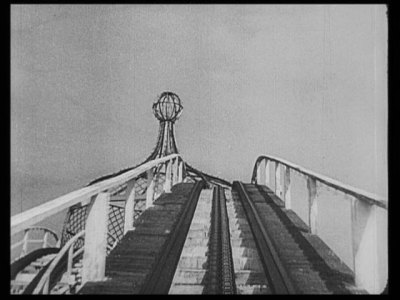
Three piers, The Golden Mile, The Big Dipper,
trams, a Tower to rival Paris, arcades and donkeys; even in it’s dotage
Blackpool still defiantly breaks more hearts than any other UK seaside resort
but, as we saw tonight, Llandudno’s subtle charms can compromise even the most
careful girl. For, climbing the Great Orme, near the still-extant Victorian
pier and staying at the Grand Hotel, where I worked two summer seasons as a
student, Fanny Hawthorn risked her future with some posh fella on the lookout
for more than fresh air and fun.
Maurice Elvey told the BFI in 1949 that Hindle Wakes
was “the greatest play ever written” and one of the films he most enjoyed
making and, in fact, he was so keen on Stanley Houghton’s play that he made it
twice. This is more than just a “Lancashire film for Lancashire people” as the
publicity had it, this was a liberating tale for all at a time of increasing
class awareness and the growth of unions and the Labour Party. Houghton’s play
was written just a year after the Liverpool general transport strike which,
apart from causing Home Secretary Winston Churchill to send troops and a battle
cruiser up the Mersey, did so much for union membership. My grandfather was a
tram driver who withdrew his labour for the strike during which two men were
shot dead and hundreds injured by the army.
Elvey had produced plays by Chekov, Strindberg, Ibsen and
he was a trade unionist who would have identified with the play’s message of
working-class independence. He also wanted naturalism in the film and both
Estelle Brody and Peggy Carlisle spent time in a mill to learn how to properly
look like they were doing the work and to understand the culture, Peggy was
from Liverpool and would have known Blackpool well but Estelle was an American:
welcome to the real Playground of the World!

Watching this new BFI 35mm print – a full restoration is
apparently ongoing – the film stands out as one of the major works of British
silent cinema because of the expertise with which Elvey controls character and
the narrative. It may be a bit slow-paced for modern viewers but everything is
there to serve a purpose and every character will have their moments.
Fanny and Mary – Peggy’s haircut is so darn sharp!
– feel like modern women all the more surprising given the date of their
origin, years before they could vote. The fact that Fanny feels confident
enough to exert her right to independence against all odds, is one of the great
feminist statements of British silent film. I love her strength and sass as she
refuses to let the situation of her dalliance with Allan Jeffcote (John Stuart)
and the instant respect from mill-owner Nathaniel Jeffcote (a very fine showing
from Norman McKinnel) who recognises someone with drive and grit like himself.
She may be a bonny lass Mr Jeffcote but she’s far too good for your Alan!
Similarly, Fanny’s parents are mini masterpieces of characterisation
with Humberston Wright as her intelligent yet timid father and Mary Ault as her
firebrand of a mother who eye’s her daughter’s transgression as an opportunity
to be exploited and just will not be silenced about it, if only there was an
audio recording of her improvisations! Mouth almighty as they’d say in Lanky!
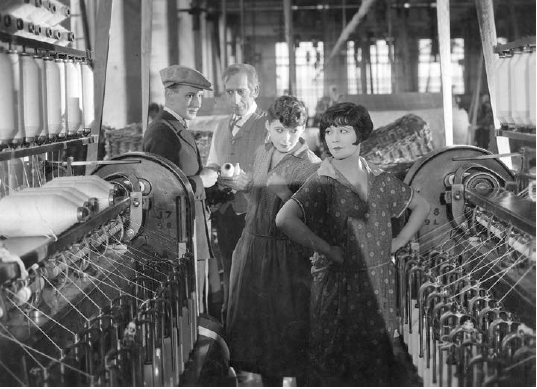 |
| John Stuart, Humberston Wright, Peggy Carlisle and Estelle Brody |
The sequences in Blackpool are outstanding especially the
footage of the Big Dipper – show the restoration in the BFI IMAX and there’ll
be folk passing out at that.
It’s a film that strengthens every time I see it and
given the politics of 1926-7 as well as 1912, it is simply a remarkable
statement about ordinary people’s right to self-determination. Away with the
old morality and guilt, time to stand up and play a bigger part.
The score was composed and conducted by Maud Nelissen and performed live by Daphne Balvers (soprano & alto sax), Lucio Degani (violin), Francesco Ferrarini (cello), Rombout Stoffers (percussions & accordion) as well Maud Nelissen on piano. In the catalogue she talks of how she researched locations and culture for the film, immersing herself in mill town history and the times of the annual wakes weeks when t’ whole mill shut down and the workers went off together in search of precious joy. On the evidence of this lovely, soulful score she’s now an honorary Lassie from Lancashire.

This morning there was more Harry Piel serving up top-notch
entertainment with Der Mann Ohne Nerven (1924) in which der mann himself
plays without fear and spends a good portion of the action attempting to rescue
the beautiful damsel Aud Egede Christensen (future Mrs Piel, Dary Holm) from a
runaway balloon flying high over Paris bumping into church spires and
industrial chimneys. All starts with a bundle of meta-confusion with story is
about a famous novelist and his new book, Der Mann Ohne Nerven which, it
seems to me, suddenly takes to life as characters start to pursue the
man without fear or perhaps that’s the book we’re experiencing.
Plot, who cares, it’s Harry’s World and we’re just
watching it.
Mr Neil Brand accompanied as fearlessly as Harry, no
safety net and with suspended chords chasing his balloonatic pursuit across the
sky.
 |
| Jaque Catelain modelling the latest in lounge wear |
More gorgeous Sonia Delaunay design next with Marcel
L’Herbier’s Le Vertige (1926) (also entitled The Living Image but
literally Vertigo, with elements of Hitchcock’s later film of the same
title as Stephen Horne pointed out) one of his major films I’ve not seen and quite
possibly one of Jaque Catelain’s best performances, as a baby-faced Ivan
Mosjoukine as someone termed him. He plays two parts, a young Russian army
officer who is killed by General Svirsky (Roger Karl) the horrendous husband of
his lover Natacha (Emmy Lynn).
After the Revolution to couple relocate to Nic and taking
a trip to Paris Natacha sees a young man, Henri de Cassel (Jaque Catelain
again) who looks exactly like her dead lover. Stranger and stranger with some
spectacular design, old jealousies are revived and history begins to repeat
itself.
Stephen Horne supplied uncannily stylish accompaniment.
 |
| Eugen Klöpfer tracking Aud Egede-Nissen |
I’ve also managed to avoid seeing Die Strasse (1923)
another of the canon revisited stream which was a digital restoration with
reconstructed titles and a mix of sources. Karl Grune’s film is indeed
impressive in terms of cinematic technique as well as its pointedly political
take on German life encapsulated on one street.
There’s a bored middle-aged man who definitely doesn’t work
in the publishing industry (Eugen Klöpfer) who sets out for a walk on the wild
side of his street, twirling his umbrella and feigning interest in shop windows*
as he approaches the local sex workers. There’s some amusing interplay between
one such woman (Aud Egede-Nissen) and this nervy punter, a dance she’s played
many times before. As we later find out, she shares a house with a small child
and a blind man played by the protean Max Schreck; two vulnerable people who exist
in the criminal uncertainties of this low life.
The man finally bucks up the courage to follow the woman
into a night club where his seduction and exploitation can be controlled, it’s
a tense voyage into the underworld, with a dreamlike quality that doesn’t make
the realities being dramatized any less pitiful.
Partners in crime Günter Buchwald (violin and piano) and Frank
Bockius (hitting things) accompanied in fine style with so many hints of
contemporary club anthems, Ain’t She Sweet being ironically right on
point!
*In one of the shop windows he passes by there’s an
advert for The White Star Line including Liverpool as one of the destinations.
The White Star offices still stands in Liverpool as does The White Star public
house just off Mathew Street and The Cavern were fifty years after Fanny and
Mary, girls went for a good time increasingly on their terms.
 |
| The wifi's decent as well... |
 |
| Liverpool has some fabulous architecture. |