
After the rain-sodden beauty of Venice, the ancient
charms of the altogether dryer Treviso waterways I finally arrived in Pordenone
to find it filled with friends from countries too numerous to mention. On days
like this, “Pords” is indeed the centre of the silent cinematic world and as we
renewed acquaintances we were also to be treated to a world-wide series of
screenings, all united, also, by their silence. Now, as much as ever, we can
only appreciate any opportunity to bring people, places and creative expression
together. One medium, one mind… sympatico!
Early Cinema – The Biograph Project with Donald Sosin
We begin with everyone’s favourite early film director
based on opinion polls from 1952. We’re less tolerant of David Wark Griffith’s
beliefs and convictions these days but there’s no doubting his part in the
history of film even if that is endlessly contested in terms of politics and
technique: you can’t divide those two things as easily as might be hoped.
Still, the people he worked with, the things he did do to popularise films, we
are probably more certain of these in his early period than after 1915…
Film Preservation Society is currently working to
preserve and restore all Biograph films directed by D. W. Griffith between 1908
and 1913 – around 460! and here were the results of their work from the Griffith
get-go. We had three shorts from 1908 each around twelve minutes and each
displaying the prevailing views of some folk at the time and how. Children were
stolen by “gypsies” in Griffith’s debut The Adventures of Dollie and
also by native Americans in his fifth film (the third surviving?) The Redman
and the Child although the child is then rescued by another.
Griffith’s second film was Fight for Freedom (1908) and this involves a Mexican murderer called Pedro and his attempts to evade capture after a card game turns violent… These are the very beginnings for Griffith, Victorian melodramas told with technical flair aided by the brilliant cameraman Billy Bitzer. There’s more to come every morning and it’s an education for those of us who have only seen his features screened.
 |
| Dollie gets hidden in a barrel by naughty people |
Sicilia Landscapes with Stephen Horne
Travel broadens the mind… that’s why I’m here! This
year’s Festival is focusing on Sicily which is a place I really must visit
having fallen short previously, how it looks now compared to Arturo Ambrosio’s Sicilia
Illustrata (1907) would be fascinating to see. This was a dreamy way to
cover the subject with films from 1907 to 1929 often covering the same
locations showing the island’s rich antiquity and pushing Palermo high up my
bucket list – it has to be warmer than Venice right?
Stephen Horne accompanied with lyrical wafts from piano and flute across this most un-Italianate environment and helped us share in the wonder of a past revealed. My grandparents were alive when these films were made, how different their lives in North Western England… almost like a different continent, and a different century.
 |
| Ivan Koval-Samborsky and Ada Vojtsik |
The Forty-First (1926), Mauro Colombis, DCP
Yakov Protazanov directed before and after the Russian
Revolution and I’ve watched quite a number of his films from the Departure
of a Grand Old Man (1912) – about Leo Tolstoy - The Queen of Spades
(1916), Father Sergius (1918) to, of course, Aelita (1924) and
it’s interesting to see him address the Russian Civil War in this film. The war
lasted from just after the October revolution to October 1922 and involved the
new Bolshevik government’s Red Army fighting anti-revolutionary White Russians,
supported by the US, UK and twelve other countries, as well as a third set of
separatist forces from Poland, Lithuania, Ukraine and others. One of the most
complex conflicts of the century estimates of the causalities range from seven
to twelve million with millions more displaced.
The story here is set in Central Asia with a Red Army
troop being pursued under the most hostile of conditions by a detachment of
whites… it’s essentially a story of love versus duty with the Red Army sniper
Maryutka (Ada Vojtsik) only slightly wounding her intended 41st
kill, a White lieutenant aristocrat Govorukha-Otrok played by the dashing Ivan
Koval-Samborsky. He’s taken capture and the Reds have to decide how to extract
the information he is holding, he’s sent off to their headquarters but ends up
abandoned on an island with just Maryutka as their feelings ebb and flow.
It's a stark film which feels politically vague –
certainly four years after the war ended – and very focused on the two main
characters, often in close up or, in one memorable shot, sitting side by side
stripped to the waist as their clothes dry on the fire. Filmed in the Karakum
Desert in Turkmenistan and the Apsheron peninsular of Azerbaijan, it has
stunning locations and as Peter Bagrov says in his catalogue essay, it may be
the only soviet-era film of the silent period to portray the civil war as tragedy
rather than victory. And so it goes.
 |
| Zítari |
Latin American shorts with José María Serralde Ruiz
We travelled again with some glorious fragments including
nitrate preserved fireworks in a collection of fragments from Salvador Toscano
including the celebrations in 1910 of Mexican independence and the
revolutionary leader Emiliano Zapata, alive and gruesomely dead. Sergei
Eisenstein’s El Desastre en Oaxaca showed the deadly results of a
Mexican earthquake in 1931 and then we had a wordless mystery called Abismos
(1931) with Salvador Pruneda prefiguring David Lynch in terms of narrative
strangeness.
Miguel Contreras Torres, Zítari (The Temple of the
Thousand Serpents) (1931) concluded the section with a mix of silent and
sound examinations of the unknowable history of Mayans, Aztecs and Toltec
ruins. I was reminded of the early works of Erik von Daniken who suggested that
these alien artefacts were actually constructed by extra-terrestrials but
nothing is more mysterious than the earthly mysteries of these cultures.

Dinty (1920) with John Sweeney
This was nominally a vehicle for the remarkable young performer
Wesley Barry it is also notable for providing one of Colleen Moore’s biggest
breaks. Moore’s extraordinary energy comes through as she plays a young
“colleen” (how many times?) who leaves Ireland for America where her new
husband is making a new life. She’s striking and vibrant in these scenes but
when fate takes a nasty twist and she falls ill with tuberculosis, she offers
up one of the most believable performances in her sick bed. There’s a stillness
to her expression, hardly the energy or will to even smile at her son and
there’s no flicker of hope in her drained eyes. That’s acting and that’s range;
and there’d be far more to come.
At the time 13-year-old Wesley was the star and he’s also
very good, displaying a winning youthful pluck that would lead to a string of
“our gang” type successes throughout the twenties. He was one of the leading
freckled performers of the age, Marshall Neilan being one of the first to
deploy them to full effect in Rebecca of Sunnybrook Farm – no grease paint and
no credit in Mary Pickford’s film, but it got him noticed! Barry grew up and
directed films with his most notable effort was The Creation of the
Humanoids (1962), apparently Andy Warhol’s favourite film, depicting a
future society in which robots are persecuted by the fanatical humans of The
Order of Flesh and Blood. I think we know who they are now, don’t we?
 |
| Anna May Wong, Walter Chung and Aaron Mitchell |
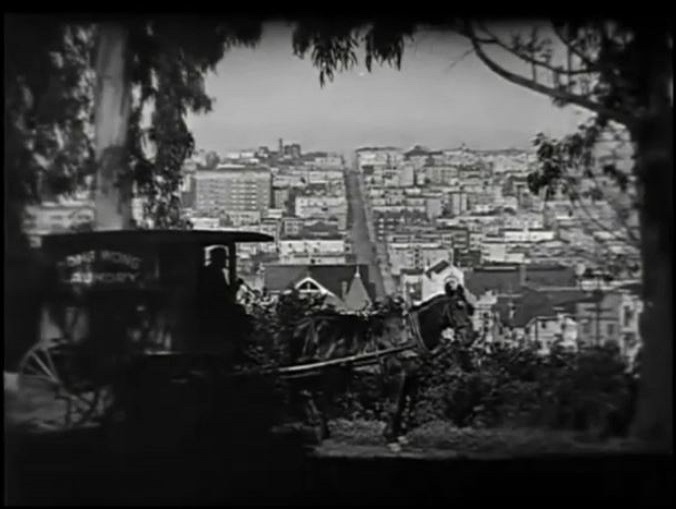
Anna May Wong was only two years older than Barry, yet
she gets to play Half Moon, not the public house in Putney, but the wife of
Wong Tai (an improbable Noah Beery) an opium smuggler and head of a Tong gang.
“Different times” yet still uncomfortable to watch. I do however, like Dinty’s
multi-ethnic band of younger brothers and paperboys with African American Aaron
Mitchell as Alexander Horatius Jones and the Chinese American Walter Chung as
Sui Lung. They still have racist epithets mind. Times have changed.
John Sweeney, still fresh after playing last night in
London – do silent accompanists have warm-up gigs before touring? – and
provided thunderous accompaniment to match this film’s shifts in tone.

Opening Event 3 Bad Men (1926), Timothy Brock,
the Orchestra da Camera di Pordenone
Thus we came to the biggest of finishes with a restored 3
Bad Men and a chance for those George O’Brien fans who saw his – very physical
- performance in the screening of The Iron Horse at the Kennington Bioscope to
appreciate his style all over again. For me this made for a nice connection
with Ford having watched The Searchers in 70mm on the big screen in
Piazza Maggiore this summer in Bologna – what an extraordinary filmmaker he was
and how well did he capture the beauty and brutality of the old West?
This is a true Ford epic, produced over a 15-month period
out in the desert near Victorville, California and around Jackson Hole,
Wyoming. It must have been like a military operation and it was tough with
three of the leading actresses hospitalised with paratyphoid fever. Horses and stuntmen
may well have been injured in the making of this film especially the huge
reconstruction of an actual gold rush as hundreds of horses and waggons race
across the desert mirroring the Cherokee Strip land rush of 1893 in King
Baggot’s Tumbleweeds (1925) starring William S. Hart and screened here a
few years back.
I was also reminded of Hell’s Hinges as the bad guys
torched a church and the townsfolk burned their bar. It’s a genuinely thrilling
film and all of the Western tropes are here connecting to The Searchers and way
beyond. The three bad men are "Bull" Stanley (Tom Santschi), "Spade"
Allen (Frank Campeau) and Mike Costigan (J. Farrell MacDonald) who are long in
the tooth outsiders and gunmen, they begin to change their perspective when
they meet a young woman Lee Carlton (Olive Borden looking very modern I have to
say) who’s father has just been killed by the gang of local really bad Sheriff
Layne Hunter (Lou Tellegen who has electric blue eyes that still shine through
the screen).
 |
| Hearts of gold? |
Lee’s love interest is a beefy cowboy Dan O'Malley (smiley
George O'Brien who, thankfully keeps his top on) but the real focus is on the
three unwise men and their voyage to redemption. Surprisingly the film failed
to be a hit at the time with audiences growing tired of epic westerns. What we
see now looks like a template but it’s the perfection of existing styles and
tropes done as well as they have ever been done though. It stands the test of
time.
Playing no small part in this was Timothy Brock who conducted
the Orchestra da Camera di Pordenone in playing his own new score and it swept
us up and back to 1926 and then the 1870s… You can never tire of the new
connections and excitement in forging a new musical alliance with these stories
and filmmakers and the ghost of John Ford, cast and crew could be heard
cheering high up in the rafters along with the rest of us! I was especially
thrilled by the powerful brass sections and hints of western musical
conventions, all brought through so subtly and coherently in ways that had me
moist of eye and on the edge of my seat for the closing section. A magnificent
27 players, or there abouts!
I also surprised myself by thoroughly enjoying Babby
Peggy rounding up bootleggers as Peg O’ The Mounted (1924), she’s an expressive
marvel and more than cheeky if you’re a criminal. Daan van den Hurk rode
side-saddle-piano in delight.
Everything under the Sun was in tune and the Sun was eclipsed by the Moon... More prog references tomorrow. Probably.
 |
| Olive winks at George |




+colour.png)


%2Bdress.jpg)


+hill+trip.jpg)




