Showing posts with label Marjorie Daw. Show all posts

Saturday, 30 January 2021

The gang’s all here… Dinty (1920), Edward Lorusso Kickstarter DVD


This was a vehicle for the remarkable young performer Wesley Barry and yet, it is perhaps more historically notable for providing one of Colleen Moore’s biggest breaks. Moore’s extraordinary energy comes through as she plays a young “colleen” (how many times? Etc…) who leaves Ireland for America where her new husband is making a new life. She’s striking and vibrant in these scenes but when fate takes a nasty twist and she falls ill with tuberculosis, she offers up one of the most believable performances in her sick bed. There’s a stillness to her expression, hardly the energy or will to even smile at her son and there’s no flicker of hope in her drained eyes. That’s acting and that’s range; and there’d be far more to come.


At the time 13-year-old Wesley was the star and he’s also very good, displaying a winning youthful pluck that would lead to a string of “our gang” type successes throughout the twenties. He was one of the leading freckled performers of the age, Marshall Neilan being one of the first to deploy them to full effect in Rebecca of Sunnybrook Farm – no grease paint and no credit in Mary Pickford’s film, but it got him noticed! Wesley grown up was less of a proposition for Hollywood and after the films dried up in the thirties he went behind the camera and was assistant director for a number of films including Roger Corman's 1967 film The St. Valentine's Day Massacre. Barry also directed films and his most notable effort was The Creation of the Humanoids (1962), apparently Andy Warhol’s favourite film, depicting a future society in which robots are persecuted by the fanatical humans of The Order of Flesh and Blood (1962) that’s gone straight to the top of my watch list!


Wesley Barry contemplates what he must do to impress Andy Warhol

Such things were probably far from Wesley’s mind in 1920 and he’s very engaging in a film that packs a lot of action and simple fun in with the melodramatic. Marshall Neilan created the film for his freckled friend with a script co-written by Marion Fairfax which allows the lad to show his own range.


Not quite knowing what to expect the early scenes in Ireland lead me to expect a romance in the old country as good catholic girl Doreen Adair (Colleen Moore), falls for protestant Danny O'Sullivan (Tom Gallery). Whilst her father disapproves of the Orangeman, he’s got plenty of get up and go and after getting approval marries Doreen and sets off to America, the land of Irish opportunity.


Colleen Moore knows the score

But as Doreen and their baby, Dinty, follow months later, she arrives in San Francisco just in time to find that her love has died in a car accident. Doreen works all the hours at menial jobs and brings up Dinty in a poor but decent way and we move forward twelve years we see her painfully ill in bed whilst the spunk kid is out selling newspapers as their breadwinner.


There’s a rival paper gang trying to muscle Dinty’s boys out of their corners but Dinty’s a determined lad and sets about the bigger bullies as you’d expect with superior vim and strategy. It’s all good fun and presages a more adult battle between local mobsters and the police. I do like Dinty’s multi-ethnic band of younger brothers with African American Aaron Mitchell as Alexander Horatius Jones and the Chinese American Walter Chung as Sui Lung, and, whilst it’s a precursor of Our Gang (1922–44), it also reminded me of the gang in Penfold and Sam (1923), itself a follow up to the now lost Penrod (1922) which starred Barry. It’s so interesting that the good guys are multi-racial whilst the bad guys are all bigger and white? Hollywood liberals eh? Hold on…


Noah Beery... bloomin' 'eck!!

Anna May Wong was just 15 and only two years older than Wesley Barry, yet she gets to play Half Moon, not the public house in Putney, but the wife of Wong Tai (an improbable Noah Beery) an opium smuggler and head of a Tong gang. Wong Tai – that leery, Beery look in his eye – is cruel and ruthless, employing a sharp-edged pendulum in his secret den to torture and otherwise ensure compliance with his commands. He can do nothing though when his son (Young Hipp) is sent down by Judge Whitely (J. Barney Sherry) but kidnaps his daughter (see-saw Marjorie Daw, … one of the great silent film stage names) with the intention of freeing his boy.


The police are involved but they need the help of Dinty’s newsboy legion who, through their work and cultural diversity have an insight into the workings of the Chinese underworld. It’s one thing for the baddies to take on the men in blue but when the youngsters get involved… things move too fast.


Anna May Wong was two years older than Wesley Barry


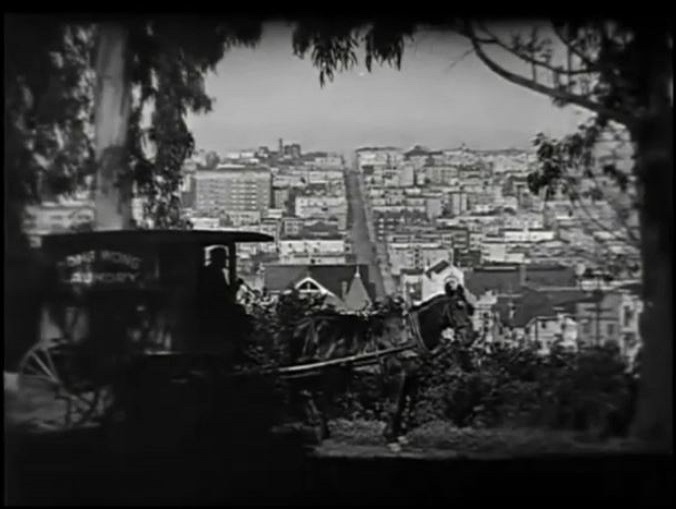
It’s "feel good" in excelsis and everything works out through collaboration and trust just the kind of message families and children most wanted to here in the land of second chances. Unsurprisingly Dinty was a success and one of the films of the year according to Photoplay magazine and box office returns. It also provides some excellent shots of contemporary San Francisco all of which add an element of realism to the film as well as glimpses of the city 100-years past.


This is Edward Lorusso’s tenth Kickstarter funded presentation and the source film came from a private collector. The print quality is very good and the experience is enriched by Ben Model’s practiced piano accompaniment which matches the flow of the film’s pace and tone to a tea.


Aaron Mitchell is ace too!


The production is now available from Grapevine Video on Blu-ray and DVD and you can buy direct from their site here. It comes with the comedy short A Two-Cylinder Courtship with Billie Rhodes and Edward Lorusso providing accompaniment.


Mr Lorusso is also on another project now, Marion Davies in Zander the Great, a new scan of the original 35mm nitrate print by Library of Congress. There’s still time to support this very worthwhile project and the link is right here… please support if you can!


Monday, 5 February 2018

Kickstarted… The Pride of Palomar (1922)


Crowdfunding has played an increasing role in securing the future and wider-distribution of silent films. It is indeed the internet done properly with like-minded people connected to projects that match with their specific interests just so long as the target group is big enough and the rights holders are pre-disposed.

This project, the clean up and release an early Frank Borzage film, The Pride of Palomar, was eventually able to also “rescue” a second film, Back Pay (1922) and to support an excellent pdf document on the director, Frank Borzage - A Dossier as well as a smaller document featuring contemporary details and much else on the main film.

I am very glad that I supported True Film’s project and impressed with how Patrick McInerney, John Heath and Patrick Ford Bowerin realised their objectives and then some more. Gentlemen, well done!

Crowdfunding?
These works may not feature the Frank Borzage who directed some glorious late period silents but they still show an interesting film-maker honing the vision and subtle emotional flavours he would display in Lazybones, The River and Seventh Heaven. Back in 2006 Slant magazine ran a career appraisal which mentioned “…embarrassments” in Borzage's career giving specific mention to “…a shameful anti-Japanese drama for William Randolph Hearst (The Pride of Palomar) …” but, whilst the racism is not comfortable (lazy Mexicans, scheming Japanese…) it’s not enough to damn the entire work 90 years on and Palomar is a fun film to watch with some lovely emotional peaks and enough narrative edge to leave you aching for the final resolution.

As Molly Haskell notes in her dossier essay, Borzage Soulmates, the director often features “…lovers who cannot be separated by distance or time…” and, whilst this is true of our two leading characters Don Mike Farrell (Forrest Stanley) and Kay Parker (see-saw, Marjorie Daw) – who are mostly blocked by family interests and the various arts of The Deal – it’s also the case with Don Mike and his father, Don Miguel (Joseph J. Dowling) who dies in mourning after hearing that his heroic son has been killed in the Great War.

There’s a terrific sequence when Don Miguel goes into the old mission at San Luis Rey to pray for his loss, he is connected to his son through his faith just as much as his housekeeper who believes that the still flaming lamp in his room, lit by his mother, shows he still lives.

Don Miguel in mourning
Indeed, young Mike is very much alive, a tragedy for father and son, and the film is as much about his saving the family honour as finding the love of his life… rights must be wronged and the Spanish-Irish Farrells must recover their ground to overcome both Yankee corporate manoeuvres and opportunist land-gabbing from Japanese property investors… specifically, and this is the difficult bit, Warner Oland in heavy make-up as Fuji Okada: a clumsy stereotype of the yellow peril.

“Land deals with Japs are not very popular in California…”

Okada’s business is buying up Californian land for “Japanese colonization” and he relies on the “shiftlessness” and “short sightedness” of the fun-loving but commercially incompetent Latinos… living la vida loca without managing cash-flow or sustainable business strategies. It is a bit rich but at least we have a baddie and injustice to be prevented.

Okada is travelling by train along with Kay Parker and her father John (Alfred Allen) who is going to foreclose on the mortgage on the Farrell’s El Palomar ranch, which the family has seemingly failed to manage. A young army officer joins them, instantly charming young Kay with his impressive character and firm jaw… he is, of course, Don Miguel “Mike” Farrell.

Travelling in style... Forrest Stanley, Alfred Allen, Warner Oland and Marjorie Daw
The two talk on the train and it’s only when he departs that she realises who he is and how he will be affected by her father’s business aims. A war moratorium means that Mike will now have twelve months to raise the $300,000 needed to settle the mortgage his father was forced to take. It’s a tough task but he soon finds that Loustalot, an ill-shaved local rancher (bad moustache) not only owed his dad over $100,000 but continues to graze his cattle on Farrell land. He’s a tricky customer backed by Parker and even more so by – boo! – Okada.

There’s also an irrigation project under construction which would, interestingly, turn the land into a bit of a goldmine  (worth $5 million!) if only Farrell could afford to keep it… so close yet so far from redemption. There’s also a rather splendid racehorse called Panchito that might, if I were you, be worth a few bob in the Kentucky Derby…

Now, I think you’ll be in little doubt how all of this will develop but its skilfully wrought by director, cast and crew. As Patrick Ford Bowering says in his essay The Path to the Summit, Palomar “demands to be seen” serving as “an important stylistic link for Borzage, with hints and treats not seen in Borzage’s prior feature films, but would appear again in his later work.” with the director’s “romanticized and gorgeous approach” in evidence, even amidst the stranger moments of the film. Back to those stunning visual set-pieces and an almost magical realist approach… life, death, balancing of the books, love and honour.

An almost mystical return...
I especially liked the repeated shots of the line of trees near the opening to the ranch; characters come and go through this tunnel as though to another world. When Mike walks back home for the first time, Kay waits for him behind a tree and as his faithful pet dog runs to greet him, the light is lovely and love is, indeed, in the air. Borzage stages some great set-piece action scenes, the pursuit of Loustalot is across stunning valley views and the horse racing scenes are genuinely exciting. It is a satisfying and well-made film.

Yes Don dresses up in disguise as a Mexican slobby gambler and he is wounded by a Chinese man with a grudge (they’re all in together these "orientals"…) and his house servant Pablo (Tote Du Crow) gets caught dozing a few times, but there are far more loyal and decent people all round than baddies. Mike even has a childhood sweetheart Anita Supvelda (Carmen Arselle) who Kay thinks will be his wife… Most importantly, the "Mexicans" win and the Gringo’s have to respect them.


I hope there are plans for The Pride of Palomar's wider release - I will try find out! I look forward to more such projects, would it be too much to ask if the Norma Talmadge/Borzage collaborations could be next? Maybe it’s time to get more involved - we're ready to help in any way we can silent compadres.