Showing posts with label Noah Beery. Show all posts

Saturday, 30 January 2021

The gang’s all here… Dinty (1920), Edward Lorusso Kickstarter DVD


This was a vehicle for the remarkable young performer Wesley Barry and yet, it is perhaps more historically notable for providing one of Colleen Moore’s biggest breaks. Moore’s extraordinary energy comes through as she plays a young “colleen” (how many times? Etc…) who leaves Ireland for America where her new husband is making a new life. She’s striking and vibrant in these scenes but when fate takes a nasty twist and she falls ill with tuberculosis, she offers up one of the most believable performances in her sick bed. There’s a stillness to her expression, hardly the energy or will to even smile at her son and there’s no flicker of hope in her drained eyes. That’s acting and that’s range; and there’d be far more to come.


At the time 13-year-old Wesley was the star and he’s also very good, displaying a winning youthful pluck that would lead to a string of “our gang” type successes throughout the twenties. He was one of the leading freckled performers of the age, Marshall Neilan being one of the first to deploy them to full effect in Rebecca of Sunnybrook Farm – no grease paint and no credit in Mary Pickford’s film, but it got him noticed! Wesley grown up was less of a proposition for Hollywood and after the films dried up in the thirties he went behind the camera and was assistant director for a number of films including Roger Corman's 1967 film The St. Valentine's Day Massacre. Barry also directed films and his most notable effort was The Creation of the Humanoids (1962), apparently Andy Warhol’s favourite film, depicting a future society in which robots are persecuted by the fanatical humans of The Order of Flesh and Blood (1962) that’s gone straight to the top of my watch list!


Wesley Barry contemplates what he must do to impress Andy Warhol

Such things were probably far from Wesley’s mind in 1920 and he’s very engaging in a film that packs a lot of action and simple fun in with the melodramatic. Marshall Neilan created the film for his freckled friend with a script co-written by Marion Fairfax which allows the lad to show his own range.


Not quite knowing what to expect the early scenes in Ireland lead me to expect a romance in the old country as good catholic girl Doreen Adair (Colleen Moore), falls for protestant Danny O'Sullivan (Tom Gallery). Whilst her father disapproves of the Orangeman, he’s got plenty of get up and go and after getting approval marries Doreen and sets off to America, the land of Irish opportunity.


Colleen Moore knows the score

But as Doreen and their baby, Dinty, follow months later, she arrives in San Francisco just in time to find that her love has died in a car accident. Doreen works all the hours at menial jobs and brings up Dinty in a poor but decent way and we move forward twelve years we see her painfully ill in bed whilst the spunk kid is out selling newspapers as their breadwinner.


There’s a rival paper gang trying to muscle Dinty’s boys out of their corners but Dinty’s a determined lad and sets about the bigger bullies as you’d expect with superior vim and strategy. It’s all good fun and presages a more adult battle between local mobsters and the police. I do like Dinty’s multi-ethnic band of younger brothers with African American Aaron Mitchell as Alexander Horatius Jones and the Chinese American Walter Chung as Sui Lung, and, whilst it’s a precursor of Our Gang (1922–44), it also reminded me of the gang in Penfold and Sam (1923), itself a follow up to the now lost Penrod (1922) which starred Barry. It’s so interesting that the good guys are multi-racial whilst the bad guys are all bigger and white? Hollywood liberals eh? Hold on…


Noah Beery... bloomin' 'eck!!

Anna May Wong was just 15 and only two years older than Wesley Barry, yet she gets to play Half Moon, not the public house in Putney, but the wife of Wong Tai (an improbable Noah Beery) an opium smuggler and head of a Tong gang. Wong Tai – that leery, Beery look in his eye – is cruel and ruthless, employing a sharp-edged pendulum in his secret den to torture and otherwise ensure compliance with his commands. He can do nothing though when his son (Young Hipp) is sent down by Judge Whitely (J. Barney Sherry) but kidnaps his daughter (see-saw Marjorie Daw, … one of the great silent film stage names) with the intention of freeing his boy.


The police are involved but they need the help of Dinty’s newsboy legion who, through their work and cultural diversity have an insight into the workings of the Chinese underworld. It’s one thing for the baddies to take on the men in blue but when the youngsters get involved… things move too fast.


Anna May Wong was two years older than Wesley Barry


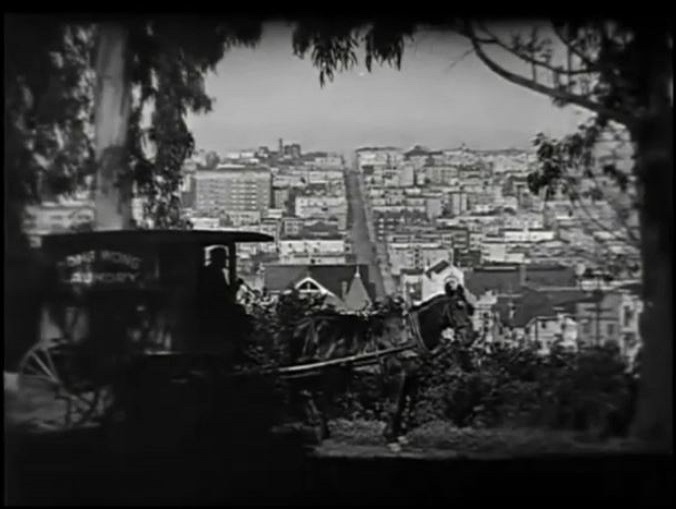
It’s "feel good" in excelsis and everything works out through collaboration and trust just the kind of message families and children most wanted to here in the land of second chances. Unsurprisingly Dinty was a success and one of the films of the year according to Photoplay magazine and box office returns. It also provides some excellent shots of contemporary San Francisco all of which add an element of realism to the film as well as glimpses of the city 100-years past.


This is Edward Lorusso’s tenth Kickstarter funded presentation and the source film came from a private collector. The print quality is very good and the experience is enriched by Ben Model’s practiced piano accompaniment which matches the flow of the film’s pace and tone to a tea.


Aaron Mitchell is ace too!


The production is now available from Grapevine Video on Blu-ray and DVD and you can buy direct from their site here. It comes with the comedy short A Two-Cylinder Courtship with Billie Rhodes and Edward Lorusso providing accompaniment.


Mr Lorusso is also on another project now, Marion Davies in Zander the Great, a new scan of the original 35mm nitrate print by Library of Congress. There’s still time to support this very worthwhile project and the link is right here… please support if you can!


Wednesday, 18 July 2018

Forbidden colours… The Red Lantern (1919), Costas Fotopoulos, Kennington Bioscope


“East is East, and West is West… and never the twain shall meet.”

Anna May Wong makes a brief and almost impossible to spot, film debut in a film in which a Russian and an American play the two Asian leads. The Red Lantern is “of its time” and yet it is not unsympathetic to these characters whose lives are limited by Caucasian prejudice. The eye make-up is jarring and makes for awkward viewing but whilst attitudes have shifted there were those even at the time who found this unacceptable… in a time when Sessue Hayakawa was a bona fide star. But this is about love and prejudice and whether the lines quoted from Kipling should still be true some twenty years after the Boxer Rebellion led to the deaths of over 30,000 in Peking.

The film features Alla Nazimova in dual roles as Mahlee the illegitimate, mixed-race daughter of Sir Philip Sackville (Frank Currier) and half-sister to his pure English rose Blanche. Nazimova proves again her ability as the most stylised protean performer of the time and you’d scarcely recognise her as her own sister – blonde wig and a lighter touch – vs the taught angularity of Mahlee.

Alla Nazimova, also known as Naz (natch).
The Boxer Rebellion was not old news at this point as the Great War ground out its last days, and issues of self-determination drove the post-war agenda. China had been the subject of many international hands and the “allies” opposing the uprising had been a mix of British, American, German and Japanese who by the time of this film had assumed the lead role.

June Mathis’ screen play was based on Edith Wherry’s novel, written in 1911 and described in The Spectator review on release as an extra-ordinarily “vivid” account of missionary life and as “… a statement of existing conditions it is of the very highest interest.”

In this context it’s fascinating that Noah Beery’s Doctor Sam Wang is not an out and out baddie; firstly, he’s a Doctor, committed to heling and secondly, he too is “Eurasian” – mixed race – and has been humiliated by his attempts to integrate in the West. He gets involved in the uprising as he wants to earn his place in the East… he’s also a bit too fresh with Mahlee, just to push him into “bad guy” territory, behaviourally. As the book reviewer noted, the two best realised characters are Mahlee and Wang.

Another Beery baddie? Also the father of Noah Beery Junior of the Rockford Files!
Mahlee herself is got at for not having had her feet bound – the express wishes of Sackville as he abandoned her as a baby, little realising it would mark her as an outcast. So much so that when her grandmother is dying she asks her to cut her feet so that she may be accepted into heaven by the gods (tough gods!). But, nor can she truly find a place with the Christian Europeans, even as she works as a nurse in the Mission.

 
“Hush, child! You are like a cat treading on my heart. You have the foreign devils’ fear of death… my time is near and I am not afraid.”

She falls for Andrew Templeton (Darrell Foss), the son of the mission leader Reverend Alex Templeton (Winter Hall), but the son's admiration is tempered by her mixed race as indeed is that of his father and mother; as much as they like and admire Mahlee, she is not for their son.

Naz and Darrell Foss
Things become even more pronounced when the Stackville’s arrive and Andrew is automatically drawn to the Caucasian version of the woman he has felt such an uncomfortably strong attraction for. This is not good news and naturally Wang plays the rejection as another reason for Mahlee to help the Boxer rebellion by pretending to be the Queen of the Red Lantern.

Again, it’s of interest that the story doesn’t leave it there and there is still a chance for the Westerners to redeem themselves by accepting Mahlee for who she is and not how she was made but no… they can’t even manage that and so it is that Mahlee joins the revolt. What else has she got left and, despite her efforts to save them and repeated offers of friendship they just can’t get over her skin colour… even her love and even her father.

The imperliasts aren't budging!
So, by now we’re rooting for the Boxers… and so – probably - were many of the audience in 1919 which is an extraordinary thing.

 
Veteran Albert Capellani directs… and there are some excellent crowd scenes and luscious mise-en-scene: it’s an epic and I’m not surprised it was one of the biggest films of the year and established Nazimova as: ”The star of a thousand moods… in a drama of a thousand delights.” I wasn’t counting and that may well have been hyperbole but there were many delights…

Costas Fotopoulos accompanied and, sight unseen, did a marvellous job matching the dramatic and emotional pace of a film that does lead its audience along a twisted path to the denouement.

Now THAT. Is a hat.
Illegal drug frenzy at South London Silent Film Speakeasy!!

Before all this we were treated to Coke Enneyday (Douglas Fairbanks) and his opioid adventures trying to break up a gang of evil-doers using inflatable fish to smuggle. Lovely Billie Love is caught up in all of this and I especially liked the moment when one of the – Chinese – henchmen trapped her and said he could now do what he wanted with her… she beats him up and ties him up in his arms.


Anita Loos probably added the Girl Power and Todd Browning (you know, him!) summoned all the rest coming down from one bad trip on Venice Beach. Maaaann!

John Sweeney played along, as sober as a Judge m’lud! He had to be: Doug takes no prisoners and in amidst the fun drugs, he clearly forgot to take his worming tablets.

The men in a boat. 1910.
There was also some beautiful colour footage of the Italian Lake Garda taken in 1910 using the innovative British Kinemacolor process which, as the Bioscope’s expert projectionist, Dave Locke, explained, used a spinning disc, with red, green and clear plastic to synchronise with film shot using tinted stock. The result was simply stunning and “colour fringing” aside, when someone moved a little too fast for the camera to follow, it was something to behold.

If you travel down to Brighton and Hove, you can still see the Kinemacolor sign on the side of the building where it was developed.

One of the most remarkable shorts ever shown at the Bioscope or, indeed, anywhere else.


The Red Lantern was the recent Belgian restoration and was screened on 35mm. It is avialable from the Belgian Cinematek as an extraordinary extras-laden DVD with a 200 page book which tells you all you could possible imagine about Naz, the Boxer background and the making of this film. Highly recommended!