
So, here it is... and what another resilient year it’s been for cinema. I saw a lot more films in theatres this year and stand in admiration all those involved in making this possible, so thank you for the projecting, programming, popcorn and perseverance. Thank you for showing me to my seat, introducing and politely requesting that we all wear masks… every little really does help. But this year’s list is dominated once again by digitally streamed films albeit from live events with Bonn, Bologna, Pordenone and others re-emerging and offering the choice to be there in person or the opportunity to watch from home. the way forward as many are still vulnerable whilst the pandemic lasts whilst those who could attend did so with appetite renewed.
So without further ado and in no particular order here's twelve highlights from the year behind us.
 |
| When Igor met Mary |
1. A Kiss from Mary Pickford (1927), with John
Sweeney, 10th Hippodrome Silent Film Festival
I’m hoping that 2022 allows me to attend Scotland’s premier
silent film festival… OK, one of Europe’s premier festivals! This delicious
soviet comedy typifies the focus on programming a mix of well-know and more
obscure but historically significant films and is a film I’ve wanted to see for
some time.
In 1926 Mary Pickford and Douglas Fairbanks came to Moscow
as part of a grand European tour and seeing how rapturously they were greeted,
how fetishized they were as something beyond ordinary humanity, Sergei Komarov
devised a means of using this to both shine a comic light on the nature of this
ultra-fame. He had no special access to the stars, just a collection of
newsreels and one crucial sequence in which Mary agreed to perform a short skit
with Igor Ilyinsky at the end of which she kisses him on the cheek; the moment
which makes this film transcend its sources, from meta to better.
John Sweeney provided accompaniment and delighted in every
comedic twist and turn in this joyful film that is as much a celebration of the
Muscovite sense of humour as its cinema. As John said in his introduction, this
is exactly the kind of film you fall for… one that is largely unseen but one
that is further evidence of the strength of Russian comedy and cinematic ideas
during the Twenties.

2. Siren of the Tropics (1927), Günter A. Buchwald and
Frank Bockius, Slapstick Festival 2021
My first missed Slapstick Festival for a few years but the
programme was as strong as you’d expect especially this opportunity to see the
great Josephine Baker in her first feature. At the time, Hollywood was
certainly not ready to go as far as French directors Mario Nalpas and Henri Étiévant
do by placing Baker as the main focus in La sirène des tropiques and by
giving her a story largely free of the cliqued tramlines of other multi-ethnic
stories. Baker is perhaps treated as more
overtly sexual than most white actors at this time – she’s topless twice - is portrayed as both innocent and with a
childlike wildness; she attracts (white) male lust as well as love and
protectiveness, revels in powerfully expressive jazz dancing – seriously, that core
and the way she co-ordinates massive extensions without any apparent strain
- and yet her character remains in awe
of western spirituality. So many questions… but it’s still a shock to see someone as naturalistic as her placed,
largely, at the centre of a story from this period and one in which race is not
really mentioned.
Live musical accompaniment was provided by Guenter A.
Buchwald on piano and Frank Bockius on percussion, who, in addition to
deploying an almost telepathic musical synchronicity, smartly avoided the
cliches of cultural referencing. This being one of the great jazz babies, they
gave us a rip-roaring, hi-tempo jazzed score that not only kept pace but lifted
the film to the vibrational level of its all-powered star. When Baker eventually
struts her considerable stuff towards the end of the film you felt that this is
the moment the players had been pacing themselves for.
 |
| Marthe Fabris... L’Arlésienne |
3. L’Arlésienne (1922), Il Cinema Ritrovato,
Günter Buchwald and L’Octuor de France
A film with a fantastic sense of place, shot on location in the
gorgeous city of Arles and the surrounding countryside of the Camargue, it’s
almost entirely shot outdoors, featuring the images of locale and rural
practice you’d expect from André Antoine, the director of L'hirondelle et la
mésange (1920) and La Terre (1921).
This 4k restoration is a thing of beauty completed in 2020
by Fondation Jérôme Seydoux-Pathé and La Cinémathèque française from two unique
diacetate prints preserved at the latter and it benefited mightily from musical
accompaniment based on orchestral arrangements by Gabriel Diot from the score
edited by Pathé in 1922. Günter Buchwald rearranged the score, which features
compositions from Bizet (who incidentally wrote an opera based on this story),
Gillet, Rachmaninov and others. He also added his own Impressions d’ Arles and
conducted L’Octuor de France to create a perfectly synchronised emotional
narrative that not only pull at present day heartstrings but also recreates the
sound of the contemporary silent experience.
 |
| Lyda Borelli |
4. Fior di male (1915), Bonn Silent Film Festival
with Cellophon
I’m not having a best of list without a new-to-me classic
Diva film and here was a prime cut of imperial Borelli in all her operatic pomp
and with a collection of magisterial emotional displays only matched by her
gorgeous and frequently changing wardrobe. Only in Italy miei amici and it took
a German film festival to highlight that point.
Accompanying were the Cellophon duo, aka Paul Rittel and
Tobias Stutz who both play cello in ways that are emotionally resonant and
respectful of the source visuals. They used admirable flavour and restraint
with both recognising the need to underplay when confronted by the operatic
fireworks on screen using this most mournfully flexible of instruments in
musical tribute to perhaps the greatest Italian silent film diva…
Another excellent presentation from this year’s Bonn
festival and I have completely run out of reasons not to go there in 2022.
 |
| Magda Holm |
5. The Girl in Tails (1926), Stephen Horne and
Elizabeth Jane-Baldry, Bonn Silent Film Festival
I’m to be disgraced simply because I’m a girl. A meek and
mild, simple and unassuming girl…
Karin Swanström’s uplifting film, a delicate mixture of
comedy and drama that fully lives up to its promise as A Light Summer Film
Story especially with truly delicious accompaniment from Horne and Baldry,
without whom no remote access Bonn would be complete. It is notable for
addressing so many issues that might be considered more modern concerns and it
tackles proto feminism in ways which are never black and white, flowing
naturally with the story. It’s sophisticated about its subject and uses
cross-dressing as a means of creating conflict as well as comedy and makes
points about fairness that doesn’t bang the drum so much as rolls it around the
ballroom between social conservatism and the heroine’s “fight against
injustice”.
Stephen’s multi-instrumentation and Elizabeth-Jane’s harp work
so well together as they leave each other so much space and support, sharing
the leading lines with the harp being used as percussion and bass as well as
the heavenly flourishes you’d expect. There were some exceptionally lovely
themes and the improvised was hard to separate from the pre-arranged which says
it all. The ideal accompaniment for this delightful film!
 |
| Leslie Howard and some of my old neighbours |
6. Breaking the silence… The Wit and Wisdom of A.A.
Milne, BFI, with Bryony Dixon and Neil Brand
This was not my first cinema of the pandemic but it was
the first silent screening with live accompaniment since March 2020… and, what
a way to break the silence with BFI Curator Bryony Dixon providing expert
introduction and Neil Brand accompanying with all the contextual flourish and
narrative instinct you would expect.
There were two films written by Alan Alexander Milne for
Minerva Films, founded in 1920 by the actor Leslie Howard with his friend and
story editor Adrian Brunel. The company’s board of directors included C. Aubrey
Smith, Nigel Playfair and A. A. Milne. First up was The Bump (1920)
featuring Smith as the famous explorer with a “bump” that enables him to find
even the darkest parts of Africa but in London he gets hopelessly lost. Smith
was 57 and the film makes great play of his cragginess with a sequence notating
the origins of the scars on his face, a shark bite here and a lions’ claw
there; he’s explored the world and has the autographs left by every predator
he’s met.
The second film featured Leslie Howard in Bookworms
(1920) another witty tale of love and adventure this time transporting a knight
and fair maiden to Edwardian semi-detached suburbs in what is now West
Wimbledon. Turns out the location was just around the corner from where I used
to live too.
 |
| Henry Edwards |
7. The parade returns… The Joker (1928), with
Stephen Horne, Le Giornate 40th Edition Streaming, Day One
The 40th Edition of Le Giornate del Cinema Muto mixed physical
media and digital content with the cinemuto-philes returning to Pordenone for
the full programme including live screenings, accompaniment and lashings of
Aperol Spritz late into the night… and a lighter schedule available online and
worldwide. It was the best of both worlds and the best we can hope for as the
cautious C-19 recovery continues.
The streaming got off to a rip-roaring start with a big
party in Nice, featuring the annual carnival, covered extensively, including
one or two hangovers and a reunion of Mander and Horne; not a long-lost music
hall pairing but the star of The First Born, accompanied once again by
the man who produced one of the most memorable scores for modern restorations
at the London Film Festival in 2011. Directed by Danish Georg Jacoby this “Euro
pudding” had a charming cast to match its location and story of playboy jewel
thievery with The Joker played by the British actor and director, Henry Edwards,
in prototypical Bond fashion admittedly more Niven than Craig.
 |
| Ellen Richter |
8. Moral (1928), with Donald Sosin, Le Giornate
40th Edition Streaming, Day Seven
The rediscovery of Ellen Richter was one of the big themes
of this year’s Giornate live in Pordenone and she did not disappoint digitally
either. She’s one of those performers who naturally draws the eye and
apart from having charisma to burn she has a richly centred persona with a
smile that radiates glee as powerfully as sardonic rage. You don’t mess with
Ellen but, if you do, she’ll have you back and relish a cool revenge that aims not
to destroy but to educate; it’s not just piano she teaches, it’s self-respect.
Here she plays stage performer Ninon d’Hauteville who causes
a stir when her troop come to play in the provincial town of Emilsburg and
whilst battling the self-appointed Moral Society, gets the chance to teach the Prince
Emile XXVII’s “milksop” of a son piano and much more besides. There’s much comedy
and cabaret and the fashions are spectacular but so is Ellen and knowing that
enables even the truly improbable garb to hang naturally and unselfconsciously.
Donal Sosin accompanied with the appropriate sense of occasion and humour.

9. Maciste All’ Inferno (1926), with Teho Teardo
and Zerorchestra, Le Giornate 40th Edition Streaming Day Eight
This was Bartolomeo Pagano’s 26th performance as the
likeable lunk who combines power and morality as the Italian superuomo first
introduced in Cabiria (1913). It was something like a cross-over event in
the Dante Extended Universe, a follow-up to L’Inferno (1911) with a
soul-devouring Lucifer drawn directly from Bertolini, Padovan and De Liguoro’s
masterpiece, a feature film diligently drawn from Dante Alighieri’s The
Divine Comedy.
It’s a wild ride with amazing special effects from the
legendary Segundo de Chomón along with direction to die for – literally – from
Guido Brignone, along with set and costume direction from Giulio Lombardozzi. Maciste
must fight in Hell and it’s ugly, fierce and outrageously sexy. Hellzappopin’
alright and wonder it left such an impression on Federico Fellini who
remembered it as the first film he ever saw – aged five or six? – even down to
the details the capture of Maciste by Proserpina (Elena Sangro).
Spirited accompaniment was provided by Pordenone-born
composer Teho Teardo who’s electronica was accompanied by local favourites the
Zerorchestra along with Accademia Musicale Naonis and cellist Riccardo Pes. For
this tale of many contexts, the cello represented Dante’s “voice” whilst the
booming brass of the Accademia Naonis was that of Maciste. This was the
performance that kicked off the pre-Festival event in Teatro Zancanaro, Sacile and
I’d have loved to have been there in person to see it. Next year… next year.
 |
| Franciszka Themerson |
10. Europa (1931/2). BFI London Film Festival
2021, Opening Night
Well, I made it to one festival at least… this was the first
night of the BFI London Film Festival and the screening of a film not seen
since 1933; a World Premier of its restored version no less, followed by a
second screening. Europa was the first film made by Stefan and Franciszka
Themerson, two radical minded Polish artists who believed in the political importance
of art at a time of confusion.
This was an extraordinary session, not just in terms of the
content but also the context given by William Fowler, BFI National Archive
Curator, along with renowned Polish film historian and programmer, Jasia
Reichardt who first met the Themersons as a child. Europa was based on a
poem from Anatol Stern publishing in Reflektor magazine in 1925, attacking
the relentless violence of propaganda designed to undermine critical thinking
and fuel populist sympathy. Sounds familiar, doesn’t it? An important film and
one believed destroyed by the Nazis, Europa has outlasted them and
stands as a message to us all.
 |
| Their house |
11. Back home… The House on Trubnaya (1928), with
Cyrus Gabrysch, Kennington Bioscope
This was my first visit to the Cinema Museum since March
2020 and it was a delight to see the Kennington Bioscope back up and running.
The KB carried on through the pandemic with KBTV on YouTube and whilst the path
to the old place is all still familiar, what a time we’ve had. The old team was
back together in the flesh and as star of stage and small screen, KBTV’s MC
Michelle Facey introduced and John Sweeney warmed up for the first films… we partied
like it was 2019.
Boris Barnet’s The House on Trubnaya is very clever
slapstick mixed with social observation and the required political messaging:
if all bosses are as venal and self-serving as in the film – even over a decade
on from the Revolution – then workers need to join unions to support themselves
and others, not to mention their ducks… It never lectures just wends its
peculiar way scoring laughs over political points and that’s exactly why it
remains so watchable.
Cyrus Gabrysch accompanied in style and relished this return
to the silent film “club” he helped found. This was a fitting welcome home to
him and everyone else involved in this wonderful collective.
 |
| Léontine takes flight |
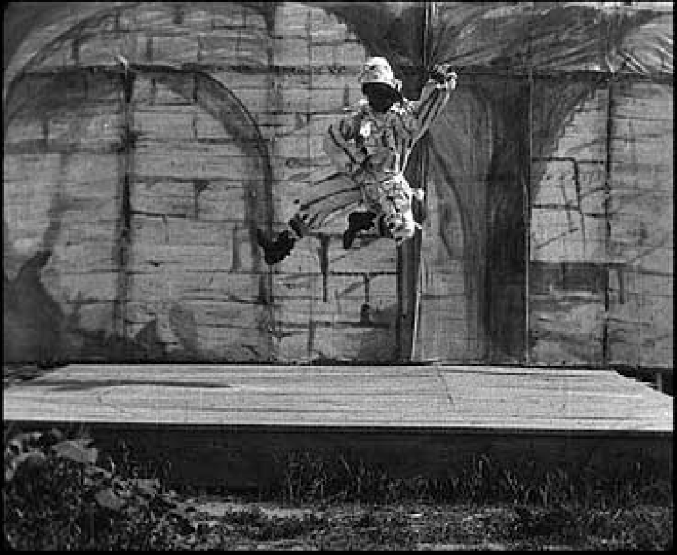
12. Anarchy in the UK… Nasty Women: A Comic Tribute, BFI
with Meg Morley
There was a guy, I’m not sure if you remember him, who once
referred to his presidential rival as a “nasty woman” long ago in The Time
Before. In response film historians Maggie Hennefeld and Laura Horak ran a
programme of comedy shorts at the 2017 Le Giornate del Cinema Muto featuring
women behaving nastily for comic effect. As there is plenty more where that
came from the BFI decided on a re-run with a new-old favourites thrown in.
Thus, we had Florence Turner’s incredibly flexible fizzog in
Daisy Doodad’s Dial (1914), Alma Taylor and Chrissie White giving plenty
of cheek in Tilly’s Party (1912) and Texas Guinan our riding and out
gunning the men in The Night Rider (1920). There was also the enigmatic
gallic anarchy of the legendary Léontine, also known as “Titine” in France and
Betty” in the United States, about whom almost nothing is known. Three films Léontine
s’envole (1911), Léontine enfant terrible (1911) and Léontine
garde la maison (1912) showed her daredevil comic flair and it is to be hoped
that her story emerges in more detail. What a talent she was.
Meg Morley accompanied with thematic variety and satisfying
melodic invention. No two scores were the same and she kept pace with the
on-screen anarchy with the acuity of a seasoned jazz player, one used to
working as part of an improvisational team, this time with her bandmates on
screen.
A splendid afternoon on the Southbank and we drank a toast
to the nasty but nice trailblazers who are being remembered anew.
So much more to discover in 2022… I hope to see you all
then!




+colour.png)


%2Bdress.jpg)


+hill+trip.jpg)




