Showing posts with label Tom Conti. Show all posts

Monday, 21 April 2025

The dark side of Tom Conti… Eclipse (1977), BFI Flipside #51 Blu-ray, out now!


In his commentary, BFI Flipside supremo Vic Pratt recalls interviewing Tom Conti for another recent release, Heavenly Pursuits (1986) in which he mentioned that Eclipse was one of the few of his films he didn’t have a copy of. Vic dutifully sought it out to make Tom a screener and discovered this disturbing and atmospheric thriller was ideal for the quirky, strange charms of the Flipside range.


IMDB describes Simon Perry’s film as a “… story of the possession of one man - his mind, heart and soul - by his twin brother”, but it’s rather more than that and possibly less. For all those in search of a neat Columbo-style ending to this emotional mystery they’d better look elsewhere as Eclipse is as full of shadowy meaning as a Mark Rothko picture painted with all the lights off and wearing sunglasses. It’s based on a novel by Nicholas Wollaston and by all accounts with less specificity.


Tom Conti is the most unreliable of narrators playing twin brothers Tom (oh yeah?) and Graham who is found dead on the beach at the start of the film with a nasty gash on his head and a moustache to match on his fore lip. Having recently seen him as the soulless advertising executive trying to manipulate the band Slade in Flame, you’re reminded of his deceptive skill in portraying empty vessels and, even when he’s emotionally wrought you’re unsure in this film what is driving him.


Tom was the only other person on the boat with his twin and throughout the film’s numerous flashbacks to the incident you’re never sure whether this is his own faulted memory or a gradual unrolling of the truth. In stormy seas out to view a total eclipse, the brothers lose control of their vessel and Graham falls into the water either struck by the boom or by something else… the flashes we see may be Tom’s imaginings or his recovering memory.


At the inquest Tom is equally hard to read with Conti playing with just a hint of guilt even as he tells the most plausible of tales. It’s death by misadventure and of a man referred to as The Big G by Tom’s sister-in-law and her son. Graham’s widow Cleo is played by Gay Hamilton who Conti had recommended for the role and who is every inch his equal in portraying her own range of barely decipherable emotions. Cleo had her darker views of G and the painting Tom finds on visiting her for Christmas shows him slighter of stature and naked on a beach. Tom cannot stand the image and asks for it to be removed.


There are clearly strong undercurrents running between Cleo and Tom, not just their mixed feelings about G but for each other too; a path well-trodden and now with new possibilities. Tom is also welcomed as the most familiar of uncles by young Giles (Gavin Wallace) who treats him almost like a father. But, as they play trains on Christmas day, Giles runs them backwards upsetting Tom by not playing to his rules and echoing Big G’s more dominant position.


The Christmas is tense as the discourse between Cleo and Tom unwinds with the former having developed a taste for gin since the accident – maybe before – and the latter still unable to recall the events of the fateful journey. Both are grieving and yet both have reason to resent Big G’s dominance in their lives. Tom, twenty minutes younger, has been overshadowed by Graham and the two would conduct conversations by completing each other’s sentences. Graham wasn’t just dominant he was the driver of so much of his brother’s choices, driving him to extremes in order to stake a claim to his identity.


Is this reason enough to kill or just to be ambiguous about his brother, and for Cleo, is she too now liberated in terms of her feelings for Tom and her choices.


It’s a broody and unsettling tale and one that offers no easy answers or resolution, you are wrongfooted throughout and the skill of the actors keeps you guessing. Vic mentioned thematic similarities to Mark Jenkin’s Enys Men (2022) and there are similarities in a narrative that shows and certainly doesn’t always tell as well as the brutal psycho-geography of the coastal location. At one point Cleo jumps into the stormy sea as if communing with the unrelenting power that took her husband and then there’s almost a re-run of the fateful voyage when Tom takes Giles out on a small sailing boat.


It’s fascinating and well worth inclusion in the Flipside alternative canon of British and Irish oddities and should have beens!


The special features below clinch the deal… especially the three classic public information adverts that amused and frightened my generation of children. Be very careful near deep waters… stay in your depth.


  • Newly remastered in 2K and presented in High Definition
  • Audio commentary by Vic Pratt, co-founder of BFI Flipside
  • Sun & Moon – Tom Conti Discusses Eclipse (2025, 10 mins): the actor on his experience of making the film
  • Relative Strangers: two stylish short films, The Chalk Mark (1989, 24 mins) and Marooned (1994, 20 mins), that echo the disjointed relationships central to Eclipse
  • Not Waving, Drowning: Joe and Petunia: Coastguard (1968, 2 mins); Charley Says: Falling in the Water (1973, 1 min); Lonely Water (1973, 2 mins): three haunting water-safety Public Information Films eerily adjacent to the psycho-geographic headspace of the main feature
  • 2025 trailer
  • Image gallery


The first pressing only includes an illustrated booklet with new writing on the film by Vic Pratt, an archival interview with director Simon Perry, an original review, an essay on the film’s locations by Douglas Weir and writing on The Chalk Mark and Marooned by the BFI’s William Fowler.


You can order direct from the BFI from their online shop. Another winner and a missing piece for Mr Conti’s shelves as well as those of us who appreciate under-appreciated British film!

Sunday, 20 April 2025

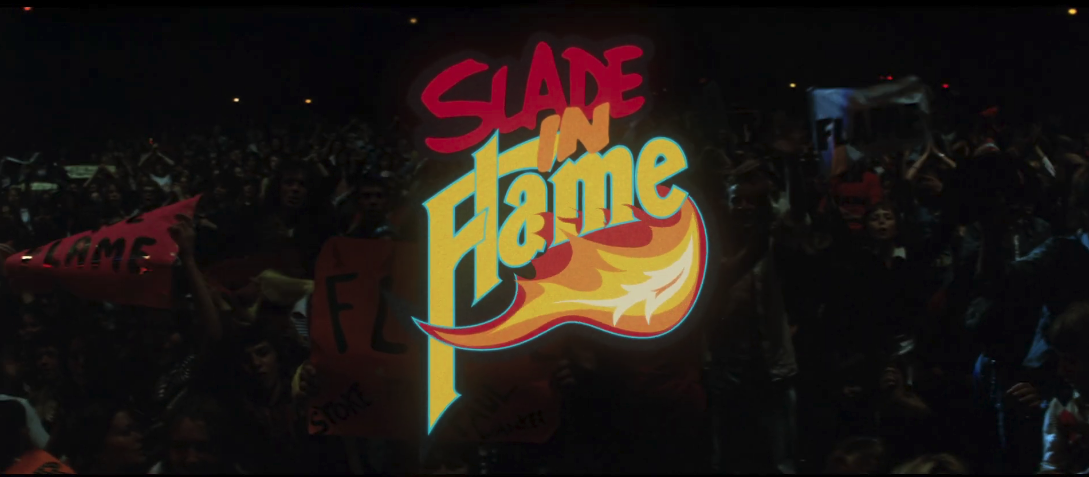
C’mon see the noise! Slade in Flame (1975), BFI restoration screenings and Blu-ray


The early seventies… they say if you can remember them you weren’t really there… oh, hang on, that’s the sixties. I may have been only ten but I was definitely there for the explosion of grimy glam rock that blew our junior-school minds after years of well-behaved formulaic bubble gum from The Osmonds, Dawn, The New Seekers and even my once beloved Middle of the Road. Glam was a turn in the road, a call to revolt and it touched our unruly instincts as we felt a connection to the sheer naughtiness and noise of Slade, Sweet and T-Rex starting in 1971 and for the next three years and beyond. We no longer cared where our mother had gone, we just wanted to get down and get with it… even if it was only in the Friday lunchtime school disco!


Slade were the greatest exponents of Glam but with a gritty edge that under-lined all of the best acts: these guys may have worn make up and glitter but they were in the main hard as nails: call Steve Priest an artiste and he’d probably give you a bunch of fives in the parlance of the time. Slade were, at one point, a “skinhead act” and, much like Oasis in the 90’s, they were working class lads who just loved The Beatles. Unlike the Gallaghers though, they brought their own songs filled with original melodies as well as fierce riffs.


They may not have known it but Slade had peaked by the time they filmed Slade in Flame and were in search of the new challenge it bought, or at least their manager Chas Chandler (ex-Animal and Jimi Hendrix’s manager) was. Several daft ideas were mooted – The Quite-a-mess Experiment being quickly dismissed not least because Dave Hill would have been despatched in scene two… In the end the band followed the Hard Day’s Night route but, rather than just mimic the actuality of the band’s existence the team devised a harder-edged drama that was loosely- based on their career and, crucially, their characters but one that was also drawn to the cynical end of the pop machine. This wasn’t Slade’s biography but it was an amalgam – amal-glam! – of theirs and many other bands experience in the dingy, cut throat, beer-stained, bingo halls and working-mens’ clubs of provincial Britain.


Noddy Holder in the Seventies

Released in 1974 - it is pure 1974 - the last time Slade would produce material of the quality of Far, Far Away and the sublime How Does it Feel. The result may have confused audiences and critics at the time (Barry Norman apart – he loved it) but now is amongst the best-regarded of its genre: the "Citizen Kane of rock musicals" as Mark Kermode calls it. As if The Monkees had been from Wolverhampton and decided to film Head not just in Sheffield but also using Alan Lake as technical advisor and not Jack Nicholson… it would have looked something like this.


Flame is raw-edged and not just because of the four main leads. The scripting from Andrew Birkin, matched their personalities to their on-screen personas to make it easy for Jim, Noddy, Dave and Don to perform as naturally as possible and was informed by the group taking both Birkin and director Richard Loncraine on tour with them to the US: the pair lasted a couple of weeks before retiring exhausted.


The story takes place in a netherworld of the North being filmed in Sheffield, Nottingham as well as London and Brighton. This may have been Loncraine’s first film but that doesn’t stop him opening the film with a single take shot from the bathroom down the stairs and into the garden at a wedding party that Robert Altman would have been proud of. At the end of the sequence, we find the disturbing sight of Jack Daniels (Alan Lake) and his Elvis Presley-stylings fronting a band with a bored bass player Paul (Jim Lea) and a cheeky guitarist Barry (Dave Hill) who sparks off a riot after lifting a girl’s skirt with his foot.


Alan Lake: none more rock or roll...

Alan Lake is superb throughout with a manic energy tempered by genuine acting skill, here in this opening scrap he doesn’t look out of place at all as you’d expect from a man who’d just finished a prison sentence for GBH. Lake has that authenticity from a period when the barriers between criminality and performance was blurred perhaps more than now. Unlike Mr Statham I doubt he needed inordinate amounts of takes to get through his lines too!


The band is eking out a living on the club scene and following the wedding fracas has to replace their drummer. Don Powell plays Charlie a metal worker – one of a number of Wolves let lose in South Yorkshire – and he easily gets the gig after rocking up with a full drum kit. The band is “managed” by local bingo-magnet Ron Harding (Johnny Shannon, a man with genuine “connections” who had played the hard man music agent before in Performance) who isn’t that convinced by Daniels’ band but has him on a lock-tight 10% all the same.


The band is in competition with another band, The Undertakers, who dress up in Halloween gear whilst their leather-lunged singer Stoker (Noddy Holder) performs from within a coffin. Barry slyly adds a padlock and Stoker gets trapped. Out for revenge the Undertakers chase after the boys and Barry’s girlfriend (Sara Clee – who does a splendid job as the long-suffering, gum-chewing, feather-cut Angie – absolutely the kind of girl I had a crush on in 1974!).


The band on manoeuvers

The band’s car crashes and after being pulled out by the Undertakers they’re all thrown in clink for the night. So it is that ace singer and lyricist Stoker pals up with ace tunesmith Paul and a new band is formed out of adversity… The new band has something more and after one gig are spotted by everyone – not least Ron, but also a detached businessman Tony Devlin (Kenneth Colley) who follows up his interest by posting a note through Paul’s gran’s letter box. Tony is employed by a wealthy advertising executive, Robert Seymour (the studiously laconic Tom Conti in only his second film although already well established on stage) who sees a market ripe for exploitation and believes that this is a band he can monetize.


The boys are made an offer they can’t refuse and gratefully swap Ron for the Home Counties’ comforts of Robert who has plans… A single is cut and the band begins the carefully orchestrated PR circuit beginning with Radio City a pirate radio station based on one of the abandoned sea fortresses in the Thames Estuary. This sequence is well filmed and the sight of the boys gingerly climbing the rusted metal steps of the fort is not entirely the results of acting – Dave Hill in particular was terrified of heights and had to be supported on his way up by Loncraine.


Once in the studio the boys are interviewed by one Ricky Storm (Tommy Vance) before gunfire is heard and the station is attacked by unknown assailants… Apparently this had happened during the pirate wars but, on this occasion at least, it looks like cynical PR from Robert. Naturally it works, and the band goes from strength to strength in spite of cracks already appearing between the moody perfectionist Paul and garrulous improviser Stocker… none of this too far from the truth.


Tom Conti muses...

There are wonderfully-observed moments of discomfort between the band and their social betters – not least Robert’s family and "friends". Then there’s a touching exchange between Charlie and his old boss Harold (Patrick Connor) by a canal in which the latter used to fish and swim but which is now a polluted mess. This sequence is all the more remarkable when you consider that Don Powell was still suffering short-term memory loss after a crash a year before. He had to learn his lines immediately before the scene yet plays a blinder.


He invites Harry to a party with his record company friends and yet Robert dismisses him with contempt… Another guest at the party gets taken a little more seriously, it’s Ron here to claim his winning ticket by informing Robert that he’s still the group’s agent. Then Robert meets Jack who is still in search of his opportunity calculating the odds very quickly Robert works out how he and Jack can quickly help each other…


Now things get messy as the band go from big to huge and a battle begins over the rights to their earnings, control of their creativity… it’s a familiar story and one not too far from the truth for many bands over the course of the rock and this roll, if perhaps not Slade. It also includes one of Holder and Lea’s very best songs in How Does it Feel which somehow manages to encapsulate a hopeful vulnerability with a defiant anthem pretty much as John and Paul did. Noel was taking notes.


Sarah Clee and Dave Hill... 

There may be occassions when the dialogue is muffled or when events rush along just a bit too quickly but Flame is still a triumph. All four members of the band perform well which not only shows the value of writing their parts so closely to their own characters but also their native ability to be authentic – the very foundation of Slade’s appeal. Unlike some they actually meant it, man… And from the young boy from the second year at Deyes High School, it takes me back to an era I only experienced as a child but I certainly felt the noise.


Slade in Flame is back in cinemas on 2 May 2025 and released on BFI Blu-ray/DVD on 19 May 2025. Details of tickets are on the BFI website and you can pre-order the home media on the BFI Shop.


There’s also a new trailer highlighting the lovely restoration on the BFI site too!


Parts of this review previously appeared on my other site: DustyVideoBox...

Friday, 5 July 2024

Special measures… Heavenly Pursuits (1986), BFI Blu-ray


‘In those days,’ Tom Shields noted in Gormley’s obituary in The Guardian, ‘the Scottish film industry could fit into the snug of the Halt bar in Glasgow’s Woodlands Road and, indeed, was often to be found there.’*


Even for those of us not old enough to go to the flickers at the time, it will be all too easy to appreciate the hand-to-mouth nature of British Cinema in the eighties, some good, Channel Four for instance, much bad, with so many bright younger filmmakers not being able to sustain a career for which most roads still led to Hollywood and unforgiving metrics. This film was Charles Gormley’s second after Living Apart Together (1982) which featured the multi-talented BA Robertson (who provides this film's score) and some young fella, a part-time musician called Peter Capaldi.


So much Scottish talent at this time, as always, and in it’s own way Heavenly Pursuits, gives some the chance to shine, including young Ewen Bremner as Stevie Deans a pupil with special needs who appears unreachable by normal teaching methods and cameos from stalwarts such as Ron Donachie and Jake D'Arcy in a pub no less… There’s also much local charm in the humour even among the classroom kids, non-professionals including Bremner, picked for looks and their ability to react in just the right way.


In the seventies, Gormley had co-founded the Glasgow production company Tree Fims in partnership with another aspirant filmmaker, Bill Forsyth and this film carries something of the latter’s charm, partly local but also in the form of the indomitably affable Tom Conti who breezes through this story with all the mumbling bemusement and deceptively naturalistic ease you’d expect. He plays Vic Mathews a disaffected but determined teacher convinced that his school could be better run, he can’t really change it but that he will and must help those children who are falling behind the majority of neuro-typical pupils.


Even in the 80s, Special Needs was only just being understood and legislated for, with inclusion a key part of the strategies. Stevie Deans is in danger of being sent to a “special school” which – in Vic’s mind, will mark him for life. Vic teachers the Remedial Class, which we had in my comprehensive and from which half the members of legendary Scouse band Echo and the Bunnymen were members – I can recommend guitarist Will Sergeant’s two volume biography, not so much remedial as exceptional! I know little of the Scottish educational system at the time but ten years later in England, SEN were rather more supportive outside of mainstream schools although this is less the case in the 2020s. You have to get lucky, you need something close to a miracle…


Talking of which… the school is Catholic and is searching for two more miracles that would promote the late Edith Semple from Blessed to sainthood. The story begins with the school’s pastor, Father Cobb (Brian Pettifer, simply in everything in those days) on a trip to the Vatican only to have the proposed miracles not being quite miraculous enough. Never the less, Father Cobb keeps praying for more and especially that pupil little Alice McKenzie may be able to walk again.


Vic, like his friend and science teacher colleague Jeff Jeffries (David Hayman), don’t believe in the miracles promised for simpler minds but strange things begin to happen firstly when Vic’s record player plays without its socket been plugged in or switched on and then, more importantly he finally get Stevie to connect to maths through the use of betting odds and returns. There’s further evidence when talking about the hardest languages the young man pipes up with the names of motorcycle companies which Vic quickly recognises is a game of two-wheeled Top Trumps. Has he found the key or is this another of the miracles the school seeks?


Things start to affect Vic personally as he is diagnosed with terminal brain cancer but only finds out after falling three-four storeys trying to rescue a pupil on a roof only to emerge unscathed and with no sign of the fatal shadow on his x-ray. By this point he has begun a relationship with a new music teacher Ruth Chancellor (Helen Mirren) who is a practicing Catholic but, like him unsure of miracles. Mirren and Conti are generational talents and their relationship is worth the price of admission on its own.


Then Alice McKenzie starts to walk and miracle mania starts to run as things reach fever pitch… The oddest thing, as Kemp notes, is that those you’d think would want to take credit for miracles seem to be the keenest to suppress them, from the Vatican, the Bishop and even the Hospital where Vic’s miracle is observed…


In The Washington Post, Rita Kempley praised the film as a ‘sweet-natured and idiosyncratic work, written and directed by former [Bill] Forsyth associate Charles Gormley. His style is derivative but his scriptwriting is inspired ... There’s always room for doubt in this delightfully quirky screenplay, with its grumbling atheists and gosh-almighty faithful.’


There is indeed always room for doubt but in the end the miracle is that we keep on keeping on and trying all the same, making miracles happen as best we can and not waiting for them to save us.


Special features


  • Illustrated booklet with a new essay on the film by Philip Kemp, biographies of Tom Conti and Helen Mirren by Ellen Cheshire, notes on the special features and credits. First pressing only!
  • Presented in High Definition
  • A Magic Touch (2024, 20 mins): Tom Conti looks back upon the making of Heavenly Pursuits in this interview recorded especially for this release
  • The Mirocle (1976, 13 mins): a man attempts to escape from his own ego, but to no avail – until a mysterious mirror appears, inviting him to look within himself. Stylish animation influenced by the work of Paul Klee
  • The Science of Miracles (1897-1943, 18 mins): feast your eyes on some startling scientific marvels – and wonder upon the peculiar power of X-ray photography – as you examine these rare films from the vaults of the BFI National Archive
  • Original trailer


Heavenly Pursuits is out now and can be ordered direct from the BFI online or in person on the Southbank: divinely charming!


*Quoted by Philip Kemp in his booklet essay.


Monday, 17 April 2023

Hybrid horror… Full Circle: The Haunting of Julia (1978), BFI Flipside No. 46, Dual Format (4K Ultra HD & Blu-ray)


For every action there is an equal and opposite reaction. Isaac Newton's third law of motion


Richard Loncraine is as responsible as anyone else for the widespread deployment of Newton’s Cradles in offices, having spotted the opportunity to manufacture these kinetic art toys for a UK market deprived of their intellectual ambience. In the late sixties, he was specialising in sculpture and designed a chrome model for the Carnaby Street store Gear which was clearly fab. Studying at Central St Martins, he opted for the film studies course and soon was directing at the BBC with an Alan Wicker documentary followed by work for Tomorrow’s World and he then moved onto fiction and from there to film.


His subsequent achievements include his first film, Slade in Flame (1975), an award-winning Richard III (1995) with Ian McKellen and Robert Downey Jnr and his Emmy Award winning work on Band of Brothers. Then we have this film, Full Circle: The Haunting of Julia which sank with little trace at the time of release and which has previously only enjoyed a short afterlife on VHS. Not everyone forgot it though and one man, writer and cinema historian Simon Fitzjohn, has campaigned for Full Circle for many years and has helped put this splendid BFI Flipside release together so that we can all see what should not have been forgotten.


What we have is a very interesting film, which is part horror/part psychological thriller, and which illustrates the Newtonian principle above with a story focused on the human reaction to the massive force of tragedy and dark deeds. Loncraine sees flaws but still thinks overall it’s a good end product, praising his cast and crew with the enthusiasm of experience, and confessed that both he and his star, Mia Farrow, both felt they were working on a psychodrama whilst the producers definitely wanted another horror in the vein of The Exorcist and, more specifically, Rosemary’s Baby.


This looks to have had an impact on the film’s enticing narrative ambivalence, horrific things do happen but they are never lingered on, the plot gathering an eerie momentum and the camera focused on Mia who excels at the catatonically unsettling, underscoring dialogue and action with an uncanny intensity that bubbles just under the surface to devastating effect. In his interview for this set, Loncraine explains how at one critical moment – as Farrow’s character attempts a tracheotomy to save her choking child – his producer decided to throw fake blood over Farrow’s hands which convinced her that she had hurt the young actress (Sophie Ward no less) – she screamed and ran away for hours. The film doesn’t need such cheap shots, all you need is shown on Mia’s face and features that reflect her mother, Maureen O’Sullivan’s delicate beauty.


Mia Farrow plays Julia Lofting, a young mother with a large trust fund, married to city financier Magnus (Keir Dullea) who, as the film opens, are sharing the odd snipe as they prepare for the day with their daughter Kate (Ward). Suddenly Kate starts choking on an apple and the couple fly into a panic quickly reaching the point at which cutting her throat open might be the only way to save her. It’s a very difficult scene to watch, far more horrifying than any supernatural event a graphic depiction of everyday nightmare.


Some months later, her daughter dead, we find Julia in hospital recovering from the event but when Magnus arrives, she leaves and, soon makes it clear that she no longer wants him or their marriage which had been failing long before the accident. She impulsively buys a large townhouse in Holland Park, number 3 Holland Park as Simon Fitzjohn informs us in one of the extras, and now worth multiple millions. All of her wealth can’t protect Julia from the guilt and the nagging horror she still feels and she begins to sense things in her new home, a radiator that won’t stay turned off, atmospheres in certain rooms and the feeling of another presence.


Out walking she glimpses a girl who looks like Kate only for the vision to disappear, she watches children playing in the park, and sees Kate again only to discover a dismembered pet tortoise… Is this all in Kate’s mind or is this a genuine haunting? Either way her friend Mark (Tom Conti, who was also in Slade in Flame fact fans!) won’t believe it and provides the common-sense rationality and good humour that offsets our expectations. Meanwhile Magnus is determined to bully his wife into submission, an all too real threat to her wellbeing not that she needs anything more than the looming dread of a house she is strangely committed to staying at.


Convinced that there’s something otherworldly about the house, Julia brings expert help in the form of Rosa Flood (the excellent Anna Wing) who hosts a séance with the help of some fellow sensitives. Mark jokes and keeps our expectations light until Mrs Flood is suddenly overcome with a malevolent spirit and has to leave in terror. Julia is convinced that the spirit is that of her daughter but revisiting Rosa, she learns it was a young boy she saw being murdered in the park by children during the war.


Julia begins to investigate the story and tracks down the story in the British Library and from there finds the dead boy’s mother who reveals the full horror of his death leading her to seek out the last surviving members of the group who were involved in his murder. We’ve come a long way from a story of grief and into a whole other haunting but is any of this real or has Julia just not recovered her sanity?


The films manages to saddle both possibilities pretty well… and we’re going to have to figure this one out for ourselves. I can well understand the fascination this continues to exert on Simon and I’m sure there will now be many more after this release.


There’s an uncanny score from Colin Towns which was instrumental in persuading Mia Farrow to undertake the project with the exquisite main theme conveying just the air of sad confusion that helps this film transcend any limitations of the “horror” genre. Mr Towns is well-travelled composer and musician who I once saw playing keyboards with his pal Ian Gillan in 1982, they played Child in Time which is close yet so far away from the mood he sets in this film. There’s a lot of lovely piano lines as well as synthesised moments that could only be from this era yet are always used to good effect. Not surprisingly he now has some 139 composing credits on IMDB and counting.


The special features as particularly fine on this release:


4K (2160p) UHD Blu-ray presentation in Dolby Vision (HDR10 compatible) or High-Definition Blu-ray (1080p) presentation

Audio commentary by director Richard Loncraine and film historian Simon Fitzjohn 

A Holland Park Haunting (2023, 24 mins): director Richard Loncraine reflects upon his artistic career and the making of Full Circle 

Park Life (2023, 16 mins): Simon Fitzjohn revisits the film’s London locations. 

What’s That Noise? (2023, 25 mins): soundtrack composer Colin Towns on one of his earliest film works. 

Coming Full Circle (2023, 11 mins): Tom Conti recalls his time on the film. 

The Fear of Growing Up (2023, 10 mins): Samantha Gates looks back on the production.

Joining the Circle (2023, 7 mins): producer Hugh Harlow recalls making the film

A Haunting Retrospective (2023, 25 mins): film critic Kim Newman revisits Full Circle

Images of a Haunting (2023, 13 mins): Full Circle aficionado Simon Fitzjohn talks us through his extensive collection of memorabilia. 

Rare stills and transparencies from the BFI National Archive’s collections 

First pressing only - illustrated booklet with a new Director’s Statement, an essay by film historian Simon Fitzjohn, a biography of Richard Loncraine by Dr Josephine Bottting, credits and notes on the special features


Full Circle is available on BFI 4K UHD and Blu-ray dual format, as well as iTunes and Amazon Prime from 24 April 2023, you can and should order the physical product direct from the BFI online shop.


It’s another lovely release from the BFI Flipside series, collect the set and be assured of happiness but not without some emotional after effects.