Showing posts with label Henry Stuart. Show all posts

Saturday, 27 February 2021

Murder outside the cathedral… Der Bettler vom Kölner Dom (1927), Edition Filmmuseum DVD


It wasn’t just St Pauls that somehow managed to resist the bombing of World War Two, Cologne Cathedral also remained standing despite of the damage wrought by fourteen direct hits from allied bombs and the largely destroyed city beneath its distinctive twin spires. It’s hard to watch this film without thinking of the devastation to come and the changes that would be painfully made across the city; it’s a travelogue of a world about to be destroyed in the most brutal of ways.


Rolf Randolf’s film makes much of the locations around the cathedral although most of the action takes place inside city hotels and bars no doubt recreated on sets. The ancient building is the crux of the plot though as befits a structure that took some 600 years to complete; begun in 1248, work was halted in 1560 and not restarted until the 1840s, finally completed to original Medieval plan in 1880 with all potential litigants for project management failures long since passed.


Based on Emanuel Alfieri’s play, this detective adventure has more of the feel of a French serial than a Weimar film with fantastical disguises, secret codes, cold-blooded killing and underground crime organisations all with a mix of comical and dramatic detection. More Fantômas than Dr. Mabuse, Der Bettler vom Kölner Dom (The Beggar from Cologne Cathedral) is a fun adventure with many an offbeat as well as the odd jarring moment throughout a slightly uneven story.


600 years behind schedule... but enduring.

It’s a battle of wits between a gang organised by an unnamed man played by Carl de Vogt who co-ordinates his operations standing on the cathedral steps disguised as the beggar, and the great detective, Tom Wilkens played by Henry Stuart. Wilkens is called in to help stop the gang and the game of cat and mouse begins. Disguising himself as the Beggar – following the death of another officer who had done the same – he is rewarded with a message from the gang, in code, which simply welcomes him! The game is afoot… and who is clever enough to survive?


Meanwhile, another member of the gang, styling himself as Marquis de Puissac (Robert Scholz), welcomes a young American woman, Mabel Strong (Elza Temary) who he has written to, persuading her that she is his niece: she is either wealthy or just young…  Then, another member of the gang, the vampish Madame Madeleine Tréville (Hanni Weisse) reads of an Indian prince coming to town from Bombay with certain materials of great worth in his suitcase… no one can accuse this gang of not working hard on many fronts. But they are being matched by Wilkens who is, of course, the moneyed Maharaja!


Henry Stuart

Wilkens, and his sub-continental disguise, duly arrives just as the city is celebrating the eve of Lent and the streets are already full of merry making as he makes his way to the hotel across form the cathedral. Here he is greeted by two odd private detectives, Napoleon Bonaparte Schmitz (Carl Geppert) and Carolus Caesar Müller (Hermann Blaß) who we are sure, will find those names difficult to live up to.


All comes together in the big party in the hotel that evening as the maharaja is very taken with Mabel just as Madeleine tries to impress; they dine with the Marquis making Mabel the only person she says she is, so far as we know at this stage… Napoleon and Caesar are knocked out with drugged drink proffered by gang member and part-time chauffeur Steffens (Fritz Kampers) and, of course, the Indian riches are stolen only for Wilkens/Maharaja to reveal that there’s a trigger device which will explode if anyone tries to open the box. Panicked Madeleine makes her excuse and heads off to warn the gang… giving herself away to the eagle-eyed sleuth.


Elza Temary and Robert Scholz


As the gang tries to work out how to open the box and keep their heads, Madeleine and the Marquis’ evil plan for Mabel is revealed as their forged life insurance papers are to be used to reap rich reward when she is to be killed en route to Paris leaving an ‘andsome inheritance for her “uncle” … and the rest of the gang.


But there’s still time for plenty of twists and turns, betrayals, ill-advised notes, hopes and new alliances as the story meanders wistfully towards its rather odd ending and one of the most unusual chase scenes you’ll see as well as vehicular gadgetry that would leave Q scratching his head.


As Wilkens says to the baddies in a taunting and, surprisingly not anachronistic note: Ohne fleiss kein preis… (No pain, no gain…) and in truth there’s a lot of the latter and only a smidgen of the former in the pacing of the tale.


Hanni Weisse

Willy Hameister’s cinematography captures the city very well especially when he sets up on one of the cars, whilst the performers give it their best shot with Stuart excelling as the man who knows far too much and de Vogt brooding with a sadistic menace.


The digitally restored version on the Edition Filmmuseum two DVD set looks smashing and comes with two alternative soundtracks: a new orchestral score by Pierre Oser, produced and performed by the WDR-Rundfunkorchester, and a live improvisation by the great Günter A. Buchwald (piano and violin, played sometimes at the same time) recorded at the International Bonn Silent Film Festival 2010. There is a 16-page trilingual booklet as well as plentiful shorts, commercials, and newsreel reports about Cologne from the silent era with Stephen Horne mostly providing accompaniment.


You can order direct from the Filmmuseum and, whilst Brexit has made delivery slightly more expensive, it’s still well worth supporting the service and the remarkable films they make available.


Tuesday, 2 July 2019

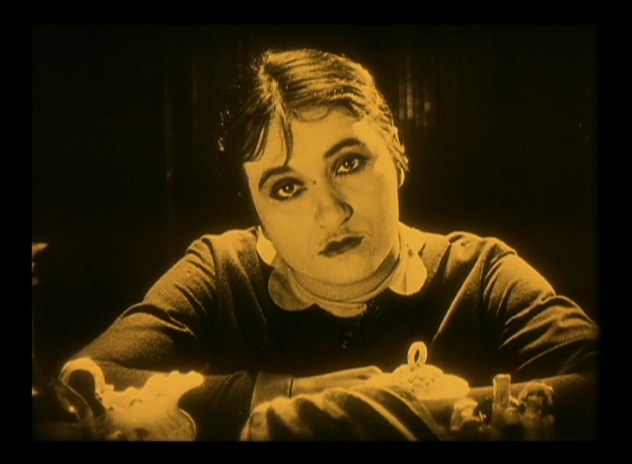
Misery loves objectivity... The Joyless Street (1925) with John Sweeney, BFI Weimar Cinema Season


This was the first time I’d seen Die freudlose Gasse on the big screen and, after my last viewing of the EditionFilmMuseum DVD, I’d connected it very strongly with the austerity programmes of the former Tory-led coalition under the joyless headline “plus ca change”. Well, French was never my strong suit but over the last five years, things have just got so much better haven’t they?

Anyway, back to 1925 and post-war depression in greater “Germany”, specifically Austria and a film that having once been ten reels long is now in an ongoing state of restoration. Even now it feels like a Diagon Alley version of the Melchior Street it’s supposed to be with understandable narrative disruption caused by using five different sources and retrospective sequencing. That said, it’s never made more sense to me than tonight, sat in the front row after a week in Bologna and yet with John Sweeney holding the story with the thematic continuity of his 151 minutes of improvisation. There’s such variety in Mr Sweeney’s playing and none of tonight sounded like what he played for Sir Arne’s Treasure or Les Vampires just a few days ago in Bologna.

Where the sun never shines... the locals queue in Melchior Street
Pabst’s film is based on Hugo Bettauer's novel and takes what is essentially a crime story and develops its socio-political aspects. Screenwriter Willy Haas described the source book as "a miserable crime novel" and said that what appealed to his director was "... the harsh social portrayal of inflation, the bankruptcy of the old-established patrician circles...the corruption, the moral decay..." The Joyless Street therefore focused on the "social" and a realistic portrayal of poverty and the consequences of mean-spirited capitalism and the greed that drove western-European economies.

Pabst cast a combination of one of the creators of cinematic acting and a relative newcomer who’d only made one feature film. Asta Nielsen was cast as Maria Lechner the daughter of a disabled father who lives in near poverty and then becomes entangled in the lives of the financiers running and ruining the economy for profit. Then into her forties, even Asta was a stretch for the part of an innocent younger woman but her skill carries her through some memorable and powerful scenes even when the lighting and unforgiving close-ups can't.

Asta Neilsen, Hertha von Walther and Greta Gustafsson soon to be Garbo
Standing next to her in the forlorn queue for the butchers is Grete Rumfort, played, of course, by one Greta Gustafsson, fresh from Gosta Berling and not quite 20 years of age. This was the film that clinched her ticket to Hollywood and it's not hard to see why Mr Goldwyn was so impressed. She's superbly photographed by Pabst and you can see the beginnings of the force of nature that would captivate millions, she’s sublimely eye-catching if markedly less centred than she will become, jumpy even.

Legend has it that Pabst used slow motion to help counteract the impression created by the young actress's nerves and this combination served to create an impression of graceful edginess. Even if Stiller was on hand to help manage his protege, can it be a coincidence that Herr Pabst managed to enable defining performances of such power and beauty from both Garbo and Louise Brooks?

Greta.
The film features many strands and an ensemble of rich characters. Werner Krauss is monstrously greasy as Geiringer the Butcher who rules Melchior Street by restricting the supply of meat to only those he favours: the wealthy or those women prepared to pay in kind. He meets his match in the local brothel when offered Grete; he can’t cope with her at all and it’s a telling moment when the bully is flawed by beauty. 
  
Running that house of ill-repute is the other ruler of the Street, Mrs. Greifer who is played by the extraordinary Valeska Gert, a dancer and cabaret artist who brings a great knowing energy to the screen – even breaking the fourth wall on occasion, yelping in silence at the audience: more Poly Styrene or Ari Up than Gloria Swanson! Mrs. Greifer runs a fashion boutique which acts as the front for a relatively high-class brothel. Women of the street are drawn into Mrs. Greifer's, seemingly labyrinthine premises driven by hunger and desperate poverty to subvert dignity in the service of selfish and, as it turns out, hypocritical males.

Valeska Gert meant it!
Amidst so much economic disruption, greedy speculators act to make things worse by manipulating the stock market and the people of the street suffer whilst the bankers waltz around in opulent hotels and drink champagne in Greifer's salon.

Further up the social scale, the Rosenow family are untouchable, with Max (Karl Etlinger) leading the stock market scams. His daughter Regina (Agnes Esterhazy) loves his assistant Egon Stirner (Henry Stuart) and this is where it gets complicated. Whilst Egon’s love appears to be true… this doesn’t stop him from having designs on the Rosenow’s lawyer’s rather striking daughter Lia Leid (Tamara Geva) AND… he’s also in a somewhat serious relationship with Maria who writes him love letters and is convinced that they have a future together.

All of this makes Egon The Eager, pivotal to the entire story and makes him a disappointing man for a happy ending with Regina or anyone else. Regina tells him that he’s too poor for her – presumably Maria is too poor for him? – and that the only way he can have her is to "... become as rich as I am, or I as poor as you."

Maria's boyfriend Egon with other lovers, Lia and Regina... what's a boy to do?
This leads Egon into willing complicity with her father’s idea to make half a million by spreading the rumour of a strike at the Petrowitzer mine which will push the value of the stocks down and then, at their lowest, reassurances will be made that send the value skyrocketing; guaranteeing a killing for those in the know. This will include Don Alfonso Canez (Robert Garrison) who is in town to make just such a profit but not, of course, Grete’s father, Councillor Rumfort (Jaro Fürth). He decides to take voluntary redundancy and to bet it all on the stock market.

When the fix comes in, Rumfort loses everything having bet on Coal stocks remaining low and the family is forced into taking a lodger as Grete struggles to keep the money worries away from her broken father. A lodger is soon found in Lt. Davy (Einar Hanson) an American serviceman in Vienna to help with reconstruction, he hands Grete $60 and she has to use it to pay her father’s stock market loses…

Asta
The plot has all the hallmarks of a novel as source but the main thing for Pabst is to foreground the social injustice with the complexities of personal and social betrayal rather less important than the fact they happen. The direction of the women’s’ lives is driven by the need to provide and both Maria and Grete move nearer and nearer to the club Frau Greifer runs with the former becoming Don Carlos’ “girl” for rent which is how she ends up in the cheap hotel next door the night Lia Leid has gone there for an illicit rendezvous with Ergon…

There are some excellent sequences in the club as Grete comes closer to following the same path; she can’t quite bring herself especially after one of the club’s waiters, Kellner (Gregori Chmara) has a rush of blood and tries to force himself on her. This is when you can see Pabst’s use of slow-motion; whether it was used to make Garbo look “smoother” or to heighten the moment of fear, it is certainly effective.

Gregori Chmara chases Greta slowly...
Even this reconstructed version is missing some content but it makes sense overall and the emotional force of the story is clear as day. As the men go wild for Grete the people in the street outside decide that enough is enough and the film ends with a call to action and for solidarity in the crisis. Nearly a century later we are still grappling with the gap between rich and poor and struggling to recover from a banking crash that has led directly to Trump and to Brexit. Who knows what will happen next?

Stylistically Joyless Street is post-expressionist and part of the “New Objectivity” movement with its resigned cynicism balanced by a desire to seize the moment. Pabst was, according to biographer Lee Aywell, the first to take up this stance with his expressive style focused on the everyday and not fantasy. Melchior Street is accentuated reality of a very stylized kind; entirely studio-based and yet gritty as any exterior; the gutters may have been papier-mâché, but the grief was all too real.