“There is nothing connected with the staging of a motion picture that a woman cannot do as easily as a man, and there is no reason she cannot master every technicality of the art... “Alice Guy-Blaché in The Moving Picture World, July 11, 1914.
This was some undertaking, a collaboration between the Kennington Bioscope and the Women & Silent Screen Online Conference, that featured nine of serial ground-breaker Guy Blaché’s films as writer, director and producer for Solax Films. As noted by the Bioscope’s Michelle Facey, the French woman was the only woman owner of a film studio at the time and she remains the only woman to have occupied this position over a century later which is remarkable and depressing in equal measure.
Guy Blaché made her own way, from inventing narrative film making to helping establish the studio system that would eventually help displace her in mainstream history. According to The New York Dramatic Mirror, by 1912 she was drawing an annual income of between $50-60,000 – some salary in modern terms and allowing for inflation a measure of her success. Whilst few with an interest in silent film would not be aware of her work, she is now emerging more fully from the shadows, as she becomes the subject of more academic research, restoration and a widespread critical rebirth. Her inclusion on Kino and the BFI’s early women filmmakers’ anthologies, Pamela B. Green’s revelatory biography, Be Natural (2018) and a new ARTE French documentary, Alice Guy, Pioneer of the 7th Art, Forgotten by History from directors Nathalie Masduraud and Valérie Urrea, all contribute to this growth in awareness of her contribution and influence.
 |
| And still the only one... |
The stream was an online equivalent of “A Solax Night”, curated by Kim Tomadjoglou from the Library of Congress who had a number of films on show along with the BFI, Eye Filmmuseum, George Eastman Museum and Lobster Films. It was hosted by Michelle Facey, KBTV’s regular compere and featured introductions by Tomadjoglou; Allison Farrell and Tami Williams, University of Wisconsin–Milwaukee (who helped co-ordinate), and the LOC restoration team, Heather Linville (Lab Supervisor), Frank Wylie (Head Lab Timer), Lynanne Schweighofer (Preservation Specialist), and George Willeman (Nitrate Vault Leader) who talked about the dream job of restoring Alice’s films.
Their efforts were much appreciated as we were able to sense for ourselves the ability and appeal of Guy Blaché’s American films, after she and husband Herbert, used Gaumont’s empty studios in Fort Lee, New Jersey, to start her own production company, Solax which produced films at an astonishing rate between 1911 and 1914 before the War and Edison’s trust, forced filmmakers to Hollywood. These films show us the cinematic skills of the director, enabling us to move beyond the “recovery narrative” and to see how well Guy Blaché made films and money in this most competitive world. We can see how she evolved as a filmmaker with more dynamic camerawork, more cuts and even split screens and how she made the most of the emotional capacity of her stock troop of players. Eat your heart out DWG!
All of this, of course, was enhanced by some of the finest musical accompaniment on the planet.
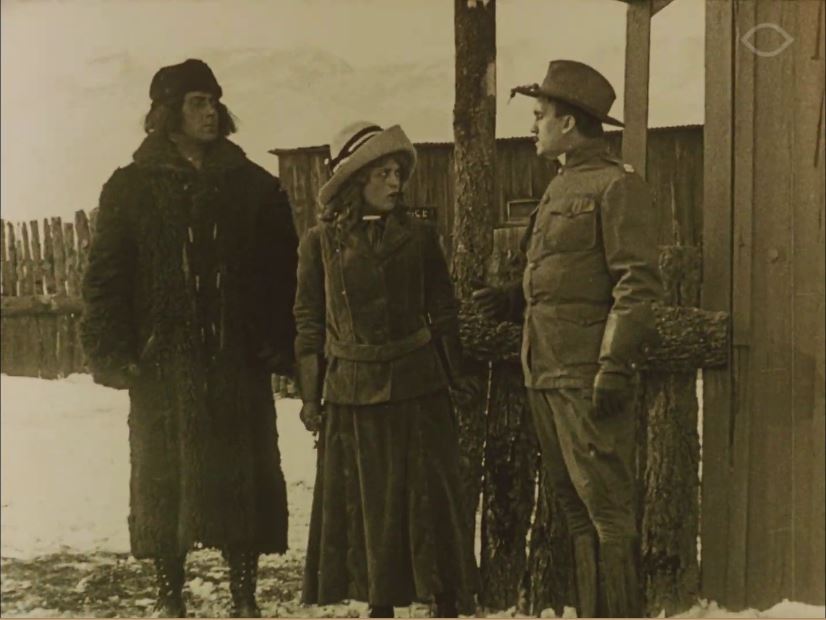 |
| Race relations on Love's Trail |
Frozen on Love’s Trail (1912) with Costas Fotopoulos
First up was a curious tale of “the devotion of a redskin” shot around Fort Lee, New Jersey – old “Hollywood” – which showed that loyalty and sacrifice were not only limited to white settlers out West. The story is set on a reservation in the “Klondike” where, Mary, a young woman, is kind to a mixed race native American courier who falls in love with her much to the distaste of her would be paramour Captain Black and others at the post. Needless to say, amongst some superb snowy locations, the courier proves he’s worth any number of Captains.
Guy Blaché’s concerns on race were also to inform A Fool and His Money (1912) which was probably the first narrative feature with an all-black cast, the white actors having refused to work with the black co-stars. She was from Paris, what did she know of old prejudice?
 |
| Vinnie Burns showing her total lack fear of fire... |
Two Little Rangers (1912) with Andrew Earle Simpson
This thriller has previously been shown at the KB live and shows Guy Blaché’s editing ability with multiple cuts enhancing the narrative urgency of what is a tough tale in which the two young women take on bandit Bill Gray. Vinnie Burns plays the older of the sisters and was the genuine article, trained as a stunt woman by Guy Blaché, and, according to Solax PR, known as “the girl who isn’t afraid of fire, water, air or beast!”
Vinnie draws her gun, races on horses, pulls the postmaster up a rock face and fashions a bow and arrow to set fire to Gray’s hideout and her little sister, a splendid Gladys Egan, gives as good as she gets out-drawing Gray and also taking man and the elements in her stride. These are the forerunners of not just serial action heroines but also women of agency that grow to populate cinema. Also proof that things did not start off with woman “the weaker vessel” having to be rescued every five minutes on screen. Post-modern, postmaster’s daughters!
 |
| Split screen telephone call in The Strike. Lois Weber was watching. |
The Strike (1912) with Lillian Henley
Guy Blaché’s stance on industrial relations next and an even-handed one it tries to be at a time when trade unionism was disturbing the balance of power in the advance capitalist economies… The director’s solution seems to be that boss and workers should understand each position more and that, as is the case, when disaster strikes all should work together. It’s fascinating to watch and to imagine the response of a 1912 audience to this over-heated melodrama which, whilst it focuses on the positivity of working together on the more important things, fails to address to underlying questions of fair pay and workers’ rights as you’d expect from a woman with a company to run. See Charlie for a more left leaning take perhaps, but there’s work to be done on the politics of silent film makers?
 |
| Poor man, rich man... |
A Man’s a Man (1912) with Andrew Earle Simpson
More social concerns are evident in this tale of gross inequality in which a poor Jewish man has his daughter killed by a hit and run rich man. It’s harrowing but also powerful in its own way as the chance for vengeance is passed over for delicately handled forgiveness with a closing scene to moisten the eye of the most cynical silent cineaste.
 |
| Something's coming... |
Starting Something (1911) with John Sweeney
From The Consequences of Feminism onwards, Guy Blaché was concerned with gender roles and often had her characters cross-dress to prove her underlying point of natural equality at a time when women did not even have the vote (except in New Zealand). Here Jones objects to the way his wife Bettie (Blanche Cornwall) dresses and takes revenge by wearing a dress… his wife’s Aunty is a suffragette and given to masculine attire and confusion reigns when Jones mistakes her for his wife, albeit with the aid of alcohol. To cure him of his addiction to the demon drink, Auntie suggests a course of “mental suggestion” to persuade Jones that his tipple is toxic and that he must keep dancing or die… I’ve really no idea what was in the water in the Solax script room but this is great fun and deserves a full viewing. Doug Fairbank’s Coke Ennyday would love this film!
The mind play also reflects contemporary fascination with hypnotism and psychology… another area of silent film that might reward study. But that’s just my suggestion…
 |
| Darwin Karr down in the sewers |
The Sewer (1912) with John Sweeney
This two-reeler is credited to director Edward Warren with set design and script by former Gaumont colleague Henri Menessier who turns the sewers of the title into a sinister underground world of shadows and twisted structures, the art of darkness. John Stanhope (Darwin Karr) and his wife are philanthropists who are being taken for a ride by Herbert Moore (William Leverton) who runs the phony “Charity Organization Society”.
Moore and his pals – led by a beefy version of Fagin – aim to use little Oliver (Magda Foy – the Solax Kid cross-dressing!), to rob the good natured Stanhopes. But Oliver refuses to steal - yes, he is not at all twisted! – and is taken in by the charitable couple giving Stanhope a concealed miniature saw as a thank you present… he obviously had one spare for just such an occasion.
The gang’s second attempt succeeds and they tie Stanhope up and lower him to his doom in the sewer… how can he escape and save his family?! The sewers are a highlight all tinted green to reflect the odorous darkness… and this is a fun film performed with conviction and skill.
 |
| Watch that man |
Cousins of Sherlocko (1913) with Colin Sell
Save me dick old top, or it’s a striped suit and iron bars for innocent me!
This awkwardly titled comedy follows the attempts of two detective “cousins” of Sherlock Holmes to track down a notorious robber called Jim Spike played by Canadian comedian Fraunie Fraunholz, a name to conjure with. Fraunie also plays Jim Neill who, unsurprisingly, is the spitting image of Spike a resemblance that costs him his engagement to Jane Ellery (Sally Crute) once her father sees “his” wanted picture in the newspaper. There follows a cat and mouse with the police and the convict involving some trademark Guy Blaché cross-dressing as Jim and his pal try to avoid the striped suit and iron bars. It’s a good laugh and well played by all.
 |
| "No Mr. Bond, I expect you to die!" |
The Detective’s Dog (1912) with Meg Morley
Does anyone know how many Rovers have rescued over the course of cinematic history? It’s a high number for sure but here we have one of the very first as the newly adopted pet of Kitty, Detective Harper’s daughter, races out to find his new master. Harper has been trapped by the evil Richard Toole, who rather than shoot him in the head, straps him to a table with a buzz saw inching towards him… probably one of the first such scenes of unnecessarily complicated execution. Can the cop be found by the hound and can the detective capture dastardly Dick Toole? You’ll still edge towards the edge of your seat…
By this point the actors are starting to look familiar – Blanche Cornwall of Two Little Rangers, plays Mrs Harper for instance, Lee Beggs is Toole just as he was Sherlocko’s cousin and Darwin Karr is James Harper, Secret Service Detective with Magda Foy – famous for Falling Leaves - as Kitty. It’s fascinating to see them at working at pace with this being just one of up to three movies they were making that week. Here we see the discipline and control from the showrunner and her team; the cast deliver comedy and tragedy on her cue.
 |
| No Greater Love... |
Greater Love Hath No Man (1911) with John Sweeney
Directed by Alexander Butler and Guy Blaché, this is another stirring western melodrama that once again features Fearless Vinnie Burns as Florence, "The Rose of the Camp". She is beloved by Jake (Romaine Fielding) but takes a shine to, handsome Harry Litchfield, the new superintendent of the Gatlach Mine in New Mexico. It’s love at first sight but not for the Mexican miners who feel Harry is cutting them short on the weighting of their gold. One of them pulls a gun but Flo’ is too fast for him, Vinnie’s persona is consistent; she always stands her ground.
The Mexicans hatch a new plan and Jake, overhearing has to decide if he can overcome his love-sick jealousy to save his rival even at the cost of his own love. It’s the kind of moral high stakes that still resonate in these disbelieving days and there’s a stirring finale culminating in a tableau echoing classic art, heroes, heroines, glory and the United States flag. Even then, the immigrants knew what this meant more than most…
The famous sign at the Solax Studios reminding the actors to “Be Natural” never led Guy Blaché to ignore the need for dramatic power in her films. As a result, they showed seemingly ordinary people living extraordinary lives and formed a powerful connection with the mass audiences of the time as they stared in wonder at people so much like themselves on screen.
Alice, please take a bow!
 |
| Alice being interviewed later in life, from Be Natural |
Seven of these films are available on the Kino Blu-ray/DVD Alice Guy Blaché Volume 2 – The Solax Years which you can order direct in the USA or via Amazon and others in the UK/EU.
Volume 1 covers her Gaumont years and both are part of Kino's Pioneers, First Women FilmMakers series. The box set has the two films from the above – Two Little Rangers and No Greater Love – that aren’t on Volume 2… all essential of course!