Wednesday, 6 November 2024

Watching the detectives… Louis Feuillade: The Complete Crime Serials (1913-1918), Blu-ray


Louis Feuillade not only popularised the dramatic serial as we still know it, he did so during a period when his country was at war with the majority of these four epic series made during the Great War either in and around Paris or in the relative safety of Nice. In truth the form had many parents across the cine-world with America providing The Perils of Pauline starting in 1914 and Edison's – or someone’s - What Happened to Mary in 1912 then Germany, Viggo Larsen's Arsène Lupin contra Sherlock Holmes in 1910 and even earlier, in 1908, the French with Victorin-Hippolyte Jasset launching his series of six Nick Carter films: le roi des detectives! Carter le roi? Je ne pense pas, messieurs... cet homme vit à Baker Street!


Anyway, using the same techniques as these great and not so great detectives, Feuillade evolved the cinematic style across four series, Fantômas, Les Vampires, Judex and Tih Minh all of which left their mark and established motifs that have been used ever since. Some have been available on Blu-ray overseas but for the first time in the UK Eureka’s Masters of Cinema series has now pulled all together in one luxurious and absolutely essential box set celebrating the birth of the box set in many ways!


The films have all been transferred from 4K restorations from original 35mm nitrate originals where possible and the results create such an immediacy and connection with the material, it almost feels like you’re clambering on a roof top with Irma Vep, with the distant sounds of German guns only 70 kilometres away at one point, with the First Battle of the Marne, in September 1914.


René Navarre in disguise as Fantômas, the master criminal!


Fantômas (1913)


Adapted from a series of popular novels by Marcel Allain and Pierre Souvestre, Fantômas stars René Navarre as the eponymous criminal mastermind. Across the serial’s five episodes, Fantômas is pursued by Inspector Juve (Edmund Breon) and newspaper reporter Jérôme Fandor (Georges Melchior) as he carries out his nefarious schemes. As Kim Newman says in his video essay on the set, Fantômas is a supervillain, a “fusion of Professor Moriarty and Sherlock Holmes…” He’s certainly a master of disguise with each episode opening with Navarre in the disguise he will use in each story and, as Newman observes, we never really find out exactly who he us. He’s a universal and uncatchable master villain.


Each episode features Detective against Villain… and cliff-hangers are the order of the day. Fantômas is relentless and Juve is always one step behind. The serial was hugely successful and spawned many impersonators in print and on screen with both the public and, Newman again, the intellectuals, the surrealists attracted by the anarchy and the anti-establishment agenda.


Feuillade filmed so often on location, here at Avenue Junot...


Les Vampires (1915-1916)


Most people’s first introduction to Feuillade and probably the best and most entertaining of this set, the ten-episode Les Vampires tells of a group of vicious criminals who terrorise Paris, stopping at nothing to gain money and to disrupt the powers that be. They are led by the Grand Vampire (Jean Aymé) who adopts different guises and disguises in most episodes and his key operative (possibly even superior?) is the anagrammatical Irma Vep, played with such vibrant menace by Musidora (the rightfully legendary Jeanne Roques*), who helps to infiltrate elegant society, financial institutions and even the hero’s household for the Vampire cause. She is, as Newman says, the first female super villain, years ahead of Cat Woman and in every way transgressive – a challenge to audience and mankind from her first appearance on stage rousing the gathered gang members.


The hero in pursut is not a policeman but an intrepid reporter – one of the first of his kind - Philippe Guérande (Édouard Mathé) who is mostly helped (occasionally hindered) by the comic Mazamette, knowingly played by the fourth wall busting Marcel Lévesque who moves from working with the criminals – his family being under threat. It’s not the first example of characters’ mutability in the free-running serial that sees an ever-changing battle between the forces of order and disorder.


Les Vampires also had to contend with costumes of silk and wool with elasticated fabric still scarce...


As film scholar Elizabeth Ezra says in her video essay, the serial included a number of references to the ongoing conflict beyond with code breaking, gas attacks and other weapons of war such as the canon in episode seven and the exploding ship in episode eight all to redolent of events so close and yet, cinematically, so far. So many men were mobilised too and the original Vampire leader had to be called off, after the actor playing him, Louis Leubas, was called up.


Another fascinating observation from Ezra relates to the multiple personalities each character potentially presents, with this being an extension of paranoid delusion, Capgras Syndrome patients traumatised by the loss of loved ones belived that those around them had been killed and replaced by imposters in their bodies. Les Vampires is therefore full of people who are not quite as they seem, and there is frequent reference to loss, the serial may not specifically mention the conflict but it’s “haunted by the war” in Ezra’s words.


René Cresté, Édouard Mathé and Louis Leubas in Judex; secret lair


Judex (1916-17)


Judex is probably the first Masked Avenger – essentially a good version of Fantomas/Musidora possibly after an official reaction to the criminality of the first two serials. At this year’s Il Cinema Ritrovato Festival in Bologna, I was able to watch the screening of the entire series – 12 episodes plus prologue - with live accompaniment which really brought out the full flavour of Feuillade’s sense of drama, his eye for dynamic framing, and his team building and his ability to keep the narrative ball rolling even when you think he’s backed himself into a dramatic dead end.


It's not quite up there with Les Vampires but it does have the essentiality of Musidora playing Diana Monti aka Marie Verdier, a scheming opportunist who becomes more and more dominant the longer the story unwinds. Judex himself as played by René Cresté, is a goodie version of Fantômas, part Sherlock Holmes, maybe part Eugène-François Vidocq – an actual French criminal turned criminalist - certainly an outlier for The Shadow, Doc Savage and even The Batman. Feuillade had been criticised for glorifying his evil masterminds and so here was one of good intent even if he does kidnap and fake the death of the businessman responsible for his father’s death and many others, Favraux (Louis Leubas) before imprisoning him for life in a remote castle.


Judex has worked a very long game, disguised as Favraux’s secretary, to infiltrate his business dealings. His plan is soon complicated when he falls in love with the banker’s daughter, Jacqueline (Yvette Andréyor) who is soon targeted by the evil Monti! There’s great support from Vampires’ alumni Édouard Mathé as brother Roger and Marcel Lévesque as the comedic Cocantin whose swimming-costume clad fiancée Miss Daisy Torp (Lily Deligny) helps save the day. The kids are alright too and Le petit Jean (Olinda Mano) and The Liquorice Kid (Rene Poyen) deserved their own series!


René Cresté and Mary Harald
 

Tih Minh (1918)


Tih Minh is a change of pace - and technically the most polished - with a new cast of characters and a number of Feuillade’s regular cast playing them again. Set in the South of France the focus is on the goodies again with explorer Jacques d'Athys (René Cresté) who has returned from the Orient with a new fiancé from Laos, Tih Minh (Mary Harald) – a half Vietnamese heroine, interesting in itself - to be greeted by his mother (Madame Lacroix), sister Jane (Lugane) and maid Rosette (Jeanne Rollette) who is romancing his faithful, cheeky, manservant Placido (Georges Biscot).


The baddies are the mysteriously bearded “Asian” Kistna (Louis Leubas), Doctor Gilson (Gaston Michel) and the La marquise Dolorès (Georgette Faraboni) who has the real dash of stylish super-vixen, biting a rose with menace in the introductory segment. What they’re about is disrupting the old order… undermining the British Empire and controlling minds with chemical concoctions. They also hold a cellarful of chemically controlled young women… for what purpose we can only guess but there is some nudity revealed at this point… and, whilst you’d never see that in a British or American film at this point, it is a reminder that down the same avenue as entertainment is the darkened rue latérale of exploitation.


This serial looks stunning and it’s rare to see such detail and to feel the century melt away as you watch the performers inhabit their roles and the familiar spaces of Nice, with such clarity. The Palais de la Jetée and the beautiful Crystal Casino may be long gone but this is very much a travelogue for the jewel of the Riviera, magnificent views, glorious mansions and the warm breeze of a Mediterranean mistral running through the relentless, narrative parkour, pace of the storyline.


Without doubt as film historian and author David Kalat says in his commentary, Feuillade’s crime serials had a huge impact on Fritz Lang who responded with Dr Mabuse, Spies and much more not to mention Alfred Hitchcock and everyone that came after. The influence spread also to pulp magazines – The Shadow – as well as comic books, radio, television and one of the most successful Caped Crusaders also known as Bruce Wayne.


Musidora in command, hands on hips, sleeves rolled up...


Join me in investigating these suspiciously special features…


·         Limited Edition Hardcase Box Set [2000 copies]

·         Set includes all four serials across 9 Blu-ray Discs, all presented in 1080p HD from stunning 4K restorations courtesy of Gaumont Film Company, with uncompressed LPCM 2.0 audio on all serials

·         Fantômas – audio commentaries on In the Shadow of the Guillotine and Juve vs Fantômas by film historian and author David Kalat

·         Les Vampires – new audio commentaries on The Red Cipher and The Spectre by film historian and author David Kalat

·         Judex – new audio commentaries on the prologue, The Mysterious Shadow, Atonement, The Water Sprite and The Forgiveness of Love by genre film expert and Video Watchdog founder Tim Lucas

·         Tih-Minh – Brand new audio commentaries on The Potion of Forgetfulness, The Mysteries of Circé Villa and Justice by genre film expert and Video Watchdog founder Tim Lucas

·         Casting a Long Shadow –  new interview with critic and author Kim Newman

·         Pamela Hutchinson on Musidora –  new interview with critic, film historian and silent cinema expert Pamela Hutchinson on the star of Les Vampires and Judex

·         The Spectre of War in Les Vampires –  new video essay by film scholar Elizabeth Ezra, editor of European Cinema and France in Focus: Film and National Identity

·         Feuillade in Context – a new interview with writer, composer and silent film accompanist Neil Brand

·         A Closer Look at Feuillade – Brand new interview with critic, writer and film commentator Tony Rayns

·         Fold-out poster – yay!!

·         A limited edition 100-page collector’s book featuring new writing by Louis Feuillade experts Jonathan Rosenbaum, Calum Baker, Annette Förster, Wendy Haslem, Robin Walz and Leon Hunt on the filmmaker and his crime serials alongside select archival imagery


The set is released on 11th November and can be ordered direct from Eureka, not home should be without it. As Neil Brand says in his video essay on the director, not only are these lengthy series with their lose plotting – “one damn thing after another” – enthralling and still engaging, they’re also a social document of the Third French Republic, the war years and the development of one of the most enduring genres in cinema. Where would The Avengers be without HYDRA or James Bond without SPECTRE? And just where would Netflix, Apple TV and everyone else be without crime and punishment? Where would any of us be? This is one to binge and relish. But you know that already.


*For more information on Musidora visit the Womens Film Pioneers Project pages and follow on from there. Pamela Hutchinson’s video essay on this Eureka set is also thoroughly recommended!


Thursday, 31 October 2024

The dark night… The Bat (1926), with John Sweeney, Kennington Bioscope


It was the KB Halloween Edition and MC Michelle Facey was accompanied by a raven and genuinely spooky tales not just about our main feature but also the fate of Roland West’s yacht, Joyita, which, to cut a unsettling mystery short, became known as the Marie Celeste of the Southern Seas after all passengers and crew disappeared leaving only and empty vessel listing and carrying mute evidence of a desperate conflagration. None where ever seen again and the ship’s former owner, director of this film, also vanished from the industry after the mysterious death of his lover Thelma Todd in 1935.


Whoever the fool was who directed Babylon (2022), there’s more things in Heaven and Hollywood than dreamt of in your ridiculous screenplay. Anyway, as usual Madame Mystery, sorry, Facey, was on song – unlike her raven – illuminating the stories of cast and crew and West’s seminal film about a costumed anti-hero who dresses like a bat, swoops around like a bat and genuinely terrifies in the manner of a large flying rodent. This is as she says one of the great Old Dark House films along with The Cat and the Canary, The Final Warning and Seven Footprints to Satan. Trilling, comedic and genuinely intriguing, we don’t know who The Bat is until the end and, having been told not to reveal the secret by an intertitle at the start, we must keep our silence as with The Mousetrap.


We were watching Ben Model’s recent restoration of The Bat which included a 2k scan from the UCLA Film & Television Archive’s original 35mm materials and it looked splendid on the big screen and with John Sweeney accompanying. I have the Blu-ray to watch having been on of the project funders and this will also be available from Ben’s Undercrank Productions site – link at the bottom. I’ve never seen the film before and whilst it’s not quite as tightly presented as The Cat…, it’s certainly an entertaining romp with plenty a twisted dark turn. Possibly too many but what the heck, it’s Halloween!


Directed by Roland West who also adapted from the play by Mary Roberts Rinehart and Avery Hopwood which was first produced in 1920 to much success. Events kick off with a daring robbery by the seemingly superhuman Bat, who is so confident he has written to millionaire jewel-fancier, Gideon Bell announcing his intention of stealing his Favre Emeralds at midnight. Despite the presence of the police, The Bat succeeds by climbing up the outside of the elegant skyscraper and pulling Bell out the window taking his prize.


The Bat is audacious and even leaves a note on a kind of Bat-Post-It note announcing his intention to visit the country for his next crime… Bob Kane was influenced by the film in creating The Batman but the template is more like one of the Caped Crusader’s rogues’ gallery, Cat Woman, The Riddler or even The Joker who himself was influenced by The Man Who Laughs (1928). Talking of which, what a great Harley Quinn Olga Baclanova would have made… a proto Gaga!


Before his trip though The Bat drops in on Oakdale Bank to enhance his short-term liquidity only to find that another has got there first to steal $200,000 from the safe. He notes the number plate of the felon and, no honour amongst thieves, sets off in pursuit in his car, a mobile vehicle for the Bat. The subject of his pursuit arrives at a large darkened house and, climbing in through the basement proceeds to climb up the laundry shaft and then a hidden stairway to a secret lair of his own. There's a cat and mouse as well as a bat in this tale.


Sojin Kamiyama, Louise Fazenda and Emily Fitzroy

As it happens, this is the mansion of the recently deceased Courtleigh Fleming, the president of the very same Oakdale Bank, where a whole bevvy of suspicious suspects are in place. Chief suspect for this unauthorised withdrawal is Brooks Bailey played by Jack Pickford who frankly always looks guilty of something. Apparently West shot during the night hours which gave his players that extra edge and it certainly has a sleep-deprived mania generated by the cast drowned in the shadows of these huge sets designed by the great  William Cameron Menzies with help from Harvey Meyers.


Brooks is accompanied by Miss Dale Ogden (Jewel Carmen aka Florence Lavina Quick aka Mrs Roland West) who is the niece of Cornelia Van Gorder (the ace Emily Fitzroy) who is renting the property and Dale not only convinced that her Brooks is innocent, she wants to marry him too. She presents him as a new gardener even though he knows less than I do about horticulture as quickly exposed by Cornelia who is generally the smartest person in every room of the house. No competition in this respect is her nervy maid, Lizzie Allen (played by the excellent Louise Fazenda) who provides enough comic relief for two films if I’m honest but she’s such a reliable pivot for the crime and the grime.


After breaking contract with Fox in 1921, this was Jewel Carmen's last film


This is an ambitious story, and I’d love to see it on stage for there are still another six characters to introduce, all of whom have their suspicious edges – almost everyone is a suspect apart from Lizzy – especially the men, Dr. H. E. Wells (Robert McKim) and his black bag, the moody Detective Moletti (Tullio Carminati), Billy the Butler (Sojin Kamiyama) and “prevalent at the time” racist tropes… There’s Detective Anderson (Eddie Gribbon) with his two guns, is he as clueless as he seems? And what’s more suspicious than Fleming’s nephew, Richard (Arthur Housman) who wants to frighten Cornelia away so he can lease the mansion?


You’ll just have to watch and find out and ideally with a live audience and as skilled an accompanist as John Sweeney who treated us to some full-blooded flourishes and mystical melodies for this gently fretful but funny silent spooky treat!


Some new blood – creatively speaking – was unveiled for the first part of the programme which was accompanied by Le Giornate del Cinema Muto Masterclass alumnus Andra Bacila who is studying at the Royal Academy of Music and who we will hear a lot more from in future. She accompanied The Red Dance (1928) in Pordenone and here sprinkled musical illumination for three wonderful shorts starting with La course aux potirons (1908) concerning runaway pumpkins in Paris, an hilarious film I'd also seen in Italy.


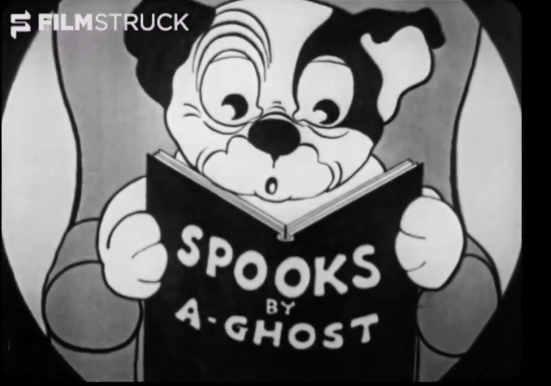
Pete the Pup is petrified!

After this was some wonderful invention from Walter Lantz with the mixed live and animation featuring the director and his cartoon dog, Pete the Pup, in Pete's Haunted House (1926) followed by a stunning The Devilish Tenant (1909) from Georges Méliès which was a trick film honed to perfection. It was hand coloured which as Chris Bird reminded us, meant that every frame on every copy was coloured individually - remarkable and beautiful film to see.


The last film was courtesy of a lucky find on eBay and was a rare surviving copy of a Cecil Hepworth film from 1922, One Too Exciting Night, a spoof on Griffith's One Exciting Night, itself an Old Dark House Mystery. What we saw may well be the only surviving copy anywhere but that's how they roll at the Bioscope - the rare, the extraordinary and the exceptional. We are privileged and all for just a few quid!


Frighteningly good!


Louise Fazenda gives her all!


To buy the Blu-ray of Ben Model's restored The Bat, please follow this link to the Undercrank Productions website - it is a very worthy release including some delightful extras. Blessed are the Kickstarters!


There's more about the mystery of the good ship Joyita here, a fascinating tale from the Bow Creek to Anatahan maritime history site.


This "near-mint" copy of the first appearance of The Batman in March 1939 last sold for $1.7 million in auction, and is now valued at $2.2 million. So, it's not just classic film enthusiasts who should check their lofts for lost treasure... I know where one copy is but I'm not telling. 


More gorgeous screen shots from the Blu-ray!


Gotham, before the Bat Signal


Saturday, 19 October 2024

Elementary… Silent Sherlock, London Film Festival, Alexandra Palace


If it’s Wednesday it must be London and the magnificent, arrested decay of the Alexandra Palace Theatre which as the BFI’s Jean Mitri awardee Bryony Dixon said in her introduction was not only contemporary with Sir Arthur Conan Doyle’s Sherlock Holmes series as published in The Strand magazine but also the films based on his work made by the Stoll Picture Company. The Theatre was originally opened in 1875 and was screening films as early as 1906 with the tin projector room installed in the early twenties still remaining. After 80 years of closure, the venue is being restored in much the same way as these three films we saw screened, with just 44 more to go…


This was the grandest of archival screenings at the London Film Festival for some time and featured new scores from Neil Brand, Joseph Havlat and Joanna MacGregor who conducted the Royal Academy of Music Soloists Ensemble, leading from the piano. My mother was a huge appreciator of Ms MacGregor’s classical work and she would have loved this evening of exemplary musicality and performance.


The Stoll corporation made three series of 15 episodes and two feature films, all featuring Eille Norwood as the great detective a performer that Conan Doyle approved of in the role, both on stage and on screen. A vastly experienced stage actor, Norwood so impressed the author with his obsessive attempts to bring every detail of Holmes to light that he gushed about his “brooding eye” and his “rare quality, which can only be described as glamour, which compels you to watch an actor eagerly even when he is doing nothing.”


Screen presence - Eille Norwood  (Photo Yves Salmon BFI) 

That original materials survive for these films is remarkable but as Bryony pointed out, duplicate positives were made in the fifties and sixties and so the BFI was thinking ahead – not for nothing is it one of the leading archives in the world. For two of these films those duplicated formed the basis of photochemical and digital restoration whilst the third, the shattering The Final Problem (1923), was based on a tinted nitrate original and looked stunning.


That film left us literally on a cliff-hanger but the future of this series is ensured and I look forward to watching everyone… the French may have had Louis Feuillade but we had Maurice Elvey and then George Ridgwell, who directed the second and third series. The project is in collaboration with Iron Mountain Entertainment and will make this unique collection available on home media as well as on the big screen. Tonight, we had episodes from across the series all of which showed the flavour of the Eile Sherlock and the ways these wonderful stories were adapted for the big screen.


Sherlock and the King of Bohemia (Alfred Drayton)


A Scandal in Bohemia (1921), score Joseph Havlat


This was the seventh in the series and Norwood crams a lot of character into his screen time ably enabled by Elvey’s economy and focus. So many stock Sherlock moments are concentrated into this film that it underlines Doyle's desciption of “glamour”: one early example is the detective noticing that his companion Dr Watson (the ever-present Hubert Willis) has employed a new housemaid who has been over-rigorous in cleaning his shoes. I noticed that modern Sherlock writer, Stephen Moffat was on hand and probably making notes furiously!


Doyle was impressed with Norwood’s “quite unrivalled power of disguise…” and in Scandal we’re treated to a taxicab driver so convincing that The Strand reported he was nearly ejected from the studios as a trespasser! He also plays a non-conformist minister in his attempts to trick Irene Adler (Joan Beverley) into revealing the whereabouts of her incriminating pictures of her affair with the King of Bohemia (Alfred Drayton). Of course, Watson is fooled every time but Miss Adler proves to be altogether as smart as Sherlock… 


Miles Mander makes an appearance as Godfrey Norton, Irene’s true love interest and – surprisingly perhaps for those who have seen his later silent work, he’s not a bounder but a thoroughly decent chap!


Watson, Prof Coram (Cecil Morton York) and Sherlock


The Golden Prince-Nez (1922), score Neil Brand


The quirkiest of the three, this puzzler was the 14th of the second series – directed by George Ridgwell who covered series two and three after Elvey moved on – and  involved the death of one Professor Coram’s secretary, who died clutching his killer’s eyeglasses in his hand. Sherlock quickly deduces that the murderer was a short-sighted woman with a broad nose and so it proves just not the one the police grab. There’s always a twist and a logical explanation and this one was a doozy.


Norwood has such presence and also a twinkle in his eye – his Sherlock enjoys the challenges and, just like our puppy Mungo, likes showing off how clever he is! Here the mystery is “readable” by the viewers and we can join in matching wits with the detective and the guilty parties.


Percy Standing and Eille grappling...

The Final Problem (1923), score Joanna MacGregor


To Cheddar Gorge and the culmination of Sherlock’s final battle with his criminal nemesis, Professor Moriarty… This was the last of the series and was directed by George Ridgwell. Here Holmes faces his evil equal, Moriarty (Percy Standing) with both men nearing the end of their tether after a series of bruising score draws in the streets of London. Sherlock makes a number of early signifying references to being willing to stop the man even at the cost of his own life.


He thwarts the evil schemer one more time and, leaving instructions with the police of Moriarty’s gang’s secret lair, heads of for some relaxation with Watson at Cheddar Gorge… it’s not quite the Reichenbach Falls but you may guess what’s coming. This featured stunning tints - restored from an original nitrate print – which really brought out the flavours of the locations and the epic battle of wits.


The orchestrations were powerful and evocative with each composer taking a slightly different route but delivering compositionally and as scores illustrating these timeless tales. Norwood plus time equals more or less Cumberbatch and I have the spirit of Sir Arthur Conan Doyle on my side. MacGregor tackled her dual role with ease and the players brought out rich textures in each approach creating a seamless whole of pure invention, deduction and delightful problem-solving verve!


Neil Brand and Joseph Havlat take their bows (Photo Yves Salmon BFI) 

The Final Problem was written in 1893 and viewers of 1923 would have been fully aware that Sherlock would return as he did originally in 1903’s The Adventure of the Empty House… but, as then, the finale here seems final. But, gentle reader, do not worry about our favourite sleuth for he will return, along with Maurice Elvey, in the feature film The Sign of Four (1923).


And now we must await further developments and restorations for the rest of the series; this was a most exciting entrée to the programme and probably the biggest such undertaking since the Hitchcock Nine back in 2012. I can’t wait.


Joanna MacGregor (Photo Yves Salmon BFI) 
Alexandra Palace Theatre
Fourth row back, chap with the beard, looks quite concerned... that's me! (Photo Colby Todisco BFI)


Michael Powell: Early Works, BFI Blu-ray Set


‘What fascinated me was the attitude: the planned yet flexible operation, led by the director, to seize the moment … to turn the light of common day into something beautiful and entertaining. This was for me! I never had the slightest doubt that I was meant to direct films from that day to this. Ten years later, I made my first.’

Michael Powell*


My family remember the BFI’s 2023 Powell and Pressburger season very well and with some fondness as my regular disappearances up to the Southbank were greeted with ironic jeers along the lines of “Mickey Powell a-gain, A Life in Movies eh?”, “Oh, so you’re not going to the tip then?” and “Is it a matter of life and death then?” The great Liverpool manager Bill Shankly might well have said that football wasn’t a matter of life and death, it’s more important than that… but latterly Jurgen Klopp added the balancing view that it was the most important of the least important things.


So it was that Michael Powell became, for a few golden months at least, “the most important of the least important things" and, from Cinema Ritrovato to the BFI, I tried to watch everything I could from the rare to the restored. The films on this set are mostly branded as “Quota Quickies”, a loaded term now and then referring to the need for US studios to invest in British B movies in order to not blow our domestic industry completely out of the domestic picture houses.


Stewart Rome in Rynox (1931)

Tight of budget and time they may have been though but for ambitious men like Powell they were a way into making films along the lines of the Rex Ingram features he had been involved in (Mare Nostrum and The Magician, in which he appeared as well) and Hitchcock’s Blackmail on which he was a photographer and, as quoted by the BFI’s James Bell in one of the extras, claimed to be responsible for the dramatic denouement. Once a bank worker, but always a film fanatic, celluloid ran in Mickey’s veins or at least the drive to create stories for the screen of a British flavour.


Here there are five of these short films – not all definitively quota quickies as King’s College London’s Dr Laurence Napper describes on one of the excellent commentaries – along with some fascinating silent shorts made by Powell as a travelogue for the South of France where his father ran a hotel. Together they form the most serious effort yet to document this most distinctive of British filmmakers and the forging of a genuinely British style during the post silent period.


In other words, it wasn’t all just Alfred.


Powell made some 23 films for various companies in the early to mid-1930s of which only 13 survive. Some are already on DVD, such as the lovable lighthouse mystery, The Phantom Light (1934), The Fire Raisers and Red Ensign (both 1933) also but this marks the first time the five “quota” films included have been on Blu-ray let alone the recently restored versions. All picture digitisation has been carried out at 4K resolution and 16-bit colour depth whilst nitrate sound negatives for the features were digitised at the BFI’s Conservation Centre. Regardless of the various sources, they all look wonderfully crisp whether you are viewing on home cinema or on the big screen


Michael Powell gives instruction during filming of Her Last Affaire


Take quota quickies, for example. You know what they are? Films made in a hurry, and much too cheaply, for an American distributing company to offer for sale, in order to comply with the law of the land. These are made by “independent” companies – so called, presumably, because they can’t afford to be independent.**


The films range from the first to the last of Powell’s so called quota quickies:


Rynox (1931)


… there never was an English film so well made. The director’s name is Michael Powell.

John Grierson, Everyman magazine


Powell was also clear that Rynox was not a quota-quickie production: It was a British feature, financed and distributed by Ideal Films, a respectable and respected English film-maker.***


The film stars Stewart Rome in twin roles, not to give the game away, and boss of a failing company who decides to finish himself off and go undercover to determine who his enemy is.  Then there’s Blackmail’s investigating officer, John Longden playing his son Tony Benedik. The film is one of the more suspenseful and rushes along at pace with some silent style in terms of cinematography. There are many soundless moments - as you'd expect at this point in British film making, and this makes for an odd experience for those of us used to fuller scores. Powell would later use silence for effect such as in One of Our Aircraft is Missing (1942).


In his commentary Marc David Jacobs draws the links from Rome's struggling company boss to Colonel Blimp, with the actor playing a man running out of options and yet who bravely faces the ultimate decisions for the sake of his family. As Jacobs says, it's very rewatchable with a lot packed into the running time and all very well played all round. The design is also very striking with art deco Rynox branding heightening the poignancy of the human drama.


Jerry Verno and guests at the Hotel Splendide!


Hotel Splendide (1932)


This is a likeable comedy that shows some visual flair from Powell on his tiny budget. As senior Lecturer in Film Studies at Kings College London, Lawrence Napper points out in his booklet essay notes, “Powell’s resourcefulness in the face of meagre resources is everywhere evident, perhaps nowhere more so than in the brief sequence that shows Verno travelling from London to Speymouth…. The entire journey is handled in less than two minutes with 18 shots edited across eight camera set-ups…”


I’ve now seen this film a number of times and I have a fondeness for Jerry Verno’s jumped up optimisem and Joyce Dacre’s plucky Vera Sherbourne. You’ll believe that a Speymouth hotel can indeed be Splendide!


Ernest Thesiger and Jane Millican


The Night of the Party (1935)


In her booklet essay, film writer Pamela Hutchinson summarises this one with trademark economy  as “… a witty parlour-game whodunnit, dismissed by its young director Michael Powell as ‘a piece of junk’ but which offers plenty of arch amusement within its brief running time, and an explosive courtroom finale.”


There’s good work from Malcolm Keen as Lord Studholme along with Leslie Banks as Sir John Holland and Ian Hunter as the reliable, solidly masculine character he came to specialise in. Then there’s Ernest Thesiger, who’s character couldn’t be anymore coded. As for time immemorial, cash-strapped British filmmakers had a ready supply of highly-trained theatrical talent who could turn up do the job and not require endless re-takes.


Francis L. Sullivan, Sophie Stewart and Hugh Williams


Her Last Affaire (1935)


This one has my favourite cast including Googie Withers in an early role, Powell stalwart John Laurie and two more legends Felix Aylmer as Lord Carnforth and Cecil Parker Sir Arthur Harding. Hugh Williams, once again, plays Hugh Williams… he was totally “method” on this one.


Film historian and Powell specialist, Ian Christie writes the booklet essay and expects that modern audiences will note Powell’s ingenuinty in resolving the plot and story line with “…the ingenious use of a BBC broadcast SOS message (the play had a message tapped out in morse code) that is striking. And even more, the montage sequences Powell and Dalrymple devised, first for Alan’s journey to the New Forest inn, and then for his return by plane from Paris.”


Behind the Mask (abridged reissue version of The Man Behind the Mask (1936)) (1944)


This last film was long considered lost until the discovery of this abridged version from the US which makes for a slightly unbalanced tale in terms of the master-mind behind the operation and the grandiose science fiction elements of his secret base… some 40% is still missing. That probably wouldn’t elevate this into a classic but it would have explained more about the grandiose plans of the chief villain, The Master aka Paul Melchior as played by Maurice Schwartz.


As with all the rest, it is charming and well made romp with good performances from Donald Calthrop especially as Dr H E Walpole and Jane Baxter as June Slade. Hugh Williams also gives another example of the Hugh Williams School of Acting. It's an enjoyable romp that takes in old school friendships and betrayal, masked balls, kidnap and chase, country pub stand-offs - with Esme Cannon as a waitress - and mystic hokum for the deranged conclusion. Another very entertaining ride!


Special features


The whole set feels like a celebration of British film preservation and specifically the BFI with both Inside the Archive extras showcasing the steps taken to restore and preserve the work with not just the head of departments but also specialists within shown at work in the painstaking process which is by turns stressful in terms of the unknown condition/completeness of original materials and most rewarding when a previously-lost film can re-emerge.


This box set is a bargain in terms of it’s breadth and depth of information and also in showing the passion involved. So, please look at these extras as extra-special!


Newly recorded feature commentaries by Marc David Jacobs (Rynox, Behind the Mask), Lawrence Napper and Dom Delargy (Hotel Splendide), Dr Josephine Botting and Vic Pratt (The Night of the Party), and Ian Christie (Her Last Affaire)


Riviera Revels – Travelaugh No.1 and No.10 (1927, 26 mins total): Powell himself appears in these rare short comedy curiosities from the silent era, with optional audio commentary by Bryony Dixon, curator of silent film at the BFI


Inside the Archive: Riviera Revels (2024, 12 mins): Bryony Dixon explores the origins of Riviera Revels and Michael Powell’s work on them


Inside the Archive: The Early Films of Michael Powell (2024, 42 mins): a new documentary on the BFI National Archive’s role in rediscovering and remastering the early films of Michael Powell


Visions, Dreams and Magic: The Unmade Films of Michael Powell (2023, 41 mins): a new documentary exploring some of Michael Powell’s unrealised films


Interview with Erwin Hillier (1988, 26 mins, audio): in these extracts from an interview recorded by the British Entertainment History Project, cinematographer Erwin Hillier recalls working with Michael Powell


The Archers in Argentina (1954, 21 mins): Michael Powell and an international film-star entourage are captured on camera at an Argentinian film festival in this home movie footage shot by Emeric Pressburger, with optional audio commentary by Marc David Jacobs


Image galleries


There’s a handsome illustrated booklet featuring contributions from James Bell, Marc David Jacobs, Lawrence Napper, Pamela Hutchinson, Ian Christie, Bryony Dixon, Dr Josephine Botting and Kieron Webb; notes on the special features and credits. It’s only available with the first pressing but is an essential companion!


So, go straight to the BFI’s shop in person or online and buy this set immediately!


*Powell writing in his autobiography, A Life in the Movies after seeing an article in Picturegoer magazine, aged 15 in 1920. Quoted by James Bell in the booklet for this set.


**On the British Sets – The Crime of quota quickies’, EG Cousins, Picturegoer, 9 September 1933, p28


***  A Life in the Movies