Saturday, 2 February 2013

Wake up call… Hindle Wakes (1927)

Estelle Brody
You’ll have to forgive me if sometimes I’m a little behind… as a late-converter to the on-going viability of silent film, I was probably too busy chasing down the latest Pedro Almodóvar movie (or changing nappies)  when Maurice Elvey’s Hindle Wakes was revived by the BFI in 2000.

Well, 12 years on I’ve just staged my own revival and having raved about Asquith and Hitchcock’s silent work I now have a third British silent director to rank alongside them.

John Stuart, Humberston Wright, Peggy Carlisle and Estelle Brody
Based on the controversial 1912 play by Stanley Houghton, this was Elevy’s second go after a 1918 effort which also included some of the same actors.

It’s a disarmingly frank story of sexual freedom amongst working-class Lancastrian factory workers and, most surprisingly, shows one of the girls completely in control of her choices in spite of all around trying to force her to follow social norms. These were our grand-parents and, in my case, my Nan, was so powerfully in favour of her own right to decide she went as far as to take out an injunction to prevent the kind of parental control attempted here. She wasn’t alone.

Dark and satanic
This was the period of accelerated development of the labour movement whilst the Great War had brought women to the commercial fore as they worked the men’s jobs in factories and mills… it became harder to deny their importance and their equality.

This story must still have been a shock in 1927, hard to imagine how the play went down in 1912.

The Wakes were a regular tradition in the North when the mills would close down for a week and the workers had a week-off (unpaid) to enjoy a bit of freedom.

Get your clogs off
For many in Lancashire, then as now, the glittering possibilities of Blackpool were hard to resist. With three piers, dozens of music halls and a tower to rival Paris, it remains the UK’s ultimate seaside resort… if a little brash for some tastes.

But it is here that the younger workers head for their week of “ecstasy and freedom”. There are two young mill girls, Mary Hollins (Peggy Carlisle) – with her short, sharp haircut suggestive of a more earthy nature than her considerate and cautious friend Fanny Hawthorn (Estelle Brody).

Blackpool's Pleasure Beach
They meet up with two of their social betters, Allan Jeffcote (John Stuart) the son of the mill owner, and his mate, George Ramsbottom (John Rowal). It seems George has the better chance as Mary seems all together more forward with Fanny initially refusing to hold hands.

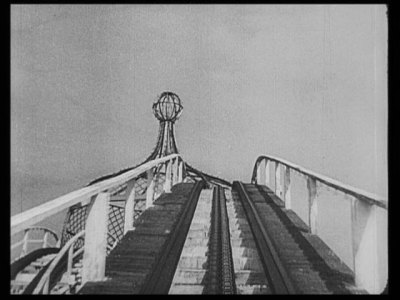
There are some fantastic scenes of the fun to be had on The Golden Mile especially on The Big Dipper (built in 1923 and still going strong) as Elvey’s camera bravely follows the actors up, down and around in a vertiginous display. But the director doesn’t overplay the location and keeps the emphasis firmly on the characters.

I want to see the bright lights tonight...
When it comes to evening’s end Mary goes home alone, repulsing her partner’s advances on the door step and it is Fanny who falls…

The next day she confesses all to Mary and reveals that Allan is to whisk her away to Llandudno. I’ve seen some reviewers be dismissive of this jewel of the Welsh Riviera but, having lived there, I can confirm that it is a cut above most resorts in the North West with a fine Victorian front and some excellent hotels (you can just glimpse the Grand Hotel where PM Macmillan once stayed and where I worked during two university summer breaks a long time ago…). Elvey takes his crew out to Wales and it’s good to see a brief glimpse of the Great Orme (home to the oldest copper mine in Europe) and the elegant bay that stretches around to the Little Orme (see what they did there?).

Llandudno, "Queen of the Welsh Resorts"
It is indeed the kind of place a well-to-do young man might take a working class woman and hope not to be recognised…

But Fanny’s plan to have her tracks covered by a postcard posted from Blackpool goes awry with the untimely drowning of poor Mary. Her friend’s death is almost secondary though, as the full “scandal” of her week with Allan is revealed and their families become concerned about the necessary “consequences”.

Peggy Carlisle and Estelle Brody
Fanny’s mother (played with bitter decisiveness by Marie Ault) want nothing less than marriage. Old man Jeffcote (Norman McKinnel, who also played the part in Elvey’s earlier film) is similarly-minded, even though it means he cannot unify his business with that of the Mayor, Sir Timothy Farrar (Arthur Chesney) who’s daughter Allan was engaged to marry.

Mrs. Jeffcote (Irene Rooke) has an altogether more pragmatic take and doesn’t see why her boy should have to marry beneath himself for this indiscretion. Whilst Fanny’s father  Chris, (Humberston Wright) – a man physically broken by a combination of his dedication to work and timidity – fears most for his daughter’s happiness. Long ago he could have taken shares in his mate’s enterprise but he was too risk averse… he doesn’t want his daughter’s life to be lived with the same compromises and the same regrets.

John Stuart and Gladys Jennings
All have different motivations and overlayed on this moral maze is the confused romance between Allan and Beatrice. It’s hard to take to Allan who, so close to his wedding, was happy enough to indulge in a week with Fanny and then, when faced with the consequences, expects to walk straight back to where he was. Beatrice (Gladys Jennings) does at least have some moral backbone, refusing to forgive Allan and insisting that he should make Fanny an honest woman.

Such sensibilities are not too difficult to relate to even over this distance. Class remains a massive issue in the UK and we still struggle with the idea that women can enjoy sexual freedom in the same way as men. Then as now the “moral” standpoints of various characters can be nothing of the kind, most are out for what they can get and are only trying to use convention to advance their own cause or to ignore the inconvenience.

Estelle Brody and John Stuart
Ultimately you side with Fanny’s father and his old friend Jeffcote: he may be a workaholic business demon but he recognises Fanny’s strength of character just as much as he despairs of his own son’s.
This is no black and white melodrama but a complex tale that defies expectations even over a century after it was written.

I’ll not give away the ending as this film deserves to be watched without preconception. The performances are exceptional especially from Norman McKinnel and Humberston Wright. But Estelle Brody gives a performance “out of its time” with naturalistic subtlety taking the plaudits: honestly, she’s far too good fer the likes o’ ‘im!

Elvey’s direction is inventive and sure footed with some sublime moments following the masses slowly whirling around Blackpool Tower Ballroom the spotlights playing across them as confetti falls almost in slow motion from the ceiling. The disorientation of a good night out… you can have your fun but mistakes can be made…

I watched the excellent Milestone DVD which comes with a very effective modern soundtrack from Sheffield band In the Nursery along with a more traditional piano score from Philip Carli. It's curious that this very British production is only available from the United States but they've done us proud.

Monday, 28 January 2013

Brooks burns out brightly… God’s Gift to Women (1931)


This is one of the few talkies made by Louise Brooks and amongst her last significant roles: her final feature. Within the space of just six years she’d gone from rising star to almost untouchable as the studios dropped and blocked.

Yet here she is alongside Joan Blondell – three months younger and at the start of a long career from talkies to Grease… But, if Louise had had it in her she would have…could have…. As it was she burned bridges like no other and enjoyed the glorious re-evaluation and rediscovery that has done as much than anything else to engender fascination with silent film. After all, if Hollywood could miss out on this transcendent talent what else are we missing?

It’s better to burn out than fade away… and Brooks burned bright indeed before a rapid fade...

24 hour party people... Louise on the left.
God’s Gift isn’t especially to comedy, but it’s an effective if slight film. It uses Brooks to good if limited effect playing a fringeless flapper, part of the mobile 24 hour party people that surround Frank Fay’s character. She’s seen in a fair amount of the film, and in a succession of stunning dresses but the part’s much smaller than say The Show Off: full circle.

Of course the film is also notable as Brooksie speaks and sounds pretty good too… She’s also involved in a hell of a cat fight with Blondell and Margaret Livingston as they compete to look after the seemingly ailing Toto Duryea (Fay). As in her other comedies, Brooks just keeps it real, she hasn’t got Blondell’s humour but anchors the action in naturalism while Fey and others go (way) over the top.

Laura La Plante and Frank Fay
The film was directed by Michael Curtiz based on the play The Devil Was Sick by Jane Hinton and was one of former vaudeville star Frank Fay’s last staring roles. Fay’s character suddenly finds the love of his life, Diana Churchill (Laura La Plante, another star nearing the end) in one of his regular nightclub haunts.

He pursues her but is fended off by her father and has to promise to not see her for six months to prove serious intent. Given a medical by the family’s doctor he is told that he has a weak heart and that the slightest excitement could prove fatal.

All in the best possible taste...
Brooks’ Florine is more than capable of providing this and, descends on Toto, along with Blondell’s Fifi and Livingston’s Tania Donaliff, to nurse him.  There’s a series of gratuitous shots as each woman goes off to change after they arrive… Fay reacts like a character in a Carry on (we’re only missing Sid James’ lascivious snigger…or Kenneth Connor’s “coorr!”…) as we’re treated to glimpses of silken lingerie: Blondell even has a nurse’s outfit.

Joan Blondell and Frank Fay
So far so pre-code and Blondell in particular excels, she was a natural comedic actress with great timing and delivery – no surprise that she made a great paring with Glenda Farrell in so many comedies.

The only surprise is why the girls fancy the aging lothario in the first place and why he choses La Plant’s rather dour character over the looks of Brooks or Blondell’s good cheer.

Can Toto resists them all and hold out for Diana against all the odds?

Margaret Livingston, Brooks and Blondell
I watched God’s Gift to Women on the just-released Warner Archives DVD. It’s a good print and a film I’d recommend to all friends of Louise. Blondell is the stand out but Fay also plays his part.

He married Barbara Stanwyck in 1928 and it has been said that their relationship formed the basis of A Star is Born. What goes up must come down, what matters is that you have your moment and Louise Brooks certainly had those.

Saturday, 26 January 2013

Mob mortality… The Hit (1984)


Michael Caine once said to Bob Hoskins that there’d only been three decent British gangster films and they’d been in all three: Get Carter, The Long Good Friday and Mona Lisa. To that list I’d certainly add Stephen Frears’ metaphysical The Hit staring Caine's old mucker Terry Stamp.

To some of us locals, British crime films can be either too violent or just too American: we don’t have the guns and style of the Yanks, so why pretend otherwise? Brit-crime should be determinedly un-stylish and not directed by Guy Richie…

The Hit left a mark when I first saw it in the cinema by avoiding the enduring cliché of the genre. Yes there was violence and a dramatic situation but the film was more philosophical than psychotic.

Braddock considers his options
It touches on the deepest and most everyday fears of all, that of our own mortality and the time when death turns from distant possibility to rapidly approaching certainty (we kid ourselves otherwise…). To this end, the situation is almost secondary… all of the characters are living in mortal fear,  but just a little more focused than normal.

Staring a rejuvenated Terence Stamp as super-grass Willie Parker, the story follows his betrayal of his gang-mates in the early 70s. He’d sold them out because he couldn’t face going back inside, a prosaic and self-interested decision which certainly doesn’t make him look like the hero in the courtroom where his former gang mates send him off with a chorus of We’ll Meet Again.

Willie, the Boys and a be-wigged Jim Broadbent
We re-join Willie a decade later living a life of nervy solitude, hiding away in southern Spain with a constant bodyguard courtesy of the local police. Willie has found a new erudition with his apartment artfully decorated and the walls lined with books on philosophy and art.

But as he returns home ahead of his guard Willie is kidnapped by a group of local youths. They drag him off to remote exchange with two men: hit man Mr Braddock (John Hurt) and his apprentice, Myron (an impossibly young Tim Roth).  The Brits booby-trap the gang’s payment but leave one alive… the first of a string of crucial mistakes.

Soon after the police, led by a senior officer played by the great Fernando Rey, are seen interviewing the survivor – the pursuit is on.

Terry and Johnny
Willie overcomes his initial shock and appears supernaturally calm with his new captors… This is especially disconcerting for Myron: he only expects fear.  Willie continues an open commentary on his situation as if he’s almost on the same side as the assassins and he succeeds in unnerving even the experienced and intelligent Braddock. They are to smuggle him to Paris where he is to meet the gang’s leader (70’s pop singer Lenny Peters in a forceful yet wordless cameo) before the end: this is revenge served cold.

Willie overhears a news report detailing his abduction and Braddock is persuaded to change car in a Madrid safe house. But on arriving at the flat they find one of their paymaster’s associates Harry (Bill Hunter, vulnerably venal) holed up with a young lady friend Maggie (Laura del Sol).

John Hurt, Bill Hunter, Tim Roth and Terence Stamp
Harry’s heard too much – Willie makes certain of that - but Braddock gives him a chance by taking Maggie as insurance. As they’re about to leave Willie puts a seed of doubt in his mind and Braddock returns to find Harry phoning the police… the reward was too big a temptation.

The pace shifts as Maggie starts to have her own impact on the group dynamic. She has a fierceness and desperate need to live which contrasts with Willie’s studied acceptance: he is ready but she most definitely is not.

Laura del Sol and John Hurt
Willie continues to amaze Myron with his sang froid and skilfully drives a wedge between the young man and Braddock. At the same time Myron can’t help but let his attraction for the Spanish firebrand over-rule calculating self preservation. Braddock seemingly has no such conflict but his suppressed desire is evidenced in a number of physical confrontations with the girl.

One such battle takes place when he takes Maggie to get some petrol… she bites a clump of skin off his hand but he holds back from killing her: “you’re a very lucky girl” he later says, heart over-ruling head.


On their return he finds Myron asleep and Willie, rather than escaping is just over the hill staring in wonder at a waterfall. Braddock and Willie have their most direct exchange in the whole film Willie playing down the fear of death: “ …it’s as natural as breathing”.

They approach the border with the police close behind… the final act is played out with stunning unpredictability. 

This was Stamp’s first starring role in some time and he is superb, covering the shift from self conscious betrayal to Zen calm when life catches up with him. He’s always been great at conveying uncertain meanings in his look and here he masterfully misdirects our feelings at least some of the time…

Terence Stamp
He’s matched by John Hurt who plays against type carrying an air of martial competency you wouldn’t expect, with utter conviction. I was reminded of Ben Kinsgley in that other decent Brit crime caper Sexy Beast… also produced by Jeremy Thomas The Hit’s producer.

With these two at the centre both Laura del Sol and Tim Roth excel. Del Sol’s no-holds barred ferocity acts as the counter-point to Stamp’s fatalism whilst Roth kicks off his distinguished film career in fine style as the trainee psychopath. He’s the only one who doesn’t sense the proximity of his own death…

John Hurt
The Hit is not a film you can just walk away from and each viewing  always reveals new shades of meaning. Very few British films matched Frear’s output in the 80s and he perhaps doesn’t always get the credit he deserves for bringing a uniquely British sensibility to thrillers, from Gumshoe to The Hit and onto Dirty Pretty Things. His next film was to be My Beautiful Laundrette.

The Hit is widely available but the one to go for is the Criterion Edition which comes complete with the usual trimmings - a commentary from Frears, Roth and Hurt, an 1988 interview with Stamp on Parkinson and a lengthy essay from Graham Fuller.


Sunday, 20 January 2013

The prestige… Cagliostro (1929)

Hans Stüwe
So many silent films have been completely lost and others are shadows of their former selves - are we to be any less stricken at a film that is only partially intact: half empty of half full?  Richard Oswald’s tantalisingly incomplete Cagliostro - Liebe und Leben eines großen Abenteurers survives in just enough quantity to show us what it probably was....

This edition has been painstakingly reconstructed by the French Cinematheque in collaboration with Potemkin films. It is based on a 9.5mm Baby Pathé abridgement (intended for family viewing) and one surviving reel of 35mm including some censored scenes featuring startling nudity - their removal from view ironically ensuring their eventual survival and public display 80 years on.

In the court of the Capetian King...
Based on Johannes von Guenther's novel about the life of Joseph Balsamo, alias the Count Alessandro di Cagliostro, an Italian occultist, adventurer and freemason-adventurer (make what you will of that and pretty much the whole of his life story)… Oswald’s film is grand in scope and still has impact even in truncated form.

Hans Stüwe is impressively larger than life as Cagliostro, charming the courts of Europe with his prestidigitation and legerdemain. He turns lead into gold in some wonderfully atmospheric shots and sets the scenes with audacious use of a disco-ball…

Studio 1784
Seemingly he believes his own hype and calls for sick people that he can make better. But it may be more trickery and part of his attempt to gain social stature… moving ever closer to kings and queens. These early scenes feature elaborate mis-en-scene and expressionist flourishes that build up Cagliostro’s mystery.

Stüwe is striking enough to carry this off but he’s less convincing as a paramour and his love affair with Lorenza (Renée Héribel) initially lacks conviction, but maybe this was left on the Pathe cutting room floor? He woos Lorenza in a missing section and we quickly learn that it was not the adventurer Cagliostro she fell for but the man Balsamo who, for a time, stopped the circus.

Suzanne Bianchetti and Hans Stüwe
The couple journey to France in 1784 and find the country on the verge of uprising with economic strife compounded by uncaring royalty. In the midst of a political rally they encounter a disenfranchised noblewoman, Jeanne de la Motte (Illa Meery) a descendant of Henry II fallen on hard times: the “Barefoot Countessa”. Cagliostro takes her under his wing and vows to restore her fortune at the same time seeing a way into royal favour.


Charles Dullin
A number of characters have been lost in the cut and others have been reduced: Charles Dullin as Marquis de Espada-Comte de Breteil, is seen all too briefly for most of the film. An admirer of Lorenza the Marquis views Cagliostro as a fraud and is intent on exposing him and grabbing the girl.

In lavish surroundings, Cagliostro presents Jeanne to the court and raises money to help her, she is accepted back into royal patronage and becomes the Queen’s lady in waiting.

Illa Meery, not just bare feet...
But the Italian blows his big chance as his tricks don’t come off and he fails to impress King Louis XVI (Edmond Van Daële) and Marie-Antoinette (Suzanne Bianchetti) – has the Marquis sabotaged his act? In trying to redeem himself Cagliostro shows the Queen her future, Oswald cleverly zooming in on the magician’s eye to show Marie Antoinette’s final moments at la guillotine…

Alfred Abel
Cagliostro is banished from court but he plots revenge and calls in a favour from Jeanne to persuade Prince de Rohan (Alfred Abel) to buy an exceptionally expensive necklace for Marie-Antoinette with whom he is besotted. The con goes off well and we see Jeanne parading around in the Queen’s finery and little else. Cagliostro is strangely unmoved, perhaps his love for Lorenza is starting to affect his moral judgement although he still steals the jewels back.

But the game is soon up and Cagliostro is given over to the Marquis de Espada for questioning in his hi-tech arabesque palace – sliding doors and automated. Tied to a pillar he breaks free as the Marquis’ “questions” Lorenza in front of him… the anti gradually being striped away to reveal just  the hero.

Hans Stüwe and Suzanne Bianchetti
They escape back to Italy were they finally think they have finally found their freedom. only to be arrested by the Inquisition (no one expects the Italian Inquisition do they?) intent on punishing necromancy. Locked in Piranesi-esque dungeons, their doom fast approaches and, as Cagliostro finally seems to have caught up with the steadfast Lorenza’s feelings, they seem to have only hope left for happiness…

Elaborate imprisonment
The DVD comes with two soundtrack options which make for fascinating comparison.

There’s a DJ Cam cut up which could be perfectly suited to what is in effect a cut up of a film. He sounds very much like a Gallic version of the great DJ Shadow (a jazzier Endtroducing…?) but, even though his invention is entertaining, it lacks emotional flexibility and rides rough-shod over some of the narrative.

The piano accompaniment from Mathieu Regnault is more period appropriate and moves with the story. I understood the action more with his playing and had a better connection… there’s some lovely phrasing and it’s just more sympatico.

Both musicians make the very most of what remains and so should we. It’s difficult to make a case for this being up there with The Chess Player and other late silent era period classics, but it’s good looking and well played. The story is intact and there is sufficient drama left to have you on the edge of your seat right till the end.


The DVD is available direct from Potemkin although I got mine from the lovely BFI shop. It features an extensive booklet (tout en Français) including a fascinating essay written for May 1929 editions of Cinémagazine by Marcel Carné who was an assistant on the film. Whilst referencing lost scenes such as an apparently large-scale village fete, Carné elaborates on the set design and underlines the considerable will of his German director who, speaking hardly any French, had this film in the can within 60 days.

Not bad going for a multi-national blockbuster that interweaves so much of courtesans, kings and conjuring...


Friday, 11 January 2013

Tunnel of love… Underground (1928)

Brian Aherne and Elissa Landi
My first trip to the BFI this year and an unexpectedly rewarding one. Having once read a lukewarm review of Anthony Asquith’s second feature (his first as sole director) I was expecting an interesting film with an excellent orchestral score from Neil Brand. But the film proved to be surprisingly strong and a joy for trainspotter and cinéaste alike.

Anthony Asquith was the son of a British Prime Minister and his high-bearing has seemingly hindered his proper recognition as one of this country’s leading silent film directors. But the restoration of this previously almost un-watchable film, along with A Cottage on Dartmoor, has enabled a thorough re-assessment of his ability.

Waterloo rush hour
Underground is a confidently made film which wears its European influences proudly on its sleeve using expressionist and montage techniques which make the most of the four excellent central performances and some great London locations.

There’s a fight scene that features swift inter-cutting and point of view shots and which continues to echo in one of the characters thoughts as he strokes his wounded chin plotting his revenge… the camera tracks one of the characters as she leaves a power station and speed s up to a run at full tilt and then there’s a bold sequence of the two lovers on an open top bus speeding through fascinating London streets (South of the river I think, from Waterloo to  Kennington?).

Most of all, there’s the Underground itself. The film opens and closes with the same shot of a tube train entering and then leaving a station. Asquith could have chosen any location but he plumped for the stylishly subterranean: the “Tube” …then as now a crowded and unpredictable transport system, full of every aspect of humanity, all in enforced and unpredictable interaction.

Norah Baring and Brian Aherne
The opening sequence is precious and very familiar for those, like myself, who undertake this most egalitarian of commutes … Asquith relishes the scene as passengers squeeze on  board  and vie for seats. We focus on one particular seemingly uncouth character, Bert (Cyril McLaglen) who sneaks into a seat left by one more chivalrous traveler for a woman. But Bert changes tone when an attractive young woman Nell (Elissa Landi) sits next to him and tries to impress her but she’s too sharp for him and throws his hat over at some schoolboys.

Bert’s not to be deterred though and follows Nell as she tries to exit at the Waterloo Station escalators… here she meets a entirely more attractive proposition, Underground Porter Bill (Brian Aherne) who helps her on her way and then delays Bert by tripping him.

The story is run on co-incidence and the constant reconnection of the component characters is often achieved through simple chance… it matters not and adds a gentle sense of dislocation to an otherwise realistic narrative.

So it is that Bert somehow tracks Nell down to the store where she works and tries to romance her. He ends up with a bouquet but little else as it is clear she has another already firmly  in mind.

Cyril McLaglen and Brian Aherne
At the pub Bert drowns his sorrows and when Bill arrives there’s a scrap in which the porter emerges victorious and the electrician has his lights punched out. But Bert’s not one to forgive and forget. He persuades Kate (Norah Baring), a poor seamstress who rooms in his digs to help him gain revenge. For some reason the girls has a crush on Bert and having previously discarded her, he promises marriage if she’ll accuse Bill of assault in front of Nell and the swaying passengers of the Bakerloo Line.

The plan seemingly works and Bill faces ruin if found guilty. But Nell doesn’t believe it and, following Kate’s visit to her store to buy adornments for her impending nuptials, Nell puts two and two together and sets off to clear Bill…

Brian Aherne helps Norah Baring
The drama ramps up considerably but I won’t say more: it’s well worth a night out. Needless to say there’s a chase scene which would give many a modern adventure a run for its money: relentless and suspenseful, “visceral” as Neil Brand said.

The leads are all outstanding, with only McLaglen bringing a little ham; he still makes a convincing “bad sort” and is just the wrong side of “likeable rogue”.  Elissa Landi is a very striking actress with a protean smile: you wonder how she’s going to finish off some of her expressions… happiness that twists imperceptibly to a frown. She's very in the moment and, from the sound of it, quite under-used in subsequent Hollywood films. Oh and if you thought Asquith was posh, Elissa was a descendant of Emperor Franz Joseph of Austria (yes, that one!).

Norah Baring and Brian Aherne
Brian Aherne makes a very ‘andsome man in a uniform and an upstanding leading man: you really want him and Nell to work out. But it’s Norah Baring who has to handle the most tortuous transitions, alone in her room, distraught and unable to channel her romantic devastation except through the displacement activity of aligning her flower pots. A nuanced performance that near rips your heart out.

The post-prandial panel discussion was also very lively with the man from the London Tansport Museum revealing the back story to the Tube’s golden age and pointing out the odd “blooper” such as  the use of Northern Line carriages on the Bakerloo Line as well as some scenes shot in Waterloo and City Line carriages…he was sure there was a logical explanation.

Bryony Dixon highlighted Asquith’s experience of international film including a period in Germany at UFA and a working holiday with Mary Pickford and Doug Fairbanks. Underground is most notable for Asquith’s decision to focus on the lives of ordinary folk breaking with the English obsession with period drama and the lives of our social betters. Here was a story for everyman.

The Rivals
Neil Brand was still flowing along to his musical response to the film. After his success with Blackmail he had sweated hard over “second album syndrome” with this emotionally unpredictable film. He completely re-worked his first half hour once he’d become attuned to the story’s core. The archivists and restorers play their vital roles but only the musician’s get to actually work alongside the directors.

His approach is to score the music along with the individual moments in the narrative and let the story arc take its course. This is particularly important in a film like Underground in which events unfold in unpredictable ways. Here his music had an energy and urgency which perfectly complemented the pace of Asquith’s film. Lovely stuff – even if it was slightly out of sync due to a BFI technical glitch.

Elissa Landi and Cyril McLaglen
There's an interesting video on the BFI website discussing the film and the story of the restoration. And, if you go to the Barbican site there's a podcast with Neil Brand talking about his score.

Underground now begins national release in the UK and will get a DVD release in the summer – catch it if you can to see a British silent film director every bit the equal of Hitchcock.
