Wednesday, 16 May 2018

Good Day… Sunrise (1927), with Elizabeth-Jane Baldrey, National Centre for Early Music, York, Yorkshire Silent Festival


I have waited so long to see this film screened and with live accompaniment. Normally the film is shown with its score from the early talkie period - Sunrise being one of the first feature films with a synchronized musical and sound effects soundtrack - but as it is one of the toppermost films of the silent canon, I just had to see it done proper… and I couldn’t have chosen a lovelier venue or a better accompanist.

Elizabeth-Jane Baldrey gets more sonic variation from her harp than you’d expect; not only does she use the frame for percussion (fingers tapping to create the skin-crawling sound of scampering rats for Nosferatu…), she hits groups of strings with her palm to generate atonal power chords, picks off the harmonic sweet spots with alacrity – hard enough on a six-string – and genuinely creates a singular cinematic language from bliss to bedlam. She can even vary the tension on the strings using the foot pedal to create a kind of metallic sound: I have seen the future of accompaniment and it could be 47 string grunge!!

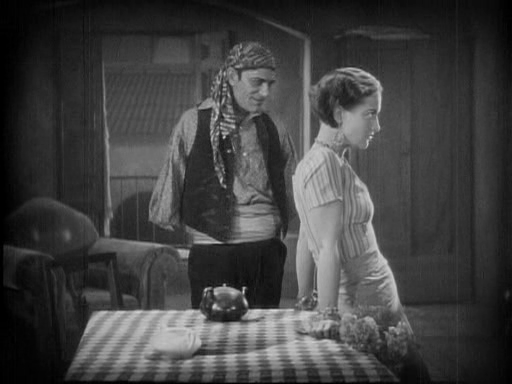
Margaret Livingston
She was on super form with Sunrise, and as with most of us, Janet Gaynor’s toupee aside, feels it is deservedly in high regard. She mixed improvisations with some lovely pre-scoring – honestly, if you don’t feel the fear when big George looms over tiny Janet in the boot, or, darn it, cry a tear, when the two finally re-connect, then you’re probably in the phantom zone. But Baldry doesn’t over-play the positive emotion in the film and the surprise, if you haven’t seen harp accompaniment before, is just how dark it can go.

Murnau’s film is a fable and as such has various elements of traditional Teutonic fairy stories, Grimm though they be. Yes, George O’Brien’s Man falls all too readily under the spell of the Woman form the City (Margaret Livingstone) but she has put a spell on him; a female version of Nosferatu whose silken stockings and knock-out undergarments, make him incapable of reason.

He agrees to kill his sweet wife because he is under the control of this jazz-age succubus, his assignations are even in the swamps, hardly the kind of place to charm a regular flapper: there is demonic power at play and Janet Gaynor’s Wife knows just by the dark shadow cast by her huge husband that all sense of himself has left.

George O'Brien towers over Janet Gaynor
After he pulls back, he repeatedly says “don’t be frightened of me” … a mantra with little persuasion given his actions and it’s only when the couple are thrown together by the alien world of the city that they begin to discover each other again. They go to a hair salon where George gets a shave and Janet hold on to her wig for dear life. When glamourous Jane Winton (a small but key role) arrives to offer the strapping lad a manicure – way to “un-sex” him now – he looks down in horror and declines and it’s another sign that he’s coming to his senses.

The two head to a nightclub after George rescues and escaped piglet (long story) and the band plays a peasant tune allowing the tow to show the townies what real dancing is: it’s a romantic display between two lovers and the jaded jazzers step back in respect. Oddly, one man keeps on replacing the shoulder straps of a slinky lady next to him, almost as if the couple’s dance has raised the bar of morality…

The couple walk through Murnau’s carefully choreographed streets as traffic passes them by and they even end up in an imagined field of blossoms. They are making their own reality.

The City sleeps as they walk
 When they get their photographs taken, it is not in a formal pose but in a clinch the photographer is delighted to capture. He seen enough posturing and recognises unconditional expression when he sees it.

All the other drama is there to enable this sunrise of a new devotion and naturally Murnau creates a universe of unreal perspectives – part set/part camera angles – architecture from a Europe left behind and a city of dreams and impossible structure – models in the foreground and at the back to create impossible depths and the impression of an endless city in constant flow. Amongst this emerge two humans in song, once more in perfect accord despite his mad moments of doubt.

It's interesting to compare with Murnau’s later City Girl which also features a young couple under pressure only they are very much in the real world of economics and more everyday wrong-doings. Sunrise has maybe more in common with the same director’s Faust?

George passes the Jane Winton test...
Technically it is a, frequently astonishing, film with those forced perspectives – gauze was used in the windows of some city scenes in order to reveal the extraordinary elaboration beyond. The two cinematographers, Charles Rosher and Karl Struss, maximise the anxious angularities and there are countless dolly shots as they cut through scenes placing the viewer deep within the heart of the interior stories of lives defined by locations: from the secret meeting with the seductress in the swamps to city streets melting away to reveal those blossoms.

In truth there's so much to discuss about the film, even weighed down by the expectations of its enduring reputation, this is a film with very high levels of content from all parties. I even watched it again just to grab these few images... result hundreds of screen shots that are all mini-marvels in their own right.

The peasant dance is completely free of city formalities - just pure passion
The storm at the end is pathetic fallacy in excelsis completing the lover’s journey with the final test of fate and faith. Elizabeth-Jane’s harp flowed alongside the conflagration and in contrapuntal opposition to thunder-cracks and flash. In her hands the harp is so flexible, fragile and fierce; the perfect instrument for Murnau’s timeless fantasy.

While George and Janet perform so well we shouldn’t overlook the playing of Margaret Livingston who gets her clutches into the country boy but is surely driven by something more than malice; Murnau always had a soft spot for his vampires.

The National Centre for Early Music is situated adjacent to the 11th century St Margaret's Church,  which today was illuminated by the almost unnatural sunlight of a York spring day; sun streaming through the churchyard trees across hundreds of bluebells still in full bloom. A splendid place and one serving York Minster Ale… the scene was well set.

Sunrise is available on Blu-ray and DVD combo from Eureka, but I’d gladly swap all of that for this experience of FWM and E-JB in the EMC at YSFF18.

Full details of the excellent programme for this year is available on the Festival's website. 

No, er, not the hair... it's erm, a very special cut...

Monday, 14 May 2018

Our friends in the North… Yorkshire Silent Film Festival, Abbeydale Cinema All-Dayer, Sheffield


What a day, ladies and gents, what a day! The Yorkshire Silent Film Festival is going from strength to strength and the Sheffield “all-dayer” at the 100-year old Abbeydale saw everything from drama to documentary with thrills spills and heartaches and a feast of musical accompaniment including percussion, strings and piano not to forget gravel, concrete slabs, banana and old suitcases…

From Hardy and Laurel to Harry Lloyd we laughed a lot and we also saw genuine history with the documentary bravery of Frank Hurley who was in the Endurance with Ernest Shackleton’s ill-fated expedition to cross the South Pole. There was evocative continental experimentalism alongside a very British detective and, for those who stayed late, Lon Chaney throwing daggers at Joan Crawford using just his feet.

A varied and enriching programme with a lot more to come as the month unfolds in Silent Yorkshire… there’s something in the air.

The Finishing Touch (1928)
 Another Fine Mess – Laurel and Hardy Triple Bill with Neil Brand

Few have the silent back-story of Neil Brand and hardly anyone can convey wit and wisdom from the silent age with such avuncular ease and all before he even sits down to start playing.  Neil is also a great champion of the next generation and encourages new players as well as new audiences alike.

Laurel and Hardy are amongst the most effective gateway experiences for silent film and here we had three of the best, my personal favourite being Angora Love (1929) in which the boys are adopted by a four-legged friend who really gets their landlord Edgar Kennedy’s goat! That said, is there any more perfect comedy violence that that visited on Jimmy Finlayson’s house by the boys in Big Business (1929) – the worse they get the more he demolishes their unseasonal Christmas Trees and their poor car.

Here and in their “housebuilding” escapade, The Finishing Touch (1928) the boy’s relationship is already clearly established and that’s what adds an edge to their slapstick. We know them so well and ask Neil says, you can almost hear them talking in these films… that was all to come.

Eille Norwood and his Watson, Hubert Willis
The Hound of the Baskervilles (1921) with Jonny Best (piano), Trevor Bartlett (percussion) and Liz Hanks (cello).

The advantage Eille Norwood has over subsequent Sherlocks is that he had the personal seal of approval from the great detective’s creator with Sir Conan Doyle so impressed with his obsessive attempts to bring every detail of Holmes to light that he enthused about his “brooding eye” and his “rare quality, which can only be described as glamour, which compels you to watch an actor eagerly even when he is doing nothing.”

It’s hard to disagree and Norwood had lots of practice in 45 shorts and two features made by the  Stoll Company from 1921 to 1923. Many were directed by Maurice Elvey and on reasonable-to-fair budgets much in evidence in The Hound which is largely studio-based although it does feature some atmospheric location shots too.

In the huge darkness of the Abbeydale – opened in 1920 just in time for the start of the series – the film generated a convincingly-spooky atmosphere, much aided by the players with Liz Hanks’ cello adding sinuous and sinister lines to Jonny Best’s piano and Trevor Bartlett’s percussion. The film is not just a procedural “who chewed it?” and there’s mystery among the people and place and these three worked so well with Elvey’s atmospherics.

The Endurance breaking the ice
South (1919), Neil Brand (piano), Liz Hanks (cello)

Sometimes we watch film as history and sometimes history as film and it never ceases to amaze me that Ernest Shackleton, Captain Scott and Mallory/Irvine took cameras with them on their adventures. The fate of the last two adds extra poignancy to the films of Herbert Pointing (The Great White Silence) and Captain John Noel's (The Epic of Everest) but here Frank Hurley was part of the adventure in ways he couldn’t have anticipated as he survives to tell the tale of near disaster and recovery.

Shackleton’s ship, The Endurance becomes trapped in the ice as he attempted to work his way closer to the pole and Hurley records the attempts to free the ship and its ultimate fate as, overwhelmed by ice and cold it is crushed to splinters by the weight surrounding it. The men, and dogs, abandon ship and make camp before starting a push North… it seems hopeless, but the unlikely escape is achieved through “pluck” as the intertitles have it and indomitable will.

Neil Brand and Liz Hanks helped us share in the jaw-dropping endurance as well as the spirit of wonder – this was like a trip to another planet in 1914-16 and the recording of penguins and seals fascinating to those back in the real world…

Nadia Sibirskaïa in Ménilmontant
French Cinema Double Bill

L’invitation au voyage (1927) with Jonny Best (piano) and Irine Røsnes (violin)

A complete change of pace now and a trip across the channel for two experiments in narrative as alien to the British sensibilities above as a King Penguin waddling down The Strand.

Germaine Dulac’s films use elements of Avant Garde technique but around a defined narrative and so it is with this film in which a married woman (Emma Gynt) visits a nightclub and enjoys a moment with a young sailor (Raymond Dubreuil). So much is said through look and gesture with no title cards.

Jonny Best’s duet with violinist Irine Røsnes passed poignant comments of love’s possibilities and the ever-present sadness of opportunities missed.

L’invitation au voyage (1927)
 Ménilmontant (1926) with Jonny Best (piano) with Sue Harding (foley) and Rebecca Glover (foley)


I’ve seen Dmitri Kirsanoff’s classic a number of time but never like this. Normally with silent film accompaniment the tone has to be right and sound effects are reserved for the clang of a bell or the bang of a gun but imagine if you had to keep pace – literally – for almost 40 minutes.

To add extra spice, imagine rehearsing your accompaniment to the nearest milli-second only to find out that the print – in this case the BFI’s 35mm copy – is significantly different from the one you practiced to… We were told this afterwards, but it did not show in the slightest as piano, concrete, gravel, banana, water bowl, cabbage and two old packing cases kept in total sync with the action.

The banana and other instruments... Sue and Reecca's portable studio
Sue Harding and Rebecca Glover performed live Foley, without a safety net and their eyes glued on the action on screen as they followed the ethereal Nadia Sibirskaïa’s journey from the violent death of her parents to the depths of the Parisian sub-culture. Anchored by Jonny Best’s piano it was a fascinating act of composition and perfectly in keeping with the style of a story that demands the audience improvise their own response.

The banana was there to provide the sound of sausage skin being pulled off by the kindly old man who shares his picnic with Nadia’s character, in the end it wasn’t needed as other events had taken sonic precedence. The audience declared the experiment a success and I think we’d like to see more live Foley please!

The subway today... Ann Christy and Harry Lloyd makee their way.
Speedy (1928)/Liberty (1929) with Neil Brand (piano) and Trevor Bartlett (percussion)

I have the Criterion DVD and would rate this as one of the best comedies (ever) and indeed films of the twenties. Nothing prepares you for seeing it on the Abbeydale’s huge screen and accompanied by Neil Brand on blistering form accompanied by his partner in sophisticated syncopation, Trevor Bartlett.

Manhattan is the co-star in Lloyd’s film and Neil threw in so many sumptuous New York moments – Gershwin and all the trimmings – in what is an amazingly-clear view of the city as it was with Lloyd’s horse drawn tram rocketing around long-demolished streets. Neil revealed that the two mighty horses pulling the tram also worked on Ben Hur and there’s also a third, if you look carefully, used as ballast inside the speeding tram.

Speedy has immense good humour and a strong story based on the last-horse drawn tram as electrification and big business took over in the name of progress and profit. In the end the community is too strong for commerce and everyone rallies round to beat off the bullies.

My sister Diane, who lives in Sheffield, thought this the best film of the day (alongside South) not just because of the stunts and scenery but because Lloyd, his co-star Ann Christy and others looked like they’d walked straight off the Abbeydale Road: they and the film felt modern and naturalistic.


We were also treated to the Laurel and Hardy short Liberty which clearly owes a lot to Lloyd’s thrill-comedy only, as Diane said though, it’s not quite as funny when it’s juts a situation; Lloyd’s predicaments always have a reason behind them.

That said, this was one of those combinations that lifted the entire room not least because of the musicians who both played a blinder!

The Unknown (1927) with Jonny Best (piano) and Trevor Bartlett (percussion). will be introduced by Vanessa Toulmin, University of Sheffield.

You can’t see them all, and I had to miss Joan and Lon in a farewell to arms…

I like this bonkers little film not least because it shows Chaney’s commitment to his roles: binding his arms back as his character does, would have been very painful and yet he took the knocks for his films. He was also more than generous as Joan Crawford later attested referring to the advice he gave her during the making of this, her first feature as lead.

Lon and Joan: look, no hands!
Another great choice for an unforgettable day. ANother was to come as I headed out for Sunrise in York... more to come.

The Yorkshire Silent Film Festival continues across the county through May and I am so tempted to nip back up for some more… There are two of Louise Brooks' best films for a start. Further details on the website.

Thanks to all the players and those who make it happen and to Mr Jonny Best whose baby this is!


Monday, 7 May 2018

Southbank shootout... The Racket (1928) with Stephen Horne, BFI

“A good story, plus good direction… a great cast… minus dumb supervision, is responsible for another great underworld film.” Variety, 1928

Two old friends from the toughest part of town, once choses the line of the law and the other takes his chances outside of it. Neither understands the other: time to get out of your racket says Louis, the gangster, “I happen to like my racket” says McQuigg a captain in the police force.

The Racket was amongst the first of many and for that reason and many others it feels ahead of its time; you can almost hear Thomas Meighan’s Irish drawl and Louis Wolheim’s guttural threats. It’s a template that grew and grew but essentially remained the same from the early 30’s to the films of Scorsese and HBO serials such as Boardwalk Empire. Modern-day Westerns? That point of emerging capitalism at which organisation is first brought by opportunism before regulations level the field…

It’s a world of nostalgic curiosity for an ultra-violent underground we never experienced and a visceral take on defined moral choices we are sure we’d be on the right side of. Produced by Howard Hughes, The Racket is well directed by Lewis Milestone who makes the most of the cramped interiors and limited mobility to create an uncomfortable intimacy that bristles throughout. From the opening moments when a window opens onto a night-time street scene to the final shocking shots, the film is noir in the literal sense.

Louis Wolheim and Thomas Meighan
I’ve seen The Racket before but this was the first time on screen and with expert live accompaniment provided by one of the hottest guns in town, Stephen Horne who, whilst he didn’t bring any violent cases… sorry, violin cases, brought his gangster game and delivered some controlled violence of his own on the NFT1's unsuspecting piano. As ever, accompaniment brings out the most meaning in silent films and today Mr Horne brought a jazz-age swagger to a jaunty piano score that matched the toughness of the majority of the central characters, including a marvellously spunky Marie Prevost.

It was a bar-room brawl of a score and made total sense in light of the film’s mix of gallows humour with a more serious side. We even had the debut (possibly…) of Stephen whistling, this time along with a couple of daredevil reporters trying to get a story at a gangster funeral: there is something comic about gangsters but they’re deadly serious.

Accordingly, The Racket shows some quite surprising shades of grey and Marie Prevost’s character is not alone in wondering what it is the separates the good guys from the bad. Based on Bartlett Cormack’s 1927 play – which featured one Edward G. Robinson – The Racket does feel like a theatrical conversion being very much dialogue-driven and mostly based in the same convincingly-drab set of a police station on the edge of town and almost outside the law…

Marie Prevost
It features Thomas Meighan as police Captain James McQuigg who gives a most convincing Irish-American turn full of swagger and sneer as he faces up to Nick Scarsi (Louis Wolheim) the Teflon crime boss from the same neighbourhood. The men are almost friends and perhaps once they were but now they’re involved in an escalating conflict that can only end one way.

Powerful as the men are they are pretty much upstaged by a dynamic performance from a blonde Marie Prevost whose nightclub singer Helen, is a girl with a heart of gold and an eye for the digging of same.  Tougher than the boys she drives the story on and balances her books in the devastating style – unscathed by compromise unlike the police, the press and the professional criminals…

Things kick off as Nick’s bootlegging distribution drifts into the territory of his rival Spike Corcoran (Henry Sedley) and there’s trouble… Nick attempts to warn off McQuigg but he turns up with his colleagues to spoil the show and arrest as many as possible. Nick invites McQuigg to a party at Weibergs for his little brother Joe… it’s not clear if he’s trying to work him or that there’s genuine respect. Either way things don’t turn out that well…

The delicate flower that is Louis Wolheim
First we see the newly curled blonde mop of Helen (Marie) as she works the nightclub room in her own way homing in on Nick’s rat-like brother before being pushed away by Nick who clearly has issues with women. But Helen’s made of stern stuff and comes back at him.

Then, events are interrupted by the arrival of Spike and his boys intent on some instant ledded-karma… they circle around with intent only to be outflanked by McQuigg’s men. It’s not enough though and in a short melee Spike buys the farm and no one saw who sold it. The gloves are off but as McQuigg targets Nick, the long arm of the outlaw reaches into the pockets of the senior officers and the earnest captain finds himself transferred out of harm’s way up in the furthest reaches of Precinct 28.

Out in these sticks, there's not much to do with Mr Scarsi’s business until his foolish brother drives up with Helen. After rebuffing his clumsy attempt at seduction, Helen leaves the car and Joe speeds off causing a pile up and the death of a young woman. He is taken into custody by the young Patrolman Johnson (G. Pat Collins) who saw it all.

No one's taking Helen for a ride... not even Nick Scarsi
The gentlemen of the press - Welch (Sam De Grasse) and Miller (Skeets Gallagher) are already gathered to get the gen on McQuigg’s relocation and sense there’s more to this story whilst a greenhorn, Ames (John Darrow) has a good heart but no sense. Helen arrives and immediately attracts Ames attention. She’s not letting on with regards to the identity of the hit and run driver and gets sent to the – rather packed – ladies quarters for the night. Sweetly Ames arrives with a nightdress and overnight bag.

Joe’s secret is soon out and the pressure from dodgy judiciary and Nick himself is soon applied. Nick tries to bribe Johnson only to have his money flung back. Having found an honest cop he simply shoots him in the back… is this film ever going to show that cheats don’t prosper?!

It’s a convoluted and very “wordy” denouement (see above on “stage origins”) yet which is well acted by the three main leads. Wolheim and Meighan are irresistible forces bouncing off each other and the corruption of their organisations. It takes Prevost’s Helen to puncture this masculine standoff and to show who it is who has the truest racket of all…

The dodgy DA tries to persuade Mac...
The Racket was only found in Hughes’ archive after his death and was restored by TCM in the noughties and presented with a forceful new score from Robert Israel which has plenty of good moments but does threaten to smother the action with intent: I enjoyed Stephen Horne’s music today far more… if ever a player could tip the end of their nose and wink at the audience then here he was, honky-tonk Horne, with nuanced gangster-wrapping for this sublte and surprising film.

The Racket was one of the first films to be nominate as Outstanding Picture in the 1929 Academy Awards – the winner being the mighty Wings - whilst Marie P surely deserved a Best Supporting Actress nomination for she steals every scene she’s in!

Great to see it “live” in BFT1 and, despite the weather, so well attended too! Here's lookin' at you...

Heart. Of. Gold.

Friday, 4 May 2018

The family that plays together… Tokyo Chorus (1931), with Cyrus Gabrysch, Kennington Bioscope


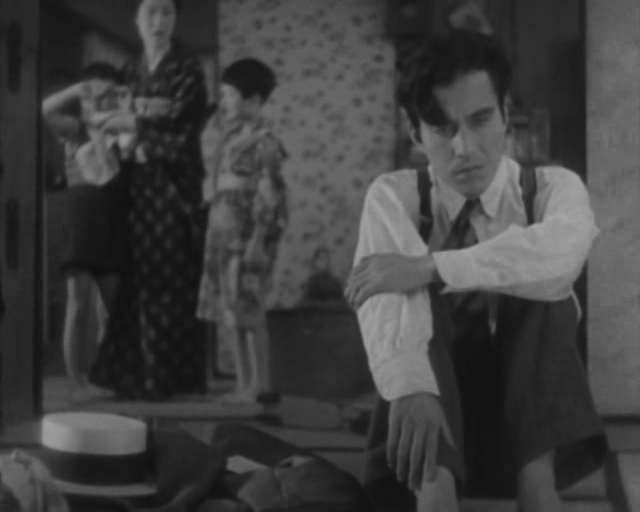
1931 and this is already Yasujirō Ozu’s 22nd film and one which, stylistically, isn’t a million miles away from his later work. This is deceptively simple story telling but it is so deliciously subtle. A father returns home from being sacked and has bought his son a scooter rather than the bike he promised, the boy is angry and the two fight with the father smacking the seven-year old in frustration. The mother arrives back and asks her husband to apologise, he shows her the letter… immediately she understands and the children, having glanced at the note turn it into a paper plane and start playing catch. The father decides to buy the boy his bike even though they are facing tough financial straits…

Everyone in this scene has a narrative line, even their baby and the boy’s sister… Ozu is showing the family and all of its parts reacting to the bad news about the job and the bike. It’s not over-dramatized and there’s no “heroic” focus on the man; even though he’s the provider, it’s a family problem and husband and wife will face this together.


This is why Ozu is such a compelling film-maker, even in his silent period when he was still experimenting with style. He lingers on interiors as he will in later films and occasionally cuts away to a brief shot of sunflowers or a washing line… both adding extra impact to the events and emotions in side. The first time I saw Ozu I felt I was viewing a strikingly-foreign culture but now I see more universal themes and some of the best acting you’ll find whether it’s the indefatigable Hideo Sugawara (who was indeed seven) to the middle-aged Tatsuo Saitō.

The central couple are played by Tokihiko Okada as Shinji Okajima and Emiko Yagumo as his wife Sugako. Okada has a comic touch and is Harold Lloyd-handsome able to gain our sympathy as the slightly devil-may-care insurance clerk who argues with his boss against an elder colleague’s dismissal. Emiko Yagumo has a kind, patient face and carries her character’s emotional responses carefully, showing them in devastating slow-release.

The film begins with a group of youths in the exercise yard with their sports teacher, Ōmura Sensei (Tatsuo Saitō) who is exasperated with one out of step student… Shinji who is late and has forgotten his underclothes. Cut forward a few years and Shinj is working as an insurance clerk and promising his son a bike on the basis of his annual bonus.

Battle of the fans
Ozu plays the humour so much we aren’t braced for the dramatic turn-about as Shinji, handsome bonus in pocket, tries to stand up for his older colleague Yamada (Takeshi Sakamoto) who has been sacked on some jumped up pretence. Even his confrontation with the company President (Reikō Tani) is semi-comic as he steals the latter’s fan to make his point only for his boss to pull out another to retaliate.

But there are serious consequences beyond just his failure to buy a bike… the family are about to suffer tough times as jobs are as scarce in Great Depression Japan as anywhere else and as their daughter Miyoko (Hideko Takamine) falls ill, they have to sell Sugako’s kimonos to pay for her care.

In themes reminiscent of The Crowd, the film deals with gradually eroding hope and self-esteem as Shinji has to do anything he can to earn money no matter how humiliating. Throughout we see the family unit hold strong despite petulance from their son (the remarkable Hideo Sugawara who was also to feature in I Was Born But… (1932)) whose spirit will no doubt hold him in good stead…

Facing up together
Cyrus Gabrysch accompanied matching the deceptive, controlled movements of Ozu’s story with figures of his own; period-appropriate arpeggios that carried wistful force and fast-fingered phrasing that echoed the detail in every frame. Those moments when the characters are seemingly still are the ones with the most happening: Shinji and Sugako looking downwards, both in profile as the weight of responsibility for the happiness and survival of their family bears down. It was all captured in Cyrus’ themes too.

The Bioscope is known for it’s excellent accompanists and we also had Meg Morley playing alongside two unusual late period films whilst John Sweeney saddled up alongside Texas Guinan…

Texas was the real thing (or is that “thang!”) a ranch gal (there I go again) from Waco, who could ride and shoot as good as any man on her father’s farm. Michelle Facey’s gone to the heart of Texas and in her introduction revealed how Guinan toured as an itinerant rodeo performer before the stage (not that one…) called. She featured in vaudeville were her pep and knack for self-promotion stood her in good stead: she once claimed to have accidentally shot herself in the side, but the show still went on, it being just a flesh wound an all. She was still a chorus girl in 1917 and as she road a horse down the runway in the theatre she was talent spotted by a movie man.


She had made dozens of short films by the time of The Girl of the Rancho (1919) a tale of thwarted cross-cultural romance in which a Mexican bandit kidnaps Guinan’s young sister to try and blackmail her into loving him. This amorous motivation was excised from most versions of the film and the emphasis was on the abduction which seems to happen for almost no reason. It’s a rip-roaring tale with lots of action: Texas fights, she shoots, she rides and she outwits all around her.

Mr Sweeney formed a piano-posse of his own and galloped along with thunderous intent.

Time for some poetry? Youth, Beside the Lonely Sea (c. 1924-25) was based on the poem, originally entitled Voices and Visions (1893) written by American writer Thomas Bailey Aldrich. It was a dreamy, bitter-sweet ode to old regrets and a call to never lose youthful wonder in the World… part of the reason we all come to the Cinema Museum. It made startling use of a triptych – before even Mr Gance – with a young soul growing old and almost losing touch with his fairies.


Things got even more surreal with painter Boris Deutsch’s only film, Lullaby (1929) which, whilst it focused on the harsh peasant life in Russia also delivered nightmarish visions to torment a young woman charged with minding the baby for her careless elders. If Lotte Eisner had seen this she might have revised her fixed limit to expressionist films. It’s lovely stuff and all illuminated with spritely precision by the deft touch of Meg Morley on keyboards.

Sweet dreams? Lullaby
Tonight was so engaging that it – almost – made me forget that Liverpool FC were playing Roma in the semi-final of the Champions League: we won 7-6! Cinema Museum: You’ll Never Walk Alone.

PS Some more of that Ozu magic...
 
Others are being called to work
The outside world intrudes
The family that plays together, stays together.