Sunday, 12 October 2014

Unimaginable… Damn the War! (1914)/ Airship Over the Battlefields (1919) w Stephen Horne, LFF, BFI


The first silent offerings at this year’s London Film Festival and a double bill juxtaposing a film imagining what a modern war could be like with one documenting the devastation after four years in which the mechanics of modern destruction had taken their horrific toll. One was a sad, technically-impressive drama and the other was reality almost beyond belief:  the smashed ghost towns of northern France and a land pock-marked with craters and scarred by the still-open wounds of never ending trench-lines.

Albert Hendrickx, Fernand Crommelynck, Suzanne Berni, Nadia D'Angely and Baert
Released in May/June 1914, just a few short weeks before the real war began, Alfred Machin’s Damn the War! (Maudite soit la guerre) was a plea for peace as Europe began to look far too small to contain the ambition within. A Belgian film directed by a Frenchman, the ironies can hardly be stacked higher given the Schlieffen Plan.

Machin’s film involved a war between two fictitious countries and the impact it has on the Modzel family as their son’s best friend Adolphe Hardeff (Baert) fights on the opposing side to their son, Sigismond (Albert Hendrickx). To add further spice their daughter Liza (Suzanne Berni) is in love with Adolphe.

Adolphe says farewell to Liza
Adolphe comes to train with Sigismond’s air squadron returning the favour his country had extended to his new comrade. Sigismond takes Adolphe home to meet his parents, Mother (Nadia D'Angely), father (Fernand Crommelynck) as well as his swell sister. The training goes well and relations all round are good but, out of nowhere, war is declared and the two friends find themselves on opposing sides.

Adolphe doesn’t believe in the conflict and hands Liza his photograph with the words “damn the war!” written on it. But he’s a professional soldier and he will do his duty.


The film looks sumptuous and has been restored by the Belgium film institute not just the print quality but also the coloured sections produced using a painstaking approach involving the stencilling of colours onto every frame. Two stencilled prints were used and one black and white: the result is stunning – the Edwardian era in colour.


The colours work especially well in the battle sequences, highlighting the troop movements as hundreds of Belgian army extras move into mock charges. There’s also an explosive sequence as Adolphe leads an audacious attack on an airbase, destroying a range of balloons and turning the screen red.

Sigismond is sent up to intercept Adolphe’s plane and succeeds in knocking him out of the sky, the two friends move closer in their unknowing pursuit of each other as the forces gather around a cornered Adolphe…  the heroic qualities of both men come to the fore and no one is getting out of this alive.

Lieutenant Maxime romances Liza
One of Sigismond’s squadron, Lieutenant Maxime (Henri Goidsen), delivers the news back to the family. He takes an instant shone to Liza and as time passes they grow close but there’s to be one final twist of the tale as the full human cost of the conflict is finally revealed…

Just off the plane from Pordenone, Stephen Horne illustrated the story with his trademark lyricism, with flute, piano and accordion used to good effect: intricately stencilled sounds to highlight this colourfully-sad vision of a war that might come…

Jacques Trolley de Prévaux
After the war that did happen, Airship Over the Battlefields (En Dirigeable sur les Champs de Bataille) was filmed in the summer of 1919 using a navy airship piloted by Jacques Trolley de Prévaux. The main cameraman was Lucien Lesaint although others were involved.

Introducing, the BFI’s Bryony Dixon, said this was part of a series of initiatives aimed at reminding people of the horrors of The War to End all Wars. The full film is 78 minutes long but we were shown about a third of that - enough to give full flavour of the scorched earth even nine months after the armistice.


Not even a spring and summer could return the leaves to so many of the trees, and the only real signs of renewal on this toxic ground were the new roads driven through flattened towns and blasted battlegrounds which even today still give up their annual harvest of unexploded ordinance.

Looking at the towns was like a flash forward to Dresden or Coventry, even Hiroshima, so expertly had the bombardments levelled almost every building. Town after town came into view and you kept one expecting to see something whole but there was nothing there but a few robust walls on roof-less buildings with empty windows all propped up by rubble.

The Great War is often characterised as a contest of military forces against each other – yet the huge “collateral” impact on non-combatants was there for all to see.


This was a difficult film to soundtrack and Stephen Horne used an electronic keyboard along with his piano to play moving accompaniment. His playing was sparse and restrained, subtly echoing the horrific implications of the destroyed landscapes on view and bringing out the humanity from the cathedral husks.

Both films will live long in the memory and for different reasons. Damn the War! may have been a fiction but if more people made films like Alfred Machin’s, perhaps we wouldn’t have to watch films recording the impact of conflict.

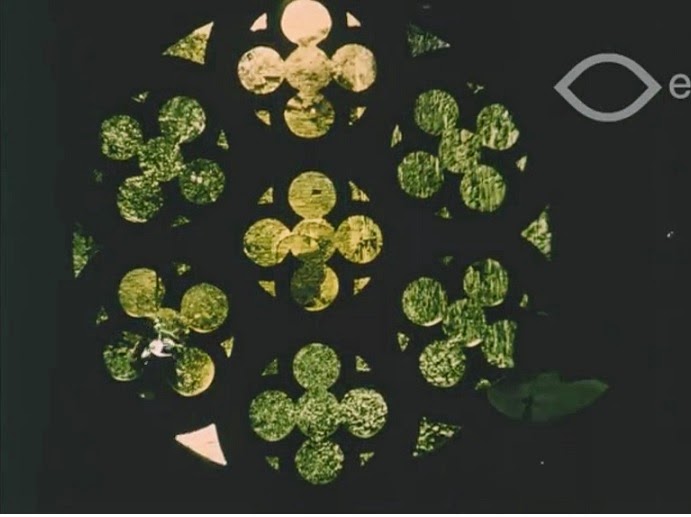
A version of Damn the War! is available on the European Film Gateway courtesy of the EYE Film Instituut Nederland. It's an unusual visual treat as the bonus screen shots below show...

Thursday, 9 October 2014

A game of two Talmadges… The Heart of Wetona (1919) vs Secrets (1924)


Of all the major stars of the silent ere – and I mean major - Norma Talmadge seems to be one of the hardest for modern viewers to connect with. Jeanine Basinger* is particularly good value of this point suggesting that whilst sister Constance had a definite persona that rises above her films, Norma was a more protean presence dependent on the strength of her material and that material was very much attuned to the tastes of the time.

For me, there’s no doubt Norma was the better dramatic actress, had greater performing ambition and more range – no matter how much I love “Dutch” as well. Her controlled expression was certainly put to good effect in Going Straight, Smiling Through and The Devil’s Needle and even lighter fare such as The Social Secretary. She could hold the camera’s gaze as well as Mary and Lillian and she was more womanly-grown-up than either and maybe that’s part of the problem.


Norma was often cast, even by herself,  as a lower middle class woman in situations of moral compromise and the audiences lapped these films up even if now their story lines are too over-used to generate much dramatic impact , no matter her skills as an actress. Perhaps she and husband/producer Joseph Schenck targeted the Norma Talmadge Film Corporation too firmly at their winning formula: the popular middle ground?

And how tastes change.

These two films represent extremes of Norma’s career: one an almost risible western and the other a far classier affair well directed by Frank Borzage and allowing the actress to really show her ability. They show what she could do and what she clearly chose to do and the day job served her very well…

Wetona worries...
The Heart of Wetona (1919) features Norma as the daughter of a white mother and an Indian chief Quannah (Fred Huntley), she has been educated in the East but still speaks in broken English… This is a film about the nobility of the savage as well as their hot-headed-ness and adherence to strange old religions. Of its time… naturally.

It’s also a remarkably frank film in terms of young Wetona’s sex life. She creates a scene at the tribe’s tribute to their gods by revealing her inappropriate casting as their “vestal virgin”: she has been having relations with a white man and father, severely unimpressed, plans to exact messy retribution.

Gladden James looking shifty
The guilty man is irresponsible Anthony Wells (Gladden James – who always looks a wrong ‘un) a young man who avoids responsibility at every turn in spite of the patronage of Government agent, Hardin (the asdmirable Mr Thomas Meighan).

Hardin offers to take responsibility until such time as Hardin is “ready”… it sounds a bit vague but we get the drift. Wetona goes along, her faith in Tony remarkably unshaken… even though we’ve worked him out long ago.

Wetona about to fail the vestal medical...
No spoilers… you can probably work it out for yourself. Needless to say, James is suitably craven, Huntley is a very noble savage and Meighan is excellent as the stand-up, stand-by guy.

Norma has a lot of screen time and a fair amount of close-ups to allow her to show her skill but the story rings slightly false in spite of some genuine conflict and peril, most of it constructed on narrative sand…  That face simply isn’t given enough emotional to work with and the close-ups only serve to remind the viewer how much real drama is missing.

Thomas Meighan and Norma
The Variety reviewer was unimpressed…  “…it is hardly a star part for Miss Talmadge. To be sure she is the pivotal character about which the plot revolves, but the role is purely a receptive one, and she is called upon to do little but pose as the bearer of the heavy burdens.”

Then again, Edward Weitzel was more positive in Moving Picture World, January 4, 1919 “…none of her impersonations has revealed deeper feeling or a better understanding of the art of acting. There is never the slightest doubt in the mind of the spectator as to what Norma Talmadge is trying to convey. …she is picturesque and beautifully human…”

See… even then “… the bearer of heavy burdens…” but "...beautifully human..." all the same.


Secrets (1924) is an altogether more satisfying film not just because of a superior story but obviously through Borzage’s inventive direction which provides a much richer dramatic scope. Based on a stage play – itself adapted from an opera – the film starts in the present and works forward from the past in a clever script from Frances Marion.

It’s 1924 and Norma is seventy-something Mary Carlton anxiously waiting for an improvement in the failing health of her husband John (Eugene O’Brien). She barely looks like Norma (30 at the time) and, even through the poor quality haze of the Silents are Golden DVD, she is clearly relishing the range of this role. She begins to look through her old diary and drifts off remembering her earlier life…

Norma goes from 1924 back to 1865...
We’re whisked back to 1865 when a 16-years old Mary is being prepared for a ball by her mother (Emily Fitzroy) and aunt. This is the lightest-hearted part of the film and there’s much fun to be had with the application of various large constructs that form parts of the tent-like evening wear… The joviality stops when Mary’s father, William (George Nichols) reveals that he has discovered her nascent affair with one of his clerks (O’Brien).

George O'Brien and Norma Talmadge
Mary is locked in her room but decides to elope – on a penny farthing no less – with young John and to head off for America…

Five years later and the couple have established a home stead and have a small baby. A doctor calls to tend to the sick infant and reveals that a gang led by local ruffian Jack are intent on gaining revenge on him for his part in capturing one of their own.

The gang duly arrive and John defends house supported by Mary who refuses to let him sacrifice himself. The tense battle is lent further poignancy when Mary discovers her baby has perished and confirms the death by using a mirror to try and detect any signs of breathing… the saddest of silent mimes. Realising her husband must fight on, Mary cuddles the dead baby pretending that he is asleep…and  you’d have to be made of granite not to be moved. Talmadge handles these moments with incredible grace.

Holding a mirror up to life
Moving forward to Mary’s 39th birthday in 1888 we hit one of the missing sections of this copy4 – by now Mary has three more children Blanche (Alice Day), Audrey (Mae Giraci) and John Jnr (Donald Keith – Merton of the Movies himself!). She has also been reconciled with her family.

But another crisis takes place as her husband’s affair with one Mrs. Estelle Manwaring (Gertrude Astor) is revealed by her parents. Matters come to a head when Estelle arrives and brazenly asks for Mary to let John go, claiming that she has ruined his life and cannot make him happy… it’s a point of view but we wonder what the steadfast Mrs Carlton could possibly have done…

Gertrude Astor, Donald Keith and Norma Talmadge
Mary being Mary she offers to let John go if he truly loves Estelle who senses victory only to have her hopes dashed as John returns and decides no contest… Norma’s performance of quiet resolution and dignity is persuasive and genuinely moving…

The scene shifts forward to the present day: will there be one last act for Mr and Mrs Carlton?

“It is a work of art, deftly handled with a divine touch that makes it stand out as one of the greatest screen characterizations in years…” raved Variety, before continuing...“The direction of Frank Borzage must be credited with a great part in the success that the picture is certain to have. He has taken Miss Talmadge and handled her in a manner that makes her reveal artistry such as she never displayed heretofore…”

Silent scream
Photoplay agreed saying that “The photography, particularly in the first part of the picture, is touched with real loveliness. And the scenario, by Frances Marion, is always searchingly human. But it is the personality, and the ability of Norma Talmadge that makes this a thing worth seeing.”

This final point takes us back to Jeanine Basinger’s comment: but here it was not just Norma’s talent that was engaged – there was a very personal investment in the performance that gave it such integrity. An actor must draw on personal experience to convince but there’s always control. Maybe with the right combination of director, script and circumstance, Norma Talmadge really put on a show?


We should see more… unfortunately only Wetona is currently available on DVD and it is to be hoped that Secrets and Norma's other film with Frank Borzage, The Lady (1925) will someday get the release and restoration they deserve.

*In her book Silent Stars - essential reading!
** Press comments lifted from Greta de Groat's superlative Talmadge site. Go straight there now!

Saturday, 4 October 2014

Paris in the dreamtime… Paris Qui Dort (1924)

 
A recurring dream of my childhood involved the world or at least Merseyside, “stopping” enabling me to walk freely amongst the statuesque neighbours, classmates and teachers… I enjoyed the liberty although I can’t remember the narrative going much further than pushing Timothy Pollard off his bike…

I don’t know how common this dream is but back in the Dadaist days of the early twenties, René Clair was expressing the same fantasy for his first film Paris Qui Dort (also known as The Crazy Ray).  The magic still works for me with the added thrill of seeing this most overcrowded of cities almost completely empty, all roads and avenues quiet and inhabited only by people asleep or frozen in stop-motion. A tourist’s dream: the Louvre without the queuing, Notre Dame without the camera phones and the Champs-Élysées without manic traffic and distracted, slow-moving pedestrians…


But what would you do with your time and without human interaction, how long would the fun of freedom last?

The story begins with the Eiffel Tower’s night watchman, Albert (Henri Rollan) awaking to find an unusually quiet city below him: he stares out but cannot hear or see a living thing. He runs down the Tower’s stairs (pre-figuring Alec Guinness’ panicked descent in The Lavender Hill Mob…) to find the streets emptier than the earliest of Sunday mornings (when did they film the silence?).

Stop motion
At first he’s thrilled by the novelty, a drunk leans frozen against a window, a policeman is just on the point of catching a thief and a man on the point of suicide hovers over the Seine bankside… human life interrupted in the course of its everyday process.

Meanwhile a plane lands off-loading a group of very awake passengers: the pilot (Albert Préjean, later to feature in Under the Roofs of Paris), a rich man (Antoine Stacquet), the glamorous Hesta (Madeleine Rodrigue) and an international thief (Marcel Vallée) accompanied by a detective (Louis Pré Fils). The group walk past frozen airport staff and drive into Paris in disbelief.


By this time Albert has grown a little bored of being on his own and he welcomes these animated people with relief. They head off to the rich man’s house where he is shocked to find his wife caught in an amorous tableau with her lover…

After some more examinations of Parisians asleep the party make themselves to a café: what better thing to do when you’ve the freedom of a sleeping city but get drunk. They take the best wine on offer and Albert homes in on Hesta, stealing clothes and jewellery to impress her.


After the debauchery is concluded the party is seen high up Eiffel Tower in some vertiginously impressive settings: playing chess, picnicking and in the Pilot’s case, hanging off the side of the girders. They’re wearing fine clothes and have an excess of money and jewels… boredom is setting in.

And, when men are bored… their attention shifts to the only woman and pretty soon all of them are fighting over Hesta with Albert and the Pilot in the most energetic confrontation… Is this really the future of free will?


Just as they’re about to knock themselves off the heights, Albert hears a faint voice on their radio: there’s someone else awake in Paris and they want to meet.

Following the radioed instructions, the group makes its way to the house of a young woman (Myla Seller) who explains that her scientist father (Charles Martinelli) is the cause of the city’s sleep and that she needs their help to stop him. They follow her inside and make a grab for the man who, like all truly mad scientists has overlooked the impact of his experimentation.

Myla Seller requests silence
He explains how his ray had covered the lower-lying areas of the city and induced the sleep with Albert and the airplane passengers escaping as they were too high up to be in range. The only problem is; he hadn’t worked out a way to reverse the process…

The Professor explains...
We’ll leave the scientist working frantically on corrective sums and you’ll have to find out for yourself if Paris was ever re-animated. The meat of the story is already in Clair’s impressive set-up and I wonder if his point was not so much about the consequences of total freedom or just the excitement of its possibility?


He’s helped by some amazing city shots from cameramen Maurice Desfassiaux and Paul Guichard who help to paint a convincing picture of a city robbed of consciousness and of the daring Tower-side recklessness of the group.

The film is included as an extra on the Criterion edition of Under the Roofs of Paris* making it doubly hard to resist. It’s available from Amazon.com as well as direct.

*Reader, I was so close to entitling this post Under the Snooze of Paris... sorry.

Wednesday, 1 October 2014

Murray Mae but Rudolph will... The Delicious Little Devil (1919)


Long believed lost, this film was rediscovered in the early 1990’s and is a precious example of early Rudolph Valentino as well as the bee-stung lips of Mae Murray. This was Murray’s twentieth film and she certainly has star billing out-pouting Pickford (as you’d expect) and throwing herself around like a ditzy dervish.
Mae in full flow
Murray had a few years on Pickford and her performance background had been dance rather than straight drama. She was part of Vernon Castle’s troop on Broadway, became a star in the Ziegfeld Follies and then made her first film in 1916 at the grand old age of 30… Movement aside – and there’s no denying the sheer zest! – Murray had great timing - she wasn’t quite the actress Mary was but then who was?

Here she’s ranges from delicious to quite demented in a vehicle high on laughs and improbable, knowing, narrative. She’s not really a devil but she pretends to be…

Edward Jobson and Rudolph Valentino
Mae plays Mary a youngster with a good heart and an irrepressible joie de vivre that makes it hard for her to hold down regular employment. She gets a good job at a hotel but can’t resist play-dancing with one of the guests shawls… her co-workers are impressed and listen wide-eyed to her story of a childhood of carefree spinning in what looks suspiciously like a medieval European town… but her boss is not and he fires her on the spot.

Back home she lives with her mother and Uncle Barney McGuire (Richard Cummings) with her father Patrick (Harry Rattenbury) seemingly too lazy to be bothered even living with either child or wife?

Ma,Uncle Barney and Mary
Paddy turns up when he’s told there’s a new wage-earner in the house only to be disappointed as she has quickly re-joined the ranks of the unemployed… What is she to do?

Meanwhile, over at the out of town Peach Tree Inn, manager Larry McKean (William V. Mong) is trying to think of the big idea that will save the joint from closing. Talking with aged owner Mr Musk (Burt Woodruff) and his wife (Martha Mattox) he comes up with the idea of a new jazzier approach led by a woman with a dark past (and a bright future…). He’s looking to bring a touch of sophisticated sleaze to the suburbs.

"A good future for a girl with a past."
Mary sees this intriguing ad in the local paper (Press advertising to the rescue again!) and finds a backstory for her non-existent “past” in the strange tale of the Duke de Sauterne who has been causing a scandal in Europe romancing a famous dancer, Gloria du Moine, who has left him and gone into hiding.

Mary turns up at the auditions to find Larry rapidly offending a long line of dancers thereby narrowing the odds to an elegant tall woman (Gertrude Astor) applying too much foundation and Mary who stands below the lady grabbing as much of the cast-off dust as she can.

Larry falls for it... never sell to a salesman eh?
Mary clumsily slips and looks to have lost her chance until her wayward syncopation gets the band playing some righteous rag-time. Mary jitters around and Larry is impressed… all the more so when that phoney history is revealed.

Mary’s opening night is a hoot as she descends down the Peach Trees long staircase to perform the Peacock Walk; her own creation. For all her moves, Murray plays this for laughs, especially as she almost gets stuck after bending over backwards just a little too far.

The Peacock Walk almost ends with a cramped crab...
Amongst the audience is young Jimmy Calhoun (fresh-faced, mascara-encrusted Rudolph Valentino!) who is instantly impressed with Mary’s flexibilities. He is the son of construction tycoon, Michael Calhoun (Edward Jobson) a self-made man expecting perhaps too much of his son and heir.

Jimmy romances Mary and all looks good until Dad tries to show her up at a dinner party – he thinks she’ll drink too much and make a fool of herself but Mary doesn’t drink – not even to maintain her exotic cover story – and she doesn’t rise to the bait, much to her dark-eyed boyfriend’s pleasure.

What an absolute cad!
But the evening takes a turn when the Duke de Sauterne (Bertram Grassby) arrives to reclaim his girl. Turns out the Duke is no gentleman at all and had to leave Paris after his many misdemeanors were in the process of catching him up.

Mary and Jimmy eat carefully...
Spotting the fake du Moine he doesn’t let on, clearly fancying his chances of leveraging his knowledge to disreputable effect…


Will Mary get revealed as a good girl with a bad future and will gentleman Jimmy manage to win her in the face of the Duke’s aggressive persistence… even if he does will his father let him marry so far below his station? There’s a lengthy car chase, some fisticuffs and a chance reunion that combine to settle things in a frantic closing section.

Crickey, Jimmie's a bit macho ain't he?!
Robert Z. Leonard directs Harvey F. Thew’s scenario with pizazz and it’s an energetic hour of top-notch tom foolery. Murray maybe didn’t have the striking USPs of the top tier but she acts very well and, excessive face-pulling aside, makes for a very likeable little devil.

Mr Valentino performs longing looks to no doubt dazzling effect in spite of the heavy make-up of the time. It’s Murray’s film but clearly we’re going to see a lot more of him!

I watched the Milestone DVD (the film is on a double disc with Swanson Valentino film Beyond the Rocks) which features a sprightly performance of a 1922 cue sheet by the Mont Alto Motion Picture Orchestra! Milestone and Mount Alto always do right by these precious little devils.