Saturday, 16 February 2013

Yevgeni Bauer’s debut - Twilight of a Woman's Soul (1913)

Nina Chernova
This is a striking debut from Bauer and one of the most advanced films I’ve seen from 1913.

There are some wonderful compositions using the director’s typically well-designed sets through which his actors move through amazing shifts in light and tone. It also features possibly the earliest tracking shot as the camera follows the main character, pulling the viewer and their sympathy behind the troubled young woman.

The first dolly?
As ever with Bauer it is somewhat unsettling to view his tales of aristocratic ennui in a country that hardly knew itself. Within a few years, the way of life he depicts will have disappeared forever as Russian society – perhaps the most divided in Europe – is re-worked by the Great War and the Bolshevik revolution. Sadly the director himself was to face oblivion before this event was settled.

Bauer did have sympathy for the revolutionary cause as his later films show and, whilst here he depicts some of the underclass as criminal, there's none more listless and decadent than the idle rich, with their pointless parties and affordable morality...

Depth, design and despair
The film centres on Vera Dubovskaja (Nina Chernova) a bored young woman who has lost her taste for the endless frivolity of her privileged lifestyle. Her mother cajoles her through a party which takes place in amongst the first of what was to become Bauer’s trade- mark multi-layered sets.

Vera is seen reluctantly joining in with the party and then breaks away from the dancing and moves camera-forward to rest on a chair where she is briefly harassed by two male admirers. Shoo-ing them away she stands and walks down set to be followed briefly by Nikolai Kozlovski’s camera – a short, stunning moment of film history.

Let there be more light...
But even without his moving lens, Bauer used lighting, mis-en-scene and well-choreographed performers to create a real sense of depth and movement. In Vera’s bedroom she is almost detached from the World bathed in blue-tinted light behind a gauze drape, she gets up and moves through the flimsy barrier to open her curtains and be illuminated by the daylight streaming through.

Vera’s mother takes her to give aid to the poor who seem pre-occupied by drinking and gambling… society no doubt to blame but… In the shadowy loft they encounter Maksim Petrov (V. Demert) who pretends to have injured his arm, Vera’s applies a bandage and Maksim correctly spies a sucker.

Vera in the slums
He leaves her a letter – breaking into her room in the dark and tells her he is in need of help. We see Vera making her way through the slums as Maksim looks down from his loft. There’s great shot from on top the building tracking Vera’s hesitant progress she looks afraid and very vulnerable…

In Maksim’s flat the tale takes its pivotal turn as Vera is raped and ends up killing her assailant as he falls into a drunken stupor… Bauer doesn’t show specifics but enough to make the audience aware what outrage has taken place.

V. Demert and Nina Chernova
Vera returns home knowing that nothing will ever be the same again… she stands distraught in the former comfort of her room.

But, over time, she returns to society and meets the handsome Prince Dolskij (A. Ugrjumov). The two start a romance but Vera starts having visions of the man she murdered and falls ill. Recovering she prepares herself to tell her love the truth…


But the Prince, seemingly prepared to forgive her anything, is unable to process the full extent of her news… particularly the fact that she has “known” another, no matter the circumstances – in the context of the time an obviously difficult situation as the film acknowledges.

The Prince casts Vera out of his life and by the time he relents and realises the mistake he’s made, it is too late and she has gone. He spends a fortune on trying to find her but the private detectives comes can find nothing.

A. Ugrjumov and Nina Chernova
Spoilers ahead: The years pass and Vera has changed identity becoming a famous actress. There are some stunning shots of her curtain call – a confusion of pink light – and her dressing room, again bathed in pink.
By chance an almost exhausted Prince has been persuaded to attend the theatre and he looks on in astonishment recognising his lost love.

Will they be reconciled? And is it the twilight for more than one person’s soul?


A fascinating historical document, Twilight of a Woman's Soul shows how many of Bauer's techniques were already in place as well as how far he would travel by his later films – After Death (1915) and A Life for a Life (1916) are covered elsewhere on the blog.

Nina Chernova acts well as the tortured star and never drifts overboard... understated and naturalistic.

What a remarkable culture Russia had at this time, so sophisticated and European – the nobility often spent more time in France than Moscow – and yet so near to societal collapse. The seeds of revolutionary wildfire were laid long before this period though and the fateful catalyst was mere months away when this film was released.

I watched the BFI DVD which contains The Dying Swan along with After Death and a nifty video essay by Bauer expert Yuri Tsivian. It's available direct from the BFI site.

Monday, 11 February 2013

Dreyer's Devil… Leaves Out of the Book of Satan (1920)

Helge Nissen
“Satanas who must tempt mankind, in obedience to the Divine doom.”

Carl Theodor Dreyer once dismissed this early work as "a dreadful collection of oil prints", but there’s enough here to show his cinematographic flair and sheer ambition.

Leaves Out of the Book of Satan (1920) (Blade af Satans bog) is a portmanteau film made up of four tales, each of which shows the impact of Satan’s evil on Man’s choices. Satan is painted as the fallen angel who desperately wants to return to Heaven yet his God is unforgiving and sets him the task of testing mankind… for every failure Satan gains an extra 100 years’ torment but every success will knock a millennia from his sentence… it’s a tough job but someone has to do it.

One of the "dreadful collection of oil prints..."
Influenced by DW Griffith’s sprawling Intolerance, the Dane set out to make a similarly multi-stranded morality play but with a more linear structure than the former’s inter-linked, time-shifting narrative. I don’t know enough about Dreyer’s spirituality to gauge his motives in making this epic fable but it is a theologically interesting film and political too with the last two sections reflecting the post-war concern with the right to rule.

Helge Nissen
Helge Nissen plays Satan/Satanas in all four stories and is excellent throughout: a mixture of regret and rigour informing his endless evil doing… no one gets let off the hook easily and all are tested to the ultimate degree.

1st section: Christ's betrayal

This section shows the days leading up to Jesus’ arrest, and contains many faithful quotations from the scriptures, Dreyer revealing his trademark fondness of original source material.

All the best tunes?
There’s an interesting and subtle take on Judas (Jacob Texière): not an evil schemer as such but a man of principle, who wants the cause to succeed… His doubts lead him to betray Jesus (Halvard Hoff) or is it pride? Either way he is helped on his way by Satanas who poses as a pharisee.

This section features some lavish tableaux and looks like an 18th Century religious painting with the scenes around the Last Supper and the Garden of Gethsemane are acted out to the letter of the scriptures.

Halvard Hoff
The main divergence from classicism is a modernistic portrayal of Judas’ horrendous guilt… how much simpler to cast his as a man of pure selfishness and evil: here he looks to throw his thirty pieces of silver away…

2nd section:17th Century Spain

Dreyer focuses on the well-to-do family of Don Gomez de Castro (Hallander Helleman) a man of learning who is takes a scientific interest in new discoveries including those concerning the movement of the planets and their influence on our earthly lives.

Hallander Helleman (left) Ebon Strandin (right)
His daughter Isabel (Ebon Strandin) is taught by Don Fernandez (Johannes Meyer) a priest, who has developed a most un-holy obsession with the girl.

Don Fernandez is strong enough to remove himself from temptation but falls under the thrall of The Spanish Inquisition’s Head Inquisitor (Satanas) who makes him responsible for the de Castro’s when they are bought in for questioning. The father is tortured but Satanas encourages the priest to do far worse to Isabel…

Johannes Meyer and Ebon Strandin
Dreyer covers the sexual undertones uncomfortably well – self flagellation followed by gratification but Satanas ensures there are consequences… How sordid the mix of spirituality and sensuality.

3rd section: The last days of Marie Antoinette

The longest section, deals with the French Revolution, the temptation to take advantage of the chaos and the nobility of the ancien regime… Dreyer paints Marie Antoinette (Tenna Frederiksen Kraft) as a tragic figure and given the revolutionary chaos on Denmark’s doorstep at this time, perhaps sympathy with crowned heads is not too hard to understand.

Tenna Frederiksen Kraft
Against this back-drop a smaller story plays out featuring the family of the Count de Chambord (Viggo Wiehe). He charges his loyal servant Joseph (Elith Pio) with protecting The Countess (Emma Wiehe) and their daughter Genevive (Jeanne Tramcourt).

Another of the Count’s former servants (Satanas again) leads him into joining the revolutionary movement and Joseph must chose between his love for La Republic and for Genevive…Yet, as he proposes, Dreyer cuts to a group of children playing at guillotining a cat… and even as Genevive declines we can sense that she is sealing her fate, even though the cat leaps free…

The haves and the have-nots...
Marie Antoinette’s situation nears the end and Dreyer quotes from her tear-stained final letter… Joseph appears to be her way out but his quick temper and her regal poise damn them both. This segment is the busiest and you wonder why the royal story had to run alongside the noble one?

It does however, look superb and, in particular, there are stunning close-ups of Satanas, Genevive and Joseph at the inquisitor’s trial … as the latter is finally forced to betray his aristo friends…

Elith Pio
4th section: Finish Civil War 1918

The final sequence is based in the Finish Civil War and here the film finally finds a hero.

Clara Pontoppidan
Satanas plays Ivan, a Rasputin type character leading the socialist Reds in the battle against the conservative Whites… This is an odd conflation of recent Russian history – Rasputin may have inadvertently helped discredit the Tsarist regime but he was no Bolshevik.

Ivan’s motley band of revolutionaries captures a White communication post run by Paavo (Carlo Wieth) and his wife Siri (Clara Pontoppidan). They try to force the couple to send misleading messages to entrap the White forces but they refuse.

The scenes with Siri and Paavo are very moving and Dreyer lingers for a very long time on Pontoppidan’s gentle, naturalistic acting – she’s great and, along with Nissen is the stand-out performer in the film.

Paavo looks on as Siri stays strong
Siri refuses to bend as Ivan orders her husband to be shot and then threatens to do the same to her children… her loyalty to God and country comes first.

Satanas looks heavenward, he’s finally found some relief in his eternal quest to find the good in Man… but he must continue to fight the bad fight...

Satanas and his book
Like many a “double album”, Leaves Out of the Book of Satan occasionally creaks in terms of continuity and concept: there are more than enough good ideas to make a single superb feature film but maybe not one with four “sides”.

Throughout Dreyer frames his shots beautifully. like the oil paintings he invokes and he moves his cameras around to good effect – on dollys smoothing around corners or following characters down stairs. Light and shadow are used to focus the narrative – as when Joseph proposes in the third sequence. Dreyer blocks the light and closes it round each character as they interact… and it is the same with Judas and Jesus in first sequence.

There are, as you’d expect… extensive close ups and there are also plenty of ordinary faces… the “ordinary” was important to Dreyer as, in spite of the high concepts, he wanted his history kept real.

Ordinary men...
As for the moral force of the production… it seems that Old Nick is not the one performing the evil deeds, he is simply the catalyst for choices made and not the instigator of human desire, a challenge to restraint that so many fail. For this subtle positioning of evil, Dreyer deserves credit for not preaching and for issuing this slow, drawn out challenge to his viewers…

“Anew is heard the voice from above: Continue thy evil doings!” Satanas is damned to test mankind’s will for eternity – only by resistance to his influence will he be saved.

No rest...
I watched the Danish Film Institute’s superb restoration which looks astonishingly clear and has a sympathetic new score from Ronen Thalmay who must have had very tired hands by the finish. It also comes with a short biography of the director and an alternative ending to the Siri sequence.

It’s available direct from DFI whilst I got mine from the BFI Shop.

Wednesday, 6 February 2013

Really free… Mantrap (1926

"Well well - a big boy from Away Back!"
There are no rules for this blog but if there were, they wouldn’t prevent me from writing twice about films of particular note.

Mantrap I covered in the “early days” (2011) and didn’t really go into much detail – I had seen a VHS copy and it wasn’t great... no more than a bootleg view of a great concert.  But now the film has been cleaned up and released as part of the Treasures from the American Film Archives: Volume 5: The West (1898-1938) box set, it’s worth another, clearer, look: you can certainly see more.

Clara Bow
Directed by Victor Fleming, Mantrap is a vehicle designed to allow Clara Bow to dazzle as she flirts with all around her… but far from showing a woman exploited, Mantrap actually shows a woman in control.

Watching with my blue stocking mother–in-law (she takes pride in that term!) confirms this and we got to considering how much 20s film helped in liberating women or at least changing perceptions. After all, even the 60s looked back to icons of the earlier decade, Greta, Louise and, of course, Clara. It wasn’t just their looks or their style it was their intelligence and self-determination.

Ernest Torrence
Clara snags herself a husband from the middle of nowhere but this is what she wants – it’s not an escape but a choice. Joe Easton played by Ernest Torrence (the bad prison cap’n from Captain Salvation) isn’t everyone’s idea of a leading man but he’s steadfast and smart and will just about do for Alverna. The intervention of disaffected city lawyer, Ralph Prescott (Percy Marmont) provides only a temporary destabilisation.

Percy Marmont
For a while he takes Alverna’s fancy but he’s not strong enough to see through her “rescue” and she’s already bored with him when hubby arrives to sort things out. Initially the two men are bargaining amongst themselves but after Alverna threatens to take off in Joe’s boat they quickly realise that the situation is not theirs to dictate.

Throughout Clara Bow is genuine and energetic: she is thoroughly naturalistic and effortlessly powers through this film with ease. Mantrap was one of her favourite films and you can see why. She has the central role, in spite of all the male introspection, and emerges with her free will intact at the end.

It’s a very entertaining film with first rate support from the wildly expressive Torrence and  the uptight sophisticate Percy Marmont (who I’d last seen getting bumped off by Peter Lorre in Hitchcock’s Secret Agent).

The film starts with Marmont’s character driven to the point of ennui by an endless succession of lucrative divorce cases and their endlessly needy divorcees. He’s had enough and needs to escape from woman kind.

Getting away from it all...
His friend, (Eugene Pallette, on the right), suggests a fishing trip to the wilds to clear the air and cement their friendship. Cut to the two men looking miserable sat drenched outside their tent as the rain falls hard on their parade.

Meanwhile, back-woodsman, Joe, has headed up to the big city where he is in a whirl of disorientated surprise. His eyes fall on a shapely ankle and the camera follows his gaze up to the owner… it’s Clara of course.

Clara Bow and Ernest Torrence
He follows the legs into a barber shop and orders everything on the menu just so long as Alverna is the one serving it up. The moment when Clara enters the salon and strolls majestically towards camera, drawing the eyes of all around her is the mark of a player at the height of her powers. So casually commanding and always with a twinkle in her eye that says, you’re in on this and we’re going to have some fun.

Alverna accepts Joe’s invitation to dinner and the two end up marrying and returning to Joe’s home. This is where they encounter Ralph who has been rescued by Joe from his miserable fishing trip. Ralph immediately recognises that he’s in trouble…

Clara Bow - City Girl or Lady of the Wildwoods?
You’d be surprised if either Ralph or Joe could win Clara’s heart under normal circumstances, but then this was part of the Bow phenomena – if these guys stood a chance with Clara then maybe you could too? Reciprocation might might – just might – be a possibility. All you needed was the chance and to be yourself… How many stars had this affect on their audiences?

You can measure Clara Bow against all the other stars but she was uniquely grounded in the reality of the everyday. In fact, she’d probably had it much tougher than you, so dust yourself down, pick yourself up and keep on… Energising and empowering what more can you expect from a true star?

Mantrap is available as part of the Treasures from the American Film Archives: Volume 5: The West (1898-1938) which also includes Al Jenning's Lady of the Dug-out as covered here.

Saturday, 2 February 2013

Wake up call… Hindle Wakes (1927)

Estelle Brody
You’ll have to forgive me if sometimes I’m a little behind… as a late-converter to the on-going viability of silent film, I was probably too busy chasing down the latest Pedro Almodóvar movie (or changing nappies)  when Maurice Elvey’s Hindle Wakes was revived by the BFI in 2000.

Well, 12 years on I’ve just staged my own revival and having raved about Asquith and Hitchcock’s silent work I now have a third British silent director to rank alongside them.

John Stuart, Humberston Wright, Peggy Carlisle and Estelle Brody
Based on the controversial 1912 play by Stanley Houghton, this was Elevy’s second go after a 1918 effort which also included some of the same actors.

It’s a disarmingly frank story of sexual freedom amongst working-class Lancastrian factory workers and, most surprisingly, shows one of the girls completely in control of her choices in spite of all around trying to force her to follow social norms. These were our grand-parents and, in my case, my Nan, was so powerfully in favour of her own right to decide she went as far as to take out an injunction to prevent the kind of parental control attempted here. She wasn’t alone.

Dark and satanic
This was the period of accelerated development of the labour movement whilst the Great War had brought women to the commercial fore as they worked the men’s jobs in factories and mills… it became harder to deny their importance and their equality.

This story must still have been a shock in 1927, hard to imagine how the play went down in 1912.

The Wakes were a regular tradition in the North when the mills would close down for a week and the workers had a week-off (unpaid) to enjoy a bit of freedom.

Get your clogs off
For many in Lancashire, then as now, the glittering possibilities of Blackpool were hard to resist. With three piers, dozens of music halls and a tower to rival Paris, it remains the UK’s ultimate seaside resort… if a little brash for some tastes.

But it is here that the younger workers head for their week of “ecstasy and freedom”. There are two young mill girls, Mary Hollins (Peggy Carlisle) – with her short, sharp haircut suggestive of a more earthy nature than her considerate and cautious friend Fanny Hawthorn (Estelle Brody).

Blackpool's Pleasure Beach
They meet up with two of their social betters, Allan Jeffcote (John Stuart) the son of the mill owner, and his mate, George Ramsbottom (John Rowal). It seems George has the better chance as Mary seems all together more forward with Fanny initially refusing to hold hands.

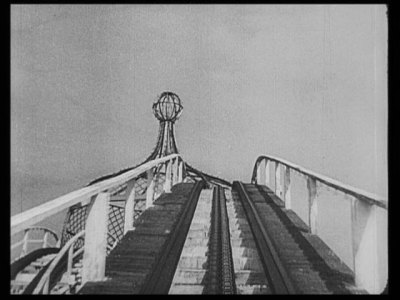
There are some fantastic scenes of the fun to be had on The Golden Mile especially on The Big Dipper (built in 1923 and still going strong) as Elvey’s camera bravely follows the actors up, down and around in a vertiginous display. But the director doesn’t overplay the location and keeps the emphasis firmly on the characters.

I want to see the bright lights tonight...
When it comes to evening’s end Mary goes home alone, repulsing her partner’s advances on the door step and it is Fanny who falls…

The next day she confesses all to Mary and reveals that Allan is to whisk her away to Llandudno. I’ve seen some reviewers be dismissive of this jewel of the Welsh Riviera but, having lived there, I can confirm that it is a cut above most resorts in the North West with a fine Victorian front and some excellent hotels (you can just glimpse the Grand Hotel where PM Macmillan once stayed and where I worked during two university summer breaks a long time ago…). Elvey takes his crew out to Wales and it’s good to see a brief glimpse of the Great Orme (home to the oldest copper mine in Europe) and the elegant bay that stretches around to the Little Orme (see what they did there?).

Llandudno, "Queen of the Welsh Resorts"
It is indeed the kind of place a well-to-do young man might take a working class woman and hope not to be recognised…

But Fanny’s plan to have her tracks covered by a postcard posted from Blackpool goes awry with the untimely drowning of poor Mary. Her friend’s death is almost secondary though, as the full “scandal” of her week with Allan is revealed and their families become concerned about the necessary “consequences”.

Peggy Carlisle and Estelle Brody
Fanny’s mother (played with bitter decisiveness by Marie Ault) want nothing less than marriage. Old man Jeffcote (Norman McKinnel, who also played the part in Elvey’s earlier film) is similarly-minded, even though it means he cannot unify his business with that of the Mayor, Sir Timothy Farrar (Arthur Chesney) who’s daughter Allan was engaged to marry.

Mrs. Jeffcote (Irene Rooke) has an altogether more pragmatic take and doesn’t see why her boy should have to marry beneath himself for this indiscretion. Whilst Fanny’s father  Chris, (Humberston Wright) – a man physically broken by a combination of his dedication to work and timidity – fears most for his daughter’s happiness. Long ago he could have taken shares in his mate’s enterprise but he was too risk averse… he doesn’t want his daughter’s life to be lived with the same compromises and the same regrets.

John Stuart and Gladys Jennings
All have different motivations and overlayed on this moral maze is the confused romance between Allan and Beatrice. It’s hard to take to Allan who, so close to his wedding, was happy enough to indulge in a week with Fanny and then, when faced with the consequences, expects to walk straight back to where he was. Beatrice (Gladys Jennings) does at least have some moral backbone, refusing to forgive Allan and insisting that he should make Fanny an honest woman.

Such sensibilities are not too difficult to relate to even over this distance. Class remains a massive issue in the UK and we still struggle with the idea that women can enjoy sexual freedom in the same way as men. Then as now the “moral” standpoints of various characters can be nothing of the kind, most are out for what they can get and are only trying to use convention to advance their own cause or to ignore the inconvenience.

Estelle Brody and John Stuart
Ultimately you side with Fanny’s father and his old friend Jeffcote: he may be a workaholic business demon but he recognises Fanny’s strength of character just as much as he despairs of his own son’s.
This is no black and white melodrama but a complex tale that defies expectations even over a century after it was written.

I’ll not give away the ending as this film deserves to be watched without preconception. The performances are exceptional especially from Norman McKinnel and Humberston Wright. But Estelle Brody gives a performance “out of its time” with naturalistic subtlety taking the plaudits: honestly, she’s far too good fer the likes o’ ‘im!


Elvey’s direction is inventive and sure footed with some sublime moments following the masses slowly whirling around Blackpool Tower Ballroom the spotlights playing across them as confetti falls almost in slow motion from the ceiling. The disorientation of a good night out… you can have your fun but mistakes can be made…

I watched the excellent Milestone DVD which comes with a very effective modern soundtrack from Sheffield band In the Nursery along with a more traditional piano score from Philip Carli. It's curious that this very British production is only available from the United States but they've done us proud.