Sunday, 31 July 2022

Do not miss… The Divine Voyage (1929), BFI 14th August with live accompaniment


If I were an architect and had to build a monument to cinema, I would place a statue of Duvivier above the entrance. This great technician, this rigorist, was a poet. Jean Renoir, Mémoires


Given the widely quoted proportion of missing silent film it’s amazing how much is still extant which can surprise, uplift and thoroughly engage. This mood-altering beauty, La divine croisière en français, was all but lost at sea and was splendidly restored in 2020 by Lobster Films from a variety of sources; an abbreviated nitrate print used for Pathé Baby 9.5 mm home cinema, four different 35mm fragments and two 17.5mm diacetate Pathé Rural prints including shots that were censored. The results are on the absolutely essential Cinema of Discovery: Julien Duvivier in the 1920s set from Lobster/Flicker Alley – nine films including Au Bonheur des Dames (1930) – which was released earlier this year: the uncovering of a veritable “cinematic Atlantis” as described by Serge Bromberg, Lobster’s leader.


Due to wedding commitments, not mine but the next generation are in a post-pandemic rush, I can’t make the screening but I would urge everyone who can to do so, book now, stop reading and go straight to the BFI website, you will not be disappointed with film or accompaniment; this is going to be a revelatory show.


Suzanne Christy and Jean Murat


There is so much pleasing late-silent technique on show from Duvivier in this film – Renoir’s “rigorist poet” in action – with a roving camera that moves in and out of buildings, follows crows as they race to the harbour side or to confront wrong-doing. Close ups of locals cast for face and rapid cutting that shows the influence of both Russian and German directors, not to mention intense close-ups that rival Dreyer for impact. The locations, Paimpol in Brittany, Louvigny sur Mer in Normandy and Ermenonville, now in a national park northwest of Paris, are superbly photographed and edited to create an impression of a people on the edge, battling unforgiving nature.


Against this backdrop Duvivier, who wrote and directed, presents a story of faith, bravery and class conflict. The film’s critique of blind capitalism is one of the reasons it was heavily censored at the time, and it begins with an act of desperate revolt when a mariner Kerjean (Henri Valbel) who has defaulted on his rent, attempts to assassinate unforgiving businessman Claude Ferjac (Henry Krauss), Ferjac in his chateau. Ferjac runs the town with a callous calculation and he will push the citizens to the brink before the story is through.


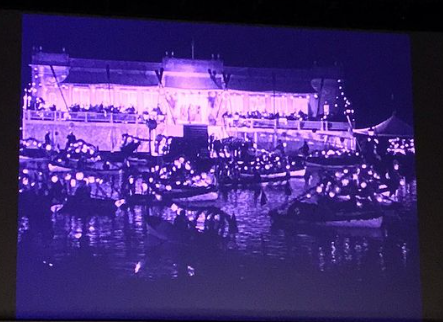
Almost the opening shot...


On the run Kerjean encounters Ferjac’s daughter, Simone (Suzanne Christy) who, for a few moments he considers killing her but she is a completely different proposition to her father who connects with the locals and shows compassion. We cut to the Kerjean’s house being emptied and see that his wife has killed herself… but none of this cuts any ice with Ferjac, who threatens a child who throws a stone at his limousine… property is more important than people’s lives.


Times is also money and Ferjac makes it clear to the local mariners that manning the insufficiently repaired La Cordillère is of far more importance than the risk to their lives. Captain Jacques de Saint-Ermont (Jean Murat) makes their case but he knows there’s no way of changing Ferjac’s mind. The meeting between the boss and the sailors shows the hatred and fear they feel for this man and the desperate calculations they have to make for their families.


There’s further intrigue with Simone romantically attached to Jacques and the two meet in the bay, separated by a fishing net, both trapped in their relationships with her father who will listen to no one be it the curate (Louis Kerly) or Jacques mother (Charlotte Barbier-Krauss, who also featured in Carrot Top (1926) also on the Lobster set and Duvivier’s favourite film.)


Simone and Jacques, caught in the net


The ship sets sail and includes the last-minute arrival of a mariner from outside the area, Mareuil played by Thomy Bourdelle who gives a stand-out muscular performance as the faithless opportunist upon whose actions so many lives will rest. Simone visits the Curate in his church and dedicates herself to repainting the frescoes and especially the painting of Maris Stella, she who is the “Star of the Sea”.


Things swiftly go awry on the voyage as Mareuil decides that stealing the cargo is the way forward – another heartless capitalist? – and persuades most of the men to revolt, throwing one unfortunate who refuses into the sea to drown. His group overpowers the Captain and his men, taking control just before the sea, as it was always going to do, erupts in a storm that would challenge even the finest of ships.


Back on land, the body of the murdered man is found and there’s a harrowing passage as his wife, Jeanne (Line Noro in her first feature film of what would become a long career) is told of the news and leads a march to confront the man responsible. Ferjac is busy hosting a lavish dinner party to announce the marrying off of Simone to one of his business contacts, she cannot even hold her glass to toast the depressing nuptials and then Jeanne arrives followed by dozens of the locals who are now convinced that the ship has sunk and there’s only one man to be blamed.


Roughhouse Thomy Bourdelle


NO SPOILERS!


This is only the narrative entrée though and the Divine Voyage is yet to really begin… there’s a magical realism at play and faith, fate and hate will all have their role to play as the full story enfolds.


Duvivier maintains not only the pace but also a startling consistency of cinematic expression throughout as well as bringing out some extraordinary performances. Watchable on so many levels, The Divine Voyage is indeed as Serge Bromberg suggests, as glorious a discovery as you would expect from an unearthed cinematic Atlantis.


Do not miss it on screen if you can make it. You can book here.


The Duvivier box set is available from Flicker Alley and Lobster Films.


Tuesday, 26 July 2022

Classical comedy... Phil-for-Short (1919), with John Sweeney, BFI


Oh, my husband’s all right – but he’s not vital.


These notes are based on my introduction to the screening of this film on 17th July, I’d like to thank the BFI for the opportunity, John Sweeney for his amazing accompaniment and the audience for not booing me off stage. A splendid time was had by all.


Women's films were changing


This film was released on 2nd June 1919, just two days before Congress passed the 19th Amendment in the US which finally granted some women the right to vote and could be seen as part of a broader trend of films that focused on female stars taking charge of their own destiny.


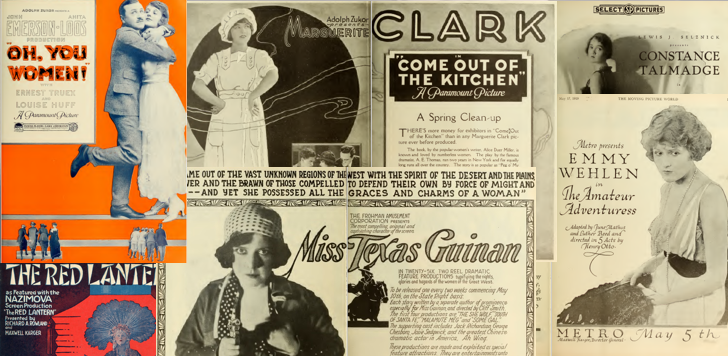
Cinema had always had tomboys with Mary Pickford and others not just cheeking the men but outwitting them but there was a definite moment being created after the Great War opened up a new drive for relative equality. Films such as Come out of the Kitchen, The Amateur Adventuress and the entire oeuvre of Texas Guinan showed more confident leads actively taking on men at their own game and leading their own agendas.


Famously, there were more women working in Hollywood in 1916 than 2016*, over half of silent films were written by women and there were more directors, not just Lois Weber, Mabel Normand and Nell Shipman. It wasn’t to last after male corporatisation led to the establishment of the Hollywood we all know; Universal, once home to 30 female directors, didn’t have another woman director after Weber left in 1919, until 1982…


Summer releases in 1919


Clara Beranger


It needs no cursory glance at the current releases and those of even six months ago to prove that there are more writers among the feminine sex than the male persuasion. The heart throb, the human interest note, child life, domestic scenes and even the eternal triangle is more ably handled by women than men because of the thorough understanding our sex has of these matters…

Moving Picture World, 24th August 1918


Clara Beranger co-scripted Phil-for-Short with Forrest Halsey and was a fierce proponent of women’s role in the industry for the reasons outlined above.  Not only were more women watching films at this point, but the industry relied on their input.


Clara was able to peruse her own agenda and she also scripted Miss Lulu Bett (1921), screened last month at the BFI and another film tackling the role of women post war and suffrage. Both Lulu and Phil ultimately decide their own course of action and they are true to themselves.


Clara Beranger in 1918


Evelyn Greeley


The studio PR suggested that Evelyn was the most proposed-to woman in America? Well, she may or may not have been but she was married three, possibly four times in the end. Her past is obscured by the usual studio hype but she was certainly not an all-American girl having been born in Austria before emigrating with her family aged ten.


She began on stage before small roles in short films from 1914 onwards – she was 25 – before being signed up from 1917-19 by the World Film Corporation with whom she featured mainly alongside Carlyle Blackwell up to Phil-for-Short, billed as her first solo starring role. Her final film was in 1922 with Blackwell, Bulldog Drummond, after which she retired with the first of those husbands presumably to start a family.


She’s very good in this film though, energetic and very naturalistic, greeting every misfortune with a pause and then a smile as she figures out a countermeasure. The education she has been provided by her academic father seems to have not only informed but enlightened her approach; she’s a woman of action, decisive and morally courageous.


Whilst reviews seem to have been mixed, but no one seemed to complain about her ability.


Evelyn Greeley hiding from proposals...

I don’t want to be a man?


One of the reasons for negativity is almost certainly the fact that Phil by name means Phil by nature. Evelyn dresses as a boy for a good portion of the film and initially out of necessity as she has to pick up the responsibility for keeping the family farm running. Later she disguises herself as a boy in a bid to escape the local moral majority and to solve certain romantic difficulties.


This was definitely a challenge for some, with Variety, according to Nasty Women curators Maggie Hennefeld and Laura Horak, condemning it as a “a sissy play, too nice for our boys; we want them to be manly,” after a local screening attended by a Boy Scout troop in Wilmette, Illinois. What would our Robert Baden-Powell have said? I do hope he saw the film.


Possibly the filmmakers saw Ossi in drag in Lubitsch’s cheeky, I Don’t Want to be a Man (1918) but there’s no way an American film could be as daring… and whilst this is hardly the only example of cross-dressing in early Hollywood, Phil is a challenge because of her sex and not sexuality.


I work like a boy, why shouldn't I dress like one?


Stronger woman, weaker men


Phil stands out as practical, inventive and a leader; all very male characteristics for the older generation. She has to deal with reality as her aged father is still buried in the myths and legends of his books and, lovely and liberating though he is, she works the farm and is happy to step up.


Then the man who takes her fancy, John Alden (Hugh Thompson, wonderful as a stuffed shirt), has decided he hates all women after discovering his fiancée was a gold digger.  He doesn’t know himself any longer but Phil, educated in the emotional meaning of classical philosophy, knows what to do. For what it’s worth, I don’t see John as emasculated just confused and bruised by his experience. More than anything he needs a friend like Phil who can manage his mood…


Then there's the more general complaint from John's sister, who's husband is "alright" just not "vital" with the meaning focused on his lack of vitality, not so much unmanly as submerged in manners and the day-to-day. Men need liberating too.


Charles Walcott and Hugh Thompson


High society and lower morality


Within the film as well as without there are some very old-fashioned responses to the ancient ideas of Greek freedoms of movement, thought and free will (gosh). The moral majority base their high ground on the old days but they’re completely at a loss in explaining away the really old ways… especially the aptly named McWrath family (emphasis on Wrath, nice one Clara!), Donald the village banker, corner stone of the church and his disapproving mother.


Outside of the village, Phil has to deal with John’s wealthy bourgeois family who, whilst they like her culture also have issues with an amoral violinist making merry with John’s sister and being the very epitome of a gaslighting womaniser.


Wherever she goes, Phil tries to find a way forward. A classical education needn’t be as bad as Britain’s Prime Minister has made it seem… and she is liberated in thought as well as action by the clear-sighted pursuit of moral balance.


The McWraths respond


Is it all Greek?


Phil’s so-called after a poem by the much-misunderstood Sappho who as Hennefeld and Horak point out was often referenced in silent films as part of a general attraction to Greek literature with the hints of her precise hidden depths that the Old Fogey’s object to here.


As with “Greek Deployments” by the likes of DeMille, there’s an excuse for under-the-counter meaning and shorter frocks justified in the name of higher art and here, whilst we do have dancing in diaphanous skirts, we also have Phil berating saucy male onlookers and Donald’s appreciative leer cut short by his mother’s disapproval. The hypocrisy of inappropriate male gazing is made clear and the dancing, whilst hardly balletic, is more about freedom than allure.


This film plays with so many angles and Greeley is wonderfully peppy, hardly pausing for breath justifying her love of Greek movement and expression or deciding on cross-dressing as her own “twin” to escape from unwanted suitors including her late father’s doctor - a man old enough to be her censor.


The search for beauty is perhaps the search for truth?


Moving Picture Classic, June 1919


Entertaining intertitles


I love the film’s witty intertitles and the design of the title cards is as deft as the film’s overall tone, overlaying text on images and the live action in a very effective way that doesn’t take you out of the action but smooths the flow. There’s wit and there’s wisdom and the BFI audience laughed with and not at… the sense of the moment still ruining true after 103 years.


Here’s why Phil is so called.


That joke isn’t funny anymore?


Critical opinion in the trade press was split and, as ever, the challenge for the modern viewer is to understand why.


It is too bad that Evelyn Greeley… did not lead off with a stronger picture… Miss Greeley has a pleasing personality and is a sufficiently accomplished actress, given the right sort of role, but only occasionally does she have the opportunity to appear at her best in this unconvincing story.

The Film Daily, 11th July 1919


This picture offers Miss Greeley splendid opportunities for her starring debut, and her natural ability will see her up the ladder of fame. Considerable ingenuity was exercised in compiling this scenario to fit the piquant charm and saucy roguishness of the new fledged star…This picture will please young people.

The Billboard, 7th June 1919


This is a thoroughly daft but enjoyable film but it succeeds precisely because of Greeley’s open-hearted playing. Phil is a real pick-you-up leaping every moral hurdle in a single bound and connecting comedically and emotionally.


John Sweeney enriched the film with his seemingly effortless array of classical lines mixed with the authentic moods of period and narrative that make his work so highly valued. As usual his improvisation fitted seamlessly with the orchestra on screen, from Phil’s dance and romance to the light and shade of the lightened drama. I’d previously only seen Phil on the small screen, streamed from last year’s silent festival in Pordenone, but this, this was the way to properly see and understand this charming production.


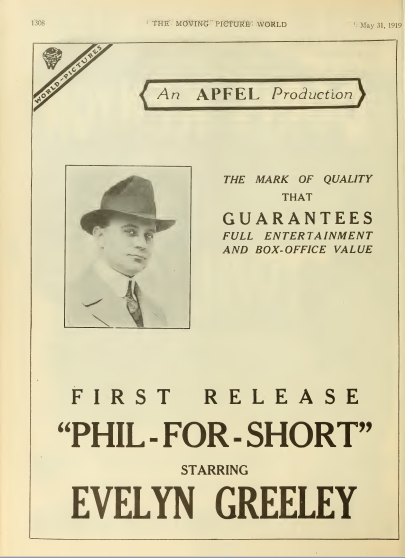
Directed by Oscar Apfel, the Mark of Quality...


A Nasty Woman?


Inspired by a remark made by the grandson of a one-time Yukon bordello owner, there has been an ongoing project to research and revive interest in unsung women filmmakers who broke new ground in the early years of cinema.


One of the outputs is a magnificent new box set from Kino which includes this film and 98 others. It’s out in August and it’s on my Christmas list if anyone’s thinking of a gift?


I wouldn’t say that Phil is a nasty woman though but she is a liberated one. Imagine how good it felt to watch her in 1919 newly enfranchised and with new choices starting to open up.


PS You can find out more about Nasty Women on the Women Film Pioneers Project website.


There's also a piece about Phil and other NW films from project co-director Maggie Hennefeld, also of the University of Minnesota, on the Flow Journal site.


*Silent Women: Pioneers of Cinema (Supernova Books, 2016), Melody Bridges, Shelley Stamp et al.

Tuesday, 5 July 2022

Eight days a week… Il Cinema Ritrovato 36th Edition, (Part Two)


Well, here's another clue for you all, the Walrus was Paul… John Winston Lennon, Glass Onion


Let me take you down to the Piazza Maggiore, nothing is real and there’s nothing to get hung up about… There’s no limit to the Beatle references I can fit into this stuff so, anyone of you in the cheap seats can clap whilst those in the sponsored area just rattle your jewellery because this is my personal selection of mini-reviews for screenings that struck me in the eight days a week that was Il Cinema Ritrovato 36th Edition… Eight halves as it were and most certainly not definitive. There's more... 


As you would expect, my week was mostly silent but the joy of this festival is firstly that there are half a dozen choices at any one point and secondly you can go eclectic at any point you choose, when it’s just too hot to walk all the way to Silent Town at the Sala Mastrioannie, or you just really need to see what Peter Lorre is doing or what Sophia Loren is wearing. It’s All Too Much, as I believe George Harrison once sang, but that’s the beauty, after a mad few days of completism – gotta see them all! - exhaustion, hangovers, sore feet and failing concentration demands variety!


1.       Ménilmontant (1926) with Stephen Horne


There were quite a few films I’d already seen but this new restoration was something else with Lobster films restoration not only adding clarity to the images – Nadia Sibirskaïa’s freckles have never been clearer – but also tinting which adds so much to one of the most beautiful of silent film. There was also the revelation that director Dimitri Kirsanoff was not actually a Russian emigre but from Estonia whilst Nadia was from Brittany; the two having adopted the more exotic background as part of the vogie for creative emigrees from Russia?


Whatever their reasons, the films they produced were esoteric and distinct even shot in the middle of Paris and this ethereality was enhanced by the new colours and, of course, Stephen Horne’s way with sympathetic and emphatic accompaniment. It was the most perfect blend of “special” audience, film and music. Not for the last time this week, the restoration of a film I thought I knew really brought new depth of meaning and fresh response.


The same could be said for Timothy Brock's splendid new orchestral score for Nosferatu (1922) which, watching him conduct the Orcestra del Teatro Cimunale di Bologna in the Piazza Maggiore, was as good a screening as I've seen, revealing much new about this very familiar film and helping the audience access a narrative of broader meaning. Good job sir!


2.       Superheroes…  Protéa (1913) with Maud Nelissen


There were some interesting early serials, pre-dating the works of Louis Feuillade and with a focus on the works of Victorin-Hippolyte Jasset with his evildoer Zigomar and endless adversary Nick Carter seemingly engaged in a non-stop exchange of capture and escape. Far more engaging was woman of mystery Protéa played by Josette Andriot, who was not only a mistress of disguise, she also had a male sidekick called The Eel (Lucien Bataille) so called because of his ability to squeeze in and out of tights spots.


Protéa was far more stylish in all ways, with disguises and a plot that was thoroughly entertaining and not, even by 1913 standards, hackneyed. She wears a black body stocking two years before Musidora as Irma Vep and needs it too to practice her martial arts and physical daring. Not surprisingly her protean quality and striking looks insured that four other episodes followed. Well, I’m onboard for more screenings and for the box set if at all possible.


Maud Nelissen accompanied with sisterly dynamism, supporting our heroine as she leapt from conclusion to capture and freedom, outwitting her captors time after time.


Jean Valjean (Henry Krauss) and his nemesis Javert (Henri Étiévant)


3.       Les Misèrables (1912) with John Sweeney, Gabriel Thibaudeau and Silvia Mandolini


Talking of serials, this was an unexpected joy equalling in its own way, the lengthier silent serial of 1926. Based in four parts totalling 168 minutes in length it was split into two screenings and, like a true serial left you wanting more – see above).


The first parts, focusing on Jean Valjean and then Fantine, dealt economically well with the complexities of the source material and was genuinely gripping as our hero made his way from humble beginnings and his arrest for stealing bread for his dying mother, to imprisonment then escape where his huge strength of character and physique enable him to take control of his own destiny always pursued by his nemesis, the unforgiving Walmer.


John Sweeney’s accompaniment gave the classic support this film required and the audience were on the edge of our seats before leaping off for the cheering applause. We were back the next day for Gabriel Thibaudeau’s piano and Silvia Mandolini’s violin to provide equally pleasing musical support as the focus shifted onto Fantine’s daughter Cosette, whom Valjean, having promised to support, rescues from a miserable family who use her as little more than a slave. Valjean once again makes a fortune and sets Cosette up for love with Marius a radical student who takes part in the battle of the barricades to try replace the post-revolutionary republic with an more egalitarian one. Recommended for fans of French history and film alike. An extraordinary clarity of purpose from Albert Capellani, way ahead of many at this time.


Glamour in Tu M’Appartiens

4.       The Diva endures… Tu M’Appartiens (1929), with Daniele Furlati


I don’t recall seeing anything with Francesca Bertini, one of the three great Italian Divas of the 1910s after that decade and yet here she is in this French film towards the very end of the silent era and her screen career, looking as proudly beautiful and emotionally nuanced as ever: the eternal diva.


Directed by Maurice Gleize, Bertini plays Gisèle a woman who is intent on gaining revenge for long ago being dumped by Rudolf Klein-Rogge’s Burat Laussade a reformed criminal who long ago escaped justice and the penal colony to build a new life for himself married to the nice-but-not-Bertini, Suzy Vernon. Under French law, anyone who manages to stay free for 20 years after the offence is able to avoid prosecution and, Laussade is quietly approaching that safety line before Gisèle catches up with him with her operatically grand revenge: she, naturally, wants it all.


The pace of the second half is especially intense and we get the chance to see Bertini ease through the gears like an emotional explosive device that sucks the air from your lungs as you hold your breath just watching her shift from violent resolve to heard-breaking compassion with audacious precision. They never made another one like Francesca and this is a precious film.


We watched a new sparkling 4k restoration from Gaumont in collaboration with CNC – Centre national du cinéma et de l’image animée presso il, and when it comes to the UK and elsewhere, is not to be missed. Daniele Furlati accompanied, enhancing the drama and working at the same esoteric levels as Bertini and, to be fair, Klein-Rogge who knew a thing or two about guilt, all the better to portray some innocence here.


5.       Roscoe returns… Crazy to Marry (1922) with Donald Sosin


Having recently seen a presentation on the ill-fated and entirely innocent Mr Arbuckle, how he was kept working by his mates like Buster and how he almost made it back only to die young with a heart attack. Had it not been for the false accusation of rape this is the kind of film he would have made more of; just imagine, a body of work that may have been as inventive and as funny as Buster’s, Harry’s and Charlie’s?


Directed by James Cruze, this was a laugh riot from start to finish with Roscoe on top form with every facial trick, forlorn look to camera and that extraordinary trademark prat fall when he shifts his bodyweight to fall flat on back or front. Donald Sosin accompanied his old friend, thousands of hours shared between them on sight and sounds.


Jean-Louis Trintignant


6.       The Conformist (1970)


Screened on the opening day in the Piazza Maggiore; a film about how fascism works in front of a largely Italian crowd, who applauded it long and loud at the end. I can’t think of many similar films for the UK, maybe parts of Gandhi, but can you imagine Oh, What a Lovely War being screened in Trafalgar Square and the Daily Mail and various commentators saying it was traitorous. Strange times for us Brits and this film is even more essential viewing given the recent drift towards intolerance in public discourse.


The late Jean-Louis Trintignant is of course, incredible as Marcello Clerici, faithless civil servant happy to help out the secret service in the matter of “dealing with” his former friend and teacher, the wrong-thinking anti-fascist Professor Quadri (Enzo Tarascio). Marcello travels with his fiancée Giula (the ageless Stefania Sandrelli who was on hand to provide the introduction) who seems to reflect more his desire for normalcy than romantic connection. He’s also accompanied by his handler, Special Agent Manganiello (Gastone Moschin) and things get very complicated when Marcello is attracted to Quadri’s lover, Anna (Dominique Sanda) who is also attracted to Giula.


Marcello sees marriage as the way to fit in and, whilst he certainly has some fear of his own true sexuality, this is not the only thing forcing him to make compromises that cost him friends, lovers and anyone but himself. He’s a survivor, he’ll do and say anything. Terrifying.


A 4k restoration from an original camera negative by the Cineteca di Bologna, in collaboration with others, it was magnificent on the Maggiore’s huge screen, a feast for the eyes and with ever more complex puzzles for the conscience.


Down on the street was my friend Charlie, taking a break from Bunjies folk cafe...


7.       Get Back (2021), with John, Paul, George and Ringo


Peter Jackson’s extraordinary three-part reworking of The Beatles Let it Be sessions, recorded at Teddington and Apple Studios in January 1969, has already been streamed but watching it with the thousands in the open air of the Piazza Maggiore, was something else indeed. You may not like this 60-year-old pop group but for some generations it’s musical magic, beyond nostalgia. If you’re from Liverpool and your Dad went to school with John and lived near George, then there’s not only local pride but community involved.


Jackson’s film allows us the most intimate access to their working methods and also completely blows away the bad taste of the original Let it Be film which focused on the negative. Here there’s the natural dialogue between very close friends and the piss-taking of a strong group. At one point Paul and John discuss the recording’s direction and it’s a startling moment as the two look directly into each other’s eyes, with even Ringo and George on the periphery; this is core band discussion, no producers, directors or wives… We see the creation of some epic tracks, even Octopuses’ Garden, alongside Paul’s epics hymns, Let it Be, Long and Winding Road and the rocker Get Back.


Everything culminates in the Apple Building Roof Top concert and this has never been fuller of more extensively covered. You feel The Moment and the vox pop support from all ages in the streets below runs alongside a triptych showing differing camera angles. Then the Police arrive and Macca turns round to whoop with extra energy, Mal Evans unplugs an amp, but George plugs it right back in and Lennon, already transformed by performing live, rises up a notch, Time travel doesn’t get much more visceral.


Film, plus audience and memories… we got back alright.


Maria Jacobini, the hills are alive.


8 Cainà: La Figlia Dell'isola (1922), with Laura Agnusdei, Tullia Benedicta, Stefano Pilia and Cecilia Stacchiotti


Under the sky at the splendid carbon arc projector fired up at the Piazetta Pier Paolo Pasolini this film

was confused by my late arrival as well as an electronic score that was sincere but just too emotionally inflexible to add much to the rather lovely images and dynamic central performance. Having now rewatched the whole film my impressions are reinforced with Gennaro Righelli’s film making the most of the Sardinian locations on land and sea as well as the remarkable display from Maria Jacobini as Cainà a part she co-wrote.


Cainà lives with her goats and conservative parents in a small farming community on the island and is on course to marry local boy Giannatola (Sig. Carmil) but she dreams of escape and the world beyond, even just the mainland. A boat arrives and she listens intently to the stories from the sailors. She stows aboard their ship and leaves, being discovered by the captain Pietro (Carlo Benetti) as a fierce storm strikes almost sinking the ship but killing her father on land. Unaware of the tragedy back home Cainà follows Pietro, much to his two sister’s disgust, and struggles with his expectations as well as life in a town.


It's a classic tale of restless youth and Cainà will find that she has no home wherever she goes… as the critic P. Amerio, wrote in the December 1923 Rivista Cinematografica, Maria Jacobini … expressed with admirable effect… the eternal fatal torment of the restless wanderer.


8 ½… C'era una volta (1922)


Sophia Loren in a dish washing competition with seven princesses, Omar Sherif being a mean old Prince riding horses and a squadron of flying saints... what more needs to be said?!


There’s more, of course there’s more… and there’s a number of films I shall be writing about in more detail over the coming days but it’s been fun!


Grazie mille Bologna, everyone who took part, who screened and who played, who organised and who served! See you in 2023!!


Wednesday, 29 June 2022

Back home… Foolish Wives (1922), Timothy Brock, Il Cinema Ritrovato 36th Edition (Part One)


OK, remind me how this goes again, we leave the country that has held us prisoner since 2016, sorry 2020, and land in a place where almost everyone wears face masks and where films of all eras are screened every day from 9.00 till passed midnight. Some how we’re supposed to sleep, eat and socialise and to take care of the other routines as the Celsius hits high 30s… and, somehow, some of us are supposed to write stuff about it? The pleasure and the pain of this festival is precisely down to their being too much to do… so, turn off you mind, turn on your out of office, relax and float downstream on the Reno.


Herewith begins my highlights of the first few whirlwind days… let’s start with a biggie.


“Sooner or later those romantically inclined American wives who believe the superficial polish of Old Worldling and his fascinating ways are the essential qualifications of a husband will be disillusioned. They are sure to come to the realization that the man for the American Woman – is the American Man.”


Foolish Wives (1922) 


The first million-dollar movie acclaimed the publicity… and, spectacularly, Erich von Stroheim delivered on the ROI and Universal had another hit on its hands from the most complex man in most parts of Hollywood whose productions had the skill of DeMille, the scale of Griffith and a dark heart the latter could never think or feel. The son of a hatmaker, the Austrian was all too aware that clothes maketh the man and, for that matter, how far you need to go to get a hat to get ahead, his incredible drive seeing his not only create himself anew in the USA but also emerge from the field of European theatricals to be trusted with audacious projects such as this one, the controversial Blind Husbands (1919) – screening later this week here – and his masterwork, Greed (1924) of which I had the pleasure of seeing the four hour reconstruction screened at the BFI a few years back.


He arrived in 1909 and how he built his reputation in less than a decade is a story for another time but what you can see in this film is the extent of his control, basing it on a “novel” he didn’t write, and using huge reconstructions of Monte Carlo and a cast of thousands, he effectively played a version of his invented self. Instead of a bourgeois Viennese faking German aristocratic airs, he’s a phoney Russian military officer, Count Wladislaw Sergius Karamzin, accompanied by his two cousins, minor white Russian royals who have fled the unfortunate events in their home country.


The three live in a grand villa and frequent the Casino and all the best places so they can work their various whiles on unsuspecting rich tourists, the more American the better. This is a slick crime caper movie from before the days when slick crime capers set in this period were all the rage. But Erich is making sure we see the seedier side as well, he and his two “cousins” may smile and be villains too, charming con artists, but he has a debauched sexuality which is revealed early on when Cesare Ventucci, a local tradesman/counterfeiter visits with his young daughter Marietta (18-year old Malvina Polo) who is distastefully described as “half-witted”, clutching her dolly. Marietta attracts reptilian glances from the Count, who even licks his lips (not for the last time) and if we were under any misapprehensions about the true depths of this man’s character von Stroheim makes is crystal clear right from the off.


It might even be described as “Hitchcockian” in another country, another decade… but the director is making us complicit in his character’s agendas from the get-go, and, as we want redemption for all our lovable rogues, he’s giving us a tricky moral maze to navigate. Also, about that redemption… this film was made in Hollywood but this is not a “Hollywood director”. The Count is charming us all if we let him, suspending our own disbelief despite all of the evidence of all that is put before us, call him Boris by any other name, or Don. This is just fantasy or is it real life?


Von Stroheim puts so much detail in the films of his I’ve seen and this was to have been over six hours long and split in two screenings if he’d had his way. The length was as grandiose as the location, designed by Richard Day, his debut as art director, and who later won seven Oscars and worked on Greed, and this presented the studio with all the dull problems you’d expect and with his presented cut of 31 reels, soon reduced to 14 for its New York premiere and then another four, including the spectacular extended opening. This restoration produced by MoMA and the San Francisco Silent Film Festival, contains no previously unseen footage, but does attempt to recreate the balance and sense of that first theatrical release as well as the sparkling clarity, via digital processing. Scenes have been returned to their original order, the 1928 re-release – the basis of most version to date - intertitles have been replaced with the original texts, adding tinting and recreating the spectacular colour effects of the climactic fire sequence.


Erich and Miss DuPont

The other characters are almost as nuanced as the Count, with Maude George as Her Highness Olga Petchnikoff and Mae Busch as Princess Vera Petchnikoff, ugly sisters on the inside but not without good humour and some compassion; professionals without the Count’s unhealthy singlemindedness and tastes. They distract rich American Andrew J. Hughes (Rudolph Christians who was replaced by Robert Edeson’s back view after dying during production) whilst the Count attempts to seduce his much younger wife, Helen (Miss DuPont aka Patricia Hannon from Kentucky) in front of his very eyes. They first meet on a sunlit hotel veranda and the start of the seduction is so very well signified with not a moment out of place as by almost imperceptible gesture, stolen glances, over newspaper and book, yes Foolish Wives by Erich von Stroheim (100% meta) the two begin to connect and to collude. She is, after all, a bored young wife who is reading about romantic fantasy and quickly interested in the attractions of foreign nobility.


The Count is sexually voracious – a predator in every way – and we soon learn that he has not only wooed their maid Maruschka (Dale Fuller, excellent here as in Erich’s Greed and The Wedding March, proper skilled actor) but made her pregnant. He keeps making her promises we know he won’t keep and maybe, at the time he means it, maybe… but people pleasing won’t save him for ever and she will have her revenge at some point.


It’s all but pointless to describe the narrative in too much detail as its detail on screen is so full of nuance that only by viewing can you fully appreciate (yes, that is a cop out) but to see it on the giant screen in the Piazza Maggiore, was special. Which brings me to Timothy Brock’s extraordinary score and the performance of L’Orcestra del Teatro Comunale di Bologna which he conducted. His score was technically brilliant in terms of the Russia themes he borrowed and interwove to support the grandiosity on screen and also the delicious lines of his own written to map every strange and unusual nuance from von Stroheim’s screen. It felt complete with the film and completed that magical connection between the place, the audience and the film that makes live silent screenings so compelling and which makes this place, almost uniquely, a truly silent city.


Brava Mr Brock, Bologna and Erich’s cast and crew. Glad to have you all back where you belong*.


*Get Back screens at the Piazza on Thursday, natch.


Sunday, 19 June 2022

A house is not a home... Miss Lulu Bett (1921), BFI


The family beast of burden, whose timid soul has failed to break the bonds of family servitude…


This film is an almost perfect exemplar of a Hollywood studio film of this period featuring a superb performance from Lois Wilson in the lead and smoothly satisfying direction from everyone’s third-favourite de Mille… William ranking behind his brother Cecil and then his daughter Agnes a hugely successful dancer who was not “pretty enough” for films but became a huge star on stage and then choreographed a dozen stage musicals revolutionising the genre over a long career.


Clearly, she was given the kind of encouragement from father William that is solely lacking in the Master of the Deacon house, Dentist and Justice of the Peace, Dwight (Theodore Roberts), who seems to treat his family as slaves, especially his sister-in-law Lulu. In its own quite gently comic way Miss Lulu Bett is as powerful as many more serious dramas with a story of a family drudge, run down not just by the domineering but also everyone else; a modern-day Cinderella five years before Colleen Moore’s Ella Cinders, but of a genre and a general situation many endured.


Ethel Wales, Lois Wilson and Milton Sills

Based on Zona Gale’s Pulitzer-prize winning play and bestselling novel with a screenplay by Clara Beranger, the film reflected Gale’s activism and concern with suffrage and women’s right to choose their own destiny. It was still commonplace for family hierarchies to leave the unmarried supporting their parents, I have this in my own story with a great grandmother looked after by her eldest daughter, Mabel. When my Nain married in the mid-1920s, Mabs, the elder sister, objected on the grounds that she should be wed first but her elder brother stepped in on our Jenny’s behalf. So, thank you Uncle Alec, without whom I wouldn’t be here.


As a member of the National Women’s Party, Gale lobbied for the 1921 Wisconsin Equal Rights Law and she was also an Executive Member of the Lucy Stone League which concerned itself with opportunities for women beyond the right to vote. A century on it’s hard to understand some social attitudes although perhaps a lot less difficult after the last five years…


Theodore Roberts is shocked, shocked I tell you!

Back to the film…. everyone has written Lulu off – destined for spinsterhood and chained to the household chores. Lois Wilson is a revelation, emoting in an understated way and carrying a lot of subtle meaning. This is the only film I’ve seen her in and watching it for the second time – the first at an excellent Kennington Bioscope weekender in the before times – you appreciate more of the seamless directorial skill and Wilson’s ability to hold not only the narrative but our belief together. She gives her character strength and the willingness to repay her light-hearted and inconsiderate oppressors the benefit of the doubt. Driven by duty and her own sense of honour she’s also just waiting for an opportunity to re-join the World outside the kitchen.


Dwight sets the tone but Lulu’s half-sister Ina (Mabel Van Buren) does nothing to help her, not so much a wicked stepsister as a lazy one. Their mother, Grandma Bett (Ethel Wales) is no better, dodging her duties as easily as she deflects Dwight’s supposed dominance, usually by stomping off out of range. The Brett’s two daughters also have their own techniques for avoiding the bully’s blasts, youngest Monona (Mae Giraci) is far too quick for the old man, feigning deafness and fading from view when it suits whilst Di (Helen Ferguson) is the apple of his eye, being, unlike her spinsterish aunt Lulu, eminently marriable. The only problem is that Dad has eyes on more socially advanced suitors than Di’s boyfriend Bobby Larkin (Taylor Graves).


Lulu listens intently to tall tales

Lulu has to suffer a thousand unkind cuts from Dwight, she’s both relied upon to cook and clean whilst at the same time blamed for being too useless to get married. It’s no joke but never say never… Lulu’s chance comes in the unlikely form of Dwight’s likeable blow-hard of a brother Ninian (Clarence Burton) who returns from a supposedly action-packed World tour and regales the family and their friends with stories of daring do. Lulu is by this stage transfixed after Ninian shows her just the slightest kindness yet even this is inspired by the family friend, teacher Neil Cornish (Milton Sills) who is the one to ask where she is and looks on in despair when Lulu swallows the big fat fibs.


Ninian takes Lulu, Dwight and Ina for a meal and makes a joke of asking her to marry him by slipping a cigar band around her figure as she jokingly promises to honour and obey. Only trouble is, Dwight’s a JP and, therefore, they had accidentally had a proper ceremony and are now man and wife. Ninian’s up for giving it a go and Lulu takes the chance too, feeling there’ll be no other.


She moves in with her “husband” but a few days later he reveals that he’s already married to a woman who left him years ago and whilst he’s not sure is still alive, there’s a big chance she will be. That’s big of Ninian and it’s also big of Lulu that she puts principle first and reluctantly returns “home”.


Milton Sills ain't fooled

Now things really kick off as she discovers the house in a mess and the family bickering over chores… you’d think they’d be pleased to see her but no, she’s putting Dwight’s reputation at risk and has to accept the blame and the ignominy of being rejected by her husband after just one week. Yet Lulu discovers new depths: “The only thing I’ve got left is my pride and you’ve got to let me keep that…” and she works upwards from there.


There are superb performances not least from Theodore Roberts who would have been a shoo-in for Best Cigar-Chomping, Blood-Vessel-Busting Oscar had they been invented at this point, whilst Milton Sills is a steadfast lead with future salvation written all over him. But it’s Lois Wilson who wins out and she’s great value for a story that makes it’s point without getting too improbable of tiresome… we’re all for Lulu and, as the poet said, you’ve got to hope for the best and that’s the best you can hope for and Lulu Betts does not disappoint with an uplifting ending that blows the roof off!!


The film is available on Blu-ray from Grapevine and is online too if you peruse YouTube. Great to see it getting this screening in London though.