Showing posts with label Jacques Feyder. Show all posts

Monday, 26 December 2022

These are a few of my favourite things… 10 from 2022


And so this is Christmas and what have we done...? Turns out quite a lot more than in the Year of Our Covid, 2021 but still not as much as we’d like to have done… in this game you take what you can get though and savour each experience as much as you can. Silent film doesn’t throw itself at you like an overeager superhero flick desperate to win back it’s $200 million budget, oh my no, you have to make an effort and all of that is rewarded with the shocks and joys of unremembered humanity and artistic enterprise. All of which is a Boxing Day hungover way of saying; hey Ma, will you look at these apples (and no, I don’t really know what that means)!


Woman of the Year: Dora Brandes (1916)/Poor Jenny (1912) with Stephen Horne, BFI Asta Nielsen Season


She acts, that’s the thing… she does not just pose before the camera… She impersonates a character, she makes it live and have meaning, a hundred meanings… New York Times, 1921


Who could have foreseen that Asta Nielsen would be 2022’s MVP – someway ahead of Liz Truss in terms of relevance, attainment and talent – but Pamela Hutchinson and the BFI set out one of the finest seasons of silent treasures for many a year with screenings of rare Nielsen grooves propelling us into the year with a spring in our step and a growing appreciation of this most important actor. Sure, I’d seen Asta’s before but mostly in her greatest hits, Hamlet (thrice), Joyless Street (twice), Afgrunden (so many times…) but it was a real connoisseur’s delight to be able to dig deeper into a body of work that is very rarely screened in this breadth and depth.


Asta Nielsen


As an example of Die Asta’s almost unparalleled range I’ve picked these two with accompaniment from Stephen Horne who has a way with Silent Sirens (and a CD to prove it, available here if you are shameless and unhip enough to have not bought a copy!). Poor Jenny (1912) was from the early days of the Asta series, written and directed with partner Urban Gad who the actress insisted at the time came with her to Germany to carry on the work begun with Afgrunden. It’s a typical rags-to-riches-back-to-rags again narrative but, as she joked, this was more than enough to feed her dramatic energy.


Dora Brandes, directed by Magnus Stifter, following her break with Gad, plays with the already well-worn Star is Born tropes. Asta playing a successful actress who finds herself having to choose between an older politician and a much younger journalist. Drama ensues… hearts break. As you watch you can begin to fully understand Asta’s ability to express and connect. So often at the start of her films, she’s seen smiling straight to the audience before the action begins, melting hearts and renewing her intimacy with the watchers and unflinching honest look, the only time she’s out of character, or at least the character she’s about to play. As a person she’s a mystery and her pre-show smiles just hint at the complexity to come whilst showing how easily she can draw us in… it only takes a few seconds looking at those huge dark eyes. Queen.


Asta and her infinite variety...

Downfall (1923) with John Sweeney, introduced by Pamela Hutchinson, BFI Asta Nielsen Season


Sorry, but I’m not just having one Asta moment and this was a breath-taking film that showcased the full power of Asta’s performance level whilst also confronting the fact that she was getting older – she commissioned the film aged 41. Watching her character with minimal make-up. looking in horror at her unfamiliar face in the unforgiving mirror before being deadened by her lover’s unyielding humiliations and finally vanishing from the love of her life’s vision… is oddly rewarding. Certainly, she presents one of the most searing portrayals of aged tragedy in silent film and proof, if any were needed, of her ability to transcend melodrama and to give something extra special entirely from within character.


Back in Bologna… Foolish Wives (1922), Timothy Brock, Il Cinema Ritrovato 36th Edition


At last, I was back in Italy and it was too hot, there was too much to do and far too much to see: I loved it!! So many highlights, watching the restored Nosferatu with Mr Brock and full orchestra in the Piazza Maggiore,  watching, The Conformist and Singing in the Rain in the same space and then the almost supernatural hit of three hours’ worth of The Beatles in Peter Jackson’s third episode of Get Back, including the full Rooftop Concert: the gear does not get any fab-er than that, a revelation and a stunning twist of the Extended Scouse Universe.


The big silent showcase was this splendid restoration of the first million-dollar movie, as acclaimed the publicity… Spectacularly, Erich von Stroheim delivered on the ROI and Universal had another hit on its hands from the most complex man in most parts of Hollywood whose productions had the skill of DeMille, the scale of Griffith and a dark heart the latter could never explain to himself. This is a slick crime caper movie from before the days when slick crime capers set in this period were all the rage. But Erich is making sure we see the seedier side as well, he and his two “cousins” are charming con artists, but he has a debauched sexuality which makes his character all too difficult to root for and yet we are conditioned to try… even now.


Timothy Brock’s extraordinary new score was performed with vigour by L’Orcestra del Teatro Comunale di Bologna which he conducted. His score included Russia themes reflecting the grandiosity on screen and also delicious lines of his own mapping every strange and unusual nuance from von Stroheim’s screen. It felt complete with the film and completed that magical connection between the place, the audience and the film that makes live silent screenings so compelling and which makes this place, almost uniquely, a truly silent city.


Les Misèrables (1912) with John Sweeney, Gabriel Thibaudeau and Silvia Mandolini


This was epic in length and was an unexpected joy equalling in its own way, the lengthier silent serial of 1926. Based in four parts totalling 168 minutes in length it was split into two screenings with different accompanists. The first parts, focusing on Jean Valjean and then Fantine, featured John Sweeney’s accompaniment and we were back the next day for Gabriel Thibaudeau’s piano and Silvia Mandolini’s violin as the story shifted onto Fantine’s daughter Cosette.


Recommended for students of French history and film alike; extraordinary clarity of purpose from Albert Capellani who was able to capture so much from the book with a narrative fluidity not often associated with this early period.


Evelyn Greeley


Phil-for-Short (1919), with John Sweeney, BFI


This film was introduced by me at the BFI and for a few hours at least, I was an honorary Nasty Woman.


Inspired by a remark made by the grandson of a one-time Yukon bordello owner, there has been an ongoing project to research and revive interest in unsung women filmmakers who broke new ground in the early years of cinema. This film is a deceptively nuanced take on gender roles in the wake of the Great War and increased recognition of women’s roles.


I wouldn’t say that Phil is a nasty woman, but she is a liberated one and just imagine how good it felt to watch her in 1919 newly enfranchised and with a range of choices starting to open up. As played by the energetic Evelyn Greeley, Phil stands out as practical, inventive and a leader; all very male characteristics for the older generation. She has to deal with reality as her aged father is still buried in the myths and legends of his books and, lovely and liberating though he is, she works the farm and is happy to step up to make things happen for herself and the men in her life.


There is now a magnificent new box set from Kino which includes this film and 98 others. It’s out now and is THE Archive Release of the Year – US and Canada can order direct.


Mary Johnsson - Gunnar Hede's Saga (1923) 

Gunnar Hede's Saga (1923) with Guenter A. Buchwald and Neil Brand, Bonn Silent Film Festival


Have Internet will travel and virtual Bonn was as excellent as usual. As many may know I’m always up for a Saga directed by Mauritz Stiller and based on a book by Selma Lagerlöf and, even though this one is still missing about half an hour, it is a thoroughly entertaining romp through snow, love and madness which features the humanity you’d expect from Selma along with the mastery of locations and character you can rely on from Mauritz. It’s a story about reindeers and redemption (the latter, always a Selma theme) and, how fitting that a film featuring two violin players and the healing power of music, should be accompanied by the Silent Film Supergroup of Guenter A. Buchwald on violin and Neil Brand on piano… I really wish I’d been there to witness this gig in the flesh but the streaming screening will have to do for now and how!


Norma Talmadge in The Lady (1925)

The Lady (1925), Daan Van Der Hurk, Le Giornate del Cinema Muto, Streaming


Oh, outrageous fortune! All set, ALL SET, for my first Giornate since pre-C, and I catch the latest variant a few days before I’m due to head for Venice Airport. So it goes, so it goes and at least we had the streaming version to give us some of the finest films from the full festival. 


Norma Talmadge has always been relatively undervalued in recent times, not afforded the screen time or respect of stella contemporaries Gloria, Mary or Lilian and so I was pleased to see her featured so extensively in this year’s programme and, if I had to pick just the one film to watch t would have been Frank Borzage’s The Lady, a film rated so highly by Talmadge scholars such as Greta de Groat. Norma and Frank did not disappoint and she provides perhaps the most affecting, emotionally powerful performances of her career although not one she wanted to repeat too quickly.


After the mid-teens, Talmadge called the commercial shots and as Jay Weissberg pointed out in his introduction, The Lady was too louche for middle American audiences and did not perform that well. As Talmadge herself said, quoted by Ben Brewster and Lea Jacobs in their notes on the Giornate site, she wasn’t going to follow up the film’s style “… I am not going to do any more like it for a time, anyway. Not that I don’t like to do characterizations – I love it. But what can we do? We must play to the box office… So, for a while I am going to do modern things. I think they want to see me in gowns, in style.”


A great actor but also a smart businesswoman who played the game until, to paraphrase, she no longer needed to.


Faces of Children (1925), with Meg Morley, Kennington Bioscope


2022 we were back home to the Cinema Museum and here was one of the great films of the French silent period, and one accompanied with consistently emotive, compelling improvisation with hints of period classical as well as Meg’s diverse jazz chops, so in tune with Jacques Feyder’s tale of childhood grief. The film was critically-acclaimed yet a commercial failure and for a long time this it only circulated as a two-reel 9.5mm condensed version – available on YouTube and worth watching! – and as Christopher Bird said in his excellent introduction, this encouraged the young Kevin Brownlow to seek out more complete versions. The film was finally restored over a twenty-year period starting with the Cinémathèque royale de Belgique in 1986 and ending with Lobster Films in 2004 but it is still rarely screened which is exactly why we need the Kennington Bioscope more than ever!


Face off: Ivan vs Brigitte


Manolescu (1929), with John Sweeney, Le Giornate del Cinema Muto Streaming


This was like watching Fantasy Silent Film, a game in which the combination of two of the best strikers in cinema muto score hattrick after hattrick combining in ways that seemed impossible especially to this viewer who had no idea they had ever played together. Manolescu… Ivan “The Cat” Mosjoukine versus Brigitte “The Panther” Helm in a battle for our eyeballs, our attention… our love. Honestly, you could have taken the script for Carry on Cabby and given it to these two and we’d all be collapsed in a pool of utter distraction. You want engagement well here he and she are…


Mr Sweeney was fully aware of all of the above and slotted into musical midfield as the great playmaker he is (that’s enough footie references. Ed.)


Up in Mabel’s Room (1926), Günter A. Buchwald & Zerorchestra, Le Giornate del Cinema Muto Streaming


Directed by E. Mason Hopper, this perfectly executed farce was based on the play by Wilson Collison and Otto Harbach from 1919, and like every successful comedy of this type it relies on perfectly executed performances and timing, whether from the performers and director or in the editing suite. There’s also some exceptionally pithy title cards courtesy of F. McGrew Willis’ script and Walter Graham’s text… and if a picture paints a thousand words, the expressions on Marie Prevost’s face are a British Library’s worth of inuendo!


Extra spice was added by accompaniment recorded right at the start of this year’s festival at the screening in Teatro Zancanaro, Sacile, it had that live energy some of the streaming films don’t always get, although, to be fair this was an ensemble, with the local group Zerorchestra improvising alongside Günter A. Buchwald’s piano and violin. This film was the perfect finale for the streaming version though, setting us up for a physical return in 1923, sorry, 2023!


We’re back up and rolling and 2023 I aim to attend as many screenings and festivals as possible, I’m looking at you Hippfest, Slapstick, Europe and even further afield… as for Pordenone, we are long overdue!


Happy Christmas and a let’s have a brilliant 2023!


Look to the future now, it's only just begun.

Click on the cover to order this set!

Thursday, 27 October 2022

Life, live from Lambeth... Faces of Children (1925), with Meg Morley, Kennington Bioscope


Back home to the Cinema Museum for one of the great films of the French silent, and one accompanied with consistently inventive Verve, the odd delicious Blue Note and Stax of syncopated stamina from Meg Morley; two hours of emotive, compelling improvisation with hints of period classical as well as Meg’s diverse jazz chops. She won’t agree but she made the evening and was so in tune with Jacques Feyder’s tale of childhood grief.


The film was critically-acclaimed yet a commercial failure and for a long time this it only circulated as a two-reel 9.5mm condensed version – available on YouTube and worth watching! – and as Christopher Bird said in his excellent introduction, this encouraged the young Kevin Brownlow to seek out more complete versions. The film was finally restored over a twenty-year period starting with the Cinémathèque royale de Belgique in 1986 and ending with Lobster Films in 2004 but it is still rarely screened which is exactly why we need the Kennington Bioscope more than ever!


Never work with animals or children unless, that is, the children are exceptional actors… was my observation of first watching this film on DVD. My cold shrivelled soul had prepared me for the worst with this tale of youthful anguish but, once again, I was so wrong as it is a naturalistic marvel and one that at almost a century’s years’ distance, it was made in 1923, rings true with unflinching honesty and the director’s iron grip on the dimensions of love and pain. Children are childish, but also easily desolated and whilst Feyder’s players are casually cruel, they learn their lessons hard.


Jean Fores and Victor Vina


A good deal of this is attributable to the film’s remarkable lead Jean Forest, who was just 12 at the time and plays with the controlled intensity of someone twice his age; that’s direction but also a natural talent. The director had featured him in his previous film, Crainquebille (1922) and probably wrote Faces… with him in mind – you can only make this kind of story work with such a freak of acting nature. He is not alone though, with the actor playing his stepsister, Arlette Peyran also remarkable.


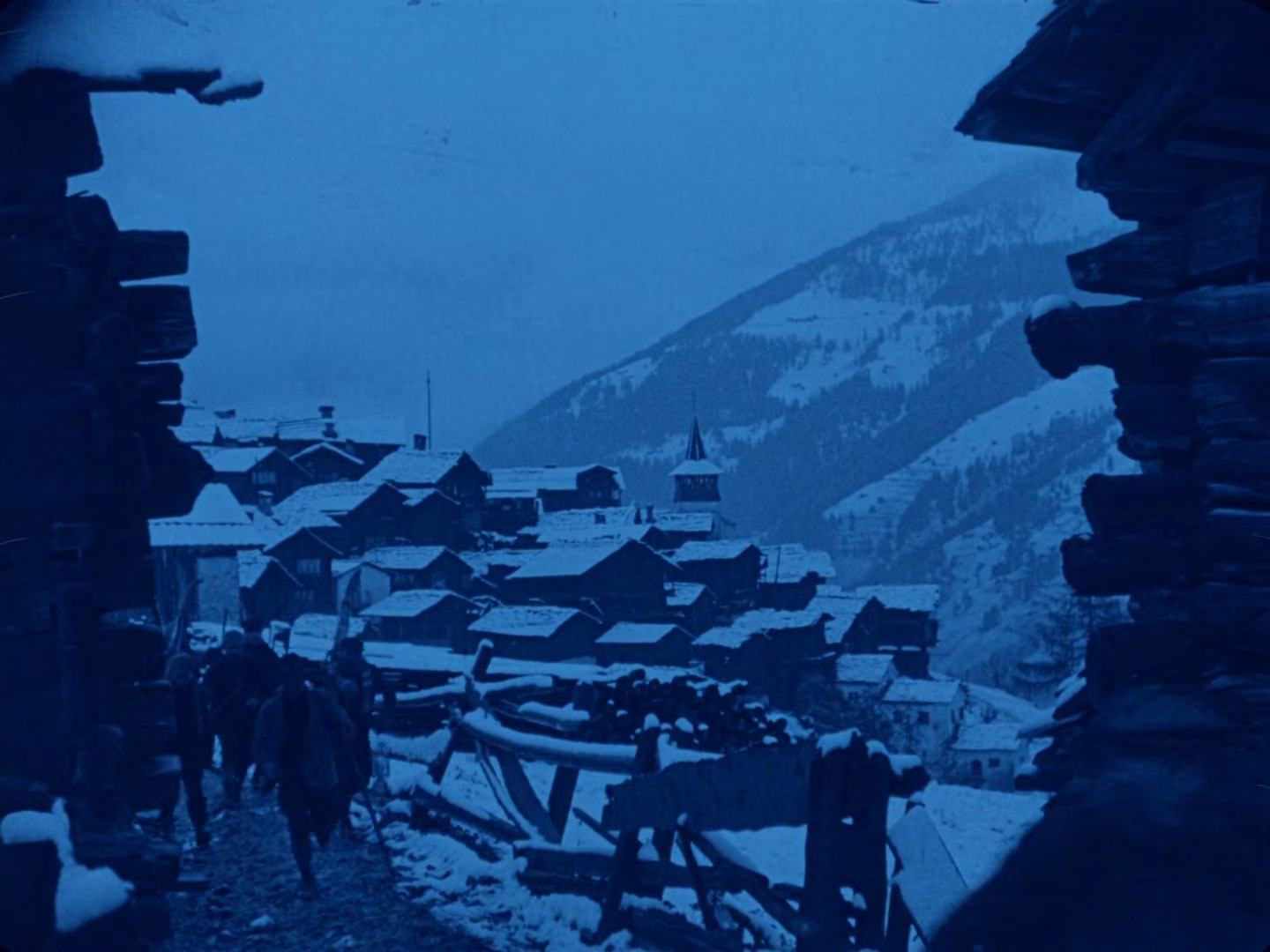
Feyder hits us hard right from the opening, showing the funeral of the boy’s mother; ten-year old Jean is numb but expected to stand with his father Pierre Amsler (Victor Vina), the local mayor, through the ceremony as his five-year old sister Pierrette (Pierrette Houyez) is distracted by play. In ten potent minutes, the director introduces the main players and the situation against a stunning backdrop of Saint-luc, a village nestled high in the Swiss Alps. It is a beautifully location for a sad occasion and the worst of all situations: a mother dead leaving her young children all too early.


Amongst the serious adult mourning, Jean looks on in shocked silence as the funeral process unfolds and his mother’s coffin is lowered down the stairs in their chalet. Pierette is too young to understand and is told that Mama has gone away for a while, but Jean is old enough to understand that he’ll never see his mother again. The procession extends out of the house and through the snow-covered streets to the cemetery at the edge of the town. Jean follows alongside his weeping father whilst we keep cutting to see Pierrette playing with a neighbour… The boy braves the entire ceremony before finally collapsing in sadness… you’d need a heart of stone not to be moved but Feyder isn’t just creating a melancholy drama; these are well-drawn characters showing natural grief.


Rachel Devirys and Victor Vina


The months pass with father and son paying due respect to the departed but Pierre begins to worry about his children’s’ care with no mother. He starts to court a milk maid Jeanne Dutois (Rachel Devirys) but hasn’t the heart to tell Jean of his intentions. There doesn’t appear to be anything calculated in this new relationship as events will bear out… and what we see of Pierre, is what his children see, a man subdued by responsibility and grief.


Jean mourns his loss intensely, saying his prayers in front of a portrait of his mother each night. The portrait comes to life and his mother (Suzy Vernon) smiles down at him. This is one of only a couple of moments of magic realism in a film otherwise anchored so much in reality but again this is not just the faces of children but their imagination


The new couple agree to marry but Pierre cannot tell Jean and sends him away with his godfather, Canon Taillier (Henri Duval) who is to break the news as best he can… As Jeanne and Pierre marry the priest tells Jean who resolves to support his father and make the best of things. Things get off to the worst possible start as Jean returns home to find himself locked out; he cannot convince his new stepsister, Arlette (Arlette Peyran) that this is his home too and, having got off on the wrong foot, their relationship swiftly deteriorates.

Jean returns to the village

Jean is relegated to a small back room as his sister shares his old room with Arlette – he resents everything that moves the family on from how they were. Jeanne is unrelentingly kind and fair minded never giving Jean a real reason to dislike her but he doesn’t need one as he works through his anger at the nearest targets: the symptoms of his mother’s absence and not the cause. It’s a film in which a lot happens even as not much happens, the audience has to connect the emotional dots; intuit emotional states and route for simply everyone!


The battle between the children hots up as Arlette tries to involve herself in the others’ games. She invades their little island where they are trying to roast chestnuts only to be repelled and pushed into the water by Jean: whatever she dishes out he sends back with increasing spite. Jean is tormented a boy trying to process adult grief and lashing out at anyone who even inadvertently increases his sadness.


Through it all his parents remain patient and Arlette – as we grown-ups can see – makes every allowance. Of course, this only makes things worse as Jean finally begins to push things too far and lives are put at risk. The closing segments of the film see Feyder rapidly pick up the pace and torture the audience with the prospect of unbearably unhappy endings: you’ll just have to sit through these moments yourself because I can say no more without spoiling things…


The Battle of Boiled Chesnuts


As controlled film making, Faces of Children ranks with the best of French (and indeed Belgian) silent cinema. The leads are all superb and whilst the three children are the obvious standouts it’s also worth highlighting the performances form those adults forced to work with them… and Rachel Devirys is especially nuanced as Jeanne.


The cinematography from Léonce-Henri Burel and Paul Parguel is also superb, especially in the later nighttime scenes whilst they capture the majesty of the background locations as well as the intimacy of the children’s interior lives. Both had worked with Gance and it shows in the snows, day and night during the desperate torch-lit search as the whole village spreads out on the snow looking for a missing child.


And, throughout the full drama Meg Morley produced nuance and emotionally sophisticated narrative accompaniment of her own. I haven’t been going to the KB enough over recent months but I was glad to be back ,,, there is indeed, no place like "home"..


David Wyatt: There was a tribute to Bioscope stalwart and multi-talent Dave Wyatt who recently passed away. Dave was one of the core group at the Bioscope and had a fascinating career in film before becoming a collector and contributor to this priceless south London enterprise. Rest in silence Mr Wyatt and thank you for all the joy you brought!


Friday, 12 October 2018

Desert song... Le Giornate del Cinema Muto, Pordenone, Day Six


There was a repeated refrain of a about a dozen notes made by using a violin bow against blocks on a vibraphone that got hooked in your head and is still with me. Arthur C. Clarke wrote a short story in which the perfect pop song is written, so catchy it completely takes over all mental function… well, this was close but combined with Jacques Feyder’s mesmerising visuals, this was immersive silent cinema: a three-hour film that felt shorter than some 70-minute ones.

That motif encapsulated the fatal allure of the city lost within the Sahara and its immortal Queen Antinéa from whom there was no release except death and conversion into a metallic mummy in her hall of trophies (we can get into the psycho-sexual details later…). It’s a place so compelling, sexy and the ultimate art nouveau man-trap so well designed by Manuel Orazi – nearly impossible to find and completely impossible to escape… welcome to the Hotel L’Atlantide.

Stephen Horne and Luigi Vitale had only been a duo for just one day (force of circumstance) and yet they combined with intuitive improvisations on multiple instruments. I was in the front row and occasionally peaked over to see who was playing what in the orchestra pit as the two followed each other and the film as if they’d had weeks… not a few hours. That this was done for such a lengthy film and one which would be so hard to play for unseen, is remarkable. There are so many great musicians here this week, but this was as good as anything you’d hear.

Manuel Oraz's film poster
This was a world premier of Lobster Film’s new 4K restoration and it has produced an eye-wateringly gorgeous result for a film that maybe long but has such a consistency of tone throughout: it never sags, it moves like the dunes, relentlessly overwhelming (ah, but we’ll get the psycho-sexual later…).

The story was based on Pierre Benoît’s novel of 1919 and resemblance between Queen Antinéa and Ayesha in H. Rider Haggard’s 1887 novel She is purely the subject of legal history. Stacia Napierkowska, a former dancer from the Folies-Bergère, plays the queen and has an earthier allure than you might expect from such a siren. I couldn’t stop comparing her with Brigitte Helm in Pabst’s 1932 version – the early film is better (although I’ve note seen the restored Pabst) but you can really buy into Brigitte’s eternal allure. Plus, she has a pet cheetah. I was also thinking of Hawkwind’s stage dancer, Stacia… and perhaps only certain gentlemen from Bristol might fully appreciate that reference!

Antinéa and a plaything
Anyway… we don’t get to see Antinéa for well over an hour and a half as the film reels out its narrative at walking pace with magnificent desert vistas and some cinematography worthy of a David Lean film. I especially liked the emergence of a gang of raiders as first one then six then dozens emerge silhouetted on the horizon and the flashback showing how a soldier had been kidnapped at a watering hole, the camera moving to the right as the seen reverse fades into view.  

This was Feyder’s first major film and he shot it in the actual locations – and eight-month long shoot in Algeria, on location among the Touaregs in the Sahara and the Ahaggar (Hoggar) Mountains and, just possibly, in the sunken city marooned in the former sea.

The tale is of lost legionnaires and both Jean Angelo as Captain Morhange and Georges Melchior Lieutenant de Saint-Avit are superb as is Marie-Louise Iribe as the Queen’s servant who tries to escape with Saint-Avit. Abd-el-Kader Ben-Ali is also good as the mysterious and principled Cegheïr-ben-Cheik a man of the desert who helps the men but also gets them stoned…

This is a film to relish and I would like to return to that score as well as L’Atlantide


 Husbands and Lovers (1924) with Mauro Colombis

This was the most polished Stahl so far and the first comedy. It features Stahl stalwart (Stahl-wart?) Lewis Stone plays, James Livingston a man taking his wife Grace (Florence Vidor) for granted and the final straw comes when she gets a perm and he doesn’t like it. His pal Rex Phillips (Lew Cody) does though and senses the chance to sneak in and steal the girl from under Jim’s insensitive nose.

We know how it’s going to go but it’s quirky and well-played enough to maintain our interest and the inevitable is eeked out to the last possible moment, Stahl knowing exactly what he is putting us through. Lew Cody though, no way is he ever going to bag Flo’ Vidor. Just saying.

Alice Tissot reading in foreground and Germaine Rouer outstanding...
La Cousine Bette (1928) with Günter Buchwald

This is another one of Balzac’s twisted tales and a film in which there are few innocents, as in life. 
It’s highly stylised by director Max de Rieux and almost grotesquely so but that starts to feel more and more right the longer you watch as bad behaviour gains all the ground. Cousin Betty as played by Alice Tissot is a malevolent watcher of other’s lives motivated by self-interest and the desire to push others lower than her. Germaine Rouer is outstanding – again – as Valérie Marneffe who is so deliciously bad as she breaks men like so many brittle toys and there are some excellent dandies in the form of Christopher Walken look-alike François Rozet as Comte Wenceslas Steinbock and Nell Haroun as Baron Henri Montès de Montejanos who has bizarrely-crafted side-burns to go with his deep eye shadow and excessive foundation: ridicule is nothing to be scared of mon brave!

Lillian Gish and Ralph Forbes
The Enemy (1927) with John Sweeney

Fred Niblo’s film is another in the Kevin Brownlow strand and is a powerful anti-war statement based around two Austrian families at the outbreak of the Great War described by Kevin as a “…rarity, a truly pacifist film, almost an M-G-M version of Isn’t Life Wonderful?”

Lillian Gish is curiously playing within herself here – she was distracted off-set by her mother’s illness – but she’s still incredible even though she doesn’t go the whole La bohème for the depravations later in her character’s arc. Lots of close-ups and actually her more “relaxed” performance makes for interesting watching, less draining than say The Wind and her measured intensity gives room for the wider narrative to breathe.

At the start the impact of the declaration of war on university pals, Austrian Carl Behrend (Ralph Forbes) and Englishman Bruce Gordon (Ralph Emerson) makes you expect that they will provide the “enemy” and meet on the battlefield but no, the real enemy is at home. Hatred and unreasoned national pride drive Carl’s father away from his wife Pauli (Gish) and her family and after her grandfather (Frank Currier) is kicked out of university for his pacifist views they struggle to feed each other and Pauli’s baby.

Grandfather swaps his overcoat for an egg, but there’s far worse to come in a stunning closing sequence largely reconstructed using stills but which still kicks you hard.

Make war no more.