Showing posts with label Bessie Love. Show all posts

Wednesday, 6 November 2019

RW Paul the 2nd & Adolphe the 1st... The King on Main Street (1925), Kennington Bioscope with Colin Sell


"Yes, yes, by all means sure-fire box office values ... the Menjou fans will eat this up ... it is mighty fine entertainment, and they will like it!" Film Daily

Mr Kevin Brownlow was rather incredulously reading out some of the notices for The King on Main Street with one paper claiming it was up there with Valentino in The Eagle and The Big Parade as one of the best releases of the month although the King’s budget could barely have covered a week of Vidor’s epic. We were seeing Kevin’s 16mm print and this has some parts missing, namely the starting reel and the saucier aspects of Greta Nissen’s role, excised for the home market and, rightly so judging by the way the actress was wearing silk in her Paris boudoir.

In truth the film is a modest effort but it does feature superb playing from Adolphe Menjou as the runaway King Serge IV of Molvania who, on a business trip to America nips out from the confines of royal duty for a day of adventure at Coney Island. Here he meets a young kid who shows him the ropes vis-à-vis hot dogs and the business of fun including a memorable roller coaster ride filmed with the camera close-up on Menjou as he acts his way up and down and, indeed, around Coney’s biggest dipper.

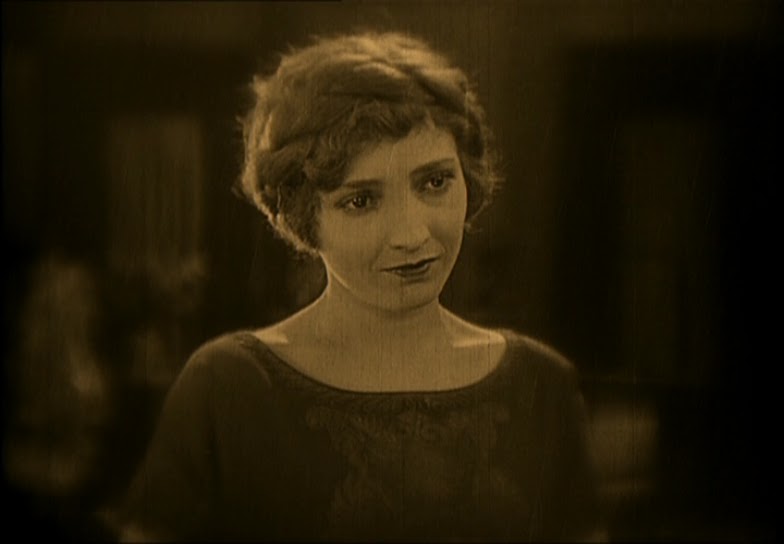
Gotta love Bessie 
He is also reacquainted with the excessively lovely Bessie Love as the all-American Gladys Humphreys who has already thrown her iced bun at him in Paris overcome with the sight of royalty. As Kevin explained the film was cashing in on the royal fad sparked by the handsome Prince of Wales, Edward the Abdicator, albeit a few years before our King ran for his life.

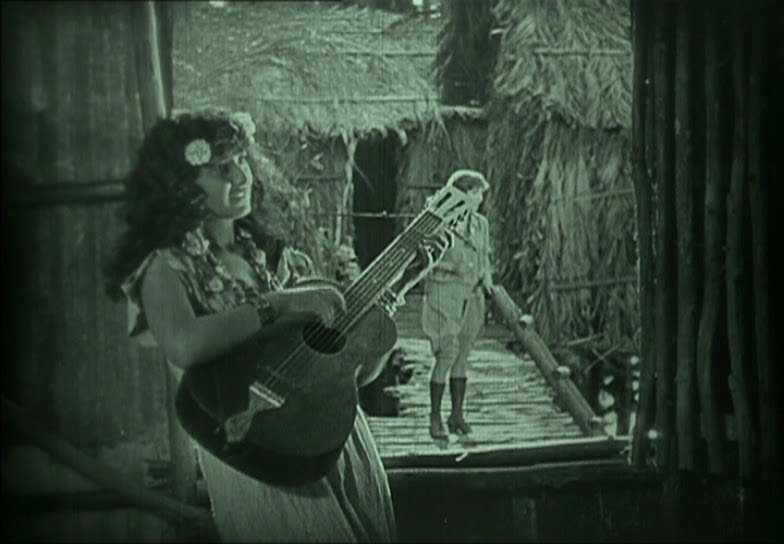
Love’s always a treat and here she absolutely rips the floor up as, ukulele in hand she Charlestons the heck out of the carpet at small-town Little Falls reception for the King arranged by her beau John Rockland (the disturbingly Ford Sterling-esque Oscar Shaw). Wikiparently, Love’s rip-roaring helped popularise the dance in the US and strictly speaking, she’s 10+ in comparison with the Saturday night kids we get from the BBC’s dance show.

Theatre Magazine was definitely impressed "... Bessie Love gives a perfect exhibition of the Charleston, proving that it can be danced with extreme grace and agility, and yet without a single hint of wriggling vulgarity. We hereby award Miss Love the palm as the greatest Charleston expert on the screen if not on the stage -- which is by way of being a miracle, for ordinarily a film dance looks as silly as the capering of goats".


There’s some business involving selling oil to unscrupulous American Arthur Trent (Joseph Kilgour) – how little things change – and the King may even be forced to betray his country’s best interests in order to protect Gladys’ honour but, y’know, it’s probably a “great deal” when you look at it closely. The King also finds a way to smuggle Greta’s saucy Therese Manix by getting her to marry his butler Hugo (Londoner Edgar Norton) and it makes a man of him in scenes largely cut to preserve our frail morality.

Monta Bell directs with straightforward efficiency influenced, as Kevin pointed out, by his time working alongside Chaplin on A Woman of Paris a couple of years earlier – Adolfe was also in that too. Other existing elements of The King on Main Street include two sequences filmed in early two-strip Technicolor which might explain its success along with the charm of the King and his women. Lois Wilson is also an uncredited "guest" extra in a hotel lobby scene – I think I spotted her but I do see her everywhere I go.

Colin Sell accompanied and riffed in divine style on By the Light of the Silvery Moon as well as launching into a spirited Yes, We Have No Bananas as the jazz band at the reception tried to find something that would pass as the Molvania national anthem.

Is Spiritualism A Fraud? (1906) 
The first half of the evening had featured Professor Ian Christie continuing his birthday tribute to RW Paul with some films he hadn’t shown at the BFI last month. One particular delight was A Soldier’s Courtship (1896, repeat 1896!) which has a good deal of performance and plot as a young couple on a bench are disturbed by an old woman as they canoodle leading the titular soldier to upend the seat and the bothersome intruder. Made the same year as Edison’s The Kiss, this film is far ahead in style and entertainment.

Edison’s failure to extend the patent for his Kinematograph to Europe was, possibly, because he was wary of a legal wrangle with William Friese-Greene’s very similar machine and there is another major step up the Ladder of Recovery currently being climbed by Bristol’s finest “father of cinema”.

This laid the way open for Paul to manufacture his own version and to advance the design and implementation of the technology. His wife Ellen, featured in heavy disguise as the annoying old lady in the first film, introduced Paul to more theatrical ideas and collaborations and the first couple of British film became established as both innovators and commercial hits.

A Soldier’s Courtship... well, they'll have to get wed after *that*!
Paul’s illustrated catalogues make it clear that his film’s were colourised even from 1896 and exhibitors would pay a pretty penny to see the likes of Comic Costume Race (1896), The Twins' Tea Party (1896) and – Christie’s suggestion for the first two-act film - Come Along, Do! (1898) recently completed with an animation based on just two frames by his son. A further four frames have now been found by the BFI and so there is more to be done.

Christie is hopeful that there will be a lot more to come as archives around the world begin to re-evaluate their possible-Pauls.What we have is fascinating and, as at the BFI, it was interesting to see how the filmmaking developed into longer-form with trick camerawork as in Artistic Creation (1901), the bizarre The Magic Sword (1901) – knight loses girl to giant devil and wins her back thanks to Fairy and Sword (I think) – up to Is Spiritualism A Fraud? (1906) a rather violent take down of the fad for communication with the dead.

The Magic Sword (1901)
Once again Paul’s documentary work was also covered including two films he made of the tragic events around the launch of HMS Albion in 1898 – 34 people were drowned when the huge wash smashed into the pontoon on which they were standing. Though criticised by former collaborator Birt Acres for exhibiting the films, Paul gave them away for free and a fund was set up to help the families who had suffered. Paul was using an electric camera which kept on running and the proof of the pudding is in the striking close-up of Ellen on the boat approaching the launch.

John Sweeney accompanied these cinematic gobbets with his uncanny period feel and sense of dramatic timing; many of the films are missing starts and ends and could catch out the unwary. Nothing got past the safe hands and quicksilver thematic inventions of Mr Sweeney though!


Saturday, 19 August 2017

Tall tails... The Lost World (1925), Lucky Dog Picturehouse, Wilton’s Music Hall


Dunkirk and superpowered Amazons aside, 2017 has not been a vintage year for blockbusters but in 1925 it was a little different with The Big Parade being a huge $20 million hit followed by the likes of Ben Hur, The Gold Rush and The Phantom of the Opera. Also comfortably in the top ten grossers was The Lost World a science fantasy from the pen of Arthur Conan Doyle who swapped Baker Street for brontosaurus in his wildly successful book of the same name

We’re not so different 1925 and 2017, are we? Literary adaptions fuelling Hollywood invention and excess only in this case they knocked the ball right out of the Jurassic Park using techniques rarely seen before and on a scale that was to set the template for the next century of alien worlds from Kong all the way to Skull Island.

Sir Arthur abides... a snip from a contemporary documatary replaces his original intro.
For Harry and Mabel, Frank, Lil, Jenny Wren, William, Jessie and Jim, this would have been their first exposure to prehistoric animation a visual shock on a par with any technological leap seen since although I can’t see our Jessie being that impressed with such frippery.

Directed by Harry O. Hoyt and completely unlike anything he or anyone else had produced before, this was adventure cinema as adventure based on a concept that was far more believable in an age before satellites took some of the fun out of exploration. As recently as twenty years ago an expedition to a huge meteor crater in Africa was touted as possibly revealing a “lost world” of new and previously-extinct species… we live in hope and we want to believe.

But here the brave band of explorers discovers the past alive; mind-blowing wish fulfilment we cinemutophiles can completely relate to. And here in the restored stucco walls of our oldest music hall, we feel the same frisson as, with Emily O’Hara’s intrepid troop of musical adventurers to guide us, we simply connect with a lost world of nitrate wonderment.

The indigenous sounds of the deep Amazonian rain forest.
The Lucky Dog players snuck on stage in character, pith helmets and jodhpurs along with an inflatable tyrannosaurus. Their music is witty and very tightly orchestrated with Emily on guitar, mandolin, cello and musical direction, Christopher Eldred on piano and clarinet, Daniel Tiberius Mays (parents, Star Trek fans?!) on woodwind – a deliciously poignant flute and Nicholas D. Ball on percussion and some very effective dino-sounds!

I loved their playful syncopations and when they were clicked off by Nick’s drums their ensemble playing is a real joy – is dancing allowed mid-film?! They also handled the thematic work well and I was especially entranced by Emily’s Spanish guitar lines and Mr Eldred’s way with the pianoforte: the bedrock of a score which not only included snatches of contemporary songs – the lovely What’ll I do? – but also a few notes from Jurassic Park (or was that just my projection?!).  It’s music that competes sometimes with the narrative but for this film and in this setting, that’s exactly what you need.
Hipsters go mad for silent film!
Wiltons is an interesting silent film gig and it was good to see so many young and unfamiliar faces and an audience who, inspired by the Lucky Dog verve, had a ball with the film: laughter is the gateway response to silents. Not that The Lost World is ever meant to be taken entirely seriously; as with its modern counterparts, there’s a rich mix of humour and action from the relationship between the squabbling professors to the convenient get-out for our main hero at the end: what happened in the jungle doesn’t always need to stay in the jungle!
                                
The Trachodon about to do battle with the Allosaurus!
We shouldn’t underestimate the impact stop motion techniques had on contemporary audiences, just as the CGI from the first Jurassic Park looks slightly awkward compared with Jurassic World over twenty years later, technology moves on and our perceptions follow. The film’s special effects maestro, Willis O’Brien had worked on stop-animation since 1918 and a short test film he made was shown by Conan Doyle a meeting of the Society of American Magicians, which included Harry Houdini in 1922. Doyle refused to discuss the film's origins but the audience and press alike were astonished… the New York Times declaring that if they were fakes they were “masterpieces”.

Sir Arthur is featured on his porch at the start of the film, he looks happy enough and I’m sure a good deal was arranged for the script as developed by Marion Fairfax. The author later declared that it was Lost World’s Professor Challenger who was his favourite character and not the Great Detective.

Wallace Beardy!
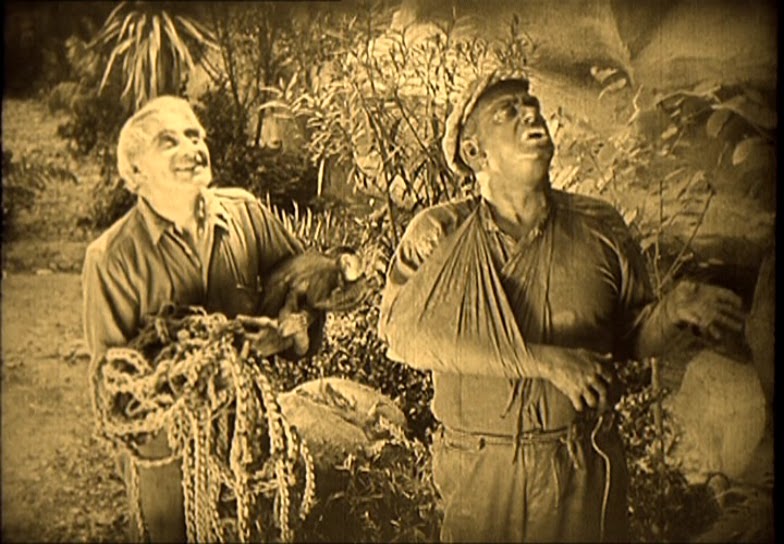
You can understand as Challenger is all for pure adventure even if here he’s opposed by the scientific establishment. He’s played by Wallace Beery complete with wildling beard and scatty fringe highlighting wide staring eyes as he’s laughed at by his peers. He’s looking for men to accompany him on an expedition to the Amazon to try and rescue Maple White whose journal suggests that dinosaurs still roam a plateau deep in the jungle. Noted adventurer and game hunter Sir John Roxton (Lewis Stone) offers to join him as does Professor Summerlee (Arthur Hoyt) who wants to prove him a fraud.

A young reporter, Edward Malone (Lloyd Hughes) also offers to join up much to Challenger’s disgust – he hates fake news – but Ed has a girl to impress with daring deeds, Gladys Hungerford (Alma Bennett). But, once then young fellow spies White’s daughter Paula (Bessie Love) we and he aren’t so sure of this prior commitment.

A US map of the Atlantic: Britain known by its proper name of Liverpool...
Cut to animation of ship skipping down a map from London to Brazil and the team are soon looking at a huge plateau with only one way up. They climb a rock tower and walk across a tree trunk to the plateau but their route is soon swiped away by the first of many huge new animals: the dinosaurs are here!

The stop motion is still impressive (thousands of movements over hundreds of painstaking days) and O’Brien worked a split screen with increasing confidence as he showed the “tiny” actors against a backdrop of dense forest and battles between Allosaurus, Brontosaurus, Triceratops and Stegosaurus (the last two my childhood favourite dinos). By the film’s spectacular conclusion, we see a Brontosaurus let lose in 1925 London… eight years later, O’Brien had a giant gorilla doing the same in New York.

Very smart split screens
If the story intensity drops on the plateau it’s because the adventure was all in seeing these great creatures live and move again and we’re all so used to seeing dinosaurs now. But there were moments when music and music hall helped us recapture the magic of discovery once again.

The Lost World was so nearly a lost film and is still being restored with a new 110 minute long Blu-ray due from Flicker Alley on 12th September. The version shown was the 93-minute restoration from 2000 used on the Eureka DVD which has perhaps 90% of the original content according to Doyle and Lost World expert, Roy Pilot’s commentary.

Reaction shots are key to believability.
It’s a classic bit of fun – pure cinematic pleasure! Wilton’s and the Lucky Dogs made sure we all had the best of it!

This was part of a short summer season from Lucky Dog at Wiltons including the magnificent Brit-com Shooting Stars and, footage of Irving and Malory’s fateful climb in The Epic of Everest. For details of upcoming show visit their website or follow them on the old social media.


Thursday, 22 October 2015

Crafted Capra with a cringe… The Matinee Idol (1928) Cyrus Gabrysch, John Sweeney, Lillian Henley, Kennington Bioscope


Of all the changed attitudes over the last century, the issue of race is probably one of the hardest to contextualise. Here Johnnie Walker plays a successful black-face entertainer in the manner of Al Jolson and it’s undeniably awkward for the modern viewer... I mean; why?!

We can't just ignore it but for audiences in 1928 minstrels were common-place and symptomatic of an unequal society were racial stereotyping was seen as legitimate entertainment… The fact that British TV still had the Black and White Minstrel Show in the seventies is even more shocking. We’ve moved on and culturally the cringes of the past must remind us of the need to keep moving further and to be mindful…

Ginger meets the face-paint in front of the man...
This film was lost until the nineties and gives an opportunity to see sweet Bessie Love in proper action. Miss Love never quite hit the top tier in Hollywood even though she featured in Intolerance and numerous features through to the talkies and was acting even in the eighties with appearances in Reds and The Hunger. She moved to Britain were she encouraged a young film fan name of Kevin Brownlow, whom she was later able to introduce to so many of her contemporaries for the interviews that became The Parade’s Gone By and, the renaissance is history…

So, not just a very pretty face… and what’s more on this evidence she was a fine comic actor.

Bessie
It’s an early Frank Capra film and whilst it would be a stretch to identify any kind of “touch” of the Capra kind from the future director of Mr Smith Goes to Washington, Arsenic and Old Lace, It’s a Wonderful Life et al, it is a focused effort telling a slight story very well.

Johnnie Walker (last seen in Bare Knees) play Don Wilson the Jolson-type who sings comic songs made up as a minstrel. He’s a big hit on Broadway and so he and the boys decide to hit the backroads for a few days. Their car breaks down and spotting a pop-up theatre advertising the Bolivar Players, they boys head off for a laugh at the locals’ expense leaving Don to find a mechanic…

Don passes the audition...
It just so happens that the company’s lead, Ginger Bolivar (Bessie Love) has just fired one of the performers and is auditioning for a replacement with the same relish a witness surveys an identity parade… She asks the men to say “I love you” and is greeted by a line-up of the inept until, that is, the last man, the one who was really only looking for a garage.


Don is duly hired under the name Harry Mann and proceeds to add humorous spice the company, turning the words of Jasper Bolivar (Lionel Belmore) from Civil War tragedy into comedy.

Out in the audience sits Don’s manager Arnold Wingate (Ernest Hilliard) who find’s Don’s interjection as hilarious as the audience. He invites the Bolivar’s to play on their revue and Don plays along. Already attracted to the feisty, loyal and lovely Ginger, he begins to have his doubts and as he hides his identity in black face he wonders if breaking her heart is the best way of getting a laugh.

They say the tights are always bright on Broadway...
The Matinee Idol was thought lost until the 1990s, shows Capra developing away from his background as gag man for Harry Langdon and forging his own style. It’s a very symmetrical film albeit with the cultural cringe of comedy homosexuals and those awful faces in black paint.

Cyrus played along and moved seamlessly from Dixieland to Yankee Doodles: comedy and romance in balance.

On the undercard were three films new to me: I do love these Bioscope surprises!

Charles not being peaceful!
First up was a quite startlingly-brutal British film from 1905, The Life of Charles Peace which told the quite extraordinary tale of a notorious felon who blagged and murdered his way to ill-gotten riches until finally stopped by the Police. The sets were painted canvas but the stunts and fights were all too real… the scarcely-serene Mr Peace was like the Krays and the Richardsons combined exercising a pull on the contemporary imagination – the man who takes what he wants and doesn’t follow decency or the law – myth amongst the mayhem.

Truth was even more extraordinary than fiction and it’s worth perusing Mr Peace’s wiki…

Walter Forde
This was followed by Walter the Sleuth (1926) a film from Walter Forde, Britain’s premier silent comic who ended up a director in the thirties and forties, producing both versions of The Ghost Train including, of course the one with Stinker Murdoch and  Big Hearted Arthur Askey – “I thank you!” (bingo!!)

Lillian Henley provided accompaniment to this meandering romp through South West London – Richmond anyone? Forde played a clownish fisherman who has to act as the fiancée of a Surrey IT-Girl (Pauline Peters) who, supported by a very distracting group of Bright Young Flappers, is trying to avoid the intentions of an older man who, it turns out, is after the family jewels. Ford has to act as a detective and, as it turns out, well… you know the rest.

Gypsies in the city
The third film was the most startling and was Grossstadt-Zigeuner a 1932 documentary directed by Laszlo Moholy-Nagy on Hungarian gypsies in Berlin which saw John Sweeney really take flight on the piano pounding out spirited gypsy patterns that would have had Brahms dancing by the fireside in his beloved Zum Roten Igel*!

This is the closest I’ve personally been to cutting a rug at the Bioscope!


*The ‘Red Hedgehog Tavern’ – where Brahms went to hear gypsy musicians play in Vienna. If you want more "gypsy" I would recommend a very talented group called ZRI who play an unique mix of classical and Romany... they will move you!

Now a couple of days break before the Cinema Museum is officially confirmed as the funniest building in South London with the Bioscope Silent Laughter Saturday. A few tickets are still left if you hurry! I can't imagine any of us will want to miss this!

Wednesday, 8 July 2015

Breaking bad… The Mystery of the Leaping Fish (1916)

It’s all so easy to laugh at this one and to shake your head in condescension – what were they thinking; making a comedy based on a drug-addled “scientific detective” who solves his crimes through frequent use of narcotics? Didn’t they know that stuff was dangerous; had they no idea that these ultra-addictive drugs would soon be out-lawed, Hollywood would stand to be accused of institutionalized decadence and that one of the film’s cast, Alma Rubens, would later die of addiction?

Sadly, unlike pretty much every one of the drugs involved, hindsight just wasn’t readily available over the counter and the involvement not just of Douglas Fairbanks but also Anita Loos (the titles), Tod Browning (the script) and even DW Griffith ( a little), showed just how “accepted” recreational drug use was as a source of humour... I don’t think the team was advocating drug use nor even the opposite – in the manner of The Devil’s Needle (1915) – just taking the idea of a self-medicating Sherlock to its extreme.

Everything the modern "scientific detective" needs...
In fact they didn’t really mean anything: it’s a joke albeit an odd one. Not to judge then but to understand…

Fairbanks later disowned the film after a lot of water passed very quickly under this particular bridge: after drugs had clearly become a killing joke. But even on release the film was banned in Boston and elsewhere: cocaine was available on prescription or over the counter from pharmacies but it had been otherwise made illegal by the the Harrison Narcotics Tax Act of 1914.

The Ennyday-Mobile in "street disguise" mode...
Directed – eventually - by John Emerson (after Christy Cabanne was fired…), The Mystery of the Leaping Fish was made during a period of consolidation in Fairbank’s burgeoning career but clearly before his action adventure persona was solidified. He plays Coke Ennyday a man whose clock tells only four times: "EATS, DRINKS, SLEEPS, and DOPE" and generally goofs around as the tripping detective. He’s pretty good but sometimes quite annoying but when he takes on the baddies near the end, bouncing around in perpetual motion he’s “our Doug” alright.

Allan Sears is rolling in it!
Coke is roused from his reveries by the arrival of the local police chief I.M. Keene (Tom Wilson), there’s a gentleman on the loose who is rolling in wealth – literally – and with no visible means of having earned it (Allan Sears) time to get the needle in and set off in pursuit of this mystery millionaire.

The Bad Men and their fish
Coke dons his ‘tec-togs, a fancy check suit that is matched by his car – a superbly-stenciled vehicle with the driver’s footman (Joe Murphy) – without whom Coke might not make it through any day -  positioned at the back in matching suit.

They arrive at the beach where the man was last seen and here the mystery of the leaping fish is revealed as the “fish” in question are inflatables loaned out to bathers…

Bessie on the blower
A Little Fish Blower (Bessie Love) is employed to blow the fish up – very slowly from the looks and size of her – and she is also having pressure applied to marry the boss of the blow-ups (William Lowery) a mean character – she could do better.

Eagle-eyed Coke spots his target frolicking in the waves and sets off in pursuit of him and his accomplice (Alma Rubens) enabling what is perhaps the first sea-based inflatables chase in cinema history… Coke’s flying fish springs a leak after he tries to inject it with cocaine and he spins off out of control enabling the dodgy duo to make good their escape.

Doug's mustache is detached and they just keep on filming... Bessie can't stop laughing!
Coke befriends the pretty little fish blower and maintains his watch on the beach… it’s surely only a matter of time before inspiration is chemically-induced and the flying fish get fried.

The Mystery of the Leaping Fish is well made, energetic, wacky and slightly shameful… It’s probably not responsible film-making but it also fails to be funny for long stretches abandoning Doug’s natural charm for bad moustache twirling and repetition of the same injection jokes… Granted the hero’s recourse to drugs eventually saves the day in unexpected ways but that’s more by accident than design.

"You are at my mercy woman..." Nope, not a bit of it!
In a cop-out twist at the end we see the real Fairbanks having his “idea” turned down by the studio head who suggest he sticks to acting and not scripting. They knew… they knew very well.

The film is available on Kino’s excellent Modern Musketeer DVD set, either direct or from Amazon

That'll be a no then...