Showing posts with label Edmond van Daële. Show all posts

Sunday, 1 December 2013

Immersed… Napoléon (1927) with Carl Davis, Philharmonia Orchestra, Royal Festival Hall


“Maintain radioactivity during the creation of Napoléon. Only write in moments like these...” Abel Gance

Oh where to start? It’s the morning after the day before and my head is still full of the Abel Gance’s images and Carl Davis’ music.

This was the biggest silent cineaste party of the year: one huge film in four parts, a sixty piece orchestra and those three stunning screens… Napoléon is a rich artistic achievement that still over-reaches itself 85 years after it was created.

Even when you know what to expect, this was the most visceral of cinematic experiences and one that almost defies rationalisation: you respond in the most subjective, emotional ways and you are constantly surprised… you can’t quite keep up.


Locked in the Royal Festival Hall from lunchtime to closing time, you are sucked into the heart of Gance’s story by his relentless energy and invention. From the beginning you are placed right in the visual heart as the camera roams freely through the snowball fight that is the foretaste of every battle to come. But it’s not just the mobility of the image, it’s the way Gance captures his actor’s emotion, cuts rapidly between his shots and overlays images that show their interior responses to the action.

Vladimir Roudenko and Albert Dieudonné play Napoléon young and old and are marvellously expressive, but only Gance can show you what they are actually thinking of: conquest, Josephine, a pet eagle… sometimes all at the same time in multiple exposures on three screens.


Simon Pegg recently described modern cinema as being like fireworks but Gance was making the explosions first, using every technical advance he could to disorientate the viewer and make them submit to the story. Forget 3D he had polyvision, cameras on bikes and horses (steam powered to counter the motion) as well as hand-held and suspended on a giant pendulum. And, whilst he originally had music from Arthur Honegger, today he had Carl Davis and the mighty Philharmonia channelling Beethoven, Mozart and Hayden – so, come and have a go Hans Zimmer if you really think you’re hard enough!


Davis’ score is an amazing composition which matches the film’s energy and tone: heroic and soulful. Even with the three breaks it must push the players to the limits: I’m amazed at the endurance and the fact that Mr Davis appeared as spritely for his fourth bow on the podium as he did for the first. Needless to say, there was a suitably-sustained standing ovation at the end… and perhaps we were also clapping ourselves for experiencing this wonder: we did it – the whole day long: we saw Napoléon!

As the crowds floated away a huddle remained around Kevin Brownlow without whom the film would not exist in the form it does… something close to Gance’s original before it was so cruelly butchered.  Here was also our physical connection to the director whom he met on a number of occasions and who got to see his original restoration aged 90. When we got home we re-watched the Napoléon section in Brownlow’s The Music of Light which features an interview with Gance as well as cinematographer Jules Kruger.


Napoléon as seen by Abel Gance to give its full title, was the first of six planned movies on Napoleon but the first one was enough… as financial issues and a mixed reception clipped Gance’s wings. There were spectacular performances with both triptych sequences intact and a full orchestra but the general distribution was compromised by business meddling. In the end, the final part, Saint Helena was made from his script by Lupu Pick in 1929 and Gance made Austerlitz in 1959 with a multi-national cast including Orson Welles and Leslie Caron.

This first part takes us from Napoléon’s school days, through the Revolution, the Terror and to his first successful foray into Italy aged just 28 and two days after his marriage to Joséphine de Beauharnais. Had Gance carried on in the same manner, it would have taken us till at least Thursday to get to Waterloo: either the battle or the station for the journey home…

School days
But what remains is a powerful exposition on the nature of the man and his motivations. Napoléon’s rise to power is amongst the most startling in history and whilst his elevation to Emperor and expansion across Europe mark him as a military dictator of the highest order – 17 years of conflict and as many as six million dead - he also brought reform as well as order.  He was a man of incredible drive and intellect and in a country that had to re-invent its concepts of authority and nation after the end of monarchy, understanding him and his relationship to the Revolution was an enduring concern when the Third Republic faced the Great War and France struggled in the aftermath.

Saint-Just, Robespierre, Danton and Marat
Gance wasn’t excusing the tyrant-to-be just trying to explain him… and, then as now, being even handed with despots is a minefield. The Revolutionary period is not straightforward and even “The Gods” - Danton, Marat and the notorious Robespierre - all fall from grace at some point: not for nothing is the latter seen reading a biography of Cromwell… All of their reputations reflect the political mores of the day but they were revolutionary.

Albert Dieudonné
Dieudonné is mesmerising as Napoléon and carries the weight of the film and history on his narrow but firmly-set shoulders… this was pretty much a suicide mission for any French actor and yet he is entirely convincing even in a wig that gives him a passing resemblance to Noel Fielding.

His Jospehine is Gina Manès (so amazing in Coeur Fidele) whose electric blue eyes are given full reign as she lures the young general in whilst politicking on his behalf with her paramour the Vicomte de Barras.
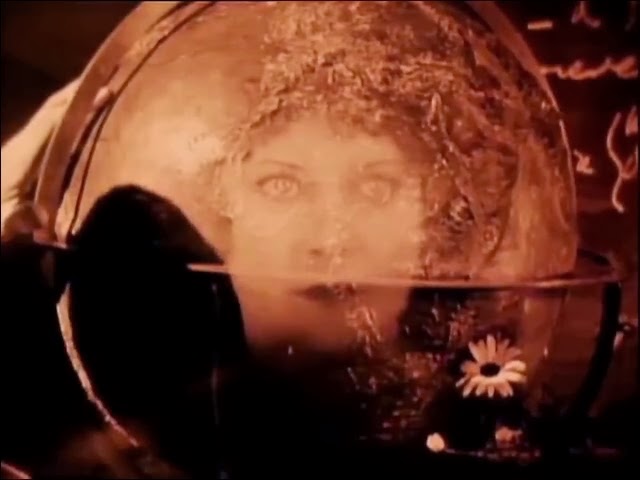
Gina Manès
 Alexandre Koubitzky makes for an operatically expressive Georges Danton, Antonin Artaud (known for the Theatre of Cruelty) is a twisted Marat whilst Edmond Van Daële (the baddie in Coeur Fidele) plays Robespierre, hiding his thoughts behind deeply tinted glasses.

Abel Gance himself plays Louis de Saint-Just encapsulating the movement’s conflicted delight in the removal of opposition via Madame La Guillotine whilst at the same time, passionately defending the continuing revolution in front of the baying mob in the Assembly.

"The Gods": Marat, Danton and Robespierre
There are two other roles that also mark Gance’s view of greater events with Tristan Fleuri (Nicolas Koline) as an “everyman” who pops up throughout the key moments of Napoléon’s career and his daughter Violine (Annabella who later married Tyrone Power!) who starts her own cult of Napoléon: worshiping him at an alter hidden in her room like a pop star, like a saint…

Both help to humanise the spectacle and to anchor the audience in the recognisably real – there are plenty of jokes too. But Napoléon was super-natural and Gance’s film is suitably extra-ordinary.

Albert Dieudonné, Annabella and Nicolas Koline 
Whatever the rights or wrongs of the character or the odd blips in pacing and tone, ultimately we’ll never forget the moments of Napoléon’s tiny ship riding the waves of the storm as the Assembly erupts in conflict. Nor will we ever see anything like the closing sequence when the curtains are pulled back and the film on view triples in size. As Davis’ score reached new heights the story soared like Napoléon’s eagle over any refusal to accept it.

Simply magnificent.

Abel Gance as Saint-Just

Sunday, 20 January 2013

The prestige… Cagliostro (1929)

Hans Stüwe
So many silent films have been completely lost and others are shadows of their former selves - are we to be any less stricken at a film that is only partially intact: half empty of half full?  Richard Oswald’s tantalisingly incomplete Cagliostro - Liebe und Leben eines großen Abenteurers survives in just enough quantity to show us what it probably was....

This edition has been painstakingly reconstructed by the French Cinematheque in collaboration with Potemkin films. It is based on a 9.5mm Baby Pathé abridgement (intended for family viewing) and one surviving reel of 35mm including some censored scenes featuring startling nudity - their removal from view ironically ensuring their eventual survival and public display 80 years on.

In the court of the Capetian King...
Based on Johannes von Guenther's novel about the life of Joseph Balsamo, alias the Count Alessandro di Cagliostro, an Italian occultist, adventurer and freemason-adventurer (make what you will of that and pretty much the whole of his life story)… Oswald’s film is grand in scope and still has impact even in truncated form.

Hans Stüwe is impressively larger than life as Cagliostro, charming the courts of Europe with his prestidigitation and legerdemain. He turns lead into gold in some wonderfully atmospheric shots and sets the scenes with audacious use of a disco-ball…

Studio 1784
Seemingly he believes his own hype and calls for sick people that he can make better. But it may be more trickery and part of his attempt to gain social stature… moving ever closer to kings and queens. These early scenes feature elaborate mis-en-scene and expressionist flourishes that build up Cagliostro’s mystery.

Stüwe is striking enough to carry this off but he’s less convincing as a paramour and his love affair with Lorenza (Renée Héribel) initially lacks conviction, but maybe this was left on the Pathe cutting room floor? He woos Lorenza in a missing section and we quickly learn that it was not the adventurer Cagliostro she fell for but the man Balsamo who, for a time, stopped the circus.

Suzanne Bianchetti and Hans Stüwe
The couple journey to France in 1784 and find the country on the verge of uprising with economic strife compounded by uncaring royalty. In the midst of a political rally they encounter a disenfranchised noblewoman, Jeanne de la Motte (Illa Meery) a descendant of Henry II fallen on hard times: the “Barefoot Countessa”. Cagliostro takes her under his wing and vows to restore her fortune at the same time seeing a way into royal favour.


Charles Dullin
A number of characters have been lost in the cut and others have been reduced: Charles Dullin as Marquis de Espada-Comte de Breteil, is seen all too briefly for most of the film. An admirer of Lorenza the Marquis views Cagliostro as a fraud and is intent on exposing him and grabbing the girl.

In lavish surroundings, Cagliostro presents Jeanne to the court and raises money to help her, she is accepted back into royal patronage and becomes the Queen’s lady in waiting.

Illa Meery, not just bare feet...
But the Italian blows his big chance as his tricks don’t come off and he fails to impress King Louis XVI (Edmond Van Daële) and Marie-Antoinette (Suzanne Bianchetti) – has the Marquis sabotaged his act? In trying to redeem himself Cagliostro shows the Queen her future, Oswald cleverly zooming in on the magician’s eye to show Marie Antoinette’s final moments at la guillotine…

Alfred Abel
Cagliostro is banished from court but he plots revenge and calls in a favour from Jeanne to persuade Prince de Rohan (Alfred Abel) to buy an exceptionally expensive necklace for Marie-Antoinette with whom he is besotted. The con goes off well and we see Jeanne parading around in the Queen’s finery and little else. Cagliostro is strangely unmoved, perhaps his love for Lorenza is starting to affect his moral judgement although he still steals the jewels back.

But the game is soon up and Cagliostro is given over to the Marquis de Espada for questioning in his hi-tech arabesque palace – sliding doors and automated. Tied to a pillar he breaks free as the Marquis’ “questions” Lorenza in front of him… the anti gradually being striped away to reveal just  the hero.

Hans Stüwe and Suzanne Bianchetti
They escape back to Italy were they finally think they have finally found their freedom. only to be arrested by the Inquisition (no one expects the Italian Inquisition do they?) intent on punishing necromancy. Locked in Piranesi-esque dungeons, their doom fast approaches and, as Cagliostro finally seems to have caught up with the steadfast Lorenza’s feelings, they seem to have only hope left for happiness…

Elaborate imprisonment
The DVD comes with two soundtrack options which make for fascinating comparison.

There’s a DJ Cam cut up which could be perfectly suited to what is in effect a cut up of a film. He sounds very much like a Gallic version of the great DJ Shadow (a jazzier Endtroducing…?) but, even though his invention is entertaining, it lacks emotional flexibility and rides rough-shod over some of the narrative.

The piano accompaniment from Mathieu Regnault is more period appropriate and moves with the story. I understood the action more with his playing and had a better connection… there’s some lovely phrasing and it’s just more sympatico.

Both musicians make the very most of what remains and so should we. It’s difficult to make a case for this being up there with The Chess Player and other late silent era period classics, but it’s good looking and well played. The story is intact and there is sufficient drama left to have you on the edge of your seat right till the end.


The DVD is available direct from Potemkin although I got mine from the lovely BFI shop. It features an extensive booklet (tout en Français) including a fascinating essay written for May 1929 editions of Cinémagazine by Marcel Carné who was an assistant on the film. Whilst referencing lost scenes such as an apparently large-scale village fete, Carné elaborates on the set design and underlines the considerable will of his German director who, speaking hardly any French, had this film in the can within 60 days.

Not bad going for a multi-national blockbuster that interweaves so much of courtesans, kings and conjuring...


Saturday, 28 April 2012

Artful… Cœur Fidèle (1923)

It’s 1923 and already the arthouse demarcation lines appear to have been drawn firmly across the Atlantic and as far East as the English Channel. I’m not sure just what is it about national culture that allowed such marked differences in style to be embedded so early on, but the evidence might seem to support the idea of more experimental and, artful for its own sake, movie making in Europe than the United States.

The innovations of de Mille and Griffith seem more “sensible” than the emotive experiments of Abel Gance or the extravagance of Robert Wiene. They developed techniques because it would improve the storytelling whereas the Europeans maybe did so merely because it offered new possibilities that might offer deeper insight.

Gross generalisation of course but… Cœur Fidèle (Faithful Heart), directed by Jean Epstein in 1923, certainly tells its story in a different way from most contemporary Hollywood fare. There is extensive use of close up, photo montage, superimpositions and unusual angles to get across the characters’ emotional states. The viewer passes through the physical storyline straightforwardly enough but Epstein seems to be mirroring the efforts of his countryman Gance, in attempting to convey the inner stories as well.

The film starts with detailed close ups of tables been cleaned and drinks being served, mundane reality. The woman holding the bottle is Marie (Gina Manès), a “foundling” brought up cruelly by her adoptive parents. They run a dockside bar in seedy Marseilles and make her work every hour.


We see misery driven deep in her eyes and reflected by the dreary workings of the dockside, the relentless greyness and eternal lapping of the polluted waves against the quayside.

Manès has electric, piercing eyes and the camera lingers on them and her face in a series of unrelenting close-ups. We’re dragged in there right with her.

A local thug Petit Paul (Edmond van Daële), has taken to Marie and, whilst he has no respect for her happiness he seems intent on possessing her.


We see her literally pull away from the window as he approaches. She loathes him but her parents are as frightened by Paul as the rest of the dock workers and won’t stand in his way.

But Marie is sustained by her secret love for Jean (Léon Mathot), a decent dockworker. He waits for her by the dockside, face deep in thought and when the two meet there is a rapture of superimposed images of their faces against the sea.

Epstein shows us the backs of their heads as is if to underline their intimacy and to pull us in. Next he overlays an image of the water over their faces but never follows through to the full fade… he’s grasping for something indistinct and I can only kill it by trying to describe things...you have to watch.

Jean attempts to extract Marie from her situation but is faced down by Paul and a gang of his friends. Marie is “given” to Paul and Jean sets off in pursuit.

Marie and Paul go to a funfair where again there are lots of intriguing shots no more so that when the camera follows them on a merry-go-round. Marie’s despair is counter-pointed by the delight all around. In this place of joy she is so unhappy.

Jean finally finds them and in the ensuing confrontation with Paul, a policeman is killed and Jean takes the rap. He is sentenced to a year in prison.

Once Jean is released, he goes in search of Marie and finds her living with Petit Paul, a disabled woman (a superb performance from Marie Epstein – the director’s sister) and a young baby.

No one is happy and Paul, having got rid of his rival and stolen his prize, has been rewarded with a life of drunken wastefulness. He brutalises the women and cares nothing for his child choosing to feed his habit rather than fund his son’s medicines.

Jean begins to meet with Marie but the local gossips start to talk and Paul eventually learns that they have been chalking heart-shaped messages as signals to meet each other throughout the docks. Graffitti is a constant theme throughout the film from the words and symbols on the walls of the tenements to those in the docks and, crucially, the words "For Ever" on the bar wall.

Paul returns to confront the lovers but is valiantly pursued by L’Invalide, even as her crutch is broken in two and he pushes her down.

Spoilers ahead: Reaching the flat, Jean grapples with Paul and his gun falls to the floor… in the confusion, the gun is picked up by the girl and she shoots her tormentor dead. She has saved all of their lives.

An epilogue completes the story showing the girl minding the baby as Jean and Marie travel round the merry-go-round. They only look on the verge of happiness as if their trials have left them traumatised. But the message is one of hope and finally we see them smiling and still in love: “Love can forget everything”.

Cœur Fidèle is a simple enough story, but its impact is largely down to the way it is told. The numerous camera tricks can be a little jarring but they play poetic tribute to the love on show.

The lead actors are also terrific with Edmond van Daële wearing his nihilism on his sleeve whilst Léon Mathot is steadfast with a sad determination throughout. Gina Manès is the standout with her amazing eyes and a face that reveals so much whilst changing very little. She is the most naturalistic of the three: the woman almost in neutral as the battle rages.

Ultimately the experimentation serves to produce a memorable story that does indeed have more impact than more conventional cinematography may have delivered. So many factors are always at play but here they are under control and purposeful.

Cœur Fidèle is available from Masters of Cinema and is very reasonably priced from Amazon or the BFI Film Store.

“L'amour permet de tout oublier.”