Showing posts with label Clara Bow. Show all posts

Sunday, 14 December 2025

Clara take a bow... Poisoned Paradise: The Forbidden Story of Monte Carlo (1924), NFPF Restoration Streaming


“Nothing but the highest praise can be accorded Clara Bow… Her performance both when she is at the heights of exaltation, and when she is cast into the depths of despair, is nothing short of inspired. There is every reason to suppose that she will become a great favorite in a short time, and her performance in this picture will do much to put her there.”

Exhibitors Trade Review


It’s true, there’s nothing that makes this film so thoroughly enjoyable than the emergent presence of Clara Bow and it seems that this was as remarkable then as it still seems now. Written by Waldemar Young, the film is based on the 1920 novel Poisoned Paradise: A Romance of Monte Carlo by Robert William Service a Preston born lad who went to Canada where he became known as the Bard of the Yukon. In reality he spent little or no time in the Gold Rush but having been posted there by his bank, he soon picked up plenty of stories. After success, he certainly spent ample time on the Riviera and could have been inspired by any number of bad nights on the tables of the Casino.


Service knew how to tell a popular tale and with sentences rich in imagery and emphatic subtext - portents of destiny - you can see why he was so successful: "Strange! Always drawing. Did I ever tell you that your father was an artist?" In the film this sentiment is echoed after the opening scene of a suicide of his father who shoots himself after losing his all. The portentous intertitles lead us into the narrative from the get-go.


There was a boy in London...


Young Hugh and his fatally ill Mother find out the elder Kildaire has passed away after leaving them to pursue the dream from which he was distracted… “You too will be an artist, but you must be brave my little son: for you have a hard, hard life in front of you…” the rest of the story is trailered right there, who could resist turning the page, or waiting for the next reel. 


“There was a girl in Paris…” shifts the scene with similar economy to Margot, a young girl living in poverty, collecting a bottle of cheap wine in a bar and watching as a local woman, Madame Tranquil, returns with success from Monaco: “God bless Monte Carlo – I bring back a fortune – champagne for all…” Margot takes the bottle to her grandmother who, promptly chases her with a kitchen knife for trying to eat some bread. She falls down the stairs chasing Margot and dies. Luckily Madame Tranquil decides on the spot to adopt her with her new wealth.


Strange how like the whirring wheel Life itself is… the hazards… the final click of the ball of destiny…


It's all a façade!

To Monte Carlo and the Casino! Unchanged season after season, down the magic years… where we meet hustler Monsieur Martel – sometimes called “The Rat” – played by Raymond Griffith with the excess of verve you’d expect. He’s spotted near the roulette by Krantz (George Andre Beranger), the secret service officer who escorts him out of the building as we switch to a grown-up Margot about to throw away her savings on the unforgiving tables remind me how I once took ten Euros into the Casino and came out with eleven… we broke the bank! 


Clara’s reaction shots are all consuming as she loses and she looks fabulous dressed in a mink stole and with a top hat. Then it’s time to visit the grown-up Hugh (Kenneth Harlan), living the life of an impoverished artist in Monte Carlo where usually the only artists are conmen and not painters. Things are looking up though as he’s just sold a painting and can now afford to eat. He’s living in the same Hotel as Margot and The Rat and is as big a mug as you might expect falling for an old line from one Mrs Belmire (Carmel Myers) for whom he ends up paying for dinner. 


Back at their rooms, Margot is in misery, broke and with The Rat harassing her. It’s not just her though and the rogue has been stealing from other guests too forcing Hugh to leave his wallet on a chair and hi door ajar in an attempt to lure the thief into making a move. Sadly, it’s Margot, desperate, who cracks and grabs his stash but he can’t help but feel sorry for her after she tells him her misfortunes – Bow again excelling with her emotions bursting through that expressive prettiness, she’s hypnotic. No wonder then that it is then that Hugh has A Brainwave! 


I have it! Since mother died I have no one – you shall come and be my housekeeper!


Clara Bow and Kenneth Harlan


As brother and sister… exclaims the intertitle as they set up home with Hugh’s room divided by a curtain to protect his housekeeper’s modesty but, surely, no one can seriously believe that even with an especially acute artistic temperament, he cannot have missed the ever-so-slightly-gorgeous flaw in his plan…?


Ah well, he’s soon distracted by another man of improbable motives in the form of Professor Durand (Josef Swickard) who has come to break the Bank of Monte Carlo and avenge those who had fallen under its spell. He has worked out the perfect mathematical formula to predict when the numbers will come up and whilst it is another crazy plan we just know that this one is going to work. 


In another shock development, Hugh hears that he has sold all of his paintings and, despite feeling that the Prof is a one sandwich short of a Monet Le Dejeuner Sur L'Herbe, decides to fund his project. At the same time Hugh doubles his money at the Casino and gets the bug, impressed with his luck. Margot is not impressed but plenty of others are namely Mrs Belmire who Hugh still sees as a romantic interest. Of course, this means that he has her firmly in the “sibling” zone, even though Margot has grown rather fond of the big lug… she calls his bluff and threatens to go off and set up her millenary shop in Paris but something tells her she needs to stay.


The rock on which it stands is built of human skulls! …I shall destroy it!


Mr Griffith, the Rat!

It is, as you can tell, a very bitty narrative but things start to firm up in the second half of the film as all of the connections are revealed and the other “artists” try to work out how the Professor keeps on winning. It’s enlivened by the performances of Griffith and Bow especially and there’s a lovely scene when Martel comes a calling to take advantage of Margot when her “brother” is away and she absolutely batters him – it’s something we love to see in silent film, a “nasty woman” taking charge of the situation! In comparison Kenneth Harlan seems too old for the part but is solid enough although I don’t believe he could even hold a paintbrush.


For such a low-budget movie some of the exterior sets do seem rather extravagant and it suddenly struck me that we might be witnessing the leftovers from Erich von Stroheim’s Foolish Wives (1922) and this turns out to be the case with footage borrowed as per the notes on the NFPC page on which you can watch the film. Apparently the studio told the press that the star were being sent to Monte Carlo but they forgot to mention it was the one built, no doubt way over budget, by “Von”. Nevertheless, it does add some atmosphere to the tale. 


Ben Model perfectly recreates the contemporary feelings of the film with a spirited, playful accompaniment that indicates he’s clearly having a ball playing along with the dazzlers on screen. All in all, a very entertaining experience and one you can have for free at the NFPF site which isright here. As it’s that time of year they would appreciate support in funding this and further restorations and you can send them a Christmas gift at this location. It’s better to give than receive and they are the Professors of Preservation who have definitely found the right formula!


About the Restoration (from the NFPF site): “UCLA Film & Television Archive and the Stanford Theatre Foundation worked from the only surviving element of Poisoned Paradise, a deteriorated 35mm nitrate print. Two missing sections were replaced with stills and intertitles, some derived from the source novel (courtesy of David Stenn). The preservation, which also recreated the film’s tinting scheme, was funded by Saving the Silents, a collaborative project organized by the NFPF and supported by the Save America’s Treasures program, a partnership between the National Endowment for the Arts and the National Park Service. Further funding was provided by the Stanford Theatre Foundation. A recent NFPF grant funded scanning and digitization of the preservation print.”


SUPPORT THE NFPF! DONATE HERE!!


Responsible gambling...
Detectives in drag...
So, you stay on one side of the curtain and I'll be on the other... you'll be like my sister/mother/housekeeper... 


Friday, 14 June 2024

Call her savage? Hula (1927), Taylor’s Version


"You look like Clara Bow

In this light, remarkable

All your life, did you know

You'd be picked like a rose?"


Clara Bow by Taylor Swift


I have to be honest, I don’t really know how much research Taylor Swift has put into the life and career of our Clara Bow especially when she follows up with a pre-chorus about a small town girl seeing the lights of Manhattan – Clara was a Bronx girl but here is inspiring others be they star-struck young women or the men who wish to exploit them and her. She was a good bet for the money men and the studio system already well set in place and one of the first "sex symbols" opening the way to Harlow, Monroe and beyond.


There are similarities with the music business a century later and a bruising process Swift has seemingly surpassed being even herself the victim of exploitation and bad deals leading to her re-recording a number of earlier albums. Women, then and now are encouraged to be “marketable” and as Taylor’s chorus reveals:


"This town is fake, but you're the real thing

Breath of fresh air through smoke rings

Take the glory, give everything

Promise to be dazzling"


Clara was nothing if not dazzling and as the all-conquering Swift well knows… that’s what you need when you are It! But when you are so dazzlingly The Thing, clearly the business of show may eat you up and it's difficult to draw the exact lines between the stars eventual mental illness which even her wealthy husband was at a loss to contain and her early years in and out fo Hollywood. That said, she was obviously a victim of her success in so many ways but able to walk away at a time of her chosing, movies still doing well, to start her family.


Clara dazzles

Clara came from the slums and, after winning the Fame and Fortune acting contest in 1921, was to become perhaps the pre-eminent sexual star of the twenties in Hollywood making mostly run of the mill films like this one, Call Her Savage or the superior Mantrap (1925) which emphasised her punk energy, wild beauty and not inconsiderable acting talent. Bow was an exceptional “emotion engine” able to shift between happy and deep sorrow, with tears, in a matter of a few frames. Her abilities partly drew on the tragedies of her impoverished background – a friend’s death in a tenement fire being her constant aide memoire for this misery business.


She made around a dozen films a year very few of which could be classified as classics – It (1927), Wings (1927), the afore-mentioned Mantrap and, probably also her first talkie The Wild Party (1929) directed by Dorothy Arzner who was very sympathetic to her star who showed she was more than capable of transitioning to the talkies. At this stage in her career and especially without the foundation of stage training, she couldn’t have wished for a better ally than Arzner – now there is someone who needs a song! Bow made another ten talkies, most of which were hits, before retiring in 1931 after marrying Rex Bell and starting a family.


You could argue that Clara emerged reasonably well from her decade in the spotlight but her early years had been ruinous and she later succumbed to mental health issues lacking the caring hinterland and wealth of Swift’s modern entourage. But, when she shone brightly there were few to match her and she elevates even Hula through her magnificence…as, indeed, she was expected to do with all of her rapidly produced films: she was worked so hard in the silent era.


Directed by the Victor Fleming, and based on the novel Hula, a Romance of Hawaii (1927) by Armine von Tempski, Clara features as the unruly Hula daughter of a Hawaiian planter, Bill Calhoun (Albert Gran) who just loves to party along with the island’s smart set. Hula meanwhile prefers the company of the locals and her “uncle” Edwin/Kahana "a half-Hawaiian ranch foreman" (Agostino Borgato) who has been her "nursemaid and bodyguard sine her baby days..." and she much prefers their more balanced existence with nature. This of course fits in with Clara’s persona of “natural” and wild, even if that would sometimes involve more over racial coding as Call Her Savage based on Tiffany Thayer’s frankly barmy novel about mixed race – one of his favourite subjects if anyone remembers Thirteen Women and Myrna Loy’s character and motivation.


Hula is certainly running wild here, opening the film skinny dipping in a pond and giving the audience what it wants in a film that Fleming makes sure covers as much of Clara Bow as possible. Clara is helped into her tight jodhpurs before racing on horseback to the party being held by her parents in their grand house with the local notables. One man, Harry Dehan (Arnold Kent), bets that he can make her get off her horse and join them inside by luring her with a present but she just rides inside and escapes with his bet lost and present in hand.


She may be only just turning 18 – Bow was 21 during filming – but Hula knows what she wants and is struck by the arrival of a “young” British engineer Anthony Haldane (Tufnell Park’s Clive Brook who had just turned 40), on the island to make his fortune and find a new life away from his wife Margaret (Patricia Dupont) and a marriage that is dying from indifference. As is the way in these films, the cultural and age differences count for little when two characters are destined for each other and the two are soon in Hollywood love as Hula’s inner flames melt his frozen heart of empire.


Clara and Clive

But there is just that one big complication and jealous forces, there are always jealous forces in these films, here the widow Mrs. Bane (Arlette Marchal), act to encourage Margaret to try and rekindle their relationship with Anthony’s hard work seemingly about to make him a fortune. She clearly has no idea that she’s up against a force of nature…


Clara’s spirit rises above the limitations of Von Tempski’s source material, in this case Doris Anderson’s adaptation and Ethel Doherty’s scenario, and she holds up the whole film especially as Brook, fine actor though he is, has very little to work with. He’s much better suited to the more cerebral Evelyn Brent on Underworld and he can’t match the Bow energy or, indeed, youth. Von Tempski is an interesting woman in her own right having been born in Maui, the daughter of a Polish ranch manager and ended up running a ranch with her sister before moving to the US and marrying a man 15 years her junior… someone should make a film!


Overall Hula, as presented in decent quality on the Grapevine Blu-ray – a bit murky in parts but very watchable – is good Clara fun but it does feel as though the more interesting edges of the story have been knocked away to free up the screen for the actor’s greatest hits in terms of expression, bodily exposure and plucky resolve to get what she wants. Clara had that in her films even if it was harder in life.


Taylor’s song moves on to Stevie Nicks and then, surprisingly, to herself as she fully recognises that she too is now the It girl and the template the industry wishes to replicate with another who fits the mould. Clara, Stevie and Taylor though, I think they broke that mould when they made these three, whatever the efforts to monetise their natural talents, all three are impossible to replicate; there’s never been a Taylor Swift before just as there’s never been a Clara Bow before or since.


The fact that Ms Swift can include herself in this company says it all about the self-awareness and power she now has in contrast to so many who were used and suffered for their fame. Taylor’s version of Clara is therefore smarter than men of my age might otherwise assume; she recognises the energy and the singular presence of the first It Girl choosing to ignore circumstances that were beyond her control. It’s a celebration as much as a warning to those who the business will try to shoe-horn into those broken moulds.


Only when your girlish glow

Flickers just so

Do they let you know

It's hell on earth to be heavenly

Them's the breaks

They don't come gently…


Thursday, 14 September 2023

Live Cinema lives… It (1927) with Cyrus Gabrysch, Kennington Bioscope 10th Anniversary


This was the Kennington Bioscope’s 10th Anniversary edition and the package was so sweetly wrapped it even had a Bow on it. Cyrus Gabrysch is, he said, often accused of starting the whole thing but what he and then John Sweeney thought would be a connoisseurs-only cinema club was transformed by a brave dog fighting his way up the stairs of a lighthouse to relight the beacon. Kevin Brownlow’s copy of a Rin Tin Tin film provided the moment when the audience erupted with applause for the heroic hound and Cyrus realised something special was happening.


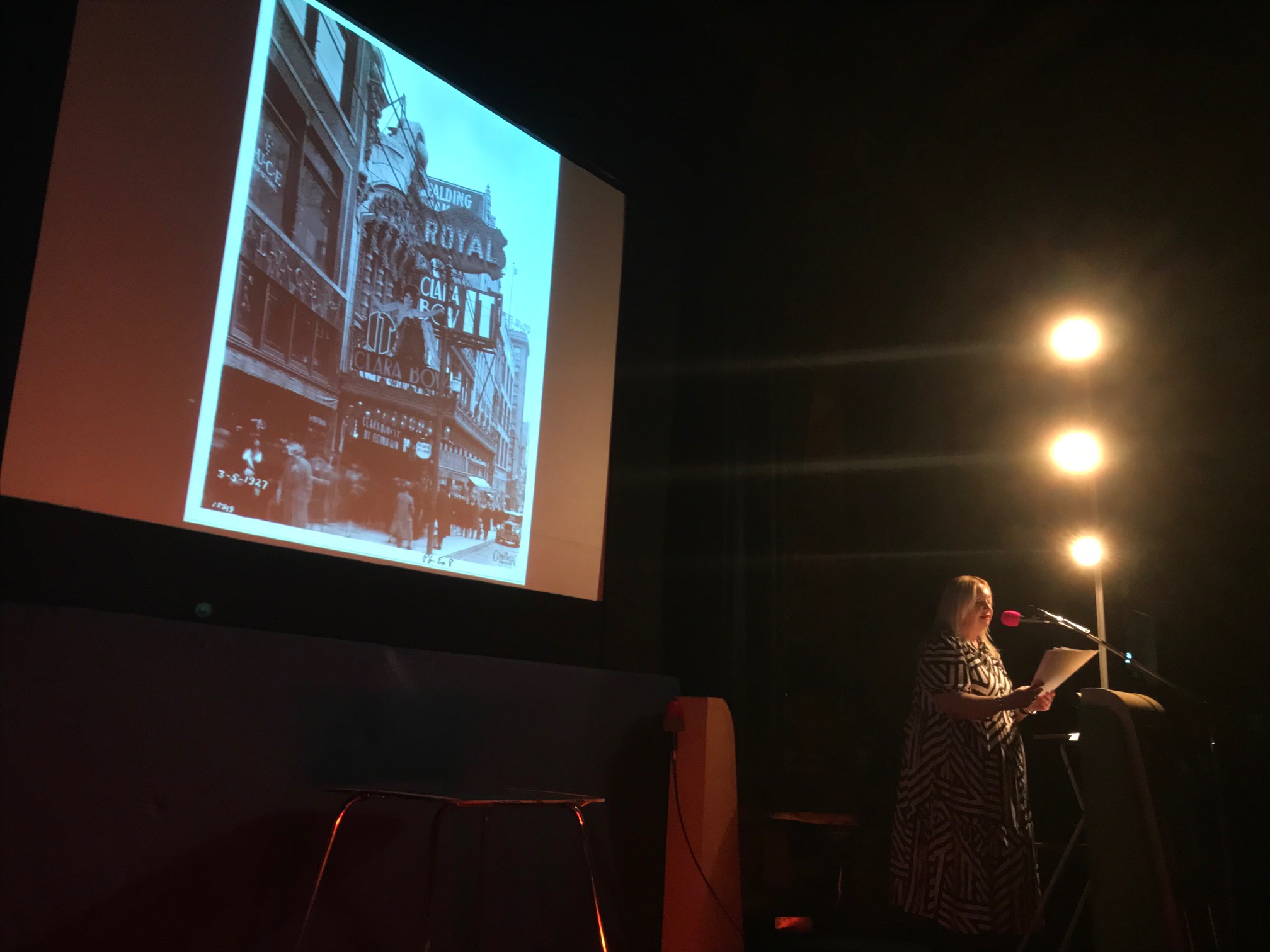
Michelle Facey quoted Pamela Hutchinson’s famous description of the KB as a silent speakeasy and, Cyrus felt it was also like the Left Bank cinema groups that inspired Truffaut, Godard, and Rohmer; maybe the Cinema Museum screenings will also assume an historic position as the place where silent film – film always on film – was resurgent through the Teens and the new Twenties that began not with a bang but with a fever as all cinemas we closed and the Bioscope moved fearlessly online with MC Facey becoming the face and voice of the silent resistance on KB TV.


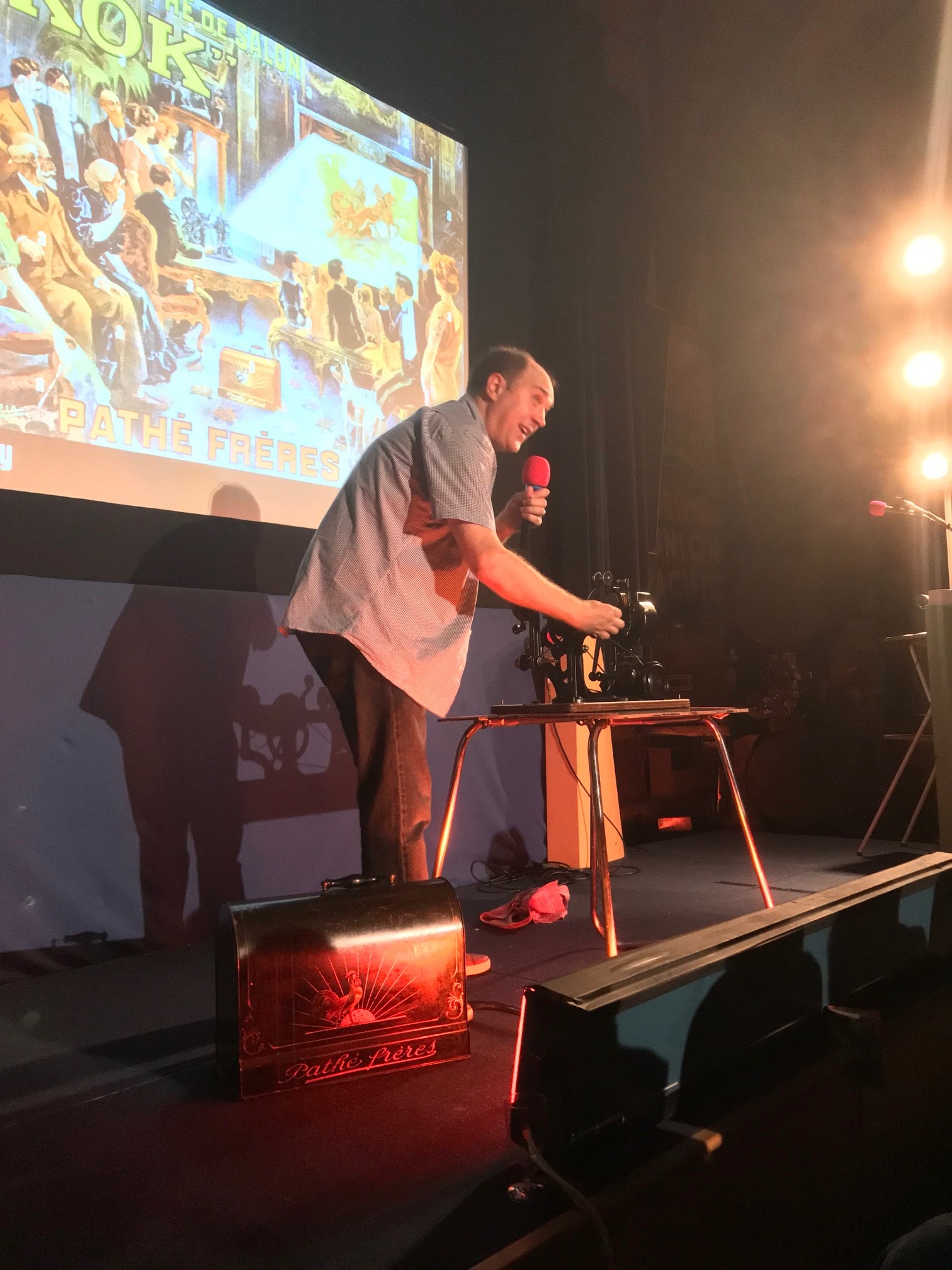
The Bioscope has always dealt with the material issue of cinema and tonight was no different with a first half dedicated to 28mm films introduced by Chris Bird, projecting 101-111 year old celluloid on 107-year-old equipment: film as history, history as film… moving history, it moves and it flickers even the hand-cranked 28mm projector Chris demonstrated on stage to audience applause. We should all be so functional after so long in the dark.


The Pathé-Frères 28mm KOK Cine Projector and Camera


We began with a couple of Pathé films, demonstrating French ingenuity in animation, Émile Cohl, one of the fathers of animation and then Méliès style trickery with Wonderful Armour?, as a devil and two women knights defied all logic and the evidence of our own eyes, as they detached body parts with a smile. Colin Sell did well to keep his head but, with the elegant Samantha looking on in silent support, he followed the action with all the concentrated control of a man who worked with Barry Cryer for decades.


Then to the USA for Lest We Forget a Mr and Mrs Sidney Drew filmin which the flowers of romance get very tangled and, as Chris stressed, the only copy, in the World, of Episode 30 (of 119) of the Hazards of Helen a very tightly wrought drama in which Helen Holmes appeared to swing off bridges, jump on to moving trains and dive into turbulent waters to retrieve stolen goods. We wondered if she used a stunt double, and John Sweeney too, who accompanied with fast-flowing lines and cliff-hanging drama all with no visible safety net.


Follow that Clara Bow. And, of course, she did.


Clara in a business meeting with Antonio Moreno


This was a 35mm print from Photoplay – company by-line “Live Cinema” - which had the natural warmth of a pre-digital restoration and looked stunning on the big screen. I say stunning and I mean Clara Bow who, despite a cameraman buddy complaining how difficult her kineticism made her to catch on film, featured in close-up after close-up that left the watched hanging on her every smile. The discussion pre-screening with my neighbour was who would be a modern-day equivalent of Clara and we struggled to come up with anyone as naturally powerful and so exuberantly un-mannered on screen.


If ever an actress has transcended the sum of her parts and if ever a star has been completely under-estimated then that must be Clara Bow. In her career from a 17-year-old in Down to the Sea in Ships in 1922 to a wise-cracking, talkie comedienne in Hoop-la in 1932… Clara made only a few classic films, although relatively few were preserved as Michelle pointed out. She never had something like The Crowd, Pandora’s Box or The Wind, to show what she could do dramatically but, in every one of the films she did make, there is ample evidence that she was an actor of considerable ability. And this is true for It made in a period in which she made some 16 films in about a year, Paramount making as much as they could from their asset. 


There was indeed something about Clara, more than just acting; something genuine and heartfelt that, coupled with her looks, earned her the respect of a large part of the cinema-going audience through these years. Watching It years later, her eldest son Rex Bell Jnr, remarked that he could see all the expressions and feeling he had seen from “mom” on a daily basis: she wasn’t just acting she was giving part of herself to the watcher. When called on to cry she would call on a childhood memory of one of her friends dying in her arms after being consumed in a house fire: those huge shining eyes would well up with genuine tears of sorrow.


If It is one of the great films it is because it perfectly captures the essence of Clara. Clarence Badger directs well enough and makes the most of his star and story, you can’t take your eyes off her and this is not just the compulsion of trying to find new angles on that prettiness but because she’s radiating so much joy. She is It and she’s supposed to be. It’s a tough role when you think about it, no one ever had to live up to a billing founded on such an uncompromising premise: there’s no “it or miss” you just have to be on target with the casting. Tag, you’re it!!


Based on Elinor Glyn’s story, they paid the English writer some $50,000 to appear in one scene in order to clarify exactly what “it” meant and, needless to say, this was considerably more than the vastly underpaid main star had accumulated from her previous half dozen features.


Events are based in the large family-run Waltham’s department store where the heir to the business, Cyrus Waltham (Antonio Moreno), is about to take over following his father’s departure to spend more time with his gun. Junior’s best friend, Monty (William Austin), is reading an excerpt from “It” in Cosmopolitan and trying to interest his friend in this new conception of humanity although in his case he’s more “what?!” than “It!”. Talking of which there’s a young Gary Cooper flashing by as a journalist… Clara noticed him too.


Sweet Santa…


My second trip to Coney Island this week after The Crowd at the BFI...


Whilst Cyrus focuses on his new responsibilities, his pal scans the store looking for an assistant with “it”. His eyes alight on Clara’s character, Betty Lou, and he knows he’s found his woman but, try as he might, he cannot get Cyrus’ attention even though Betty already has him in her sights. She’s not about to let him out of her grasp though and this begins a game of It! and mouse as confusion and comedy mix with the odd dash of pathos and anything that gives Clara the chance to run through her extraordinary emotional gears.


It’s an absolute blast and Clara is well-supported by William Austin, nostrils flared like a Jazz-Age Kenneth Williams and Antonio Moreno who just about convinces as her love interest even though there’s no way he had the same amount of “it”! But who has?


Cyrus Gabrysch’s anniversary accompaniment was suitably celebratory, running wild with Clara and holding us aloft with the film’s dazzle and comic drama; that rare Wednesday evening atmosphere we’ve all come to treasure. Ten years after Cyrus and John started playing and Rin-Tin-Tin single-doggedly saved that lighthouse, so many others continue to create these magical evenings, I than you all and raise a glass to the next ten years of history being watched and being made!


Chris Bird demonstrates the kit

Cyrus Gabrysch explains the Rin Tin Tin connection

Michelle Facey introduces It.

Clara in colour, a precious glimpse of Red Hair one of many Paramount carelessly did not preserve.


The KB is a little bit like this... 

Gratuitous extra Clara...

Are you being served?


Monday, 5 September 2022

The young ones… The Primrose Path (1925), with Stephen Horne, BFI


The eldest son is recklessly squandering his days along the path of folly - the Primrose Path - bordered by alluring  blossoms that ever beckon to youth...


This was Clara Bow’s 24th film and yet she was only just 20 when it was released in September 1925, positively ancient in comparison with Baby Peggy (aka Diana Serra Carey) who was on her 25th film aged just five with The Kid Reporter (1923): there was no hanging about in early Hollywood was there? Both films are testament to the professionalism and productivity of cinema at this stage and the opportunities for young talent to make an impact. Once you were noticed, the demand for your services was inexhaustible so long as you kept on delivering and saying yes… or at least had a parent, guardian or agent willing to do so.


The Peggy short was up first in this double bill of restored films… The Kid Reporter is a very competent effort that was designed to meet the expectations of its stars fan base and in its own terms it succeeds. You can see why Peggy was such a compelling character and why audiences of all ages were able to relate to her energy and humour.


A lot is down to the direction of Alfred Goulding who uses his remarkable asset wisely but you still have to perform even as a five-year-old and Peggy was clearly able to play act with the best of them, playing the unlikely stenographer at a newspaper run by barely-grown-ups. A string of posh pearls goes missing and the Chief offers the post of Managing Editor to the staffer who can find the story and the jewellery. No spoilers but watch the one who’s about three feet high.


Baby Peggy takes charge.


It’s always great to see Clara Bow on the big screen and whilst an unrestored and incomplete version of The Primrose Path had been screened earlier this year at the Bioscope, who also showed Kid Boots recently, a restoration of which was shown at this year’s Bologna Il Cinema Ritrovato, these are rare events compared with other actors of similar and, indeed, lesser status. Louise Brooks chided Kevin Brownlow for not focusing more on Clara Bow who she considered much more talented than herself and, whilst their styles differed, Bow was something of an emotional phenomenon, able to tap into a deep well of experienced sadness to present high-impact expression seemingly at will.


She was a natural, natural… as we can see it here even when, as the BFI’s silent film archivist Bryony Dixon said in her introduction, she’s not given much to do other than look pretty and cry which, on both counts, she does exceptionally well. But even when she’s not the centre of dramatic attention it’s always fascinating to watch Clara Bow and, as Bryony said when referencing her biographer David Stenn, his book, Running Wild, contains a lot of painful insight into Clara’s early years and the reasons why she was always able to tap into a well of sadness and would have struggled to match Peggy’s unblemished childhood charm.


Stenn was involved in both these restorations as was the BFI with materials used in conjunction with others led by the San Francisco Silent Film Festival. The colour tinting reproduces the dye-tinted colours present in the original nitrate film sources and restored 35mm print has been chemically dye-tinted, looking as good as almost any of Bow’s films in current circulation.


Clara in curls with Tom Santschi
 

The Primrose Path is no It! or Wings but it is a very entertaining programmer well-made by director Harry O. Hoyt (who went on to make The Lost World and many more) that pulls on the heart strings whilst presenting an effective plot line with many proto-gangster elements and genuine threat. You are ware of a limited budget and the tightest of briefs as sometimes cinematic code is used where linear storytelling might elaborate more fully: that is, you need to turn off your mind, relax and suspend disbelief as you fill in the odd gap.


The story is based on a fatherless family of Bruce Armstrong (Wallace Macdonald), a young man who has had his struggles with drink which resulted in an accident which left his younger brother Jimmy (Pat Moore, a bit elderly compared to Peggy but pretty good!) requiring a leg brace. They boys have no father, only a caring mother (Lydia Knott who is so quietly effective) who carries on amidst her despair at Bruce’s missteps.


Bruce is just about to get himself in deeper as, unable to pay his gambling debts to Tom Canfield (Stuart Holmes) a thoroughly corrupt Broadway producer, he agrees to help smuggle diamonds in exchange for a clean slate. Sounds fine, doesn’t it? Just about the only thing Bruce is doing right is dating one of Canfield’s chorus girls, a proper stunner name of Marilyn (Clara) who is no dope, seeing all the good in Bruce, and all the bad in Tom, providing more help than the young man probably deserves.


The review in Variety noted that “Miss Bow looked cute…” which is code for Miss Bow looked incredible in a series of daring costumes designed to show off her “dangerous curves” but which she never lets overwhelm her striking expressiveness; she gives this script total respect and adds much to the level of drama. I’m reminded of what some of the Hammer actors have told me, they had almost no time and no budgets as well but their job was to turn up and deliver a quality performance which is what we see now and then from most of this cast.


Holmes is despicably nasty as is his muscle, Big Jim Snead (Tom Santschi) and an Englishman, Dude Talbot (the wonderfully named Templar Saxe) who is bringing the diamonds over from Blighty hidden in a cane. He exchanges the cane with one exactly the same carried by Bruce, who the authorities do not know, and is able to evade been caught sparkling-handed. It seems like everything has worked, until a row erupts between Big Jim and Canfield who, knocked backwards, breaks his neck on the fireplace.  Dude and Jim make like bananas and split leaving a stunned Bruce to be hauled away by Marilyn…


The evidence pretty much fits Bruce though and he faces a fight for his life after Big Jim, assuming he has taken the loot, comes looking for vengeance… and things get a lot more complicated.


LV Jefferson wrote the screenplay aka Leah Baird whom the Variety review praised for putting “much of the maternal instinct into the plot” and for “making Miss Bow a clean, good, lovable girl of a cabaret who (sticks) with her boy…”. The review reproduced in today’s screening notes, is pretty jaded – so many free screenings, so little time - but concludes that “this is a very interesting picture just that, which may be more for those who prefer a reliable.” Translation required…


Stephen Horne accompanied, fresh from his orchestrated score for the newly restored Stella Dallas (1925) at the Venice Film Festival. There was no orchestra on the Southbank today but there was a pleasing array of themes and tones played by the one man as Stephen brough his uncanny sensibilities to bear on supporting these two quite different films. As usual he caught the emotional resonance exactly right and was especially good with Clara as she took us from upbeat to potential tragedy.


Another lovely screening at the BFI, London’s most functional Tardis, taking us far and wide, forward and back on a regular basis. Here’s to next time, an appointment with one Pam Greer!


Monday, 10 September 2018

Lulu and Lili, Clara and Curt… Kennington Bioscope Silent Weekender 2018, Day Two


Let’s start at the end with a hi-energy workout from luminous Lili Damita abetted by livewire Curt Bois. Curt is not the leading man in The Golden Butterfly (1926) but he is the one who really clicks with the leading lady both as a dancer – if that is indeed him lifting Lil high and perfectly straight into the air – but especially as characters; eye-rolls and flicks of the hands, the little messages sent by friends amidst the power play around them: these two truly belong in a nightclub, they’re performers and not actors, speaking to us in cabaret-code across the years of dull rom-coms and worthy romantic winners.

Given a choice between marrying uptight restaurateur Andy (Nils Asther) or overly-casual inherited-millionaire Aberdeen (Jack Trevor) I’d pick Bois’ steadfast André Dubois for Lili every time, even if as a best male friend over romance.

Jack Trevor, Lili Damita and Curt Bois
This is the third film Damita made with Michael Curtiz – her lover for a while but never her husband as Curtiz expert Adam Feinstein said in his erudite and informative introduction: there is no evidence the future Mrs Errol Flynn married the future Mr Curtiz when he was simply Manó Kaminer.

The two shared an undoubted creative bond too and this film, along with Red Heels and Cab No. 13 are spectaculars that highlight not just Lili’s extraordinary talent and beauty but also the glamorous world from which she came. The sets are stunning and her dresses jaw-dropping – this is GIF-gold once these films get released in the kind of quality seen in tonight’s 35mm BFI print.

Lili Damita
Based on PG Wodehouse’s short story, The Making of Mac’s, it tells the story of a besotted couple, Andy an undergraduate at Cambridge and Lilian (Lil) who works at his father’s restaurant a rather staid if high-quality eatery. The film was partly filmed in Cambridge and the Cam, railway station and colleges are, of course, largely unchanged.  Sadly, his father dies, and he must quit the dreaming spires for the hard work of running Mac Farland’s restaurant a rather staid but high-quality institution.

Andy finds out that Lilian has been sharpening her dancing skills and, what’s more, attracting the attention of Aberdeen who decides he can turn her into a star after seeing her dance with Bois’ dance-master André Dubois. As her star rises she and Andy separate and she loses herself in the thrill of it all, but she hasn’t forgotten Andy even though he’s desperately trying to forget her.

Personally, I think he’s stubborn and pretty stupid but none of this spoils the Damita-dazzle and this is possibly the best of the trilogy although I’d love to see Red Heels on the big screen with Cyrus Gabrysch’s spirited accompaniment.

Swinging Curt Bois
Before this, ace-programmer Michelle Facey talked us through the career of Curt Bois with clips from Wings of Desire, Casablanca (another Curtiz of course) and a screening of Patent Glue a short comedy he made in 1909: his career was even longer than Lillian Gish’s – officially the longest in cinema history. A high-impact character actor who never starred but always added flavour as in the above film where he’s the only one really on Lili Damita’s wavelength.

That was the finale, but we have five other sessions on Day Two, as, according to the Bioscope’s master projectionist Dave Locke, more film was projected than ever before including 10 features and many, many shorts.

Lois Wilson, cowed as Lulu
Miss Lulu Bett (1921), with Meg Morley

This immediately jumped to the top of the weekend’s charts with a superb performance from Lois Wilson in the lead and smooth direction from everyone’s third-favourite de Mille… William ranking behind his brother Cecil and then his daughter Agnes according to Amran Vance’s introduction.

In its own quite way it’s as powerful as anything we saw with a story featuring Wilson as the titular Lulu, the family drudge, run down by the domineering master of the house, her sister’s husband Dwight (Theodore Roberts) who brooks no challenges from his wife or his two young daughters.

Everyone has written Lulu off – destined for spinsterhood and chained to the household chores. Lois Wilson is a revelation; emoting in an understated way and carrying a lot of subtle meaning. She becomes accidentally married to her tormentor’s brother Ninian (Clarence Burton) – Dwight, somehow not surprisingly, is both a liar and a Justice of the Peace… and, whilst Ninian is sincere it turns out that he’s already married, and life threatens to get a whole lot worse.

Yet Lulu discovers new depths: “The only thing I’ve got left is my pride and you’ve got to let me keep that…” and she works upwards from there. As the poet said, you’ve got to hope for the best and that’s the best you can hope for and Lulu Betts does not disappoint.

Also flourishing was Meg Morley on piano accompanying with deft flourishes of jazz-age melancholy.


The Silent Enemy (1930) with Lillian Henley

A change of pace now with one of the best-looking films of the weekend, directed by H.P. Carver and set in the Canadian Northwest, where the Chippewa tribe struggles to find food before the onset of winter in the time before the coming of the white man.  The enemy in question is hunger and there’s a documentary feel as the tribe and their animals go in search of caribou to secure their future. The cinematography of Marcel Le Picard is breath-taking.

The cast was largely native American including Chief Yellow Robe (Chetoga, tribe leader), Chief Akawanush and Molly Spotted Elk (Molly Dellis) The rather strapping Chief Buffalo Child Long Lance (Baluk, mighty hunter) was actually Sylvester Clark Long an African American but it matters not especially if you can carry off a loin cloth like he can! He’s a fascinating character in his own right as are the others: given cinema’s history of black-face/fake-race this film deserves credit for authenticity.

The writer Robert E Sherwood summed things up better than I can: “High on the list of the cinema’s nobler achievements are the names of Nanook, Grass, Stark Love and Chang. Now there is another picture to be added to the distinguished list – The Silent Enemy. It is beautiful, it is superbly acted, and in many of its scenes tremendously exciting. It is a permanent, eloquent record of a race that is vanishing from the earth. Don’t fail to see it.”


Dancing Mothers (1926), with Cyrus Gabrysch

There is no hierarchy of “It” you either have it or you don’t but there’s something about Clara Bow that fills the heart with superior levels of joy; it’s partly human pattern recognition as you react to an unconscious display of emotion but it’s also a recognition of one of the best actors in cinema. I don’t mean technically but I do mean naturally, and Clara Bow can radiate in my general direction every day.

She doesn’t steal this picture from Alice Joyce, who is superb technically and emotionally, but you find it hard to ignore Clara whenever she’s on screen. In the end, though, the narrative forces Alice centre stage and in an unexpected way…

It’s an interesting film not just for its emerging star and Alice Joyce shows what a fine dramatist she was: a very professional job all round, high-quality generational comedy that asks, once again, if parents are really people.

The Emporia Gazette described Clara Bow as “a real little modern." Which I think is undeniable.

Bobbie Rudd with Johnny Butt - his "adopted" dad and Tom Coventry. Harry Green on the right.
Messing about on the river: films from the banks of the Thames with Lillian Henley and Meg Morley

Bryony Dixon, curator of silent film at the BFI introduced a series of shorts and a feature all based on Old Father Thames.

Lieutenant Lilly and the Splodge of Opium (UK 1913) was off its head years before Fairbanks’ Coke Ennyday whilst Broken in the Wars (UK 1918) was more serious being about a charity scheme to help veterans start their own business. It featured Henry Edwards and Chrissie White who was in most things at the time.

Trips and Tribunals (UK 1918) starred Lupino Lane and was a whole mess of tribulations. Up the River with Molly (UK 1921) sounded like a throw-back to Sparrows (Mary Pickford’s character Molly escaping up the river…) but it was far gentler following a man and his dog (yay!) on a trip up the Thames. The Haunted Hotel (UK 1918) is part of a series of Kinekature Komedies using a special lens to create distortion: gimme another splodge of opium maan!

The finale was Sam’s Boy (UK 1922) with Lillian Henley on excellent, sparkling form. Directed by Manning Haynes and starring the legendary Johnny Butt – and a host of increasingly familiar faces on location around the Thames Estuary and along the Kent coast and there were docks and old pubs too… I was transported by an admitedly daft tale about a boy named Billy who adopts the ship's captain (Butt) as his father.

Again, this section was presented with support from the AHRC project ‘British Silent Cinema and the Transition to Sound’ and of the British Silent Film Festival.


Turksib (1929) Costas Fotopoulos

Now for a real change of pace and Viktor Alexandrovitsh Turin extraordinarily rhythmic “propagandist” documentary about the building of the Turkestan–Siberia Railway. The editing and cutting are mesmerising, and Turin manages to create such momentum by selecting images of things happened or about to happen: it’s rapid-fire and grabs the viewer from the first few cuts before leaving you exhausted and rather pleased that they completed the 1445 miles construction “on time.”

This was also due to a positively Stakhanovite contribution from Costas who, even though he hadn’t seen the film before, piled in cluster after cluster of artful arpeggios and fluid, fast playing never once running out of crescendos!

And then onto our grand finale with Lili and Curt.

A superb weekend and, knowing how hard the organisers, helpers, Cinema Museum staff and all the contributors work I don’t take anything for granted. As Neil Brand said during his introduction on Saturday this is a fantastic event and we are so lucky to be able to celebrate silent film in this way.

It is the Silver Age of Silent Film and it continues in just two days with Au Bonheur des Dames (1930): details on the website!